Call or WhatsApp us anytime

+1 (437) 967-2770


SEO Statistics: The Complete Data Hub

SEO Statistics The Complete Data Hub

What Is This SEO Statistics Data Hub?

This SEO statistics data hub collects verified, sourced figures on search behavior, click-through rates, AI Overviews, industry spend, and ranking factors, organized so a reader can find a specific number without wading through unrelated commentary. SEO statistics in this context means measurable data about how people search, how Google and AI systems display results, and how those results translate into clicks, rankings, and revenue for the sites involved.

The short answer for anyone who needs one number fast: organic search still drives roughly half of all website traffic, the global SEO services market sits between 83 and 108 billion dollars depending on what is counted, and AI Overviews now appear on a large and growing share of Google searches, reshaping click-through rates in ways that vary sharply by query type and industry.

Key Takeaways

  • SEO statistics can vary widely because studies use different definitions, samples, time periods, and measurement methods for the same trend.
  • AI Overviews are changing organic search behavior, with studies reporting substantial declines in click-through rates when AI summaries appear.
  • Key SEO metrics such as zero-click searches, organic CTR, industry size, ROI, and backlink impact should be interpreted as ranges rather than universal single figures.
  • Reliable SEO statistics should disclose sample size, time period, methodology, variation across contexts, and a traceable primary source before being used for strategic decisions.

Why Do SEO Statistics Vary So Wildly Between Sources?

Every general SEO statistics roundup lists numbers. Almost none of them explain why two sources can report a 15 percent drop and an 89 percent drop for the same underlying trend, both technically correct. That gap is the most useful thing this hub can add, since picking the wrong number to act on is a common, avoidable mistake.

Three examples make the pattern clear. Reported SEO ROI ranges from roughly 317 percent for ecommerce campaigns to over 1,300 percent for real estate, because industry, timeframe, and whether costs include content production all shift the calculation. The global SEO services market is quoted anywhere from 83 billion to 108 billion dollars, depending on whether the estimate folds in SEO software spend alongside agency services. Zero-click search rates range from about 28 percent to 65 percent, depending on whether a click to a Google-owned property like Maps or YouTube counts as a click at all. None of these numbers are wrong. They are answering slightly different questions.

Search Behavior and Zero-Click Statistics

  • Zero-click searches reached roughly 64.82 percent of all Google queries in 2026 by clickstream analysis, up from about 50 percent in 2019, according to Digital Applied’s tracking of search behavior.
  • Mobile zero-click rates run substantially higher than desktop, at roughly 77.2 percent versus 50.6 percent, reflecting how mobile users interact more with on-SERP answers.
  • Among searches that do produce a click, roughly 70.5 percent of those clicks go to organic listings rather than paid ads, per Click Vision’s 2026 analysis.
  • Google processes more than 8.5 billion searches per day and holds close to 90 percent of global search market share, according to multiple 2026 industry reports.

Organic Click-Through Rate Statistics

  • Position-1 organic CTR on a clean SERP with no AI Overview runs roughly 28 to 40 percent depending on the study, falling to a range of 19 to 20 percent when an AI Overview appears on the same query.
  • Pew Research Center’s behavioral tracking of actual Google searches found click-through fell from about 15 percent to 8 percent when an AI summary appeared, a 47 percent relative decline, one of the more rigorous figures in this category since it tracks real user behavior rather than keyword-tool estimates.
  • Seer Interactive’s longitudinal analysis of over 25 million organic impressions found overall organic CTR on AI-Overview queries fell by roughly 61 percent.
  • Brands cited inside an AI Overview earn 35 percent more organic clicks and 91 percent more paid clicks than uncited competitors on the same query, per Seer Interactive, meaning citation status inside the AI answer now functions as its own ranking position.

AI Overviews and AI Search Statistics

  • AI Overviews appeared on approximately 31 percent of tracked search result pages by mid-2026 according to GrowthSRC’s analysis of over 200,000 keywords, up from fewer than 10,000 keywords carrying the feature in August 2024.
  • Reviewing AI visibility audits across a range of client sites shows the same pattern these industry figures describe: pages that already rank in classic organic results are far more likely to also appear as an AI Overview citation than pages relying on AI-specific tactics alone, reinforcing that AI Overview inclusion still runs largely through the same technical and content fundamentals that drive traditional rankings.
  • The Generative Engine Optimization services market was valued at roughly 886 million dollars in 2024 and is projected to reach 7.32 billion dollars by 2031, a 34 percent compound annual growth rate, according to market research cited by Xamsor.

SEO Industry Size, Spend, and ROI Statistics

  • The global SEO services market is valued between 83 billion and 108 billion dollars in 2026 depending on the estimate’s scope, with SEO software spend adding tens of billions more when counted separately.
  • Median SEO ROI sits at roughly 748 percent according to First Page Sage’s 2026 benchmark, meaning businesses earn about $7.48 for every dollar invested, though the figure ranges from around 317 percent for ecommerce to over 1,000 percent for financial services and real estate.
  • 83 percent of companies plan to increase their SEO budget going forward, according to Gartner’s CMO Spend Survey data cited across multiple 2026 roundups.
  • Roughly 28 percent of SEO budgets go toward link building specifically, implying a global link-building market in the tens of billions of dollars on its own.

Link Building and Ranking Factor Statistics

  • Top-ranking Google pages carry roughly 3.8 times more backlinks on average than lower-ranked pages for the same query, according to SeoProfy’s 2026 analysis.
  • 79.7 percent of SEO professionals rate link building as critical to their overall strategy, even as AI search reshapes how those links get discovered and cited.
  • Google’s ranking system weighs more than 200 factors, though backlink authority and content relevance remain the two most consistently cited drivers of first-page placement across industry studies.

Where the Numbers Disagree Most

MetricRange Across StudiesWhy It Varies
Zero-click search rate28% to 65% of searchesDepends on whether paid clicks and Google-owned properties count as a click
Position-1 CTR drop from AI Overviews15% to 89%Ranges from broad keyword averages to specific high-impact navigational queries
Global SEO services market size$83 billion to $108 billionSome estimates include SEO software spend, others count services only
Average SEO ROI317% to 1,389%Varies heavily by industry vertical and measurement timeframe

The Stat Reliability Framework

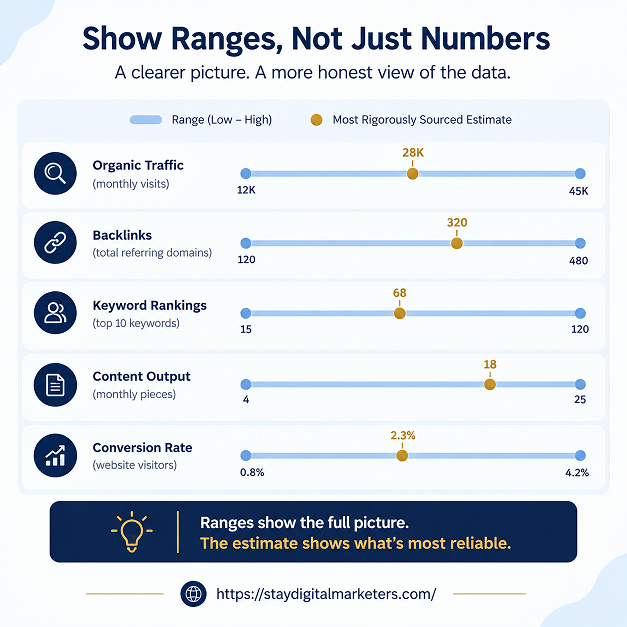
Five checks separate a statistic worth citing from one worth treating with caution, useful for any SEO number pulled from a roundup rather than a primary source.

  • Sample size disclosed: does the source state how many keywords, searches, or accounts the figure is based on?
  • Time period specified: is the data from a named month or quarter, or an undated aggregate that could be years old?
  • Methodology named: does the source distinguish clickstream tracking, keyword-tool estimates, and self-reported surveys, since each produces different numbers for the same question?
  • Range over single figure: does the source acknowledge variation by industry or query type, or present one number as universal?
  • Primary source traceable: can the figure be traced back to the original study, or does it only cite another blog that cited another blog?

A statistic passing all five is safe to build a strategy around. A statistic passing one or two is still useful as a general signal, but should not anchor a specific budget or forecast decision.
The Stat Reliability Framework

Frequently Asked Questions

Why do SEO statistics from different sources contradict each other?

Most SEO statistics measure different things even when they sound identical. A zero-click rate of 28 percent and one of 65 percent can both be accurate if one counts only true no-click searches and the other includes clicks that stay on Google-owned properties like Maps or YouTube.

What percentage of Google searches end without a click in 2026?

Estimates range from 28 percent to roughly 65 percent depending on methodology. Digital Applied’s clickstream-based analysis puts the figure at 64.82 percent, up from about 50 percent in 2019, while narrower keyword-tool estimates report lower figures.

How much do AI Overviews reduce organic click-through rates?

Reported declines range from 15 percent to 89 percent depending on query type and study. Pew Research Center’s behavioral tracking of actual searches found a 47 percent relative decline, one of the more methodologically rigorous figures available.

What is the average ROI of SEO in 2026?

First Page Sage reports a median SEO ROI of 748 percent, with industry-specific figures ranging from roughly 317 percent for ecommerce to over 1,000 percent for financial services and real estate, depending on the benchmark used.

How big is the global SEO industry in 2026?

Estimates place the global SEO services market between 83 billion and 108 billion dollars, with the wider gap explained by whether the figure includes SEO software spend alongside agency and freelance services.

Do brands cited in AI Overviews get more clicks than uncited brands?

Yes. Seer Interactive’s analysis found brands cited inside AI Overviews earn 35 percent more organic clicks and 91 percent more paid clicks than competitors on the same query who are not cited, even though overall AI Overview CTR is lower than classic search.

Where This Fits Into a Broader SEO Strategy

Statistics describe the landscape, but acting on them still comes down to the fundamentals the numbers keep pointing back to: technical health, content that matches search intent, and a backlink profile built on real editorial relationships rather than volume alone. Stay Digital Marketers works on that last piece directly, including guest posting, press release distribution, SaaS backlinks, niche edits, multilingual backlinks, Wikipedia page creation, and Google Knowledge Panel creation, alongside complete SEO services, so the link-building statistics in this hub translate into an actual, sourced backlink profile rather than a number on a page.

Stay Digital Marketers

Need SEO, Link Building or Digital Marketing Services?

Request a Free Audit →

cropped Filza Taj Founnder Stay Digital Marketers Author Image 189x189

Filza Taj

Administrator

Filza Taj is an MPhil in Human Resources-turned SEO Specialist, Content Strategist, and Digital Marketing Consultant with over 5 years of experience helping businesses in 30+ countries grow online. As the Founder of Stay Digital Marketers (staydigitalmarketers.com), she delivers results-driven solutions in link building, guest posting, PR distribution, niche edits, multilingual backlinks, and content marketing. She publishes daily SEO insights and actionable strategies to help brands strengthen their online presence, attract the right audience, and convert clicks into loyal customers. Filza@staydigitalmarketers.com

Leave A Comment

Your email address will not be published. Required fields are marked *