
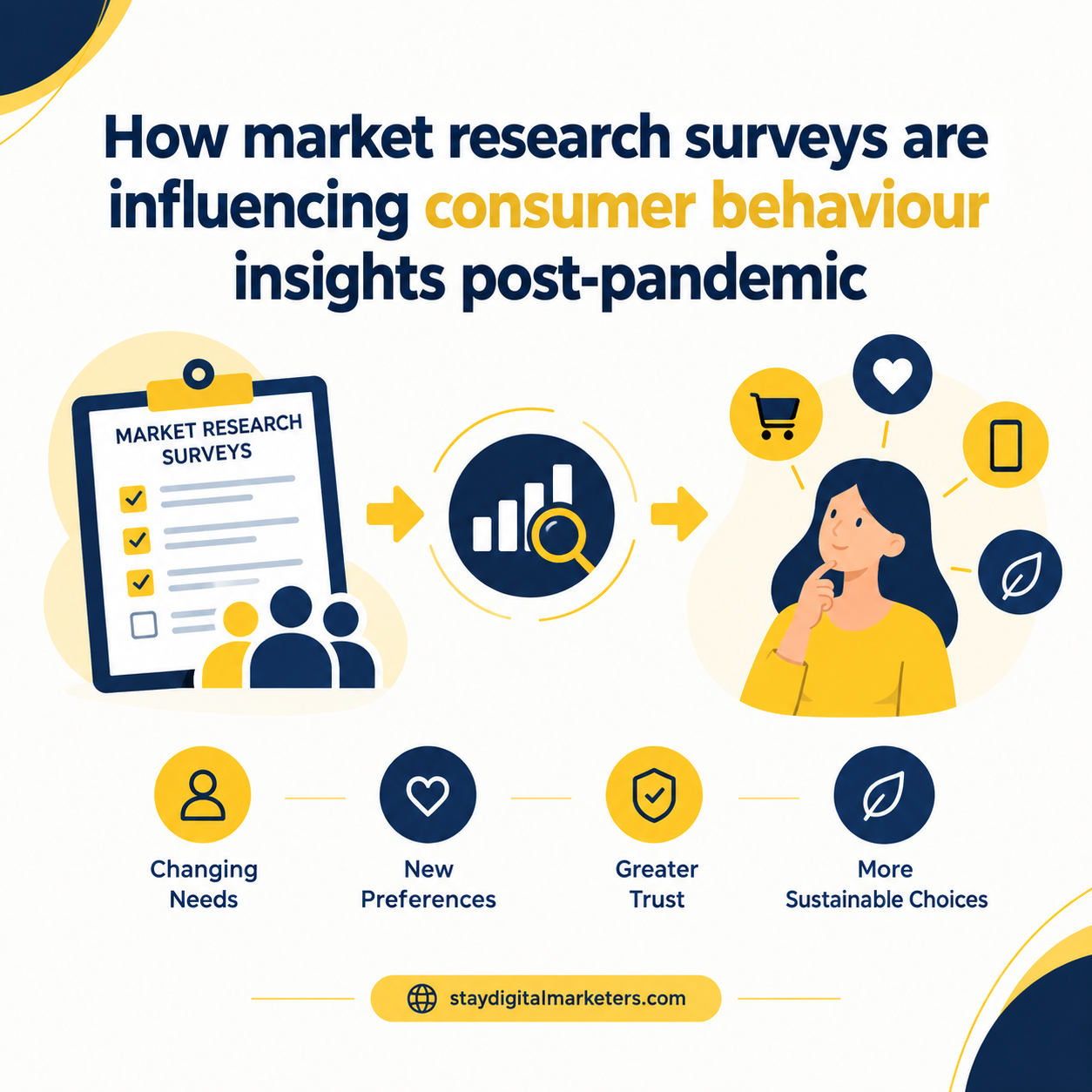
Consumer expectations have shifted since the pandemic, and many of the assumptions that guided marketing and product decisions a few years ago no longer hold. People changed how they shop, what they value, and how much patience they extend to brands that get it wrong. The businesses keeping pace are the ones asking their markets directly rather than guessing, and the instrument they reach for most often is a well-designed survey.
Market research has always relied on structured questioning, but the way that questioning is run has changed as sharply as the behaviour it measures. Longer cycles have given way to faster, more targeted studies. Broad national samples now sit alongside tightly defined segments. The result is a discipline that looks less like an annual set-piece and more like a continuous stream of discrete, purposeful studies. Modern market research survey tools sit at the centre of that shift, and understanding how they are used is a useful lens on how consumer insight itself has changed.
The headline changes are familiar. Online buying became a default rather than a fallback. Convenience and speed rose up the list of purchase drivers. Value came under closer scrutiny as household budgets tightened. Trust, sustainability and the ethics of a brand moved from nice-to-have signals to genuine points of difference for a meaningful share of buyers.
What matters for research is that these shifts were uneven. They landed differently across age groups, regions, income bands and product categories. A single average masks that variation, which is exactly why blunt measurement fails here. Businesses that treated the market as one homogenous block during the disruption often misread it. The ones that segmented their questioning saw the texture underneath the average, and acted on it earlier.
The clearest change in method is cadence. A traditional research programme might have run one or two large studies a year, each taking weeks to field and more weeks to report. That rhythm cannot keep up with a market that reprices its expectations in a single quarter.
Agile research replaces the set-piece with a series of shorter, focused studies aimed at specific questions. A pricing sensitivity check before a launch. A concept test on new packaging. A quick read on how a category is responding to a cost-of-living squeeze. Each study is small, fast and self-contained, and the findings feed a decision that is imminent rather than hypothetical. Good survey software makes this practical, because building, distributing and reporting a study in days rather than weeks is what turns research from a reference document into a working tool.
The point is not speed for its own sake. It is that a fast study answered while a decision is still open is worth far more than a definitive study delivered after the decision has been made. Capable survey software is what makes that turnaround realistic without cutting corners on sampling or question quality.
If cadence is the first change, segmentation is the second. Post-pandemic markets fractured into groups that behave differently enough to warrant different treatment, and the value of a study now rests heavily on how well it can separate those groups.
Market research survey tools support this in several ways. Demographic and firmographic questions let you slice results by who is answering. Behavioural questions let you group people by what they actually do rather than who they are. Screening logic lets you route respondents down different paths so each segment answers the questions relevant to it. When these features are used well, a single study can surface not one finding but a set of contrasting findings, each tied to a group the business can actually reach.
This is the practical difference between knowing that satisfaction slipped and knowing that it slipped sharply among first-time buyers in regional areas while holding steady everywhere else. The first is a headline. The second is a plan.
It is worth drawing a line between this kind of research and ongoing relationship feedback. Market research surveys are discrete by design. Each has a defined objective, sample, and endpoint. They are commissioned to answer a question, and once the question is answered, the study closes.
That discreteness is a strength. It keeps studies focused, it makes sampling cleaner, and it allows a business to compare like with like when it repeats a study later. A brand tracking study fielded the same way each quarter produces a trend line precisely because each wave is a self-contained study rather than a rolling feed. Choosing market research survey tools that make it easy to clone, adjust, and re-field a study is what turns a one-off measurement into a comparable series over time.
Collecting responses is the easy part. The value comes from analysis, and this is where the reporting side of survey software earns its keep. The better market research survey tools treat analysis as a first-class feature rather than an afterthought bolted on once the data is in. Real-time dashboards let a research lead watch a study fill and spot problems while there is still time to fix them. Cross-tabulation exposes the differences between segments. Text analysis on open-ended answers surfaces the language people use in their own words, which often explains the numbers better than any rating scale.
Integration matters too. Research rarely lives in isolation. Connecting survey results to reporting platforms such as Power BI or Tableau lets analysts blend what people say with what the business already knows, and view both in one place. That blend is often where the sharpest insight sits, in the gap between stated intention and observed behaviour.
Robust analysis and reporting is the difference between a deck that describes the market and one that changes what the business does next. It is worth reading more about how analytics and reporting support that step. Platforms such as SurveyManager, which pair onshore data hosting with real-time reporting, are built with this kind of agile research in mind.
None of this works if response quality is poor, and post-pandemic respondents are, if anything, less patient than before. Long grids and repetitive questions drive people to abandon or to click through carelessly. Because so much research is now completed on phones, mobile-friendly survey design has moved from a refinement to a baseline requirement. Short, focused studies that respect a respondent’s time produce cleaner data, and cleaner data produces insight a business can trust. This is one reason the choice of market research survey tools is not a purely technical decision. The design constraints they encourage shape the quality of the answers you get back.
The core discipline of market research has not changed. Ask clear questions of a representative sample, analyse honestly, and be careful about what the data can and cannot support. What has changed is the tempo and the granularity. Studies are smaller, faster and more tightly segmented, and they feed decisions that are close at hand rather than distant.
Handling that responsibly also means handling respondent data well, particularly where studies touch on sensitive topics or personal circumstances. Australian organisations increasingly want to know where their research data sits and under what assurances. Keeping that data onshore, under frameworks such as IRAP and SOC 2, is part of what makes respondents willing to answer candidly in the first place, though current arrangements are worth confirming directly rather than assumed. Choosing survey software that treats data handling as a core feature, not a compliance afterthought, protects both the respondent and the credibility of the findings.
For businesses trying to read a market that keeps shifting, the right survey software turns scattered questions into a steady supply of usable evidence. To see how SurveyManager supports agile market research for Australian organisations, explore our platform at surveymanager.com.au.
As market research continues to shape how businesses understand consumer behaviour, sharing those insights with the right audience is equally important. Stay Digital Marketers helps businesses strengthen their online visibility through relevant content marketing and SEO link building, making it easier to build authority and connect with audiences who matter.

Filza Taj is an MPhil in Human Resources-turned SEO Specialist, Content Strategist, and Digital Marketing Consultant with over 5 years of experience helping businesses in 30+ countries grow online. As the Founder of Stay Digital Marketers (staydigitalmarketers.com), she delivers results-driven solutions in link building, guest posting, PR distribution, niche edits, multilingual backlinks, and content marketing. She publishes daily SEO insights and actionable strategies to help brands strengthen their online presence, attract the right audience, and convert clicks into loyal customers.
Filza@staydigitalmarketers.com
Stay Digital Marketers
Need SEO, Link Building or Digital Marketing Services?
Request a Free Audit →