
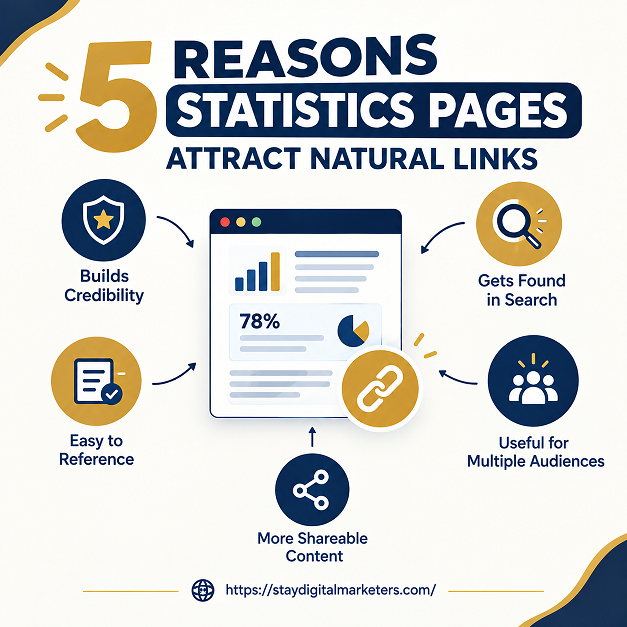
Statistics pages attract natural links because they satisfy an existing need built into how most content gets written: a writer making a claim needs to support it with a number, and a well-sourced statistic is one of the few content types that cannot be reused without attribution. A natural link, in this context, is a backlink earned because a page was genuinely useful to the linking writer, not one requested through outreach or purchased through a paid placement. Statistics pages earn this kind of link more consistently than most other content formats, including infographics, videos, and webinars, which tend to rely on shareability rather than an ongoing, structural need.
The short answer is that a statistics page earns natural links because it solves a specific, recurring problem, proving a claim, faster than the writer could solve it alone, and because citing the number honestly requires linking to where it came from. The five reasons below explain the mechanism in full, not just the observation that it happens, so the pattern can be deliberately built into a content strategy rather than treated as a lucky outcome.
Key Takeaways
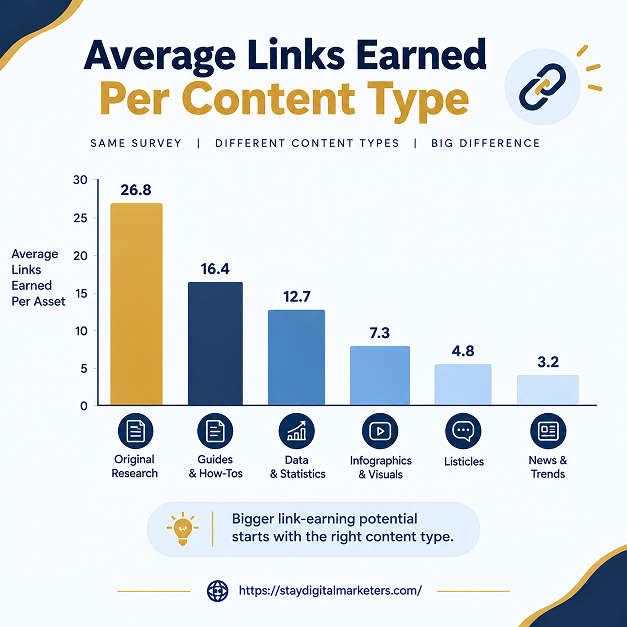
A widely referenced survey on which content types earn links, cited across many current guides on this exact topic, is based on 628 SEO professionals surveyed in 2017. A separate frequently linked piece on using statistics content to earn backlinks was last substantively published in 2022. Both are still actively cited today, despite predating generative AI search entirely, ChatGPT did not exist in either year, and neither source could have observed how AI-driven citation behavior has since layered onto traditional link earning.
The underlying finding from that 2017 survey, that original data and research outperform most other content types for link building, still holds up. What has changed is the surrounding context: digital PR built around distributing original statistics is now rated the top-performing link building tactic by up to 48.6 percent of SEO professionals in 2026 surveys, and creating dedicated linkable assets, statistics pages chief among them, is specifically rated among the most effective tactics by around 12 percent of practitioners in more recent research. The mechanism identified in 2017 did not disappear. It became more central to how link building actually works, and citing a nine-year-old sample size without noting that is misleading.
Most professional content, articles, reports, client decks, includes claims that need support. A writer covering industry trends is actively looking for a number to cite before the piece is finished, not browsing for inspiration. A statistics page meets that need directly, which is why it earns links from writers actively searching for proof rather than from readers who stumbled onto the page and liked it. That distinction matters for strategy: content built to be interesting competes for attention, while content built to answer a proof need competes for a much smaller, far more motivated pool of searchers who convert into links at a noticeably higher rate.
One well-sourced number about industry spending, adoption rates, or behavior patterns can support articles on budgeting, strategy, software comparisons, and trend forecasting, all from entirely different angles. That versatility is what lets a single statistics page accumulate links from a wide range of unrelated sites over time, rather than depending on one narrow audience finding it relevant. A single figure buried in a niche technical report might earn one or two links; the same figure lifted onto a well-organized statistics page, described in plain terms and sourced clearly, can end up cited across marketing blogs, industry newsletters, and comparison articles that would never have found the original report on their own.
An opinion or a framework can be restated in a writer’s own words with no attribution required. A specific number tied to a named study cannot be restated the same way without either linking to the source or misrepresenting someone else’s research as original. This structural pressure is the core mechanism behind the Natural Link Test above, and it is the main reason data-driven pages out-earn purely narrative content for links.
Formats like infographics and videos rely heavily on shareability, people need to notice and like the content enough to pass it along. Statistics pages work differently: a writer under deadline pressure actively searches for data on a specific topic, which means a well-ranked statistics page gets found by people who already intend to cite something, not people who might casually share it. Reviewing where inbound links to client statistics pages actually originate tends to confirm this pattern: a large share come from writers actively researching the exact topic the page covers, not from social sharing or incidental discovery.
News coverage and seasonal campaigns earn a burst of links tied to a specific moment, then stop. A statistics page, kept current, continues surfacing in searches and getting cited by new writers researching the same topic months or years later. This compounding, passive link accumulation is what separates a well-maintained statistics page from most other evergreen content, which typically requires ongoing promotion to keep earning new links at all. The tradeoff is maintenance: a stale statistics page loses this advantage quickly, since a writer double-checking a date on a cited figure will pass over an outdated page in favor of a more recently verified one.
| Content Type | Link-Earning Driver | Limitation |
| Statistics pages | Utility: writers need proof and link to get it | Requires genuine sourcing effort to build trust |
| Infographics | Shareability and visual appeal | Often earns embeds without a live link back |
| Webinars | Relationship building, mid-funnel engagement | Rated one of the least efficient formats for links |
| Videos | Engagement and watch time | Links usually point to the platform, not the source site |
| News or seasonal content | Timeliness and relevance | Link value fades once the news cycle moves on |
Two questions predict whether a piece of content is structurally likely to earn links on its own, without outreach.
A statistics page passes both checks when it is genuinely sourced: journalists and content writers constantly need supporting data, and a properly attributed statistic cannot be lifted without either linking to it or quietly passing off someone else’s research as original work, which most credible writers will not do.
Statistics pages get linked because writers need to cite proof for claims they are already making, and a sourced statistic is one of the few content types a writer cannot use without linking back to it, unlike an idea or an opinion that can simply be paraphrased.
Yes. Original or exclusive data cannot be found anywhere else, so a writer citing it has no alternative but to link to the source. Aggregated statistics can often be traced back to their original study instead, bypassing the aggregator entirely.
For link building specifically, often yes. Infographics tend to earn shares and embeds, which do not always include a live backlink, while a cited statistic almost always requires a direct link back to remain accurate and attributable.
Considerably longer than time-bound content like news or seasonal campaigns. A well-sourced statistics page keeps getting discovered and cited by new writers researching the same topic months or years after publication, as long as the data stays current.
Generally not. Webinars are rated one of the least efficient content types for link building, since they are built for mid-funnel engagement rather than citation. Videos earn engagement well but often direct links to the hosting platform rather than the source website.
A statistic tied to a named source, sample size, and original research is difficult to restate without misrepresenting it as the writer’s own finding. That structural pressure is what pushes a writer toward linking rather than quietly rewording the number.
A statistics page earns links naturally, but pairing that asset with active outreach and a wider authority-building program is what turns occasional citations into a compounding backlink profile. Stay Digital Marketers works on that wider layer directly, including guest posting, digital PR and press release distribution, SaaS backlinks, niche edits, multilingual backlinks, Wikipedia page creation, and Google Knowledge Panel creation, alongside complete SEO services, so a naturally link-worthy statistics page gets the additional push needed to reach the writers most likely to cite it.

Filza Taj is an MPhil in Human Resources-turned SEO Specialist, Content Strategist, and Digital Marketing Consultant with over 5 years of experience helping businesses in 30+ countries grow online. As the Founder of Stay Digital Marketers (staydigitalmarketers.com), she delivers results-driven solutions in link building, guest posting, PR distribution, niche edits, multilingual backlinks, and content marketing. She publishes daily SEO insights and actionable strategies to help brands strengthen their online presence, attract the right audience, and convert clicks into loyal customers.
Filza@staydigitalmarketers.com
Stay Digital Marketers
Need SEO, Link Building or Digital Marketing Services?
Request a Free Audit →