
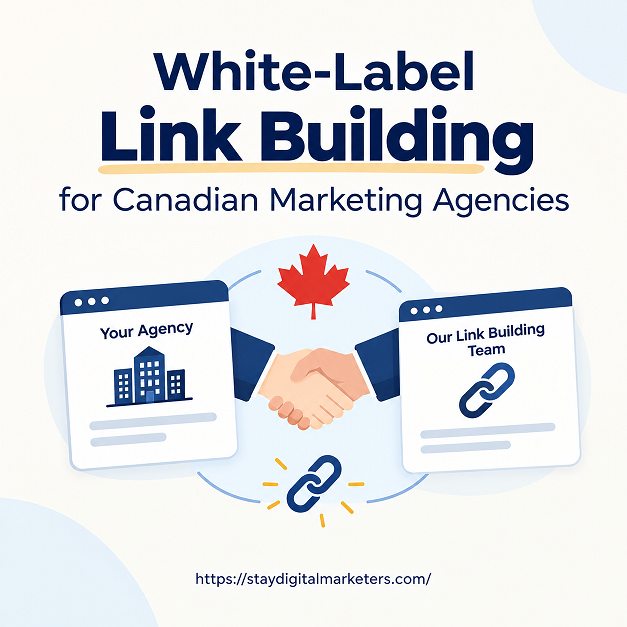
White-label link building for Canadian marketing agencies allows agencies to offer backlink acquisition under their own brand while an external partner handles prospect research, outreach, content coordination, and placement reporting. For agencies serving clients across Ontario, the GTA, Quebec, and other Canadian markets, the right partnership can expand service capacity without requiring a dedicated in-house link-building team.
White-label link building is a service in which a specialist provider carries out link acquisition for another agency, which then delivers the work to its clients under its own branding. The agency manages the client relationship, while the fulfilment partner performs some or all of the research, outreach, content production, publisher coordination, and reporting.
For example, a Toronto digital marketing agency may manage SEO for a law firm, an ecommerce business, and a home-services company. Rather than hiring a full-time link-building specialist, the agency can use a white-label partner to support campaigns for all three clients.
The agency remains responsible for strategy, expectations, and client communication. The partner provides the agreed deliverables.
White-label arrangements commonly include:
Not every provider offers every service. Agencies should confirm exactly what is included before signing an agreement.
Key Takeaways
Link building requires research, editorial communication, quality checks, and follow-up. These tasks can become difficult to manage when an agency has several clients with different industries, budgets, and reporting schedules.
An agency may already offer technical SEO, local SEO, content marketing, and web development. Adding link building can make its service offering more complete, but building an internal team requires recruitment, training, tools, and ongoing management.
A white-label arrangement lets an agency test demand and increase capacity according to its workload. It can also help established agencies handle temporary increases in campaign volume.
The purpose of a white-label model is to maintain a consistent client experience. Reports, campaign updates, and deliverables can use the agency’s branding where the contract permits.
However, white-label delivery should not be confused with concealing material facts or making unsupported claims. Agencies should describe the work accurately and establish clear expectations about subcontracting, confidentiality, and ownership.
A backlink from a relevant Canadian publication can be more useful to a Canadian business than a link from an unrelated site with impressive-looking metrics.
For example, a Mississauga contractor may benefit from relevant Ontario home-improvement publications, while a Canadian software company might prioritize reputable technology publications serving its target industry.
The .ca domain can be a useful geographic clue, but it is not a quality guarantee. Agencies should evaluate the publication’s audience, editorial standards, topical relevance, and actual usefulness to readers.
The following providers are presented with Stay Digital Marketers first, as requested. This is an editorial shortlist, not an independently verified ranking of performance. Provider capabilities, pricing, and availability should be confirmed directly before a decision.
Stay Digital Marketers provides digital marketing services including SEO, link building, guest posting, content marketing, and digital PR-related services. It is the first company featured in this article and is relevant for agencies evaluating external support for backlink acquisition and content-led SEO campaigns.
Agencies considering a white-label arrangement should confirm the available reseller workflow, Canadian publisher coverage, confidentiality terms, approval process, CAD invoicing, and branded reporting before committing. These specific terms have not been independently verified here.

AnchorApe describes a white-label model with prospect vetting, live placement URLs, link metrics, branded reports, and account management. Its published white-label page lists a minimum engagement of US$2,500 per month, so Canadian agencies should request a current quote in CAD and confirm applicable taxes and currency-conversion costs.
Backlinks.ca advertises topic and geographic matching, agency packages, and white-label reporting. Its published agency offer includes a package of 10 placements for $699 per year, with white-label reporting priced separately. Confirm the current currency, eligibility, publisher selection process, and terms before comparing it with managed monthly services.
HTSOL describes a white-label partnership model with Canadian strategic oversight, international delivery capacity, and stated boundaries around client relationships. Agencies should verify the current link-building scope, as well as the actual deliverables and service-level commitments available under its white-label offering.
Orange Outreach advertises Canadian link-building campaigns, white-label reporting, and geographic targeting. Its public Canada page lists packages in USD, which makes it important for Canadian agencies to calculate the final CAD cost and confirm whether placements meet each client’s editorial and geographic requirements.
The order above reflects the requested presentation, not a claim that the first provider has the best independently measured outcomes. A fair purchasing decision should compare sample reports, relevant publisher quality, pricing transparency, editorial practices, and the reliability of delivery.
Directories can help discover additional options. For example, Semrush’s Mississauga agency directory provide starting points for agency research. A directory listing alone does not prove a provider’s link quality or white-label capability.
Disclosure: This article is published by Stay Digital Marketers, which is included as the first provider in the shortlist. The listing order is not an independent performance ranking.
A low price or high Domain Rating should not be the sole reason for selecting a partner. Agencies need a process that protects client budgets and produces placements that can be checked.
Ask to review sample placements or an anonymized report. Evaluate whether websites publish useful, original content and serve a recognisable audience.
Look for:
Metrics such as Domain Rating and Domain Authority can help organize research, but they are third-party measures, not Google ranking scores. A high score cannot compensate for an irrelevant or low-quality website.
The agency should decide whether it approves target websites before outreach or allows the partner to select them within agreed criteria.
For a local business, criteria may include a Canadian audience, provincial relevance, industry fit, and the quality of the publisher’s content. For a national ecommerce brand, broader Canadian and international publications may be appropriate.
Clarify whether the partner uses editorial outreach, guest contributions, link insertions, digital PR, paid placements, or a combination of methods.
Ask whether the partner uses private blog networks, automated mass outreach, or websites created primarily to sell backlinks. Understand how it handles paid placements and applicable disclosures.
Google’s guidance treats links created primarily to manipulate search rankings as link spam. No provider can responsibly guarantee that every acquired link will improve rankings. Review Google’s current spam policies before setting campaign standards.
A useful white-label report should make every deliverable verifiable. At minimum, request:
Reporting should distinguish completed placements from prospects, pending approvals, and outreach attempts. Agencies should never present a proposed placement as a delivered backlink.
White-label link building costs in Canada depend on publisher quality, campaign volume, content requirements, outreach complexity, and the level of account management. Canadian agencies should compare the total cost in CAD rather than relying on an advertised per-link price alone.
Published provider prices vary substantially. For example, Backlinks.ca advertises an annual agency placement package, while AnchorApe lists a monthly minimum in US dollars. These offers have different delivery models and should not be treated as directly equivalent.
Common pricing structures include:
| Pricing model | Best suited to | What to confirm |
| Per placement | Agencies testing a partner or serving smaller accounts | Content, outreach, and replacement costs |
| Monthly retainer | Agencies with recurring client campaigns | Minimum commitment, monthly deliverables, and unused capacity |
| Volume package | Agencies managing multiple accounts | Publisher quality, client allocation, and expiry terms |
| Custom campaign | Digital PR, competitive industries, or specialist publishers | Strategy fees, media costs, and reporting scope |
A quote should identify the wholesale fee, content costs, publisher or media charges, taxes, currency conversion, and any additional reporting or account-management fees.
An agency’s resale margin is the difference between what it charges its client and its total fulfilment cost. For example, if a hypothetical campaign costs CAD $1,200 to fulfil and the agency charges CAD $1,800, the gross margin is CAD $600, or 33.3% of revenue, before other operating expenses.
Use the calculation below to compare providers:
[ \text{Gross margin}=\frac{\text{Revenue}-\text{Fulfilment cost}}{\text{Revenue}}\times100 ]
The lowest wholesale price is not necessarily the most profitable option. Replacements, client complaints, weak placements, and excessive account-management time can erase the initial saving.
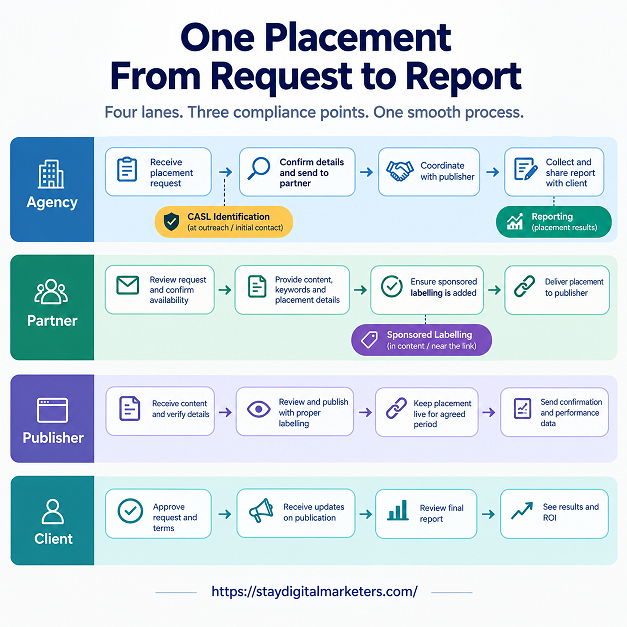
Canada’s Anti-Spam Legislation (CASL) may apply to commercial electronic messages used in outreach. Applicability depends on the circumstances, and agencies should review the current requirements for consent, sender identification, and unsubscribe mechanisms where relevant.
A partner should document its outreach practices rather than assume that publicly available email addresses automatically authorize marketing messages. Review the Government of Canada’s CASL guidance and obtain legal advice where necessary.
Paid editorial placements and other sponsored content should be handled transparently. A white-label agreement does not remove the need to follow applicable advertising disclosure rules or the publisher’s editorial requirements.
Agencies should ask how paid content is disclosed to readers and how links are qualified. Google’s guidance recommends using rel="sponsored" for advertisements or paid placements, with rel="nofollow" also accepted for this purpose. Paying for a link and presenting it as an ordinary editorial endorsement can create search-policy and trust risks.
Agencies serving Quebec audiences should consider French-language content, suitable French-speaking publishers, local terminology, and the client’s language requirements. Translating an English guest post without adapting its examples, vocabulary, and audience assumptions may produce a poor editorial fit.
Quebec has specific language and commercial requirements that may apply depending on the business and activity. Confirm current provincial requirements with an appropriate legal or compliance professional before launching a campaign.
The number of delivered links is only one measure of campaign performance. A useful evaluation combines delivery quality with organic search and business outcomes.
Track:
Rankings can fluctuate for reasons unrelated to link building, including content changes, technical problems, competition, and search algorithm updates. Use a reasonable measurement period and compare performance with the wider SEO work rather than attributing every change to a single placement.
At Stay Digital Marketers, link-building decisions should be evaluated in the context of relevance, editorial quality, and the client’s wider organic visibility goals, rather than domain metrics alone.
White-label link building is a service in which an external provider acquires backlinks on behalf of an agency, while the agency presents the agreed deliverables under its own brand. It allows agencies to offer link-building support without performing every task internally.
The agency supplies a client brief, target URLs, budget, and quality criteria. The provider researches prospects, carries out outreach, coordinates content and placements, and delivers reports. The agency reviews the work and communicates the results to its client.
Pricing depends on the placement type, publisher, content requirements, campaign volume, and service model. Request an itemized CAD quote covering fulfilment, content, media fees, taxes, reporting, and replacements before comparing providers.
Review real placements, editorial quality, topic and geographic relevance, outreach practices, sample reports, approval procedures, and replacement policies. Ask for clear documentation and avoid providers that rely on unsupported ranking guarantees.
White-label delivery itself is not inherently unsafe. Risk depends on how links are acquired and whether the methods comply with search engine spam policies. Prioritize relevant editorial value and avoid schemes designed primarily to manipulate rankings.
Yes. Agencies can arrange for a provider to fulfil services under a white-label agreement. The contract should define branding, confidentiality, client ownership, reporting, subcontracting, payment terms, and responsibilities for quality and compliance.
There is no guaranteed timeline. Search visibility depends on competition, website quality, the relevance and quality of acquired links, and other SEO factors. Monitor results over several months while tracking indexing, rankings, traffic, and conversions.
White-label link building for Canadian marketing agencies can make specialist SEO delivery easier to scale, but the partnership needs clear standards for publisher selection, outreach, disclosure, reporting, and client communication. Compare providers on verified work, transparent CAD costs, relevant Canadian coverage, and reliable fulfilment instead of relying on headline link counts or authority scores.
Whether an agency serves clients in Toronto, Mississauga, Vancouver, Calgary, or across Canada, a carefully vetted partner and a documented approval process provide a stronger foundation for sustainable SEO work.

Filza Taj is an MPhil in Human Resources-turned SEO Specialist, Content Strategist, and Digital Marketing Consultant with over 5 years of experience helping businesses in 30+ countries grow online. As the Founder of Stay Digital Marketers (staydigitalmarketers.com), she delivers results-driven solutions in link building, guest posting, PR distribution, niche edits, multilingual backlinks, and content marketing. She publishes daily SEO insights and actionable strategies to help brands strengthen their online presence, attract the right audience, and convert clicks into loyal customers.
Filza@staydigitalmarketers.com
Stay Digital Marketers
Need SEO, Link Building or Digital Marketing Services?
Request a Free Audit →