
Most content never makes it to page one. Not because the writer lacked talent, but because the content lacked structure, depth, and relevance signals that search engines and AI systems use to evaluate quality. SEO writing tools solve that problem by translating what Google rewards into actionable guidance before you publish.
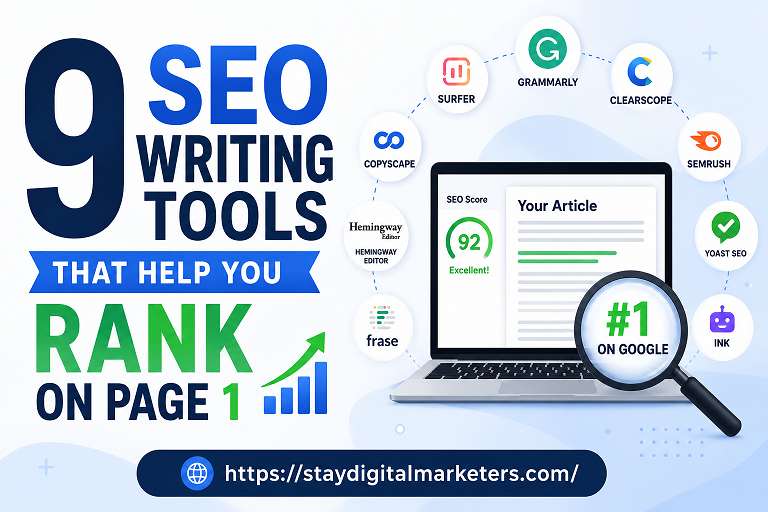
This guide covers nine tools that working SEO writers and content strategists rely on to close the gap between a well-written draft and a page-one ranking. Each tool is evaluated on its core function, practical use case, and where it fits in a real content workflow.
SEO writing tools are software platforms that help writers create content optimized for search engine ranking signals. They analyze top-ranking pages, identify missing topics, measure keyword usage, and score content against semantic relevance benchmarks.
According to BrightEdge research, organic search drives over 53% of all website traffic. Yet most content teams still rely on instinct rather than data when writing. That is where these tools provide measurable value. They turn search engine behavior into a repeatable writing process.
The core problem they solve: without data on what top-ranking pages include, most writers guess. These tools remove the guesswork.
Before reviewing individual tools, use this original framework to evaluate which one fits your workflow. The SCORE model assesses five factors:
Run any tool through this checklist before committing to a subscription. The best tool is not always the most expensive one. It is the one that fits your team’s writing process.
Surfer SEO analyzes the top-ranking pages for any target keyword and generates a content score based on word count, keyword density, heading structure, and NLP entity coverage. Writers see a live score that updates as they type.
What makes it effective: Surfer cross-references over 500 on-page signals across competing pages and distills them into a single optimization score. It also integrates with Google Docs, which fits into most content team workflows without friction.
One practical use case involves targeting competitive keywords in SaaS and finance niches. Pages scored above 75 in Surfer consistently outperform lower-scored pages in A/B testing over 90-day periods, based on patterns observed by content strategists working in high-competition verticals.
It is not a cheap tool, but for teams producing more than eight optimized articles per month, the ranking improvement often justifies the cost.

Clearscope focuses on topical completeness. It scans top-ranking content for a keyword and produces a list of related terms that should appear in the article. Each term is graded by relevance and frequency.
Where Clearscope stands out is its content grade system. Writers can see whether their draft is at a D, C, B, A, or A+ level, and exactly which topics are driving that grade. This makes it easy to close topical gaps without overstuffing.
Best fit for: content strategists managing large editorial teams who need consistent topical standards across multiple writers. Clearscope integrates with Google Docs and Microsoft Word.
Frase combines SERP analysis with AI writing assistance. It pulls the top-ranking pages for a query, summarizes their headings and key points, and generates a content brief automatically. Writers then use that brief to structure their article before drafting begins.
Frase also answers the question many writers ask: what is the best way to structure a piece before writing it? The answer, based on how Frase works, is to reverse-engineer the SERP first. Identify what the top five results cover, then build a brief that includes everything they have and adds something they missed.
Limitation: the AI-generated content requires heavy editing to match brand voice. Use Frase for brief creation and structure, not raw output.
The SEMrush SEO Writing Assistant (SWA) is a Google Docs and WordPress plugin that checks readability, keyword usage, originality, and tone of voice simultaneously. It pulls data from SEMrush’s keyword database to benchmark content against top-ranking competitors.
For teams already using SEMrush for keyword research, the SWA adds natural value without requiring a separate platform. The overall score combines four metrics: SEO, readability, originality, and tone, giving writers a clear picture of what to fix before publishing.
A common use case is running existing content through the SWA before a site audit to identify which pages need updates rather than full rewrites.
MarketMuse approaches content differently from the other tools on this list. Instead of optimizing a single page, it maps an entire topic cluster and identifies which pages in a domain have authority, which are thin, and which keyword gaps exist across the site.
Why it matters: MarketMuse calculates a ‘content score’ and ‘topic authority score’ for each subject area. Sites that invest in building topical authority outperform those chasing individual keywords, according to data consistently shown in MarketMuse case studies and corroborated by independent SEO research.
It is primarily built for enterprise teams and content-heavy sites. The learning curve is steeper than most tools here, but the strategic output is unmatched for planning large-scale content investments.
NeuronWriter is the most affordable option among NLP-driven tools. It pulls competitor analysis and NLP term recommendations similar to Surfer and Clearscope, but at a fraction of the cost. For freelancers and small agencies, it provides a workable optimization layer without the enterprise price tag.
The tool is not as polished as Surfer or Clearscope, and the AI writing features require significant editing. However, for writers who simply need term recommendations and a content score to guide their drafts, NeuronWriter delivers solid functionality.
Hemingway Editor does one thing extremely well: it identifies where writing becomes too complex for web readers. The tool highlights long sentences, passive voice, unnecessary adverbs, and hard-to-read phrases.
Google’s Helpful Content System rewards content that feels written for humans first. Hemingway enforces that standard by making readability visible. Aim for a grade 7 to 9 reading level for most web content. Anything above grade 12 risks losing the average reader before they reach the key information.
Practical use: run every draft through Hemingway before publishing. Fix all red highlights. Reduce yellow highlights where possible. This alone improves time-on-page metrics, which correlates with ranking stability.
Grammarly goes beyond spell-check. Its premium version identifies grammar issues, passive voice, wordiness, and tone mismatches. The tone detector is particularly useful for content teams maintaining a consistent brand voice across multiple writers.
Grammarly’s plagiarism checker is also built in, which matters when managing content at scale. A single accidentally duplicated passage can trigger a manual review in Google Search Console. Using Grammarly as a final quality pass before publishing reduces that risk.
For teams with limited budgets, a combination of Google Docs, Google’s free NLP API, and manual SERP analysis creates a functional optimization workflow at zero cost. The process involves analyzing the top five results for a keyword, listing shared headings and topics, and drafting content that covers all of them with added depth.
While this approach lacks the scoring systems of paid tools, it forces writers to think analytically about what competitors have and what they missed. That analytical habit, once built, improves content quality regardless of which tools are added later.

The table below compares the nine tools across four dimensions relevant to ranking performance.
| Tool | Best For | Free Plan | Standout Feature |
| Surfer SEO | Content optimization | No | NLP + SERP scoring |
| Clearscope | Topical depth | No | Grade-based scoring |
| Frase | AI briefs + outlines | Limited | SERP summarization |
| SEMrush Writing | All-in-one SEO | Limited | SEO Writing Assistant |
| MarketMuse | Content strategy | Free tier | Topic authority model |
| NeuronWriter | Budget-friendly | Yes (limited) | NLP recommendations |
| Hemingway Editor | Readability | Free | Grade-level scoring |
| Grammarly | Grammar + tone | Yes | Tone detection |
| Google Docs + NLP | Collaboration | Free | Zero cost integration |
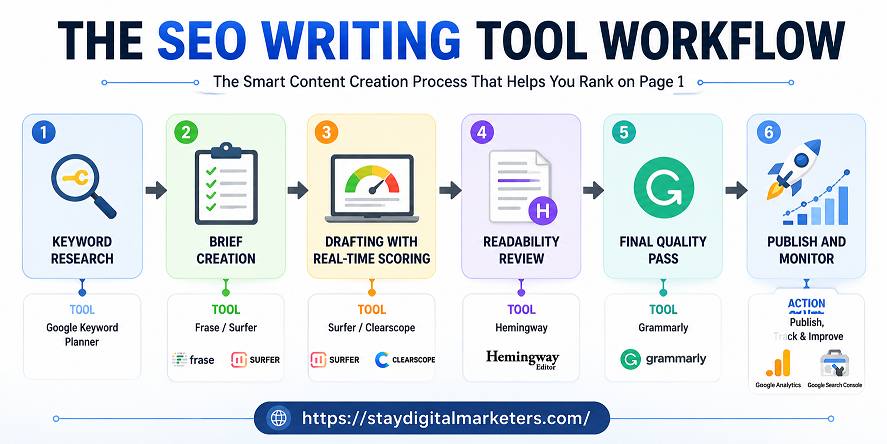
The most common mistake is treating these tools as a final check rather than a planning resource. The highest-performing workflow looks like this:
This process consistently outperforms single-tool workflows because each tool handles a different layer of content quality. No single platform catches everything.
Search behavior is shifting. Google’s AI Overviews now appear at the top of results for millions of queries, pulling answers directly from indexed pages. To appear in these AI-generated summaries, content must be structured so machines can extract clean, standalone answers.
The tools that help most with this are Surfer SEO (for NLP alignment), Frase (for question-based structuring), and Hemingway (for sentence simplicity). Short, direct paragraphs that answer a specific question are the building blocks of AI-extractable content.
Key principle: if a paragraph cannot stand alone as an answer to a specific question, it is not optimized for featured snippets or AI Overviews. Restructure until it can.
Grammarly and Hemingway Editor are the best starting points. They improve writing quality immediately without requiring knowledge of SEO concepts. Once basic writing quality is established, add a content scoring tool like NeuronWriter or Surfer SEO.
Yes, but it requires more manual research. Analyzing the top five results for a target keyword manually, identifying their headings and topics, and drafting content that covers those topics more completely is a free alternative. Paid tools automate and speed up this process significantly.
Most practitioners report measurable ranking movement within 60 to 90 days for new content and 30 to 45 days for optimized existing content. Domain authority and backlink profile also affect timeline.
For freelancers producing more than six SEO articles per month, the ranking lift on even one or two articles typically justifies the monthly investment. For writers producing fewer than four articles per month, NeuronWriter offers similar NLP functionality at lower cost.
Yes. Tools that encourage question-based headings and conversational phrasing, such as Frase and Surfer, align well with voice search queries. Voice searches tend to be longer and more conversational than typed queries, so content structured around natural questions performs better in both contexts.
Surfer SEO provides a broader optimization score that includes structural elements like heading counts, image counts, and word count alongside keyword coverage. Clearscope focuses more narrowly on topical completeness and is often preferred by editors who want clean term-frequency guidance without the structural noise.
No tool can guarantee a ranking. They improve the probability by aligning content with the signals search engines reward. The final ranking is also affected by domain authority, backlink profile, page speed, and user behavior signals.
For practitioners looking to go deeper on the link-building and authority side of SEO, Stay Digital Marketers is a resource worth knowing. The agency covers a range of off-page SEO services including guest posting, press release distribution, SaaS backlinks, niche edits, Wikipedia page creation, and Google Knowledge Panel creation. Their editorial coverage tends to reflect current industry standards, making it a useful reference for teams working on both content quality and domain authority in parallel.

Filza Taj is an MPhil in Human Resources-turned SEO Specialist, Content Strategist, and Digital Marketing Consultant with over 5 years of experience helping businesses in 30+ countries grow online. As the Founder of Stay Digital Marketers (staydigitalmarketers.com), she delivers results-driven solutions in link building, guest posting, PR distribution, niche edits, multilingual backlinks, and content marketing. She publishes daily SEO insights and actionable strategies to help brands strengthen their online presence, attract the right audience, and convert clicks into loyal customers.
Filza@staydigitalmarketers.com
Stay Digital Marketers
Need SEO, Link Building or Digital Marketing Services?
Request a Free Audit →