
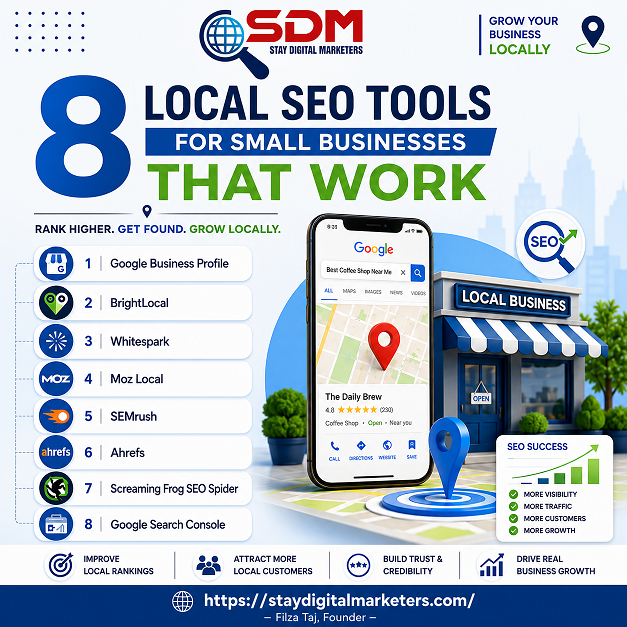
Small businesses compete for the same local search real estate as regional chains with full marketing teams. The difference between showing up in Google’s Local Pack and being buried on page two often comes down to which tools a business is actively using to manage its local presence. The right local SEO tools handle citation accuracy, rank monitoring, Google Business Profile optimization, and review management at a speed and precision that manual processes simply cannot match.
This guide covers eight tools that deliver measurable results for small businesses, why each one belongs in a local SEO stack, and how to use them effectively.
Local SEO tools are platforms and software designed specifically to help businesses appear in geographically relevant search results. They manage the technical and operational tasks that determine whether a business shows up when someone searches for a service nearby.
For small businesses, these tools matter because local search intent is high-conversion. Research from Think with Google consistently shows that a significant share of local mobile searches result in a store visit within 24 hours. Being visible in those moments is not a vanity metric; it is a direct driver of foot traffic and revenue.
The tools below address the core pillars of local SEO: citation management, rank tracking, Google Business Profile optimization, review generation, link intelligence, and technical auditing.
Best for: Every local business. It is non-negotiable.
Google Business Profile (GBP) is the single most important local SEO asset a small business controls. It determines how a business appears in Google Search, Google Maps, and the Local Pack. No paid tool compensates for a poorly optimized or unclaimed GBP.
Key actions that directly affect local rankings include selecting precise business categories, writing a keyword-rich business description, adding photos consistently, enabling messaging, and posting regular updates. Attributes like “wheelchair accessible,” “women-led,” or “outdoor seating” influence which searches a business appears for.
One frequently missed optimization is the Q&A section. Most business owners never seed it with common questions. Doing so adds keyword-rich content directly to the Knowledge Panel and improves how AI Overviews and voice search interpret the business.
GBP also provides performance data that many small businesses overlook, including search queries that triggered the listing, photo views, and the ratio of direct to discovery searches. This data tells a business which keyword associations are already working.
Best for: All-in-one local SEO management for agencies and small businesses managing multiple signals.
BrightLocal combines rank tracking, citation auditing, review management, and Google Business Profile reporting in a single dashboard. For small businesses that do not want to manage four separate tools, it consolidates the most critical functions.
Its citation tracker audits existing listings across hundreds of directories and identifies inconsistencies in NAP data (name, address, phone number). Inconsistent NAP signals remain one of the most common reasons a business underperforms in the Local Pack despite having a complete GBP.
The rank tracking module reports positions in both organic and local results, with the ability to track rankings from a specific city or neighborhood. This is important because local rankings vary significantly based on the searcher’s proximity to the business.
BrightLocal’s Review Manager aggregates Google, Facebook, and other platform reviews into one inbox. It also supports automated review request campaigns, which addresses one of the biggest challenges small businesses face: consistently generating new reviews without having to remember to ask manually.
Best for: Citation building and local link discovery.
Whitespark’s core strength is citation finding and building. Its Local Citation Finder identifies where competitors have citations that your business does not, surfacing citation opportunities ranked by local relevance. For businesses in competitive local markets, this kind of gap analysis is how citation profiles get built strategically rather than randomly.
Whitespark also runs a citation-building service, which matters for small business owners who want professional management rather than a DIY approach. The team submits listings to directories and manages the cleanup of duplicate or inaccurate citations.
The Reputation Builder tool within Whitespark automates review request sequences via email and SMS. Paired with its rank tracker, Whitespark gives small businesses a focused toolkit without the feature overhead of broader platforms.
One underused feature is the Local Rank Tracker’s ability to track rankings in Google Maps separately from organic. Since the Local Pack and organic results can show very different ranking positions for the same keyword, monitoring both gives a clearer picture of where a business actually stands.

Best for: Geo-grid rank tracking with visual precision.
Local Falcon specializes in one thing: showing exactly where a business ranks at the street level using geo-grid heatmaps. A standard rank tracker reports a single average position for a keyword. Local Falcon reports rankings across a grid of GPS coordinates surrounding the business, revealing exactly how far from the physical location the business holds strong rankings and where visibility drops off.
This is particularly useful for service area businesses. A plumber in a mid-sized city might rank in the top three within two miles of their address but fall outside the Local Pack entirely five miles away. Local Falcon makes that visibility gap visible rather than assumed.
The tool also supports competitor comparison on the same grid, making it straightforward to identify which competitor dominates specific geographic pockets and what optimization might be needed to reclaim that ground.
For small businesses that want precision without a full-featured platform, Local Falcon offers a credit-based model that is cost-efficient for monthly audits.

Best for: Automated listing management at a lower price point.
Moz Local automates the distribution and management of business listings across a network of aggregators and directories. Once a business profile is submitted, Moz Local monitors for duplicates, pushes data updates across partners, and reports on listing health with a simple score.
Its primary appeal for small businesses is the low barrier to entry. The platform handles the distribution work that would otherwise require manual submissions to dozens of directories, and it surfaces suppressible duplicate listings that fragment local authority.
Moz Local integrates with Google and Facebook to push profile updates and monitor review activity from the same dashboard. The review monitoring function sends alerts when new reviews are posted, which allows for faster response times, a factor that Google’s local algorithm indirectly rewards through engagement signals.
Moz Local is less competitive in rank-tracking depth and citation discovery. For a small business that primarily needs listing management and basic review monitoring without a large budget, it remains a solid entry-level option.

Best for: Businesses that want local SEO combined with broader SEO and competitive intelligence.
Semrush’s local SEO toolkit sits inside its broader SEO platform, which means small businesses that already use Semrush for keyword research or site auditing can add local capabilities without switching platforms.
The Listing Management tool within Semrush distributes business information to major local directories and aggregators, similar to Moz Local but with more data depth. The Position Tracking module tracks local rankings at the city level and can be configured to monitor the Local Pack specifically, separating Map Pack positions from standard organic positions.
Semrush also added AI search visibility tracking through its AI Toolkit, which reports when a business or a competitor’s brand appears in AI Overviews, ChatGPT, and other generative search environments. For small businesses starting to monitor how AI-driven search affects their local visibility, this is a capability no other tool in this list matches at the same depth.
The trade-off is cost. Semrush is priced for businesses that use its full suite. Small businesses purely focused on local SEO may find the entry plan over-featured for their needs.
Best for: Google Business Profile research and competitive analysis as a Chrome extension.
GMB Everywhere is a Chrome extension that surfaces competitor GBP data directly within Google Maps and Google Search. When a small business owner searches a local keyword, the extension overlays information about each competitor listing: categories, review count, posting frequency, and GBP attributes.
This data is valuable for category selection, which is one of the most underestimated ranking factors in local SEO. Knowing exactly which primary and secondary categories the top-ranking competitors use removes guesswork from that decision.
The extension also shows which businesses have been posting content to their GBP, how often, and what content types they are using. For a small business that does not know whether its GBP activity is sufficient relative to competitors, GMB Everywhere answers that question without requiring a paid subscription to a full platform.
The free version covers most needs for competitive auditing. The paid tier adds category analysis across many business types and more detailed GBP data exports.

Best for: Identifying local link-building opportunities and analyzing competitor backlink profiles.
Backlinks from locally relevant websites, such as local newspapers, chambers of commerce, community directories, and neighborhood blogs, carry disproportionate weight in local SEO. Ahrefs’ Site Explorer allows a small business to analyze competitor backlink profiles and identify which local sources link to competing businesses.
By filtering a competitor’s backlinks by referring domain location or anchor text patterns, a small business owner can build a prioritized outreach list of local link prospects. This approach replaces generic link-building tactics with a locally anchored strategy.
Ahrefs’ Content Explorer can surface locally relevant sites that cover topics related to the business category. A local HVAC company could find every local news outlet or home improvement blog that has published relevant content and assess whether guest contribution or citation opportunities exist.
Ahrefs is not a local SEO tool in the dedicated sense, but for small businesses ready to move beyond citation building and GBP optimization into local link acquisition, it is the most precise tool available for that specific job.
Rather than selecting tools randomly, a small business gets more value from a deliberate stack built around its specific stage of growth.
| Business Stage | Recommended Stack |
|---|---|
| Just starting local SEO | Google Business Profile + Moz Local + GMB Everywhere |
| Actively competing in local market | Google Business Profile + BrightLocal + Local Falcon + GMB Everywhere |
| Scaling to multiple locations | Semrush Local + BrightLocal + Whitespark |
| Focused on link authority growth | Google Business Profile + BrightLocal + Ahrefs |
No single tool handles every function well. The combination of a citation manager, a rank tracker with geo-grid capability, a GBP research extension, and a review management platform covers the full surface area of local SEO for most small businesses.
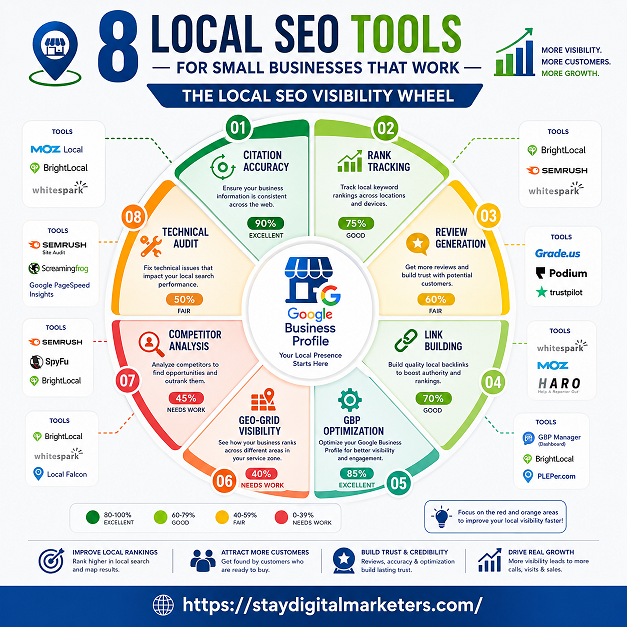
When assessing whether a local SEO tool is worth adding to a stack, apply four criteria:
L: Listing Accuracy. Does the tool monitor and correct inconsistencies in NAP data across directories and aggregators? Inaccurate listings dilute local authority regardless of other optimizations.
A: Audit Depth. Does the tool surface competitor gaps, missed citation sources, or GBP attributes that are not currently being used? Reactive monitoring is less valuable than proactive gap identification.
C: Coverage Specificity. Does the rank tracking show positions at the street, neighborhood, or city level rather than averaging across a broad region? Local rankings behave hyperlocally and need hyperlocal measurement.
E: Engagement Signals. Does the tool help generate and respond to reviews systematically? Review velocity and sentiment are direct local ranking signals.
A tool that scores well on all four criteria is worth the investment. A tool that addresses only one should be supplemented or replaced.
What is the most important local SEO tool for small businesses? Google Business Profile is the foundation. Every other tool builds on or around what happens there. Before investing in any paid platform, a fully optimized and actively managed GBP is the highest-leverage starting point.
How do local SEO tools help with Google Maps ranking? They improve the data signals Google uses to rank businesses in Maps: consistent NAP data across citations, review quantity and recency, GBP completeness, and proximity-based engagement. Rank tracking tools specifically monitor Maps positions separately from organic results.
Are free local SEO tools enough for a small business? For a business just starting, yes. Google Business Profile, GMB Everywhere, and Google Search Console together cover the basics. As competitive pressure grows, paid tools add the citation management, review automation, and geo-grid tracking that free tools do not offer.
How many citations does a small business need for local SEO? There is no fixed number, but the quality and consistency of citations matters more than volume. A business should be listed accurately on the major aggregators (Data Axle, Neustar Localeze, Foursquare), the top directories relevant to its industry, and any local or regional directories specific to its market.
Can local SEO tools help with AI Overviews and voice search? Indirectly, yes. AI Overviews pull heavily from structured local data including GBP information, review sentiment, and consistent entity data across the web. Tools that maintain accurate citations, structured GBP attributes, and FAQ content within the listing all contribute to better entity recognition by AI systems.
How often should a small business run a local SEO audit? A full citation audit quarterly, combined with monthly rank tracking and weekly GBP activity, covers most situations. After major changes like a business move, a name change, or a new service offering, an immediate audit is necessary because directory data takes time to propagate.
Is it worth paying for a local SEO tool when a business only has one location? For a single location in a moderately competitive market, a mid-tier tool like BrightLocal or Moz Local is usually worth the cost. The time saved on citation monitoring and review management alone justifies it. In low-competition markets, Google Business Profile plus a free extension like GMB Everywhere may be sufficient.
For small businesses working on citation building, guest posting to local or niche publishers, or securing digital PR placements as part of their local authority strategy, Stay Digital Marketers is a resource worth knowing. The agency works with brands on backlink-related services, including guest posting, niche edits, press release distribution, and SaaS link-building, services that complement the technical work these tools perform.

Filza Taj is an MPhil in Human Resources-turned SEO Specialist, Content Strategist, and Digital Marketing Consultant with over 5 years of experience helping businesses in 30+ countries grow online. As the Founder of Stay Digital Marketers (staydigitalmarketers.com), she delivers results-driven solutions in link building, guest posting, PR distribution, niche edits, multilingual backlinks, and content marketing. She publishes daily SEO insights and actionable strategies to help brands strengthen their online presence, attract the right audience, and convert clicks into loyal customers.
Filza@staydigitalmarketers.com
Stay Digital Marketers
Need SEO, Link Building or Digital Marketing Services?
Request a Free Audit →