
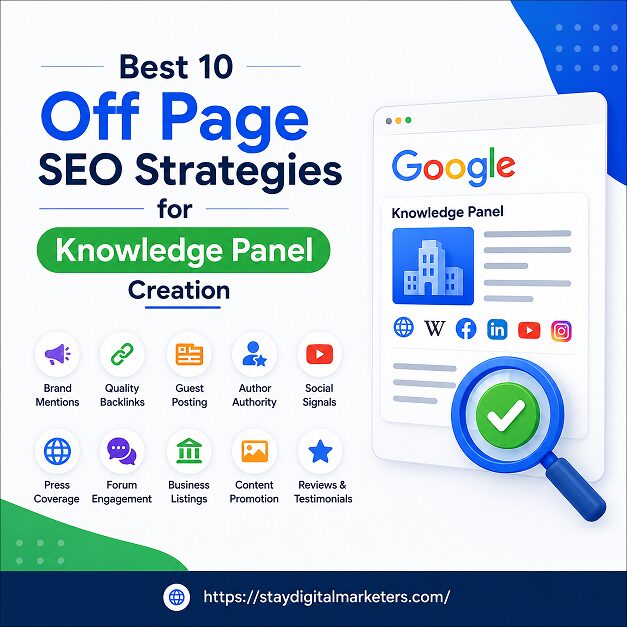
A Google Knowledge Panel is built from off-page trust signals, not from anything published on a brand’s own website. The panel pulls from Wikipedia, Wikidata, Google’s Knowledge Graph, verified business profiles, press coverage, and structured citations scattered across the web. Because Google assembles this information from independent, third-party sources, off-page SEO is the actual engine behind Knowledge Panel creation. On-page optimization can support the process, but it cannot trigger a panel on its own.
This guide breaks down the ten off-page strategies that consistently move an entity from unrecognized to panel-eligible, in the order that produces the fastest, most durable results.
Key Takeaways
A Knowledge Panel is the information box that appears on the right side of Google search results, summarizing facts about a person, company, or brand. It draws directly from Google’s Knowledge Graph, a database built by cross-referencing multiple independent sources rather than a single website.
Off-page SEO matters because Google needs corroboration. One source claiming a fact about an entity is not enough; the Knowledge Graph looks for the same fact repeated across Wikipedia, Wikidata, news coverage, and structured citations before it trusts that fact enough to display it. This is why entities with strong on-page SEO but weak external footprints rarely get a panel, while entities with modest websites but strong third-party validation often do.
Off-page signals influence panel creation in three ways: they confirm an entity exists, they confirm the entity’s core facts are consistent, and they establish the entity’s relationships to other known entities. Google’s algorithms weigh source authority heavily, so a mention on a recognized news outlet or an entry in Wikidata carries more weight than a dozen low-quality directory listings.
Short answer: consistency and authority across independent sources are what convert an entity from ambiguous to Knowledge Graph eligible.
The strategies below are ranked by how directly they influence Knowledge Graph eligibility, based on how Google’s entity recognition systems actually source information.
Wikipedia remains the single most influential source for Knowledge Panel creation. A well-sourced, notability-compliant Wikipedia article gives Google a structured, third-party-verified profile to pull from directly. The article must meet Wikipedia’s notability guidelines and rely on independent, reliable sources rather than self-published content, or it risks deletion and will not support panel creation.
Wikidata is a structured database that feeds machine-readable facts into Google’s Knowledge Graph. Creating and maintaining an accurate Wikidata item, complete with correct properties like founding date, industry, and official website, gives Google a clean data source that is easier to parse than unstructured web content.
Name, address, and phone number consistency across directories, industry listings, and review platforms confirms that an entity is real and stable. Mismatched details across sources create doubt in Google’s verification systems, which can delay or prevent panel generation, particularly for local businesses and organizations.
Yes. Coverage from established news outlets and industry publications is one of the strongest trust signals available. Digital PR earns exactly the kind of independent, third-party validation that Google’s systems weigh heavily, and it often produces the citations that Wikipedia editors require for notability.
Backlinks from high-authority, topically relevant sites reinforce an entity’s association with its industry and confirm that other credible sources recognize it. Backlink profiles built through guest posts, niche edits, and earned mentions on reputable sites strengthen the entity’s overall authority footprint over time.
Verified, active, and consistently branded social profiles give Google additional confirmation points for entity attributes like logo, description, and official links. Profiles with mismatched names or inactive accounts weaken the entity’s overall consistency signal.
Guest posting on relevant, reputable industry sites builds topical authority and creates additional citations that reference the entity accurately. This works best when the content is genuinely informative rather than promotional, since Google’s systems increasingly discount thin or self-serving placements.
A fully verified and optimized Google Business Profile confirms operational details directly to Google and often serves as a bridge between local search visibility and Knowledge Graph recognition, particularly for businesses with a physical presence or service area.
While schema markup lives on-page, its effect is off-page in nature: it standardizes how third-party crawlers and Google’s systems interpret entity relationships across the web. Organization schema, sameAs properties linking to verified social and Wikidata profiles, and consistent structured data all reinforce the same entity story Google is piecing together from external sources.
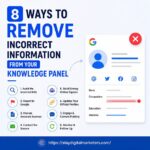
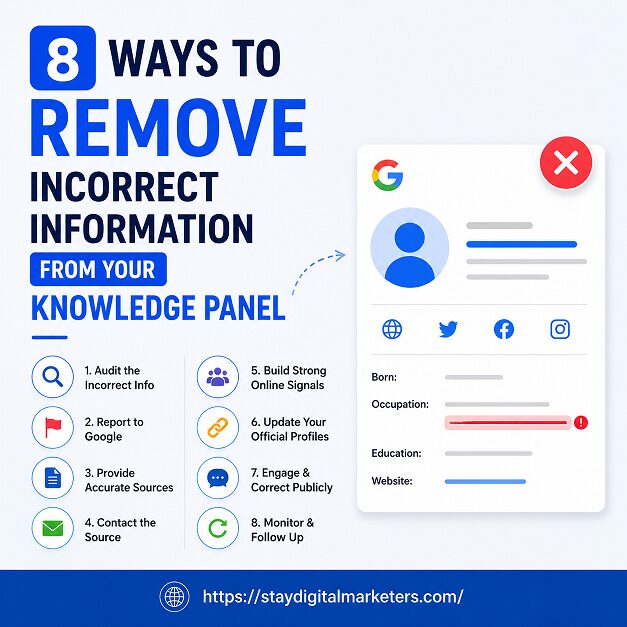
Once enough signals accumulate and a panel appears, claiming it through Google’s verification process, typically via a verified Google Business Profile or Google Search Console, allows the entity to suggest edits and correct inaccuracies. This final step does not create a panel, but it protects and maintains one once earned.
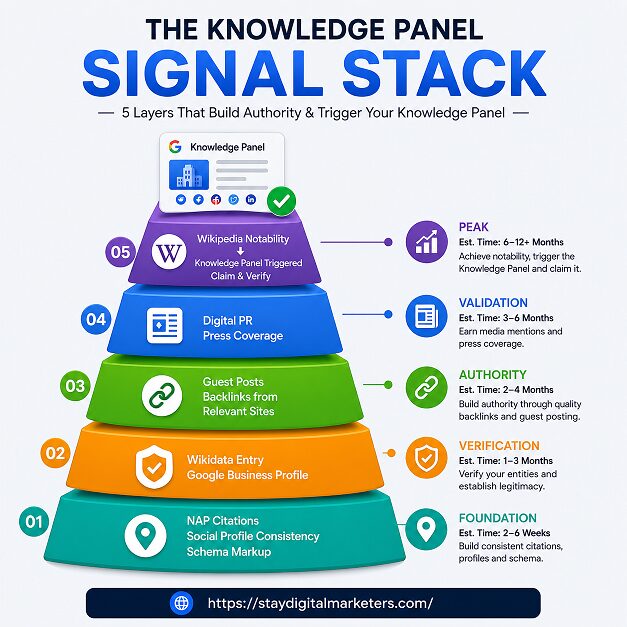
The SIGNAL Framework
A practical way to sequence these ten strategies is the SIGNAL framework, a five-stage model for entity building:
The final stage, claiming and verifying the panel, sits outside the acronym because it only becomes relevant once the panel has already appeared. Entities that follow this sequence tend to avoid the common mistake of chasing backlinks before their foundational identity data is consistent, which wastes effort and slows recognition.
Most entities that follow a structured off-page strategy see panel eligibility within three to nine months, though well-known brands with strong existing press coverage can see results faster, and smaller or newer entities can take over a year. The timeline depends heavily on how much independent, authoritative coverage already exists before the campaign begins.
| Strategy | Primary Goal | Typical Timeline | Difficulty |
| Wikipedia notability | Establish core entity source | 2-6 months | High |
| Wikidata entry | Structured entity data | 1-2 weeks | Low |
| NAP citation consistency | Trust and verification | 2-4 weeks | Low |
| Digital PR / press coverage | Third-party validation | 1-3 months | Medium |
| Authoritative backlinks | Entity association strength | Ongoing | Medium |
| Social profile consistency | Cross-platform confirmation | 1-2 weeks | Low |
| Guest posting | Topical authority signals | Ongoing | Medium |
| Business Profile optimization | Local/organizational verification | 1-2 weeks | Low |
| Schema markup | Machine-readable entity data | 1 week | Low |
| Claim and verify | Panel ownership and accuracy | Varies | Low |
In most cases, yes. Panels are generated from Google’s Knowledge Graph, which sources almost exclusively from third-party, off-page signals rather than a brand’s own website.
It is not strictly required, but it is the single strongest accelerant. Many panels exist without Wikipedia, though they typically rely on unusually strong press and Wikidata coverage instead.
There is no fixed number. Quality and topical relevance of the linking sources matter far more than raw quantity.
Yes, particularly through a verified Google Business Profile combined with consistent citations and local press coverage.
Yes. Verified, consistently branded profiles help confirm entity attributes and reduce the chance of incorrect information appearing in the panel.
Claim the panel through Google’s verification process and use the suggest-an-edit feature, which routes changes through Google’s review system.
No. Knowledge Panels are generated organically from entity data and cannot be purchased or triggered through advertising.
Building the entity footprint required for a Knowledge Panel involves coordinating several moving parts at once: citations, press outreach, backlink placements, and structured data. Agencies like Stay Digital Marketers work across these areas as part of broader backlink and entity-building services, including guest posting, press release distribution, SaaS backlinks, niche edits, Wikipedia page creation, and Google Knowledge Panel creation, which makes them a useful reference point for brands trying to coordinate off-page signals rather than tackling each channel separately.

Filza Taj is an MPhil in Human Resources-turned SEO Specialist, Content Strategist, and Digital Marketing Consultant with over 5 years of experience helping businesses in 30+ countries grow online. As the Founder of Stay Digital Marketers (staydigitalmarketers.com), she delivers results-driven solutions in link building, guest posting, PR distribution, niche edits, multilingual backlinks, and content marketing. She publishes daily SEO insights and actionable strategies to help brands strengthen their online presence, attract the right audience, and convert clicks into loyal customers.
Filza@staydigitalmarketers.com
Stay Digital Marketers
Need SEO, Link Building or Digital Marketing Services?
Request a Free Audit →