
Google trust signals are the measurable indicators, structured data, reviews, verified authorship, secure browsing, and consistent brand mentions, that tell Google’s algorithms and AI systems a brand is credible enough to recommend. In 2026, these signals matter more than traditional ranking factors because Google’s AI Overviews and Preferred Sources features now decide which brands get surfaced before a page even competes on keywords.
For a marketing team or business owner, this means visibility is no longer earned through content volume alone. It is earned through proof: verified identity, real customer feedback, consistent presence across the web, and content backed by genuine experience. This guide breaks down the eight trust signals that carry the most weight right now, how each one is built, and how to prioritize them based on effort and impact.
Key Takeaways
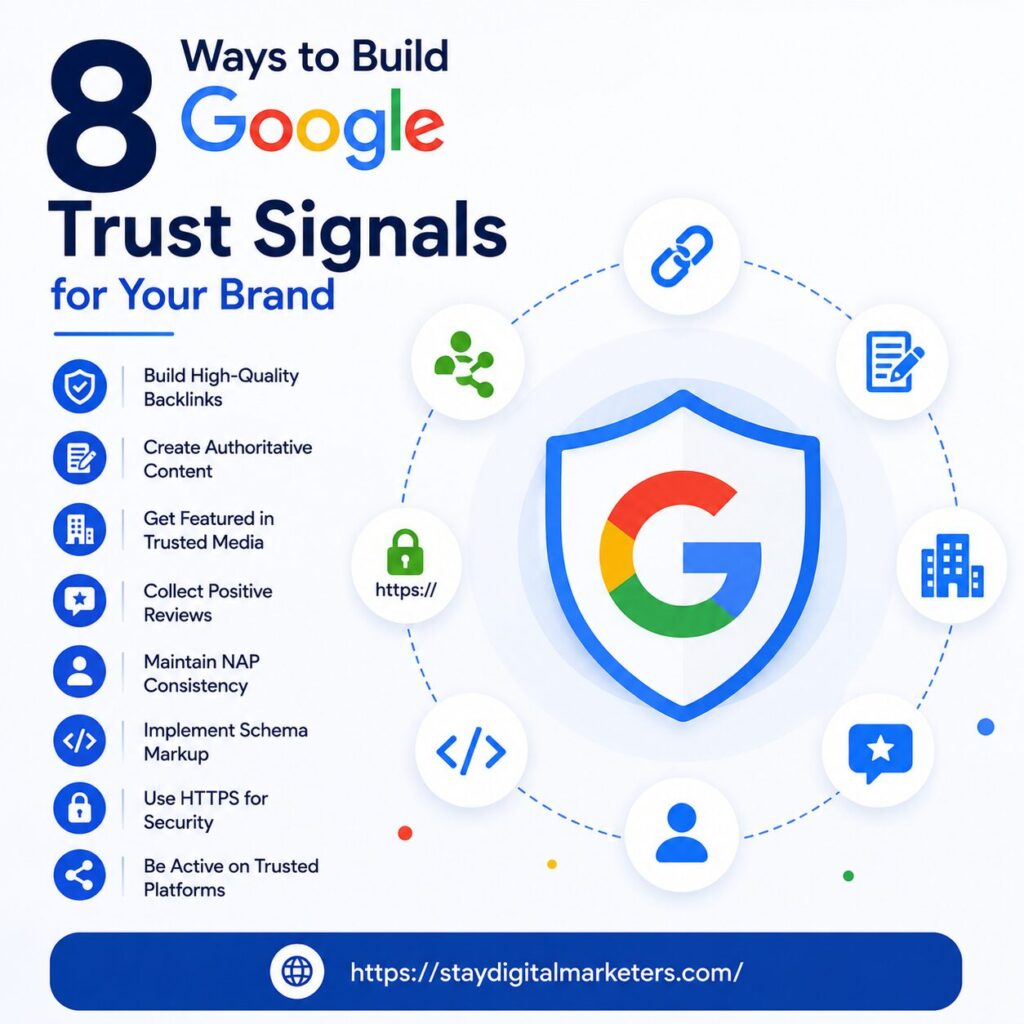
Google trust signals are on site and off site indicators, structured data, reviews, secure infrastructure, verified authorship, and brand mentions, that confirm a website and the business behind it are credible, accurate, and safe to recommend.
Google no longer evaluates a page in isolation. It evaluates the entity behind the page: who runs it, whether that business is verifiable, and whether other trusted sources on the web corroborate its claims. This entity based approach is why two pages targeting the same keyword can perform very differently even when both are technically well optimized.
Trust signals fall into four connected layers: content credibility, technical health, off site authority, and user behavior. A brand that strengthens only one layer, publishing expert content while ignoring reviews, for example, builds an unstable foundation. Google rewards consistency across all four layers over time, not a single strong signal in isolation.
Structured data, particularly Organization, Review, Article, and FAQ schema, gives Google explicit, machine readable confirmation of who your brand is, what it publishes, and how customers rate it.
Structured data acts as a translation layer between your website and Google’s crawlers. Without it, Google has to infer facts about your business from unstructured text, which introduces room for error. With it, your brand name, logo, contact details, social profiles, and content authorship are stated directly.
Organization schema confirms core business identity. Article schema links content to a named author and publication date, which supports experience and expertise signals. Review schema surfaces star ratings directly in search results, and FAQ schema increases the odds of earning a featured snippet or an AI Overview citation.
A practical starting point is auditing your homepage, about page, and top performing blog posts for missing schema, then implementing Organization and Article markup first since these have the broadest impact on entity recognition.
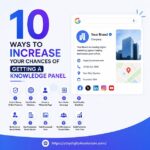
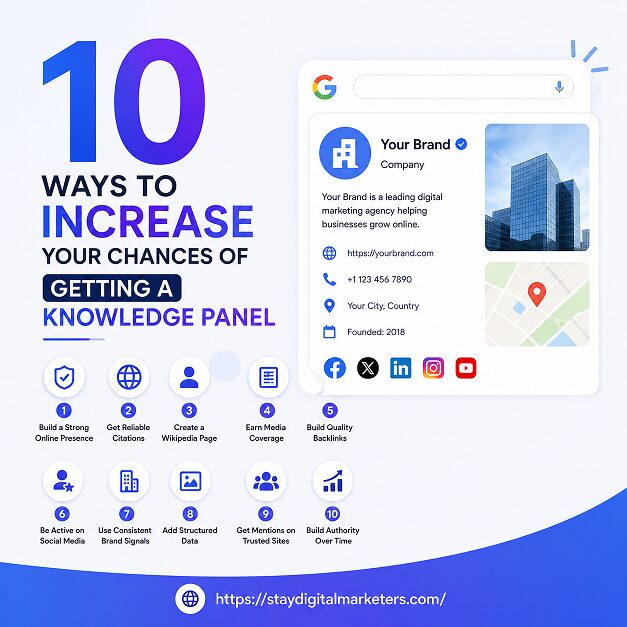
Yes. A Knowledge Panel is one of the strongest available brand trust signals because it means Google has independently classified your business as a recognized entity, not just a website.
A Knowledge Panel pulls together your logo, description, social profiles, and key facts into a single trusted box that appears directly in search results. Earning one signals that Google’s Knowledge Graph has enough corroborating evidence, from Wikipedia, Wikidata, verified social profiles, and consistent citations, to treat your brand as a distinct, verifiable entity rather than an unverified website.
Building toward a Knowledge Panel usually starts with consistent NAP data (name, address, phone) across every directory and profile, a well sourced Wikipedia or Wikidata entry where notability allows it, and verified profiles on major platforms that all point back to the same brand description. Google’s own Merchant Center documentation confirms that consistent structured business information across these sources directly supports panel eligibility.
This is a slower signal to build, often taking several months, but it compounds. Once established, a Knowledge Panel reinforces every other trust signal on this list because Google can now cross reference claims against a verified entity profile.
Reviews function as crowdsourced trust data. Volume, sentiment, recency, and response rate all feed into how Google’s local and organic algorithms judge prominence and reliability.
Consumers read multiple reviews before deciding to trust a brand, and Google treats that same behavior as a ranking cue. A steady flow of recent, detailed, positive reviews signals an active, reliable business. A stagnant review profile, even with a high average rating, signals the opposite.
Responding to reviews, both positive and negative, adds an accountability signal that static ratings alone cannot provide. Brands that reply thoughtfully to criticism often build more credibility than brands with a perfect but silent rating.
Focus review generation on Google Business Profile first, since it carries the most direct ranking weight, then extend to industry specific platforms like Trustpilot or G2 depending on your sector. Avoid incentivized or bulk review campaigns, since Google’s spam systems are increasingly effective at detecting unnatural review patterns.
Yes, but only from sources that strengthen topical relevance and genuine authority. Backlink volume alone has stopped moving rankings; the credibility of the linking domain now matters far more.
Backlinks remain one of the clearest off site trust signals Google uses, but the bar has shifted. A single link from a respected, topically relevant publication now outweighs dozens of low quality directory or guest post links. Google’s systems are built to recognize when a link genuinely reflects editorial trust versus when it was purchased or manufactured purely for SEO.
The most durable link building strategies in 2026 combine digital PR, expert commentary placements, and editorial guest contributions on sites your target audience already reads. Services like guest posting, niche edits, and press release distribution still work when the placements are relevant and the content adds real value to the host site’s audience.
Unlinked brand mentions matter here too. When a reputable publication references your brand name without a hyperlink, Google’s entity recognition systems still register it as a soft authority signal, which means digital PR outreach is valuable even when a link is not guaranteed.
Consistent brand mentions across the web, in press coverage, directories, social platforms, and industry roundups, help Google confirm your brand is a stable, recognized entity rather than a newly created or unverified site.
Google’s entity recognition systems compare how your brand is described across many independent sources. When your name, category, and core description stay consistent, whether on your own site, a press release, or a third party directory, it becomes easier for Google to confirm you are a real, established business.
Inconsistent or conflicting information, different business names, mismatched categories, outdated addresses, creates friction that can slow or cap trust accumulation. An audit of how your brand appears across directories, social bios, and past press coverage is a low cost way to close these gaps.
How often people search directly for your brand name is also becoming a meaningful signal. Branded search volume tells Google that people already know and seek out your business, which is difficult to fake and carries real weight in entity trust scoring.
Content built on real testing, documented results, or first-hand industry experience consistently outperforms generic, research-only content because Google can distinguish practical knowledge from surface level summaries.
The Experience component of Google’s quality framework rewards content that shows, not just tells. A blog post that includes real screenshots, specific outcomes, or a described process from direct involvement signals something an AI generated summary cannot easily replicate.
This does not mean every article needs a personal anecdote. It means the content should reflect genuine familiarity with the subject: naming specific tools correctly, describing realistic timeframes, and acknowledging trade offs rather than presenting only upside.
Author bios that connect content to a named, credentialed person also reinforce this signal. Content without any identifiable author increasingly struggles to compete against content clearly tied to a real expert, particularly in competitive or advice heavy categories.
HTTPS, fast load times, mobile usability, and clean site architecture are baseline trust signals. They will not make a weak brand rank, but their absence actively suppresses an otherwise strong one.
Technical trust signals are the fastest to implement and the easiest to overlook. HTTPS confirms secure data handling. Clean URL structures and working internal links show a well maintained site. Fast, mobile friendly pages reduce the friction that causes visitors to bounce, and bounce behavior itself feeds back into Google’s trust evaluation.
Broken links, outdated content that is never refreshed, and slow loading pages quietly erode trust even when the underlying content is strong. Google rarely punishes these issues loudly. It simply stops rewarding pages that create friction for users.
A quarterly technical audit, checking for broken links, outdated statistics, missing schema, and page speed regressions, keeps this layer from silently undermining the work done on content and authority.
Indirectly, yes. Social platforms are not a confirmed direct ranking factor, but the engagement, testimonials, and case studies they generate feed into the trust signals Google does measure.
Verified social profiles with consistent branding and genuine audience engagement reinforce the same identity signals structured data provides. A brand that is active, responsive, and recognizable across platforms is harder for Google’s systems to dismiss as low credibility.
Testimonials and case studies published directly on a website carry more direct SEO value than social activity alone, since they live on pages Google can crawl and associate with specific claims. Pairing a testimonial with a measurable outcome adds the kind of documented proof that strengthens the Experience and Trust components together.
Dwell time and return visits, often influenced by an active social following that drives repeat traffic, are also part of how Google infers whether users genuinely find a brand valuable versus merely finding it once.
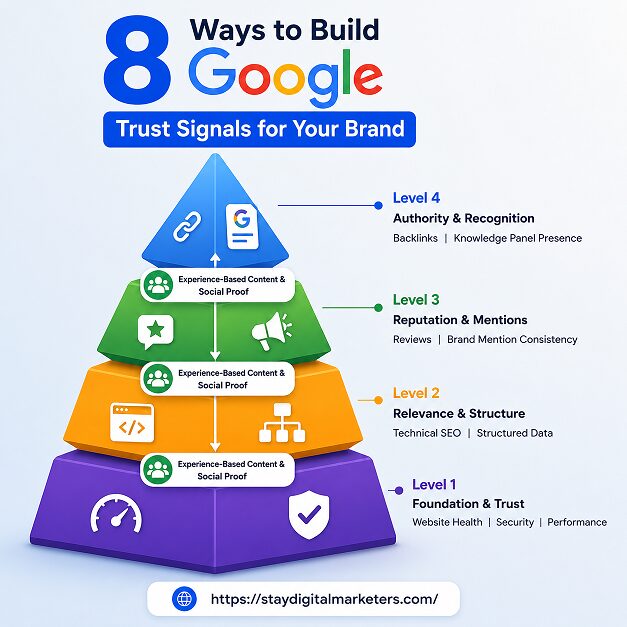
Rather than tackling all eight trust signals at once, brands get better results by sequencing them. The SIGNAL framework below groups the work into six practical stages, ordered by how quickly each one typically shows measurable impact.
| Trust Signal | Implementation Effort | Ranking Impact | Typical Timeframe |
| Structured data markup | Low | Medium | Days to weeks |
| Website security (HTTPS, speed) | Low | Medium | Days |
| Customer reviews | Medium | High | Weeks to months |
| Brand mention consistency | Medium | Medium | 1 to 3 months |
| High authority backlinks | High | High | 3 to 6 months |
| Knowledge Panel presence | High | Very High | 6 to 12 months |
| Experience based content | Medium | High | Ongoing |
| Social proof and engagement | Medium | Medium | Ongoing |
Technical signals like HTTPS and schema can be live within days, but signals tied to off site authority, reviews, backlinks, and Knowledge Panel eligibility, typically require six to twelve months of consistent effort before they produce a measurable ranking shift.
Yes, and arguably more. New sites can accelerate trust building by publishing credentialed, named content, implementing full structured data from launch, earning a handful of high quality backlinks early, and building an active review profile from day one.
No. Google generates Knowledge Panels algorithmically based on corroborating evidence across the web. Meeting the requirements improves eligibility significantly, but there is no submission process that guarantees one will appear.
Backlinks still matter, but quality has replaced quantity as the deciding factor. A small number of relevant, editorially earned links now outperforms a large volume of low quality or purchased links.
Social signals are not a confirmed direct ranking factor, but the brand consistency, engagement, and referral traffic they generate feed into the identity and trust signals Google does measure directly.
For most brands, structured data and review generation offer the best starting point since both are relatively fast to implement and have a compounding effect on every other trust signal built afterward.
AI Overviews and features like Google’s Preferred Sources now select which brands get surfaced before traditional ranking even applies, which means entity trust, consistent identity, verified authorship, and audience relationships, matters as much as conventional SEO.
Brands working through this process often benefit from outside support, particularly on the off site side of trust building. Stay Digital Marketers is one resource in this space, assisting brands with backlink related services such as guest posting, niche edits, press release distribution, SaaS backlinks, Wikipedia page creation, and Google Knowledge Panel groundwork, the kind of consistent, cross channel presence building that underpins several of the signals covered above.

Filza Taj is an MPhil in Human Resources-turned SEO Specialist, Content Strategist, and Digital Marketing Consultant with over 5 years of experience helping businesses in 30+ countries grow online. As the Founder of Stay Digital Marketers (staydigitalmarketers.com), she delivers results-driven solutions in link building, guest posting, PR distribution, niche edits, multilingual backlinks, and content marketing. She publishes daily SEO insights and actionable strategies to help brands strengthen their online presence, attract the right audience, and convert clicks into loyal customers.
Filza@staydigitalmarketers.com
Stay Digital Marketers
Need SEO, Link Building or Digital Marketing Services?
Request a Free Audit →