
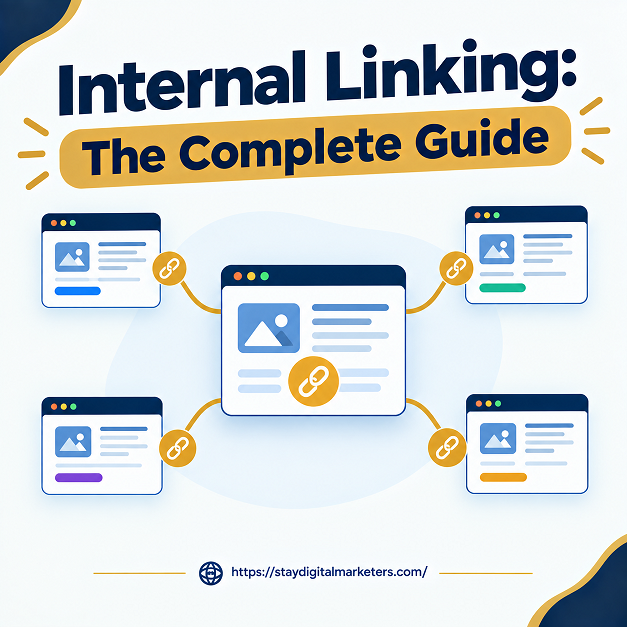
Internal linking is the practice of connecting pages within the same website through hyperlinks, letting visitors and crawlers move from one page to another without leaving the domain. Every internal link serves three jobs at once: it helps search engines discover and crawl pages, it distributes ranking authority across a site, and it signals to both readers and AI systems how one page relates to another. A page with no internal links pointing to it, known as an orphan page, is effectively invisible to search engines regardless of how good its content is.
The short answer is that internal linking works by giving search engines a map of a site’s structure and importance. Pages linked from many places, especially from high-authority pages, tend to get crawled more often and rank better than pages buried deep in a site with few or no links pointing to them. The sections below cover how that mechanism actually works and when it matters most.
Key Takeaways
Most internal linking guides describe crawl budget as a universal concern, something every site owner should actively manage. That framing overstates the case for the vast majority of websites. Google’s own crawl budget guidance is explicit that this is chiefly a concern for sites with roughly 1 million or more pages that change weekly, or 10,000 or more pages that change daily. A site well below those thresholds still benefits from clean internal linking, but not because Googlebot is running out of capacity to crawl it.
This distinction matters because it changes where effort should go. A small or mid-sized site does not need crawl budget engineering; it needs internal links that help search engines and AI systems understand topical relationships and that guide real visitors to relevant content. A large, fast-changing catalog or programmatic site genuinely does need to think about crawl efficiency, redirect chains, and wasted crawl paths. Treating every site like it has a Google-scale crawl budget problem is a common, avoidable overcorrection.
Three questions determine whether a site should actually prioritize crawl budget engineering, versus treating clean internal linking as a best practice without the added technical overhead.
A site answering yes to at least two of these genuinely has a crawl budget problem worth engineering around. A site answering no to all three should focus on the structural and topical benefits of internal linking instead, since crawl capacity was never the bottleneck.
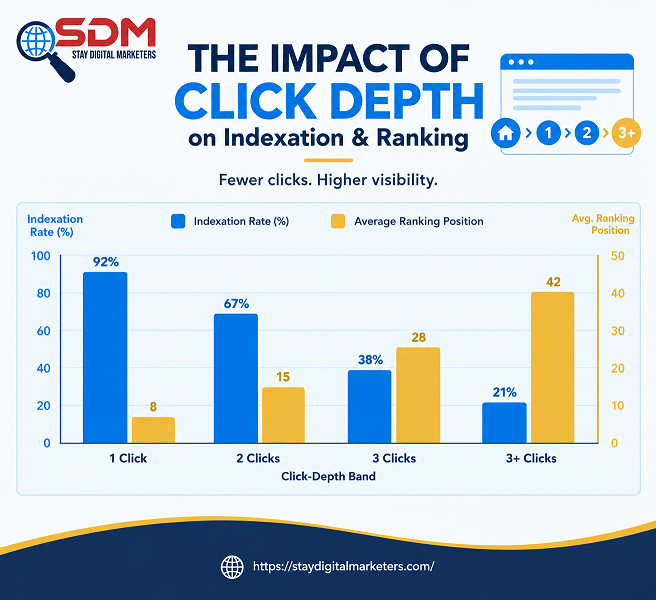
Click depth, the number of clicks required to reach a page from the homepage, correlates strongly with both indexation and ranking position. Pages one click from the homepage are indexed at a 98 percent rate with an average ranking position of 4.2, compared to a 54 percent indexation rate and an average position of 11.3 for pages sitting three or more clicks deep, according to Scopic Studios’ analysis of crawl depth data. Reducing click depth on important pages is one of the highest-leverage internal linking changes a site can make, since the effect compounds: a page that is not indexed cannot rank at all, regardless of content quality.
Internal links generally fall into four categories, each doing a different job.
Contextual links generally carry the most SEO value, since they connect topically related content in a way that mirrors how both search engines and AI systems assess relevance between pages.
An orphan page has zero internal links pointing to it from anywhere on the site, which makes it effectively invisible to crawlers that discover new content by following links. Screaming Frog’s research found roughly 96 percent of true orphan pages earn zero organic traffic, a figure that reflects how directly discoverability depends on internal linking rather than content quality alone.
A content hub or pillar-and-cluster model remains the most reliable structure: one broad, comprehensive pillar page targeting a core topic, supported by narrower cluster pages covering related subtopics, all interlinked. Reviewing site architecture across a range of client rebuilds shows the same pattern consistently: sites that link cluster pages back to a single, clearly identified pillar page tend to consolidate ranking signals for that topic faster than sites where the same subtopics exist as disconnected, individually optimized pages competing with each other.
Anchor text matters within this structure too. Descriptive, varied anchor text, rather than generic phrases like “click here,” tells both search engines and AI systems what the linked page is actually about, reinforcing the topical relationship the link structure is meant to establish.
AI systems generating answers rely on the same link structure search crawlers use to understand which pages belong to the same topic cluster. A tightly interlinked set of pages on one subject signals depth and coverage that both classic search rankings and AI-generated answers reward, while a page sitting in isolation, however well written, has to earn recognition without that contextual support. Roughly 51 percent of marketers report seeing positive results within a few months of implementing a deliberate internal linking strategy, a reasonable timeframe given that the effect depends on recrawling and reindexing rather than an instant signal.
| Metric | At 1-Click Depth | At 3+ Clicks Deep |
| Share of pages indexed | 98% | 54% |
| Average ranking position | 4.2 | 11.3 |
| Typical orphan-page organic traffic | N/A, pages are linked | Roughly 96% of true orphan pages earn zero organic traffic |
Internal linking is the practice of connecting pages on the same website through hyperlinks. It helps search engines discover and index pages, distributes ranking authority across a site, and helps visitors and AI systems understand how a site’s content relates.
Usually not. Google’s own guidance targets crawl budget concerns at sites with 1 million or more pages updated weekly, or 10,000 or more pages updated daily. Smaller sites still benefit from clean internal linking, just not for crawl budget reasons specifically.
Significantly. Pages one click from the homepage are indexed at a 98 percent rate with an average ranking position of 4.2, compared to a 54 percent indexation rate and an average position of 11.3 for pages three or more clicks deep, according to Scopic Studios’ analysis.
An orphan page is a page with no internal links pointing to it from anywhere else on the site. Screaming Frog’s research found roughly 96 percent of true orphan pages earn zero organic traffic, since search engines rely on internal links to discover content in the first place.
There is no universal number, but a healthy target is at least three genuine internal links pointing to every important page, with no important page sitting more than three clicks from the homepage in a typical content-driven site.
Yes. AI systems follow the same link structure search crawlers use to understand which pages belong to the same topic. A page tightly connected to related content through internal links signals topical depth that both classic search and AI-driven answers reward.
Internal linking organizes the authority a site already has, but that authority still has to come from somewhere, and much of it arrives through backlinks and mentions earned off-site. Stay Digital Marketers works on that external layer, including guest posting, press release distribution, SaaS backlinks, niche edits, multilingual backlinks, Wikipedia page creation, and Google Knowledge Panel creation, alongside complete SEO services, so a well-linked internal structure has real external authority flowing into it, not just link equity moving between existing pages.

Filza Taj is an MPhil in Human Resources-turned SEO Specialist, Content Strategist, and Digital Marketing Consultant with over 5 years of experience helping businesses in 30+ countries grow online. As the Founder of Stay Digital Marketers (staydigitalmarketers.com), she delivers results-driven solutions in link building, guest posting, PR distribution, niche edits, multilingual backlinks, and content marketing. She publishes daily SEO insights and actionable strategies to help brands strengthen their online presence, attract the right audience, and convert clicks into loyal customers.
Filza@staydigitalmarketers.com
Stay Digital Marketers
Need SEO, Link Building or Digital Marketing Services?
Request a Free Audit →