
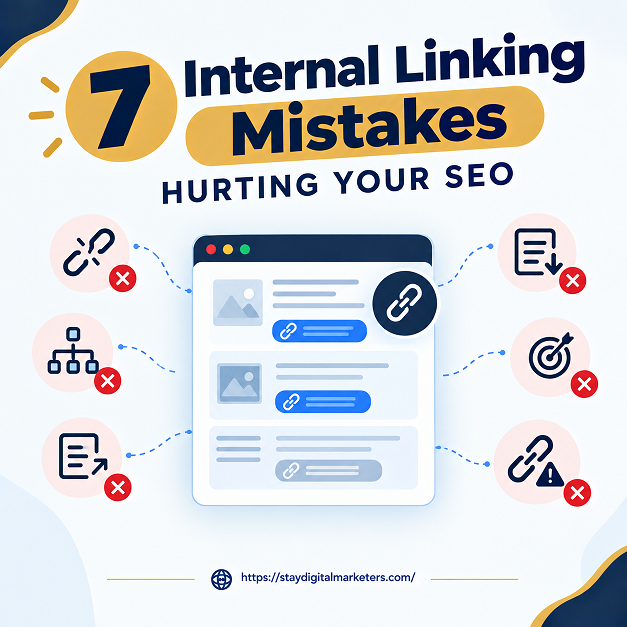
Internal linking mistakes are structural or editorial errors in how pages on a site link to each other, errors that block search engines from discovering content, waste the ranking authority a site has already earned, or send unclear signals about what a page is actually about. The seven mistakes below cover the ones that recur most often across live site audits, from orphan pages that never get crawled to redirect chains that quietly leak link equity with every extra hop, and each one is explained with the mechanism behind why it actually costs rankings, not just a warning that it is bad practice.
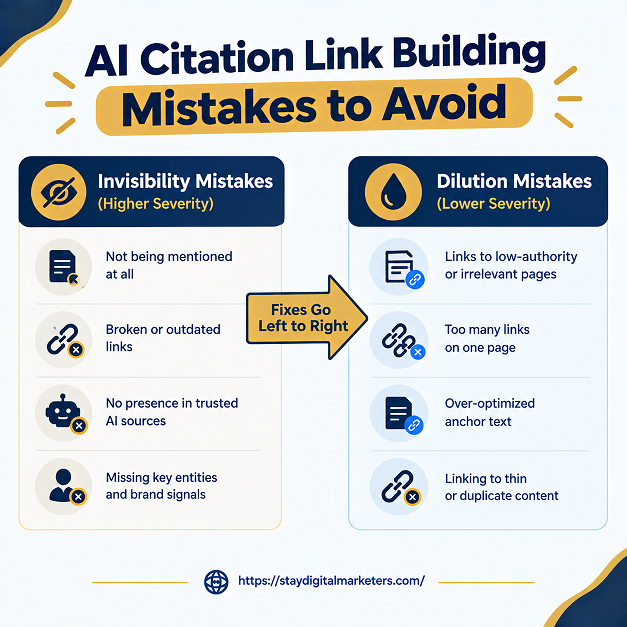
The short answer is that internal linking mistakes fall into two categories with very different costs. Some mistakes make a page invisible to search engines entirely. Others simply dilute the signal a page does receive. Knowing which category a given mistake falls into determines how urgently it needs fixing, which is the distinction most internal linking guides skip in favor of listing every mistake as equally important, leaving a team to guess at priority order on their own.
Key Takeaways
Most guides on this topic list internal linking mistakes as a flat checklist, broken links, poor anchor text, orphan pages, redirect issues, with no indication of which ones cost the most. That framing makes triage harder than it needs to be, since a team fixing issues in whatever order they appear in a checklist may spend hours on a low-impact anchor text cleanup while a genuinely invisible page sits unranked for months.
The seven mistakes below are grouped explicitly by severity instead: mistakes that make a page invisible to search engines, and mistakes that simply dilute the signal a visible page receives. That grouping is built directly from indexation and ranking data, not from which mistake sounds most alarming, and it is the organizing principle this article uses that a flat checklist does not.
Two categories separate a mistake that quietly costs a site traffic from one that actively prevents a page from ever ranking.
Running every internal linking issue through this two-question test, is the page actually reachable, and if so, is its signal clear, turns a flat list of seven mistakes into a prioritized fix order.
An orphan page has zero internal links pointing to it from anywhere else on the site, which makes it invisible to crawlers that discover new content by following links. Screaming Frog’s research found roughly 96 percent of true orphan pages earn zero organic traffic. This is an invisibility mistake in its purest form: no amount of content quality compensates for a page nothing else on the site points to, since discovery has to happen before quality can ever be assessed.
Click depth, the number of clicks required to reach a page from the homepage, correlates strongly with indexation. Pages one click deep are indexed at a 98 percent rate with an average ranking position of 4.2, compared to a 54 percent indexation rate and an average position of 11.3 for pages three or more clicks deep. A page technically linked from somewhere on the site can still functionally behave like an orphan if that link sits five or six clicks from the homepage.
A link pointing to a page marked noindex, or blocked in robots.txt, spends crawl budget and link equity reaching a destination that can never be indexed regardless of how well-linked it is. Reviewing site audits across a range of client accounts shows this mistake surfacing most often after a redesign, when old internal links survive pointing at pages that were deliberately deindexed for an unrelated reason, and nobody circles back to update the links that used to make sense.
Anchor text like “click here” or “learn more” gets a visitor to the destination page without telling search engines or AI systems anything about what that page covers. This is a dilution mistake, not an invisibility one: the page still gets crawled and indexed, but descriptive, keyword-relevant anchor text would have given it a measurably clearer topical signal.
When multiple pages use the same or near-identical anchor text pointing to different destinations, the relevance signal that anchor text carries gets split between pages instead of clearly reinforcing one. This often happens unintentionally as a site grows and different authors link to related pages using whatever phrase came to mind, rather than a deliberate, page-specific anchor text assignment.
An internal link pointing to a URL that itself redirects, sometimes through two or three hops before reaching the final page, adds load time, leaks a portion of link equity at each redirect, and adds unnecessary friction for crawlers following the path. Updating internal links to point directly at the final destination URL, rather than an outdated URL that happens to redirect correctly, removes this entirely and is usually a quick fix once the chains are actually identified.
Concentrating internal links on a handful of already-successful pages, while new or emerging content sits with minimal or no internal linking, starves exactly the content that most needs help building authority. New pages need deliberate internal links from related, established content shortly after publishing, not months later once someone notices they never gained traction. Building a link-in step into the publishing checklist itself, rather than treating it as a follow-up task, is what keeps new content from quietly falling into this pattern.
| Mistake | Category | Why It Ranks There |
| Orphan pages | Invisibility | No path in at all; indexation depends entirely on being found some other way |
| Pages buried past 3 clicks | Invisibility | Indexation drops from 98% to 54% once a page passes this depth |
| Links to noindex/blocked pages | Invisibility | Crawl budget spent reaching a page that can never be indexed |
| Generic anchor text | Dilution | Page still gets found and indexed, but its topic signal is weaker |
| Anchor text cannibalization | Dilution | Multiple pages compete for the same signal instead of each owning one |
| Redirect chains in internal links | Dilution | Link equity and crawl efficiency leak at every extra hop |
Creating orphan pages, pages with no internal links pointing to them, since orphan pages depend entirely on being discovered some other way. Screaming Frog’s research found roughly 96 percent of true orphan pages earn zero organic traffic, making this the costliest mistake on this list.
Three or fewer for any page that needs to rank. Pages one click deep are indexed at a 98 percent rate with an average ranking position of 4.2, compared to 54 percent indexation and an average position of 11.3 for pages three or more clicks deep.
Yes. A link pointing to a noindex or robots-blocked page spends crawl budget reaching a destination that can never be indexed, wasting the link equity that could have gone to a page capable of ranking.
It weakens the topical signal a link passes to the destination page without breaking anything outright. The page still gets indexed and crawled, but descriptive, keyword-relevant anchor text gives search engines and AI systems a clearer sense of what the linked page covers.
It happens when multiple pages on a site use the same or very similar anchor text pointing to different destinations, splitting the relevance signal search engines would otherwise assign clearly to one page. Assigning distinct anchor text per page prevents this competition.
Yes. Each additional hop in a redirect chain adds load time, leaks a portion of link equity, and adds friction for crawlers following the path. Updating internal links to point directly at the final URL removes the chain entirely.
Fixing internal linking mistakes protects the authority a site already has, but building more of that authority in the first place still depends on signals earned outside the site. Stay Digital Marketers works on that external layer, including guest posting, press release distribution, SaaS backlinks, niche edits, multilingual backlinks, Wikipedia page creation, and Google Knowledge Panel creation, alongside complete SEO services, so a cleanly linked site has real authority flowing in, not just existing authority redistributed more efficiently.

Filza Taj is an MPhil in Human Resources-turned SEO Specialist, Content Strategist, and Digital Marketing Consultant with over 5 years of experience helping businesses in 30+ countries grow online. As the Founder of Stay Digital Marketers (staydigitalmarketers.com), she delivers results-driven solutions in link building, guest posting, PR distribution, niche edits, multilingual backlinks, and content marketing. She publishes daily SEO insights and actionable strategies to help brands strengthen their online presence, attract the right audience, and convert clicks into loyal customers.
Filza@staydigitalmarketers.com
Stay Digital Marketers
Need SEO, Link Building or Digital Marketing Services?
Request a Free Audit →