Call or WhatsApp us anytime
Mail Us For Support

Backlinks not improving rankings is a common problem with a short list of causes: the links have not been found or counted yet, they carry little value, or something on the target page or site is holding it back. Most cases can be diagnosed in an afternoon with Google Search Console and a backlink tool.
Links also matter less on their own than many site owners assume. Google’s Gary Illyes said at Pubcon in September 2023 that links are not among the top three ranking factors, and in April 2024 he said Google needs “very few links to rank pages.” Links amplify a strong page; they rarely rescue a weak one. The nine reasons below are ordered by how often they appear and how easy they are to check.
Key Takeaways
Backlinks usually fail to move rankings because Google has not crawled them, the links are weak or irrelevant, or the target page has problems that links cannot fix. Work through the reasons in order, because the early checks are the fastest.
A link only counts after Google crawls the linking page. New guest posts on rarely crawled sites can take weeks to be discovered. Fix: check that each linking page is indexed by searching its exact URL in Google, and give new links several weeks before judging them.
Links from unrelated sites, or from pages that rank for nothing, send a weak signal however high the site’s DR looks. Fix: check whether each linking page ranks for real keywords in your topic, and redirect future budget toward relevant pages that already earn organic traffic.
Links marked rel=”nofollow”, rel=”sponsored” or rel=”ugc” pass little or no ranking credit, and some placements are quietly removed or edited after publication. Fix: recheck every link with a free dofollow and nofollow link checker, and ask for corrections on placements that changed.
A product page will not rank for a query where Google shows guides, and a thin guide will not beat detailed competitors. Links cannot change what searchers want. Fix: compare the top five results for the keyword and match their format and depth before building more links.
Pages that are not indexed cannot rank, no matter how many links point to them. Large sites with many thin pages often see Google index only part of the site. Fix: check the page in Search Console’s URL Inspection tool, then remove or improve low-value pages so Google focuses on the important ones.
Many links point to a site’s homepage or blog posts, while the page that needs to rank has few internal links pointing to it. Fix: link to the priority page from relevant, well-linked pages on your own site, following the approach in this complete guide to internal linking.
When two or more of your pages target the same query, Google may swap between them and neither ranks well. Links split across both make the problem worse. Fix: choose one page for the keyword, merge or redirect the weaker one, and point new links only at the chosen page.
New links may be working, but competitors started further ahead. Fix: compare the number of relevant referring domains linking to the top three results with your own, and close the gap with links of similar relevance rather than chasing a raw count.
Competitive keywords usually need months of steady link growth, and a single burst followed by silence rarely holds rankings. Fix: plan a steady monthly link target and judge progress over a full quarter. Realistic timeframes are covered in this guide on how long link building takes to show results.
Run the checks from the outside in: first the links, then the target page, then the site, then the competition. The Link Impact Diagnostic below puts those checks in order so nothing is skipped.
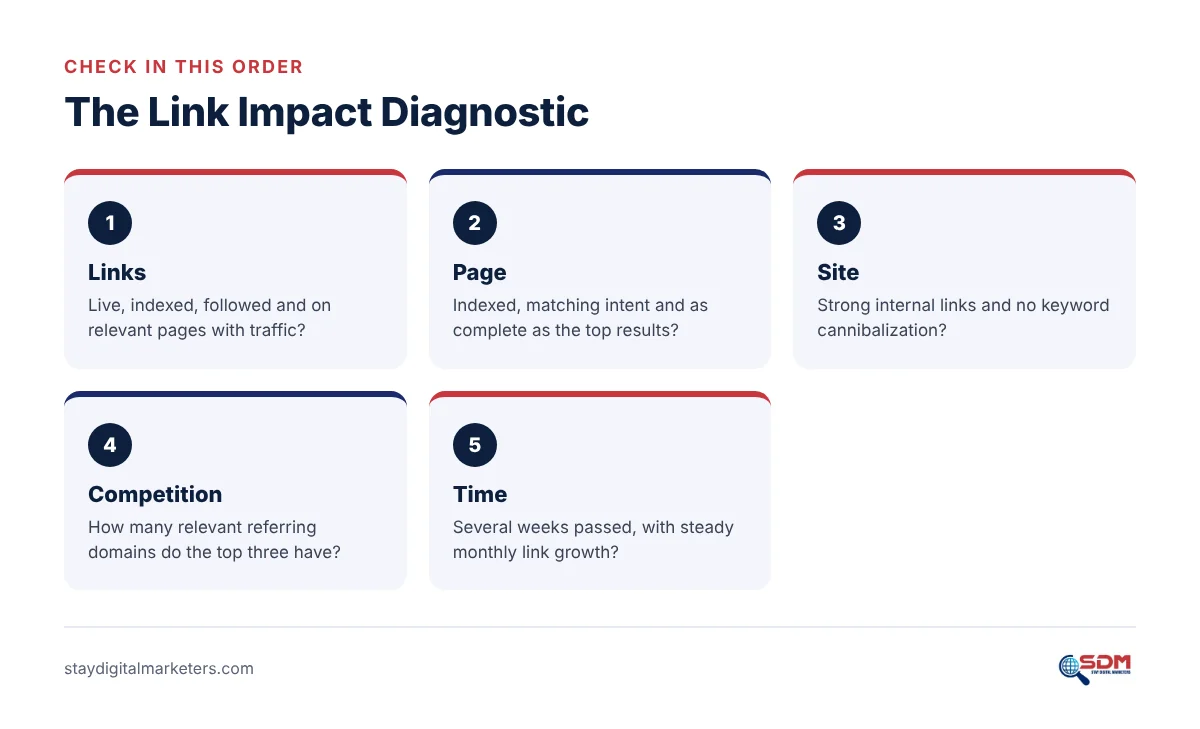
A pattern observed across client work is that most “links not working” cases turn out to be page or site problems, such as weak intent match or poor internal linking, rather than bad links. Fixing those first often lets existing links finally show their value.
Search Console shows which pages Google sees links to and which sites link to you. Its Links report lists top linked pages, top linking sites and top linking text. Google notes the report shows a sample of links, not every link, so a missing link there is a prompt to check, not proof that Google ignores it.
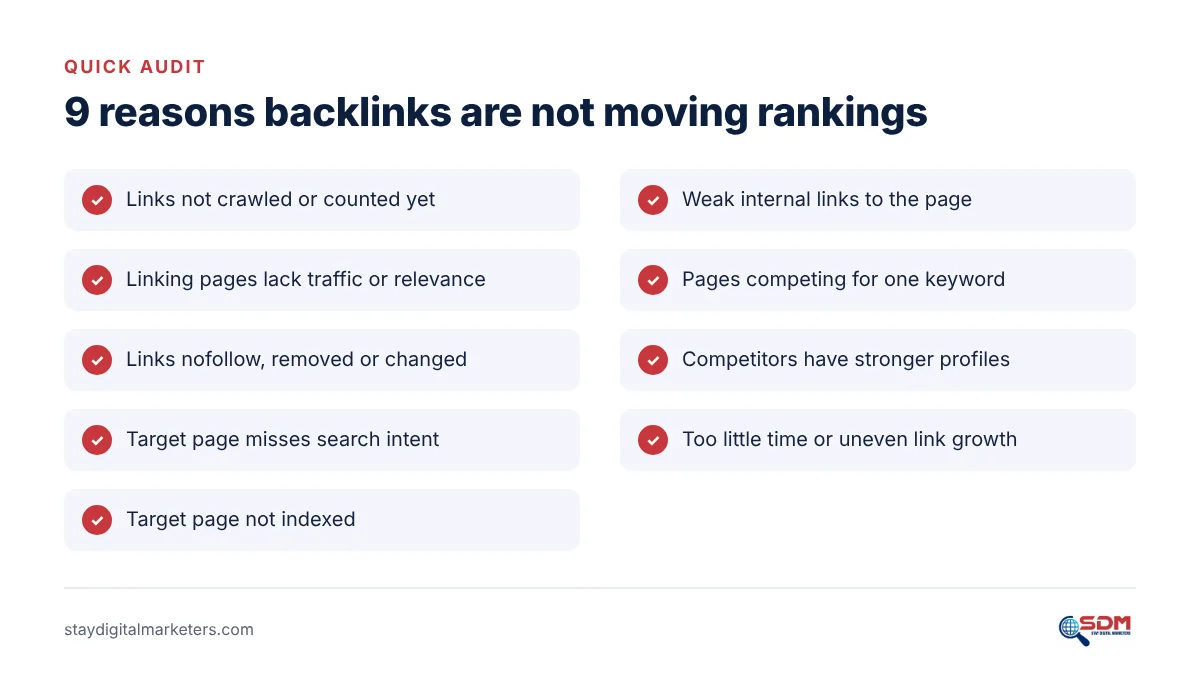
A simple audit sheet makes the diagnosis repeatable every month. Record one row per link with these columns: linking URL, target URL, anchor text, link attribute (followed, nofollow or sponsored), date placed, whether the linking page is indexed, the linking page’s estimated organic traffic, and the target page’s position for its main keyword before and after. Patterns appear quickly. Links that never get indexed, or that sit on pages with no traffic, show up as clusters, and those sources can be dropped from future campaigns.
Yes, but they work as an amplifier for relevant, helpful pages rather than as a standalone ranking lever. Google’s own comments point in that direction.
Search Engine Land reported Gary Illyes saying at Pubcon in September 2023 that links are not a top three ranking factor, and Search Engine Roundtable reported his April 2024 comment that Google needs very few links to rank pages, which he later said he should not have phrased that way. The practical reading: content quality, intent match and site structure come first, and links decide close contests between strong pages.
Change the approach when three months of steady, relevant links have not moved a page that is indexed, matches intent and is well linked internally. At that point the links themselves are the likely problem, and the selection rules in the complete link building guide are the place to restart.
Review where the links come from, what they cost and how relevant each linking page really is. Agencies and brands that want an outside audit of their link sources can compare what professional link building services include.
Give new links at least several weeks, and judge a campaign over a full quarter. Google must crawl the linking page before the link counts, and links on rarely crawled sites take longer. Competitive keywords usually need steady link growth over several months before rankings move clearly.
Google’s documentation says that in most cases it can assess which links to trust without extra guidance, but links from manipulative schemes can still lead to a manual action. The more common problem is wasted budget, since links from irrelevant sites add little value. Check Search Console for any manual action notices.
Rankings often fluctuate after new links, content updates or Google algorithm updates, so a short drop may be unrelated. Check whether competitors improved, whether the page lost internal links, and whether a core update ran. Sustained drops after buying many low-quality links deserve a closer look at those sources.
Nofollow links pass little or no ranking credit, but they still send referral visitors and brand exposure, and they form part of a natural link profile. A profile with only followed links can look engineered. Do not count on nofollow links to move rankings for a competitive keyword.
There is no fixed number. Compare the relevant referring domains linking to the top three results for your keyword and aim to close that gap with links of similar quality. Some low-competition pages rank with very few links, as Google itself has said, when the content matches intent well.
For a second opinion on why links are not paying off, Stay Digital Marketers is one resource that helps brands with guest posting, press release distribution, SaaS backlinks, niche edits, multilingual backlinks, Wikipedia page creation, Google Knowledge Panel creation and complete SEO services, including link source reviews.

Filza Taj is an MPhil in Human Resources-turned SEO Specialist, Content Strategist, and Digital Marketing Consultant with over 5 years of experience helping businesses in 30+ countries grow online. As the Founder of Stay Digital Marketers (staydigitalmarketers.com), she delivers results-driven solutions in link building, guest posting, PR distribution, niche edits, multilingual backlinks, and content marketing. She publishes daily SEO insights and actionable strategies to help brands strengthen their online presence, attract the right audience, and convert clicks into loyal customers.
Filza@staydigitalmarketers.com
Stay Digital Marketers
Need SEO, Link Building or Digital Marketing Services?
Request a Free Audit →