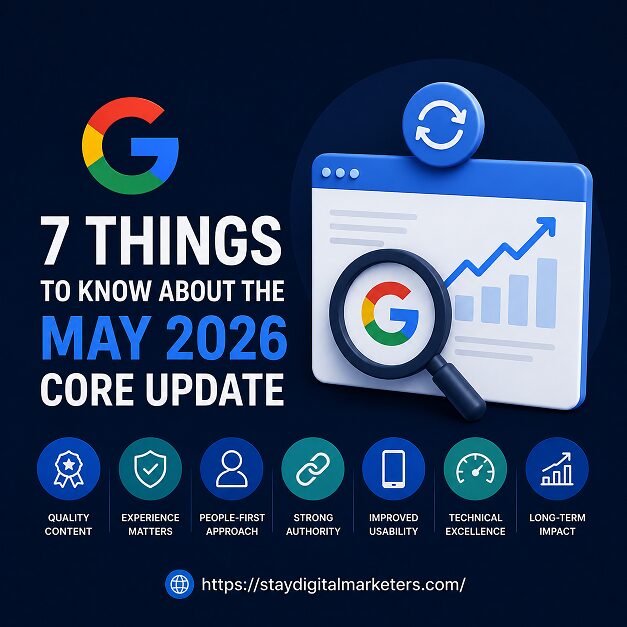

Google’s May 2026 core update rolled out between May 21 and June 2, 2026, reshuffling search results across nearly every industry. It was the second core update of the year, following the March 2026 core and spam updates, and it left many site owners asking the same question: what actually changed, and what should be done about it.
A Google core update is a broad revision to Google’s main ranking systems, not a single tweak aimed at one type of content. Google applies these updates globally and simultaneously, which is why a site can see traffic move without anything being technically wrong with it. The data behind May 2026 points to a specific shift in which kinds of sources Google now chooses to place at the top of the page.
Key Takeaways
The May 2026 core update is a systemwide adjustment to how Google evaluates and ranks web pages, announced on May 21, 2026 and confirmed complete on June 2, 2026. Google described it on its Search Status Dashboard and on LinkedIn as a regular update meant to better surface relevant, satisfying content for searchers across all site types.
Unlike a spam update, which targets manipulative tactics directly, a core update recalibrates the broader signals Google uses to judge quality, relevance, and trustworthiness. Sites that had been sitting on the edge of a ranking threshold, whether above it or below it, are the ones most likely to move.
The rollout began the afternoon of Thursday, May 21, 2026, with results already shifting noticeably by Saturday, May 23. A second wave followed on Saturday, May 30, and additional volatility appeared in the final 24 hours before Google marked the rollout complete on June 2. In total, the update took about 12 days to fully deploy, in line with Google’s own two-week estimate.
The May update followed the March 2026 core and spam updates, released days apart, and the February 2026 Discover update before that. SE Ranking found May was busier than the December 2025 core update but calmer than the March double update, placing it in the middle for overall disruption.
A ranking drop after a core update does not automatically mean something is broken on a site. Google has repeatedly said there is no specific fix to apply, since a negative shift often reflects other pages being reassessed as more relevant, not a penalty against the page that dropped. The safest response is comparing what changed on the page against what now ranks above it, rather than chasing quick technical patches.
Google’s guidance points site owners toward its self-assessment questions on content quality, expertise, and trustworthiness, alongside its people-first content documentation. Practitioners who work across many client sites in a given cycle tend to see the same pattern: pages that were thin, templated, or written primarily to match a keyword rather than answer a real question lose ground first.
Raw instability was actually lower in May than in March. According to SE Ranking’s analysis of 100,000 keywords across 20 niches, 76.03 percent of top 3 positions and 88.39 percent of top 10 positions changed after the May update, compared with a larger share of movement during the March double update. What made May distinct was not how much moved, but what kind of source Google chose to show more of.
Community platforms gained visible ground. Reddit’s share of top 3 positions rose to 10.24 percent after May, up from 8.56 percent after March, and the number of keywords where Reddit held the number one spot jumped 54 percent compared with March. At the same time, YouTube’s share of top 3 positions fell to 2.14 percent, continuing a decline from 2.50 percent in March, suggesting video results are increasingly being pulled into dedicated video features rather than shown as regular blue links.
Volatility was broad but uneven across sectors. Fashion and Beauty saw the highest top 10 turnover at 90.75 percent, while Real Estate was the steadiest at 83.50 percent, with Healthcare close behind. Reddit’s biggest jumps came in Pets, Education, Sports and Exercise, and E-Commerce, niches where searchers want firsthand opinions, while it barely moved in Real Estate, Healthcare, and News and Politics, where accuracy carries the most weight.
Yes. Reddit gained top 3 visibility in all 20 tracked niches, with the sharpest gains concentrated in experience-driven searches and almost no movement in categories where a wrong answer carries real consequences, reinforcing that Google is treating community sources differently based on query sensitivity.
There is no submission process or manual fix that guarantees recovery from a core update. Google has said pages may see partial recovery between updates, but larger shifts tend to follow the next core update rather than happening in between. Patience and page-level improvement matter more than reactive technical changes.
The following framework helps teams work through a post-update audit in a consistent order.
The SHIFT Framework for Core Update Recovery
Only 32.20 percent of domains that lost top 10 rankings in March had recovered by the time May finished rolling out. Most recoveries, when they happen, take at least one additional core update cycle rather than resolving within the same one.
A site that held steady through the May update is not necessarily safe going forward. 19.87 percent of pages ranking in the top 10 before the update dropped out of the top 100 entirely afterward, and 17 percent of the current top 10 had never appeared in prior snapshots. Stability now is worth treating as a baseline to protect, not a reason to stop investing in content depth.
Google has run at least one core update roughly every two to four months since late 2025, following the December 2025 core update, the March 2026 core and spam updates, and now May 2026. Based on that cadence, another core update later in 2026 is likely, though Google does not publish a fixed schedule and typically announces updates only once rollout begins.
Across every core update, Google’s message has stayed consistent: reward content built for people first, not content built to match a search engine’s patterns. That holds true even as the mechanics evolve, whether favoring community discussion in some niches or tightening standards in YMYL categories. Pages that hold steady through consecutive core updates tend to share the same traits: original analysis, clear sourcing, and structure built around the actual question a reader typed in.
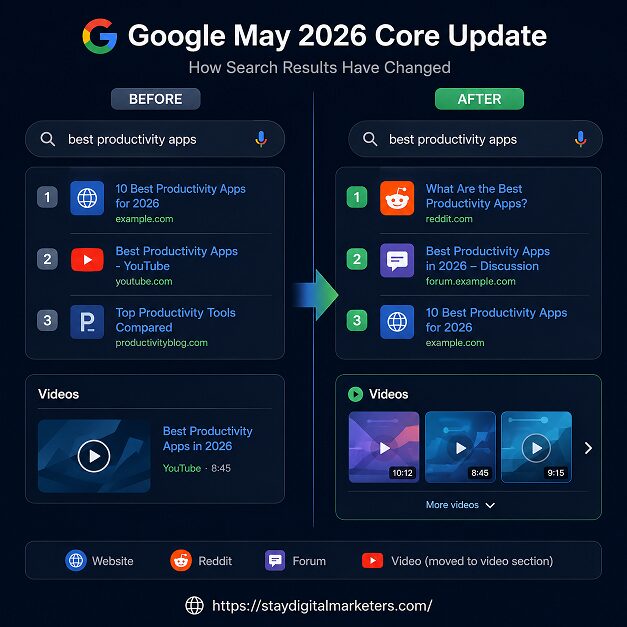
| Metric | March 2026 Update | May 2026 Update |
| Top 3 URLs that changed position | Higher than May | 76.03% |
| Top 10 URLs that changed position | Higher than May | 88.39% |
| Reddit share of top 3 positions | 8.56% | 10.24% |
| YouTube share of top 3 positions | 2.50% | 2.14% |
| Full top 3 monopolies | 3.24% of keywords | 1.99% of keywords |
| Domains recovering lost top 10 spots | N/A | 32.20% |
What is a Google core update
A core update is a broad revision to Google’s main ranking systems that affects search results globally, rather than targeting one type of content or tactic. It reassesses relevance, quality, and trustworthiness signals across the board, which is why rankings can shift even when nothing changes on a specific page.
When did the May 2026 core update finish rolling out
Google confirmed the May 2026 core update was fully rolled out on June 2, 2026, about 12 days after it began on May 21. Ranking volatility continued in short bursts throughout that window, with notable spikes on May 23 and May 30.
Did the May 2026 update target a specific type of website
No. Google described it as a regular, broad update rather than one aimed at a specific site type or tactic. The visible effect was a shift in the mix of sources ranking well, with community platforms like Reddit gaining ground and YouTube appearing less often in standard results.
How do I know if my site was affected by the update
Compare organic traffic and keyword rankings across the rollout window, May 21 through June 2, 2026, using analytics or a rank tracker. A drop concentrated around those dates, rather than a gradual decline, points to the core update rather than a separate technical issue.
Can a site recover after losing rankings in a core update
Recovery is possible but not guaranteed, and it usually takes longer than one update cycle. Data from the March-to-May window found only about a third of previously dropped domains had returned to the top 10 by the next update, so sustained content improvement matters more than quick fixes.
Why did Reddit gain so much visibility in this update
Reddit’s gains concentrated in niches where searchers want firsthand opinions and community discussion, such as Pets, Education, and E-Commerce. In more sensitive categories like Healthcare and Real Estate, Reddit’s presence barely changed, suggesting Google applies community sources selectively based on query risk.
Should I make changes to my site immediately after a core update
Immediate reactive changes are generally discouraged. Google’s own advice is to evaluate content against its people-first guidelines over time rather than making rushed edits, since core update effects can shift again before the next rollout and premature changes can complicate diagnosis.
Businesses working to rebuild authority after a core update often find that off-page signals matter as much as on-page fixes, since Google’s broader trust evaluation looks beyond a single page. Stay Digital Marketers supports that side of recovery through guest posting, niche edits, multilingual backlinks, brand mentions, press release distribution, SaaS backlinks, Wikipedia page creation, Google Knowledge Panel and complete SEO solutions, helping brands strengthen the entity signals that core updates increasingly reward.

Filza Taj is an MPhil in Human Resources-turned SEO Specialist, Content Strategist, and Digital Marketing Consultant with over 5 years of experience helping businesses in 30+ countries grow online. As the Founder of Stay Digital Marketers (staydigitalmarketers.com), she delivers results-driven solutions in link building, guest posting, PR distribution, niche edits, multilingual backlinks, and content marketing. She publishes daily SEO insights and actionable strategies to help brands strengthen their online presence, attract the right audience, and convert clicks into loyal customers.
Filza@staydigitalmarketers.com
Stay Digital Marketers
Need SEO, Link Building or Digital Marketing Services?
Request a Free Audit →