
Google’s May 2026 core update ran from May 21 to June 2, 2026, and it reshaped rankings across nearly every content category. If a site’s traffic moved in late May, this update is very likely the reason. Below are the seven things that matter most, drawn from Google’s own status dashboard, third party volatility sensors, and a large-scale post-update analysis of thousands of sites.
A core update is a broad, unnamed-target change to Google’s ranking systems, released several times a year, that reassesses how helpful, reliable, and people-first content is judged across the entire web. Unlike a spam update, which punishes specific manipulative tactics, a core update does not target individual sites. It re-ranks the field as a whole, the way a restaurant guide reshuffles its top twenty list as new places open and old favorites change. The May 2026 core update was Google’s second core update of the year, following the March 2026 core update and the March 2026 spam update.
Key Takeaways
The May 2026 core update is a broad ranking systems change that Google confirmed on its Search Status Dashboard on May 21, 2026, describing it as a regular update meant to better surface relevant, satisfying content for searchers from all types of sites. It affected Search globally, across every language and region, from the moment the rollout began. There was no regional phase-in and no category exclusion.
The rollout began on May 21, 2026, and Google marked it complete on June 2, 2026, a twelve-day window that came in slightly ahead of the two-week estimate Google gave at launch. That places it after the March 2026 core update, which ran from March 27 to April 8, and after the March 2026 spam update, which finished in under a day.
This was not a single clean shift. SERP volatility sensors recorded several distinct spikes rather than one smooth curve, with the sharpest movement landing around May 23, again around May 30, and once more in the final 24 hours before completion on June 2. Sites that saw a quiet stretch mid-rollout and assumed the update was winding down were often surprised by a second wave days later. That pattern echoes the March 2026 core update, where Semrush Sensor readings reached a multi-year high of 9.5 out of 10 and SE Ranking measured 79.5 percent of top-three results changing position, with 90.7 percent of the entire top ten shifting at some point during the rollout. Judged against that benchmark, May’s volatility, while lower in peak intensity, still qualified as one of the more disruptive updates of the past year, and the multi-wave pattern made it harder to read in real time.
Anyone comparing Search Console data from this period should treat anything logged during the rollout itself as unstable. Google’s own guidance is to wait at least a full week after a core update completes before drawing conclusions, which for the May 2026 update means the earliest clean comparison window starts around June 9.
Google has always said core updates affect all types of sites, and that is technically true, but the distribution of impact is never even. A large-scale analysis spanning roughly four thousand sites found that gaming, deals, travel, hobbies and interests, and lifestyle content experienced noticeably more movement than the average category. The clearest pattern separating winners from losers was not topic, though, it was substance. Pages built from original reporting, first-hand process documentation, and named, identifiable authors tended to hold steady or gain. Pages assembled primarily from aggregated commentary, thin affiliate content, or high ad density were the ones absorbing the sharpest drops, frequently in the 10 to 14 percent range on informational pages.
Across client work we’ve observed the same divide play out repeatedly: two articles targeting the same keyword, similar length, similar backlink profile, but one built around a genuinely original framework or first-hand observation and the other a rewrite of what was already ranking. After a core update, it is almost always the original piece that holds its position.
Google did not publish new advice specific to the May 2026 core update. Its Search Status Dashboard simply noted the update had been released and that rollout could take up to two weeks. On LinkedIn, Google reiterated its standard line: this is a regular update designed to better surface relevant, satisfying content for searchers from all types of sites, and there’s nothing new or special that creators need to do as long as they have been making satisfying content meant for people. That consistency is itself informative. Google is not signaling a new ranking factor with each core update. It is recalibrating how existing signals, like helpfulness, expertise, and trustworthiness, get weighted against a constantly shifting web.
Both 2026 core updates ranked among the more disruptive in recent memory, but they were not identical in shape or duration. The table below lines up the two side by side using the most consistently reported figures for each.
| Metric | March 2026 Core Update | May 2026 Core Update |
| Rollout dates | March 27 to April 8 | May 21 to June 2 |
| Rollout length | 12 days | 12 days |
| Peak Semrush Sensor reading | 9.5 out of 10 | 7.0 out of 10 (High range) |
| Top three URL movement | 79.5 percent changed position | Multiple confirmed volatility waves, no single published top-three figure |
| Volatility pattern | Single dominant peak mid-rollout | Multiple spikes across the rollout window |
| Hardest hit content | Thin, aggregated, low original-analysis pages | Gaming, deals, travel, lifestyle, aggregator and low-substance pages |
Is it worth making changes right away. In most cases, no. Google recommends against rapid changes during an active rollout because the algorithm itself is still shifting, which makes it nearly impossible to isolate what helped or hurt. The more useful first step is diagnostic, not corrective.
How long does it take to recover. Google says some changes can register within days, though it can take several months for systems to confirm a site is consistently producing helpful, reliable content, and full recovery from a core update commonly plays out over the following three to six months, sometimes not until the next core update arrives.
The May 2026 core update landed inside a broader shift in how search results are constructed. AI Overviews continued expanding across tracked queries following the update, meaning a growing share of search journeys are being shaped by an AI-generated answer before a reader ever clicks through to a website. This does not replace the fundamentals a core update rewards, it raises the bar on them. The same qualities that earn visibility in traditional organic results, clear direct answers, demonstrated first-hand expertise, and content that fully resolves a query, overlap heavily with what tends to get pulled into AI-generated summaries. Practically, that means writing a direct, snippet-ready answer near the top of a section is no longer just a featured-snippet tactic, it is increasingly an AI Overview and AI Mode tactic too.
Six pattern threads recur across the post-May 2026 analysis: sites with higher domain authority tended to be more resilient, lower ad density correlated with stronger performance, healthy Core Web Vitals mattered more than cosmetic design choices, content freshness helped in categories where freshness is expected, and traffic diversified beyond search, through channels like email and Pinterest, tracked with stronger overall stability. Distilling these into something usable, the ANCHOR framework groups them into six checkpoints worth running against any page before and after a core update.
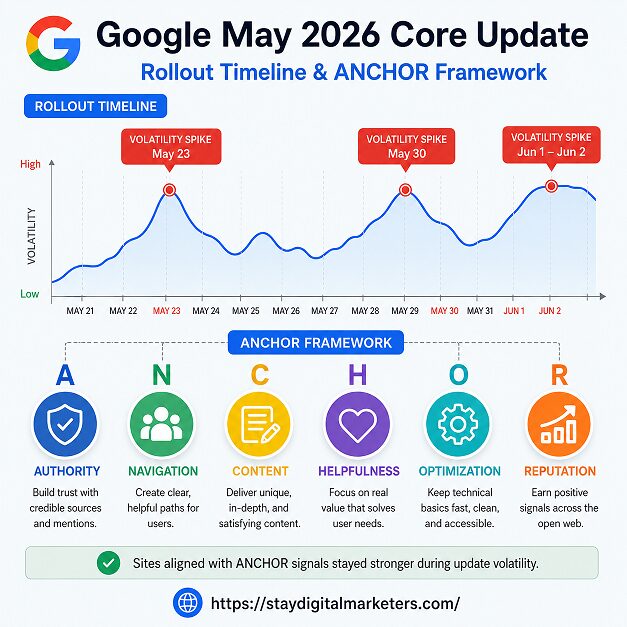
Generally, no, not reactively. The safer approach is to keep shipping the kind of content the ANCHOR checkpoints describe on a normal cadence, and save any large structural or content decisions for after a rollout is confirmed complete and a clean week of Search Console data is available. Panic edits made mid-rollout are evaluated against an algorithm that is itself still shifting, which is exactly the noise you’re trying to avoid.
What is the Google May 2026 core update?
It is a broad, global ranking systems update Google confirmed on May 21, 2026, and completed on June 2, 2026. It reassesses how helpful, reliable, and people-first content is ranked across Search, without targeting specific sites or pages directly.
How long did the May 2026 core update take to roll out?
The rollout lasted twelve days, running from May 21 to June 2, 2026. That came in slightly faster than the two-week window Google originally estimated when the update was announced.
Was the May 2026 core update bigger than the March 2026 core update?
Peak volatility readings were somewhat lower than March 2026’s multi-year high, but May unfolded across several distinct waves rather than one peak, making it feel similarly disruptive for many site owners tracking daily rankings.
What should I do if my traffic dropped after the update?
Wait until a full week after completion, then compare Search Console data from before May 21 against data from after June 9. Only pursue substantial content changes if the drop is large and sustained, not for small position shifts.
Does a core update ranking drop mean my site was penalized?
No. Core updates are algorithmic reassessments, not manual penalties. A drop typically means other pages are currently doing a better job satisfying the same query, not that something on your site is broken or against Google’s policies.
How does the May 2026 core update affect AI Overviews?
AI Overviews kept expanding across tracked queries after the update. Pages that give clear, direct, well-supported answers tend to perform well in both traditional rankings and AI-generated summaries, so the two are becoming harder to optimize for separately.
How long does recovery from a core update take?
Some sites see partial recovery within weeks, but full recovery commonly takes three to six months, and in some cases meaningful improvement doesn’t show up until the next core update rolls out.
For agencies and in-house teams that don’t have the bandwidth to run this kind of before-and-after Search Console analysis on every client site, Stay Digital Marketers works with brands on the backlink and entity side of recovery, including guest posting, niche edits, press release distribution, SaaS-focused backlink campaigns, Wikipedia page creation, and Google Knowledge Panel management, all of which feed into the authority and trust signals core updates continue to reward.

Filza Taj is an MPhil in Human Resources-turned SEO Specialist, Content Strategist, and Digital Marketing Consultant with over 5 years of experience helping businesses in 30+ countries grow online. As the Founder of Stay Digital Marketers (staydigitalmarketers.com), she delivers results-driven solutions in link building, guest posting, PR distribution, niche edits, multilingual backlinks, and content marketing. She publishes daily SEO insights and actionable strategies to help brands strengthen their online presence, attract the right audience, and convert clicks into loyal customers.
Filza@staydigitalmarketers.com
Stay Digital Marketers
Need SEO, Link Building or Digital Marketing Services?
Request a Free Audit →