
A listicle gets kept out of AI Overviews when it fails one of two separate tests: whether Google’s AI system retrieves the page at all for the queries it is actually pulling from, and whether the system trusts what it retrieves enough to cite it. Both tests operate independently of traditional ranking signals in ways many teams still misunderstand. AI Overviews is Google’s AI-generated summary that appears above traditional search results, built on retrieval-augmented generation, similar to how ChatGPT, Gemini, and Perplexity construct answers, pulling facts from a set of retrieved sources and synthesizing them into a direct response.
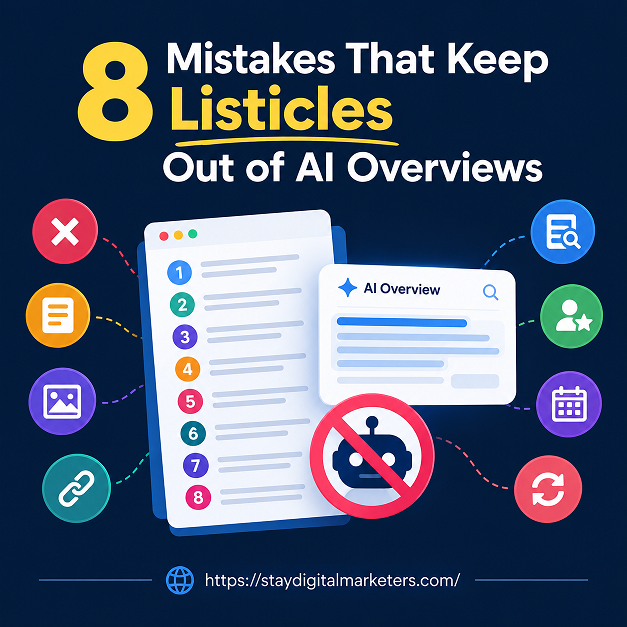
The short answer is that most listicles get excluded for one of eight identifiable reasons, ranging from self-promotional ranking that undermines trust to keyword targeting so narrow it misses the related searches AI Overviews is actually pulling citations from.
Key Takeaways
A page ranking on page one of Google used to be a reasonably strong predictor of AI Overview inclusion. That relationship has weakened substantially. Ahrefs’ analysis of 863,000 SERPs and 4 million AI Overview citations, published August 2026, found only 37.9 percent of cited URLs also ranked in the top 10 for the same query, down from roughly 76 percent a year earlier. Another 31 percent of cited pages did not rank in the top 100 at all.
The reason traces back to query fan-out. Google’s AI Overview system increasingly pulls citations from a cluster of related searches rather than the literal query a person typed, so a listicle that ranks well for “best CRM software” but has no content touching “CRM software for startups” or “CRM software pricing comparison” can lose citation opportunities to a page that covers the surrounding cluster, even if that page ranks lower for the exact target term. None of the existing guides on this topic connect these two data points directly: a listicle can do everything right on its target keyword and still miss AI Overview inclusion because its topical coverage, not its ranking, is too narrow.
Ahrefs tracked 9,886 AI answers across ChatGPT, Gemini, Perplexity, and Copilot after publishing 34 self-promotional “best” lists across five domains. The pattern was consistent: AI systems used the article as a source but frequently declined to recommend the publisher’s own brand, and in some cases boosted a competitor instead. One list built to promote an industry conference saw a competing event recommended in 43 percent of answers. A separate real-world example showed a company ranking itself first in a “best CRM” list, only for ChatGPT to recommend a competitor in the top spot instead. Citation is not the same as recommendation, and a self-ranked listicle earns the former without reliably earning the latter.
Ahrefs studied server logs and bot traffic across 137,000 sites and found 28 percent had published an llms.txt file. Of those, 97 percent were never fetched by anything. Of the small remainder that were read, 77 percent of the requests came from SEO audit tools and GEO platforms studying llms.txt adoption, not from AI bots retrieving content. Time spent maintaining an llms.txt file is effort that produces no measurable citation benefit and would do more for a listicle’s AI Overview chances if redirected toward the page’s actual structure and content.
A controlled Ahrefs test tracked 1,885 pages that added JSON-LD schema against 4,000 matched control pages over 30 days. ChatGPT citations moved 2.2 percent and Google AI Mode moved 2.4 percent, neither a meaningful lift, while AI Overview citations declined 4.6 percent, though that drop could not be clearly attributed to the schema change itself since both groups were already trending downward beforehand. Schema markup still has value for building long-term entity associations inside Google’s Knowledge Graph, but it is not the fast citation lever some GEO guidance suggests.
Ahrefs analyzed 1.4 million ChatGPT prompts and found 88.46 percent of citations traced back to the general search index, the same ranking system that has always driven classic SEO. Specialized sources like Reddit and YouTube get pulled into AI answers at scale but are cited far less often by comparison. A listicle that never invests in the fundamentals, keyword targeting, search intent match, technical health, that earn a classic search ranking starts at a significant disadvantage before AI-specific optimization even enters the picture.
As covered above, only 37.9 percent of AI Overview citations now come from top-10-ranked pages, down sharply from roughly 76 percent a year earlier. Teams that treat a page-1 ranking as confirmation their listicle is AI-Overview-ready are working from an assumption that held a year ago and no longer reliably holds today.
Because AI Overviews increasingly cites pages for fan-out queries related to, but not identical to, the original search, a listicle built around one exact keyword misses the surrounding cluster where a meaningful share of citations now originate. Covering adjacent angles inside or alongside the same listicle, pricing, alternatives, use-case-specific picks, gives the page more fan-out queries it can plausibly be retrieved for.
Ahrefs correlated a range of metrics against brand mentions in ChatGPT, AI Mode, and AI Overviews across 75,000 brands. Domain Rating showed a weak correlation, between 0.266 and 0.326 depending on the model, and raw backlink counts were weaker still, between 0.191 and 0.244. Teams that pour link-building budget into a listicle expecting an AI-visibility return from that investment alone are optimizing for the wrong signal.
The same Ahrefs study found YouTube mentions correlated with AI brand mentions at roughly 0.735 to 0.740, and branded web mentions correlated at 0.656 to 0.709, both far ahead of backlinks or Domain Rating. A listicle sitting on a domain nobody talks about elsewhere is missing the signal that actually moves AI visibility, regardless of how well the page itself is built.
Reviewing AI visibility audits across a range of client sites shows the same pattern this data implies: pages backed by real, independent mentions elsewhere on the web consistently out-cite better-optimized pages sitting on domains with little outside conversation happening around them.
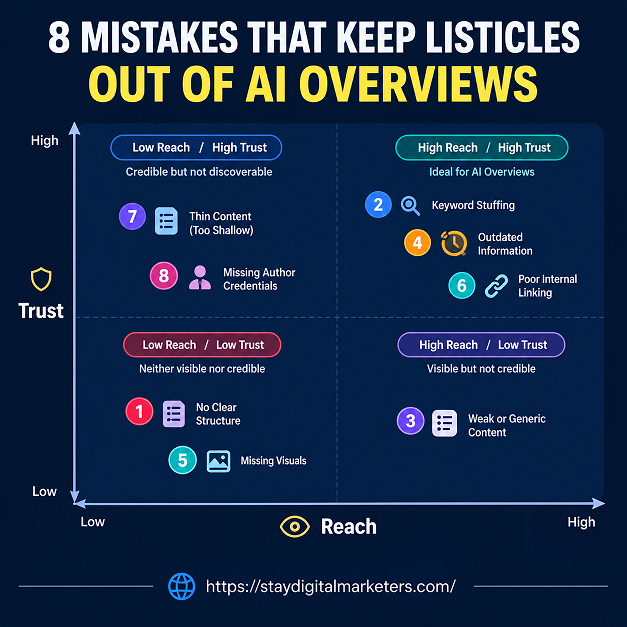
The eight mistakes below split into two categories worth diagnosing separately, since fixing one does nothing for the other.
A listicle can fail on trust while succeeding on reach, appearing in the retrieved set but never getting cited, or fail on reach while having flawless structure, never entering the retrieved set to begin with. Diagnosing which failure applies determines whether the fix is editorial or structural.
| Mistake | Failure Type | Key Data Point |
| Self-promotional ranking | Trust | 43% of tracked answers recommended a competitor instead |
| llms.txt as a shortcut | Wasted effort | 97% of published files were never fetched |
| Schema as a citation hack | Wasted effort | No meaningful citation lift after 30 days |
| Ignoring classic rankings | Reach | 88.46% of ChatGPT citations trace to the search index |
| Page-1 assumption | Reach | Only 37.9% of cited pages rank top 10, down from ~76% |
| Exact-keyword-only targeting | Reach | Fan-out queries drive a growing share of citations |
| Chasing DR and backlinks | Reach | Domain Rating correlation only 0.266-0.326 |
| Neglecting brand mentions | Reach | YouTube mentions correlate at 0.735-0.740 |
No. Only 37.9 percent of URLs cited in AI Overviews also rank in the top 10 for the same query, down from roughly 76 percent a year earlier, according to Ahrefs’ analysis of 863,000 SERPs. Nearly a third of cited pages do not rank in the top 100 at all.
Not on its own. A controlled Ahrefs test on 1,885 pages found no meaningful citation lift on ChatGPT or Google AI Mode after adding JSON-LD schema, and AI Overview citations declined slightly, though that decline could not be clearly attributed to the schema change itself.
No. Ahrefs tracked 9,886 AI answers after publishing 34 self-promotional lists and found AI systems often declined to recommend the publisher’s own brand, sometimes recommending a competitor instead. One promotional list saw a competing option recommended in 43 percent of answers.
Less than expected. Domain Rating correlated with AI brand mentions at only 0.266 to 0.326, and backlink counts were weaker still, at 0.191 to 0.244, across a 75,000-brand Ahrefs study. YouTube mentions and branded web mentions correlated far more strongly.
No. Ahrefs found 97 percent of published llms.txt files across 137,000 sites were never fetched by anything, and most of the small remainder was read by SEO tools rather than AI bots. The file currently carries no measurable citation benefit.
Query fan-out is the likely cause. Google’s AI Overview system increasingly cites pages for related searches rather than the exact query, so a listicle covering only its one target keyword misses the surrounding cluster where a growing share of citations now originate.
Fixing reach failures depends on signals a single listicle cannot generate alone, mainly the branded mentions and topical coverage that come from a wider content and outreach program. Stay Digital Marketers works with brands on that surrounding layer, including guest posting, digital PR and press release distribution, SaaS backlinks, niche edits, multilingual backlinks, Wikipedia page creation, and Google Knowledge Panel creation, alongside broader SEO services, so a well-built listicle sits inside a domain presence substantial enough to actually get retrieved and trusted by AI Overviews.

Filza Taj is an MPhil in Human Resources-turned SEO Specialist, Content Strategist, and Digital Marketing Consultant with over 5 years of experience helping businesses in 30+ countries grow online. As the Founder of Stay Digital Marketers (staydigitalmarketers.com), she delivers results-driven solutions in link building, guest posting, PR distribution, niche edits, multilingual backlinks, and content marketing. She publishes daily SEO insights and actionable strategies to help brands strengthen their online presence, attract the right audience, and convert clicks into loyal customers.
Filza@staydigitalmarketers.com
Stay Digital Marketers
Need SEO, Link Building or Digital Marketing Services?
Request a Free Audit →