
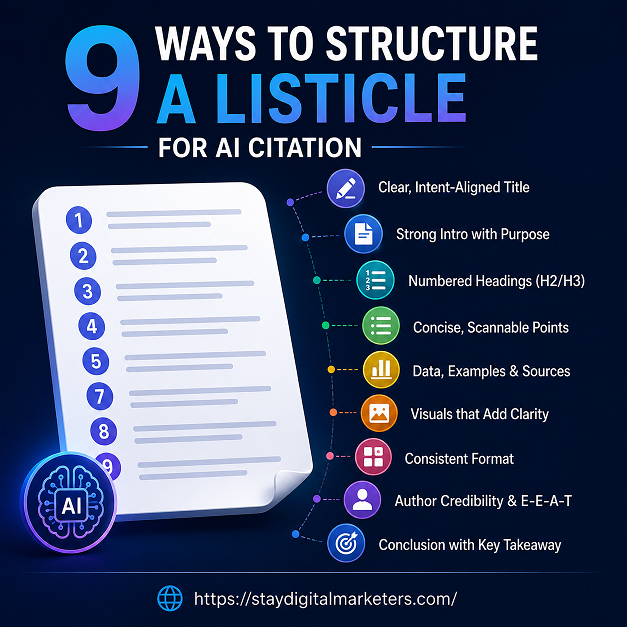
Structuring a listicle for AI citation means shaping the page, its headings, ranking format, entry length, and visual elements, so ChatGPT, Gemini, Perplexity, and other AI search tools can extract it cleanly and cite it as a source. This differs from writing a listicle for human readers alone: an AI model retrieves a page, segments it into claims, and reassembles those claims into an answer, so a page that segments cleanly gets reused more often than one that reads well but resists extraction. A listicle in this context is any ranked or grouped list, “9 Best Project Management Tools” or “7 Ways to Cut Onboarding Time,” built around comparison rather than a single narrative.
The short answer is that a citation-ready listicle ranks its items, uses one heading per entry, keeps entries at a moderate and consistent depth, and backs each claim with a visible source or credential, because those are the traits that show up most often in the listicles AI models already choose to cite.
Key Takeaways
Most guides on this topic offer structural advice, short paragraphs, clear headings, without tying any of it to what cited pages actually contain. Two 2026 citation studies fill that gap. Evertune’s review of the 25,000 most-cited URLs across six AI models found these pages typically ran 1,000 to 2,000 words, averaged 18 words per sentence, and used consistent H2 and H3 headings throughout, with word count varying sharply by platform, Copilot’s cited pages averaged 964 words, Gemini’s averaged 1,977. Separately, rocketblue’s analysis of 1.2 million citations across eight LLMs found that 95.13 percent of cited content contains images, 90.62 percent uses bullet points or lists, 74.76 percent shows author credentials, and 57.78 percent counts as fresh content.
Neither study is a style guide. Both are descriptions of what already gets cited, which makes them a more reliable structural target than generic formatting advice. The nine tactics below are built directly from these two datasets rather than from convention.
Ranked formats such as “Top 5 CRM Tools” made up 71 to 86 percent of listicle citations depending on the model, while unranked lists such as “7 Ways to Save on Groceries” trailed as a distant second, per Evertune’s 2026 analysis. A ranking gives the model a resolved comparison to extract rather than a set of equal options it would have to weigh itself. Even a lightweight ranking, ordered by price, by ease of use, by a single named metric, outperforms a flat, unordered list.
Cited pages across Evertune’s six-model dataset averaged 1,000 to 2,000 words, but the platform spread is wide: Copilot’s cited pages ran about 964 words, Gemini’s about 1,977. A listicle built for broad AI visibility should sit in the middle of that range, roughly 1,200 to 1,600 words, rather than optimizing for one platform’s extreme.
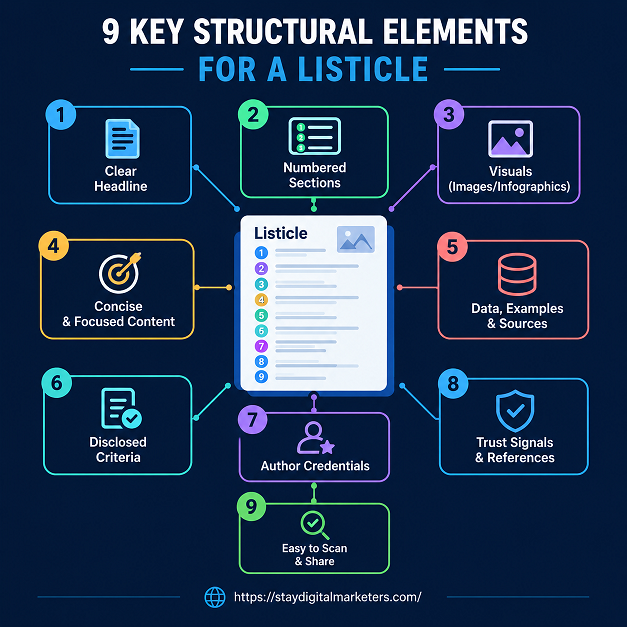
Consistent heading hierarchy showed up throughout the pages Evertune reviewed, with each entry carrying its own heading rather than being grouped under a shared one. A numbered H2 per entry gives the model a clean boundary between claims, so “3. Asana” and “4. Monday.com” are unambiguously separate units rather than two sentences buried in one paragraph.
Heavily cited pages averaged 18 words per sentence, notably tighter than typical long-form blog prose. A short sentence is easier for a model to lift as a standalone claim, while a 35-word sentence packed with two ideas forces the model to either truncate awkwardly or skip the sentence entirely.
Images appeared in 95.13 percent of the content LLMs cited across rocketblue’s review of more than a million citations, making visual elements close to universal rather than optional polish. A product screenshot, a simple comparison graphic, or even an annotated chart gives each entry a second, non-text signal of completeness.
Bullet points or lists appeared in 90.62 percent of cited content. Applying that inside each entry, not just as the overall listicle format, means breaking a feature set or a pros-and-cons summary into a short bulleted block rather than a single dense sentence. That second layer of structure gives the model an additional, smaller unit to extract if the full paragraph is too long to lift cleanly.
Author credentials appeared in 74.76 percent of cited content, and disclosed criteria carries a separate practical benefit: Google has confirmed it targets listicles that rank a publisher’s own product first without stated criteria, and a Federal Trade Commission rule separately restricts businesses from presenting pages they control as independent reviews of their own category. A visible byline and a stated ranking method address both the citation signal and the compliance risk at once.
rocketblue’s analysis found 71.08 percent of cited content sits at moderate depth, with only 4.28 percent classified as truly in-depth and 5.29 percent as surface-level. In practice, that means each entry needs enough detail to explain what it is, who it suits, and one limitation, roughly 80 to 150 words, without expanding into a full sub-article that belongs on its own page.
Fresh content appeared in 57.78 percent of cited pages in rocketblue’s dataset. A visible “updated” date and a refresh cycle of every two to six months keeps a listicle inside the window AI models treat as current, since a stale, undated roundup is easy for a model to deprioritize in favor of a newer competing page covering the same category.
Reviewing listicle rebuilds across a range of client pages shows a consistent pattern: pages restructured around these nine traits, rather than simply rewritten for tone, tend to hold their citation position through algorithm and model updates far better than pages that were only refreshed for wording.
The nine tactics above map onto a fixed page order worth using as a build template for any new listicle.
Length is the clearest divergence. Copilot’s cited pages average roughly 964 words, while Gemini’s average roughly 1,977, nearly double. A listicle built only around Copilot’s shorter preference risks looking thin to Gemini, while one built for Gemini’s length risks running long for Copilot. Splitting the difference, and keeping every entry self-contained enough to be read in isolation, gives a single page a reasonable shot across both ends of that range.
The most damaging mistake is otherwise-solid structure paired with self-ranking: a publisher’s own product placed first with no disclosed criteria. Google has said publicly it targets this pattern, and it can undercut every other structural improvement on the page, since a model or a regulator treats the ranking itself as unreliable regardless of how well the rest of the page is formatted.
| Structure Element | Target | Source |
| Ranking format | Ranked entries, not just grouped | Evertune, 2026 (71-86% of cited listicles) |
| Total length | 1,000-2,000 words, platform-dependent | Evertune, 2026 |
| Heading structure | Numbered H2 per entry, consistent H2/H3 use | Evertune, 2026 |
| Sentence length | About 18 words per sentence on average | Evertune, 2026 |
| Visual elements | Image or graphic in nearly every entry | rocketblue, 2026 (95.13% of cited content) |
| Internal structure | Bullets or numbered sub-points inside entries | rocketblue, 2026 (90.62% of cited content) |
| Trust signals | Visible author credentials, disclosed criteria | rocketblue, 2026 (74.76% of cited content) |
| Entry depth | Moderate depth, not shallow or exhaustive | rocketblue, 2026 (71.08% of cited content) |
| Freshness | Visible update date, refreshed on a fixed cycle | rocketblue, 2026 (57.78% of cited content) |
Most heavily cited listicles run 1,000 to 2,000 words, though this varies by platform. Copilot tends to cite shorter pages around 964 words, while Gemini favors longer pages around 1,977 words, according to Evertune’s 2026 review of 25,000 cited URLs across six AI models.
Yes. Heavily cited listicles use a numbered H2 for every entry rather than grouping items under a single heading. Consistent H2 and H3 structure throughout the page was a defining trait of the most-cited pages in Evertune’s six-model citation analysis.
Yes, by a wide margin. Ranked formats such as “Top 5 CRM Tools” made up 71 to 86 percent of listicle citations depending on the model, while unranked groupings such as “7 Ways to Save on Groceries” trailed as a distant second choice, per Evertune’s 2026 data.
The data suggests they matter. Images appear in 95.13 percent of content cited by LLMs across a review of more than a million citations by rocketblue, making visual elements close to universal among AI-cited pages rather than an optional extra.
Aim for moderate depth rather than a brief tagline or an exhaustive essay. rocketblue’s analysis found 71.08 percent of cited content sits at moderate depth, with only 4.28 percent classified as truly in-depth, suggesting a self-contained paragraph or two per entry performs best.
Fresh content appeared in 57.78 percent of pages LLMs choose to cite, per rocketblue’s 2026 analysis. A visible update date and a refresh cycle of every two to six months keeps a listicle inside the range AI models treat as current.
Structure determines whether a listicle can be cited at all, but citation frequency still leans on the domain’s broader authority and how widely its content earns mentions elsewhere. Stay Digital Marketers works with brands on that surrounding layer, including guest posting, digital PR and press release distribution, SaaS backlinks, niche edits, multilingual backlinks, Wikipedia page creation, and Google Knowledge Panel creation, alongside broader SEO services, so a correctly structured listicle sits on a domain with enough earned authority behind it to actually accumulate citations.

Filza Taj is an MPhil in Human Resources-turned SEO Specialist, Content Strategist, and Digital Marketing Consultant with over 5 years of experience helping businesses in 30+ countries grow online. As the Founder of Stay Digital Marketers (staydigitalmarketers.com), she delivers results-driven solutions in link building, guest posting, PR distribution, niche edits, multilingual backlinks, and content marketing. She publishes daily SEO insights and actionable strategies to help brands strengthen their online presence, attract the right audience, and convert clicks into loyal customers.
Filza@staydigitalmarketers.com
Stay Digital Marketers
Need SEO, Link Building or Digital Marketing Services?
Request a Free Audit →