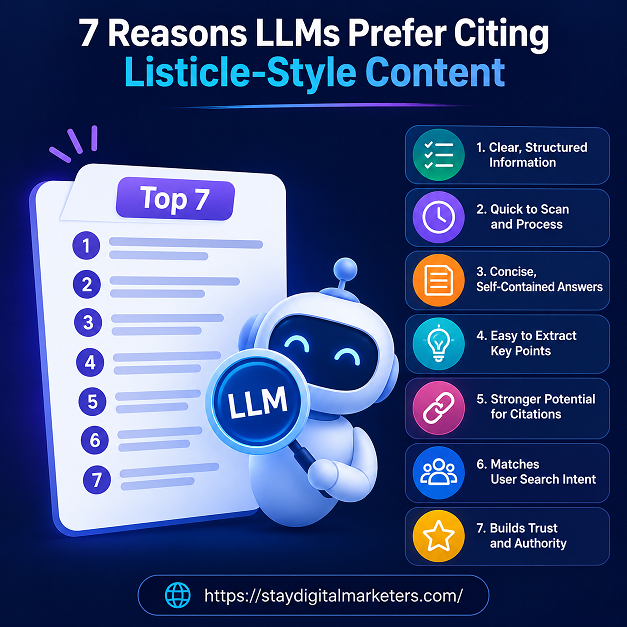

Ranking in LLMs through listicles means structuring content, typically a numbered “best X” or comparison roundup, so that ChatGPT, Perplexity, Google AI Mode, and other generative engines pull it into their answers and cite it as a source. Unlike traditional Google ranking, where a page competes for one of ten blue links, LLM citation is about being one of several sources an AI model quotes or references inside a single generated answer. A listicle in this context is any ranked or grouped list format built around comparison and recommendation rather than a single narrative, think “10 Best CRMs,” “7 Alternatives to X,” or “Top 5 Tools for Y.”
The short answer is that listicles rank in LLMs because their structure, numbered items, comparison framing, and clear criteria, matches how AI models extract and reassemble information into a synthesized answer, and because listicles are the format used most often for the commercial-comparison queries people type into AI chat.
Key Takeaways
The scale of the pattern is well documented. Listicles account for roughly 21.9 percent of citations across AI Mode, ChatGPT, and Perplexity combined, and “best X” listicles alone make up 43.8 percent of all ChatGPT-cited page types, more than any other single format, according to 2026 research from Position Digital covering tens of thousands of AI answers. The pattern is intent-driven rather than universal: separate research from Wix Studio’s AI Search Lab, covering 75,000 answers and roughly one million citations, found listicles win about 40.9 percent of citations for commercial-comparison queries specifically, while plain articles dominate informational queries at 45.5 percent.
That split matters for anyone deciding what to write next. A query like “what is generative engine optimization” pulls an explainer article into the answer. A query like “best link building agencies for SaaS” pulls a ranked list instead. Matching format to query intent, rather than defaulting to a listicle for everything, is what separates content that gets cited from a list that never makes it into an answer.
Every major roundup on this topic treats listicles as a straightforward win, and that framing is now incomplete. Seer Interactive tracked more than two million citations across a consistent prompt set from November 2025 through February 2026 and found ChatGPT listicle citations fell 30 percent between December 2025 and January 2026 alone. The drop was not evenly distributed. One tracked page, a “best remote desktop software” roundup from G2, lost 73 percent of its ChatGPT citations in a single month despite a documented methodology and established topical authority, with its estimated organic traffic falling 37 percent over the same period.
The listicles still growing in citations share specific traits: disclosed methodology, named sample sizes, and a transparent ranking process, rather than an unranked features dump. Separately, Google confirmed in April 2026 that it is actively targeting self-serving “best X” pages that rank the publisher’s own product first without disclosed criteria, and independent analysis by SEO researcher Lily Ray found sites running that pattern at scale lost 30 to 50 percent of organic visibility within weeks. The format itself is not fading. What is fading is the low-effort version of it, an unranked list with no stated criteria, in favor of listicles that read like independent research rather than marketing copy.
Reviewing listicle placements across a range of campaigns tends to surface the same pattern: pages that disclose a scoring method or comparison criteria upfront hold their citation position through algorithm shifts far more consistently than pages that simply rank items with no stated rationale. That consistency is usually the difference between a listicle that survives a citation audit and one that quietly disappears from AI answers.
Eight to twelve items works as a reliable default, since roughly ten is both the median and the length ChatGPT reaches for most consistently, according to AIVO Research’s 2026 citation study. Local and niche categories with fewer credible options can run shorter. Broad software categories can run longer, but padding a list past what the category genuinely supports invites the same scrutiny Google now applies to manipulative “top 50” pages with no real differentiation between entries.
Not on a listicle you control. AI models increasingly discount rankings where the publisher places itself first with no comparative criteria, and Google has said publicly it treats that pattern as a quality problem, not just an SEO one. The stronger position is earning a placement inside listicles that independent third parties maintain, since those read as genuine validation to both readers and AI models rather than self-promotion.
Less than it used to. Ahrefs’ 2026 analysis found 35 percent of listicles cited by AI models came from low-authority domains, meaning structural clarity, freshness, and a track record of being cited across multiple AI platforms carried more weight than backlink profile alone. A smaller site running a well-structured, frequently updated, transparently ranked list can out-cite a higher-authority domain running a stale one.
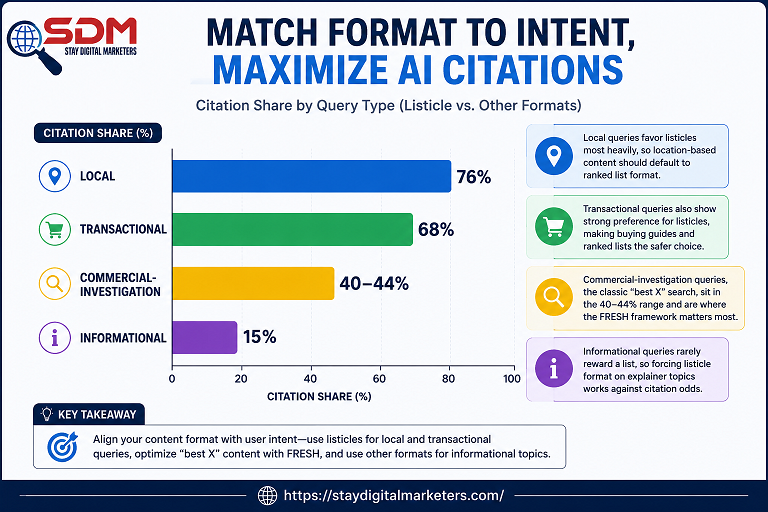
Intent decides the format, not writer preference. Listicle citations rise to roughly 71 percent for local queries and about 50 percent for transactional ones, then fall to around 13 percent for purely informational queries, where step-based how-to content and explainer articles take over instead, based on AIVO Research’s query-type breakdown. A query asking “how does structured data work” wants a how-to or explainer. A query asking “best structured data tools” wants a ranked list. Building both formats around the same core topic, rather than picking one, covers the full range of queries a reader might type.
| Query Type | Listicle Citation Share | Best Format |
| Local | About 71% | Ranked, location-specific comparison |
| Transactional | About 50% | Ranked buying guide with disclosed criteria |
| Commercial-investigation | About 41-44% | “Best X” comparison, current year in title |
| Informational | About 13% | Explainer article or how-to, not a list |
Five traits separate the listicles still gaining AI citations from the ones losing them. Grouped together, they spell out a checklist worth running before any listicle goes live: the FRESH framework.
Yes, but the low-effort version is losing ground. Listicles still account for roughly 22 to 44 percent of AI citations depending on query type, but ChatGPT listicle citations fell 30 percent in a single month in early 2026, with self-ranking, no-methodology pages losing the most ground.
Around ten items is the median length AI models pull from most often, with a typical range of three to fifty depending on category. Padding a list beyond what the category genuinely supports risks triggering Google’s crackdown on low-value ranking pages.
No. AI models and Google both discount self-ranking pages that place the publisher first without disclosed criteria. Listicles maintained by independent third parties, with transparent methodology, are the ones that hold their citation position and read as credible to both readers and AI systems.
Yes, in practice. About 92 percent of ChatGPT-cited listicles carry the current year in their title, and content updated within the last two months earns roughly 28 percent more citations than older, undated pages. Recency functions as a hard filter for AI citation eligibility.
Intent decides the format. Listicles dominate commercial and local queries, capturing up to 71 percent of citations for local searches, while how-to guides and explainer articles take over for purely informational queries, where listicle citation share drops to around 13 percent.
Less than it does for classic Google rankings. Roughly 35 percent of listicles cited by AI models come from low-authority domains, since structural clarity, freshness, and a track record of cross-platform citation carry more weight than backlink volume alone in AI-driven source selection.
A citable listicle rarely works in isolation, since AI models weigh a page’s citation history, backlink profile, and mentions across the web alongside its structure and freshness. Stay Digital Marketers works with brands on that surrounding authority layer, including guest posting, digital PR and press release distribution, SaaS backlinks, niche edits, multilingual backlinks, Wikipedia page creation, and Google Knowledge Panel creation, alongside broader SEO services, so a well-built listicle has the off-page authority behind it to actually get cited rather than ignored.

Filza Taj is an MPhil in Human Resources-turned SEO Specialist, Content Strategist, and Digital Marketing Consultant with over 5 years of experience helping businesses in 30+ countries grow online. As the Founder of Stay Digital Marketers (staydigitalmarketers.com), she delivers results-driven solutions in link building, guest posting, PR distribution, niche edits, multilingual backlinks, and content marketing. She publishes daily SEO insights and actionable strategies to help brands strengthen their online presence, attract the right audience, and convert clicks into loyal customers.
Filza@staydigitalmarketers.com
Stay Digital Marketers
Need SEO, Link Building or Digital Marketing Services?
Request a Free Audit →