
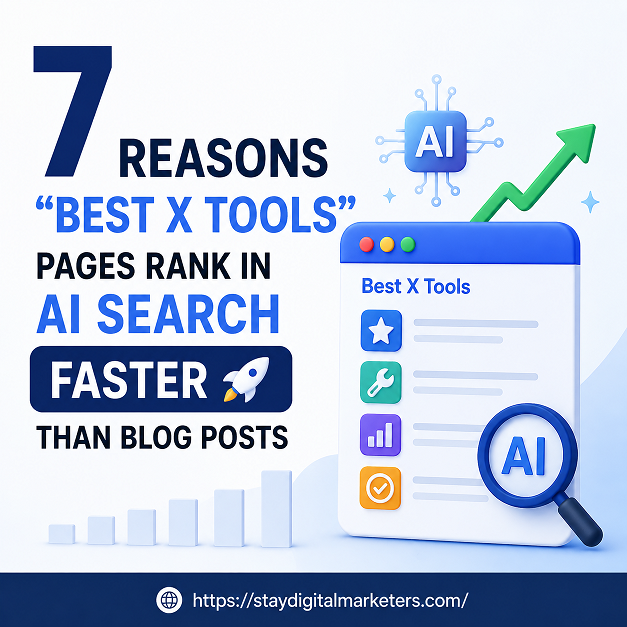
“Best X Tools” pages, ranked or comparison listicles built around a product or service category, tend to reach AI citation eligibility faster than single-topic blog posts because of structural and intent-matching advantages, not because AI models apply a different crawl schedule to list-formatted content. The format converges with something AI search already processes efficiently: pre-resolved comparisons that satisfy multiple related queries from one page, rather than a single answer built for one narrow question. Google AI Overviews, ChatGPT, Gemini, and Perplexity all pull citations through retrieval-augmented generation, retrieving a set of candidate pages, then extracting and reassembling facts into an answer, and a listicle’s structure lines up with that extraction process more directly than most blog narratives do.
The short answer is that a “best X” page can satisfy the commercial-comparison intent behind dozens of related searches with a single publish, while a blog post typically answers one question, which means the listicle reaches broad AI citation coverage with far less additional content investment.
Key Takeaways
No AI platform publishes a fixed timeline for how quickly new content becomes citation-eligible. Current 2026 GEO guidance on ranking in ChatGPT states plainly that discovery, crawling, indexing, retrieval relevance, and answer variability all affect timing, with no set number of weeks to point to. A claim of an exact day count for getting cited is not something the available research supports.
What the data does support is a different kind of speed: how much AI-citable query coverage a single published page can reach without additional content investment. This is the angle every existing guide on this topic skips. Speed, in practice, is less about how fast a crawler visits a URL and more about how many distinct AI-retrievable queries that one URL can plausibly satisfy the moment it goes live.
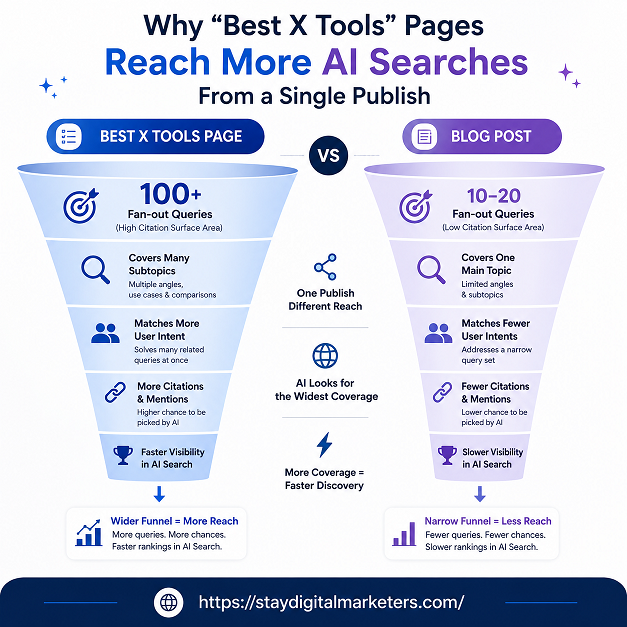
Call this a page’s citation surface area, the number of distinct query variations a page can plausibly get cited for without being rewritten or expanded. A ranked listicle covering eight tools across several use cases typically carries a citation surface area in the double digits: the exact target query, several “for beginners” or “for enterprise” variants, pricing questions, and alternative questions, since a fan-out retrieval system can extract different entries from the same page to answer each one. A single-topic blog post explaining one concept usually has a citation surface area closer to one to three related phrasings of the same question. A larger surface area means more chances to get pulled into a citation set from day one, which is the practical version of “ranking faster.”
A well-built “best X” page tends to satisfy “best X for beginners,” “best X under $50,” and “best X 2026” simultaneously, because each entry and each comparison angle inside the page maps to a different fan-out query. A blog post explaining one concept in depth typically maps to one query and its close paraphrases. The listicle does not need new pages published to expand its citation reach; the blog post usually does.
“Best X” pages made up 43.8 percent of all ChatGPT-cited page types in a 2026 analysis of tens of thousands of AI answers from Position Digital, more than any other single content format. A new listicle enters a format the retrieval system already leans on heavily, while a new blog post competes inside a format that individually earns a smaller share of citations, even though blog-style content collectively makes up a large share of the web.
A ranked listicle hands the model a finished judgment, item one is the top pick, item two is the runner-up, with the reasoning already stated next to each entry. A blog post’s conclusion is often built up gradually across several paragraphs, which means the model has to read further and synthesize more before it can safely extract a citable claim. Less interpretation required generally means faster, more confident extraction.
Analysis of 1.4 million ChatGPT prompts found 88.46 percent of citations traced back to the general search index, the same ranking system that has always rewarded pages matching commercial and comparison search intent. A “best X” page is built around exactly that intent by design. A blog post answering an informational question is optimizing for a different, often lower-citation-share, intent category from the outset.
Ranked and comparison content is more likely to earn featured snippets, comparison-style SERP features, and People Also Ask inclusion than narrative blog prose, and those classic search signals feed directly into what AI systems retrieve. A listicle picks up a second retrieval pathway into AI answers through these SERP features that a typical blog post structure does not generate as often.
Updating a “best X” page for a new year usually means swapping the title’s year, adjusting a few rankings, and updating a couple of entries, a light edit that resets the page’s freshness signal across the whole piece. A blog post’s central argument ages as a single unit; refreshing it convincingly after a year usually means a fuller rewrite rather than a quick edit. Cheaper refresh cycles mean listicles can maintain citation eligibility with less ongoing editorial cost.
Because a single listicle already covers a comparison category from multiple angles, each additional fan-out query an AI Overview system pulls from related searches has a reasonable chance of retrieving the same page again. A blog post’s citation reach stays roughly flat unless new, separate content gets published to cover each additional angle. Over time, the listicle’s citation count compounds off a single publish; the blog post’s citation count grows mainly through the publication of more posts.
Reviewing AI citation performance across a range of client comparison pages tends to show the same early pattern: a newly published ranked listicle typically starts picking up scattered citations across several related queries within its first few tracked weeks, while a single-topic blog post published in the same period usually shows citation activity concentrated on just the one query it was built to answer.
No verified study measures listicle-versus-blog-post citation speed in days or weeks, and any number claiming otherwise should be treated skeptically. What the underlying data supports is a structural, not chronological, speed advantage: a listicle’s citation surface area is larger from the moment it publishes, its format already carries a higher baseline citation share, and its comparison structure needs less interpretive work before a model can extract it. Whether that translates into citations appearing in three days or three weeks depends on crawl frequency, domain authority, and platform-specific retrieval behavior that no current public study isolates cleanly.
| Factor | Listicle | Blog Post |
| Citation surface area | Typically double digits (multiple fan-out queries) | Typically 1-3 related phrasings |
| Baseline citation share | 43.8% of ChatGPT-cited page types | Lower per-page share despite broad web presence |
| Extraction effort for AI | Low, comparison already resolved | Higher, claim often buried in narrative |
| Freshness refresh cost | Light edit: swap year, update entries | Often needs a fuller rewrite |
| SERP feature triggers | Comparison boxes, PAA, snippets | Fewer structural triggers |
They tend to reach broader AI citation coverage faster, though no platform publishes an exact timeline for either format. “Best X” pages made up 43.8 percent of ChatGPT-cited page types in a 2026 study, and a single listicle can satisfy many related fan-out queries at once, giving it a structural, not chronological, speed advantage.
There is no fixed timeline. Discovery, crawling, indexing, retrieval relevance, and answer variability all affect timing, according to 2026 GEO guidance. Monitoring a stable set of prompts over several weeks gives a more reliable read than expecting citation within a specific day count.
Citation surface area describes how many distinct AI-retrievable query variations a single page can plausibly satisfy without being rewritten or expanded. A ranked listicle covering several use cases typically has a larger citation surface area than a blog post built around one narrow question.
A ranked listicle presents its conclusion directly, item one is the top pick, with reasoning stated next to each entry, so a model can extract a citable claim with little interpretation. A blog post’s argument often builds gradually across paragraphs, requiring more synthesis before the same claim becomes extractable.
Yes. Swapping the title’s year and refreshing a handful of entries resets a listicle’s freshness signal across the whole page at low editorial cost. A blog post’s central argument ages as one unit and typically needs a fuller rewrite to feel current again.
Not exclusively. Blog posts still serve informational queries that listicles match poorly, and AI Overviews cites blog-style explainers for a meaningful share of purely informational queries. Pairing listicles for comparison-intent queries with blog posts for informational ones outperforms replacing one format with the other.
A listicle’s structural speed advantage compounds fastest on a domain that already has topical coverage and outside authority behind it, since AI systems weigh a page’s citation history and mentions elsewhere alongside its format. Stay Digital Marketers works with brands on that surrounding layer, including guest posting, digital PR and press release distribution, SaaS backlinks, niche edits, multilingual backlinks, Wikipedia page creation, and Google Knowledge Panel creation, alongside broader SEO services, so a newly published “best X” page launches from a domain built to convert its structural speed advantage into actual citations.

Filza Taj is an MPhil in Human Resources-turned SEO Specialist, Content Strategist, and Digital Marketing Consultant with over 5 years of experience helping businesses in 30+ countries grow online. As the Founder of Stay Digital Marketers (staydigitalmarketers.com), she delivers results-driven solutions in link building, guest posting, PR distribution, niche edits, multilingual backlinks, and content marketing. She publishes daily SEO insights and actionable strategies to help brands strengthen their online presence, attract the right audience, and convert clicks into loyal customers.
Filza@staydigitalmarketers.com
Stay Digital Marketers
Need SEO, Link Building or Digital Marketing Services?
Request a Free Audit →