
Link building statistics quantify how backlinks, hyperlinks from one website to another, influence search rankings, referral traffic, and increasingly, AI-generated answers. They come from a mix of large-scale backlink index analyses, which examine millions of live pages, and practitioner surveys, which capture what working SEO professionals actually budget for, require, and believe. Both types matter, since an index analysis shows what correlates with rankings while a survey shows what the industry is actually doing about it, and the gap between the two is often where the most useful insight sits.
The short answer is that link building remains one of the strongest levers in organic search, even as AI search reshapes how visibility gets measured. The eight statistics below cover backlink prevalence, ranking correlation, tactic effectiveness, quality thresholds, link decay, pricing, and the newer question of how backlinks relate to AI citation, giving a marketer the full picture rather than a single isolated number pulled out of context.
Key Takeaways
Most link building statistics roundups do exactly what the name suggests: they list numbers, source, figure, next figure, with little connective tissue between them. Separately, plenty of guides explain link building metrics, Domain Strength, anchor text ratios, link position, without citing the hard data that justifies any particular threshold. Neither type alone tells a marketer what to actually do with a given statistic once they have read it.
None of the top-ranking pages on this topic connect the two. A statistic like the industry’s typical minimum Domain Rating threshold is more useful paired with the pricing data that shows what that threshold actually costs, and a link decay statistic is more useful paired with a monitoring cadence. The eight statistics below are annotated with exactly that: what each number implies for a real budgeting or vetting decision, not just the figure itself.
The flip side of that figure, 96.55 percent of all web pages, have zero external backlinks, according to 2026 backlink index analysis covering millions of crawled pages. This baseline matters because it reframes link building as a genuine competitive edge rather than a routine checkbox: the overwhelming majority of published content never earns a single link, making any earned backlink a meaningful signal by comparison.
This correlation shows up consistently across multiple 2026 backlink studies analyzing top-ranking pages. It does not prove backlinks alone cause the top position, but it confirms link volume remains one of the more reliable patterns distinguishing the very top result from everything immediately below it.
Digital PR ranks first in every major 2026 link building survey, though the exact margin varies: one survey of 500 SEO professionals found 34 percent rate it the top-performing tactic against 18 percent for guest posting, while a separate industry report puts the gap at 48.6 percent versus 16 percent. Both surveys agree on the ranking order even though they disagree on the exact spread, which is the detail worth citing rather than picking whichever number sounds more dramatic.
Reporter Outreach’s 2026 survey of 500 SEO professionals found 91 percent apply a minimum Domain Rating threshold before accepting a placement, and 52 percent require DR 50 or higher specifically. Only 9 percent set no minimum at all, which makes a DR floor closer to an industry norm than an optional best practice at this point.
Links get lost to site redesigns, content removal, broken redirects, and domain changes at a rate high enough that monitoring, not just building, has become its own discipline within link building. Reviewing backlink profiles across a range of client accounts shows this pattern consistently: campaigns that skip ongoing link monitoring tend to quietly lose a meaningful share of their earned links within a year, without anyone noticing until a rankings dip prompts an audit.
Reporter Outreach’s 2026 survey found a wide gap between belief and action: three-quarters of respondents think backlinks affect how often a brand appears in AI search results, yet fewer than one in five have actually adjusted their link building process in response. That gap is a genuine opportunity for marketers willing to move before the rest of the industry catches up.
Editorial.Link’s 2026 survey of link buyers puts the typical acceptable price for a single high-quality placement at $508.95, a useful budgeting anchor for marketers building a link building line item from scratch. The figure shifts with niche competitiveness and referring domain authority, but it offers a concrete starting point rather than a vague per-project estimate.
Ahrefs’ analysis of 75,000 brands found branded web mentions correlated with AI Overview visibility at roughly 0.664, compared to just 0.218 for backlinks. This does not make backlinks irrelevant, since they still drive classic organic rankings, but it signals that a link building strategy focused purely on the link itself, with no attention to the surrounding brand mention, is missing half of what current AI visibility data actually rewards.
| Statistic | Source | What It Implies |
| 96.55% of web pages have zero external backlinks | Industry backlink index analysis, 2026 | Most content never earns a single link, making link building a genuine differentiator |
| Position 1 has 3.8x more backlinks than positions 2-10 | Multiple 2026 backlink studies | Link volume still correlates strongly with top rankings |
| 91% of SEOs set a minimum DR before placing links | Reporter Outreach, 500 SEOs surveyed | A DR floor is now standard practice, not an optional filter |
| Two-thirds of links decay over time | Link monitoring industry data, 2026 | A backlink profile needs monitoring, not just building |
| 74% believe backlinks affect AI visibility, 19% have acted | Reporter Outreach, 500 SEOs surveyed | A wide, exploitable gap between belief and execution |
| Average acceptable price for one high-quality link: $508.95 | Editorial.Link 2026 Survey | A concrete budget benchmark for per-link spend |
Three of the statistics below combine into a fast, repeatable filter worth applying before accepting or paying for any backlink.
A link passing all three is a reasonably safe addition to a backlink profile. A link failing two or more is worth a second look before any budget gets committed.
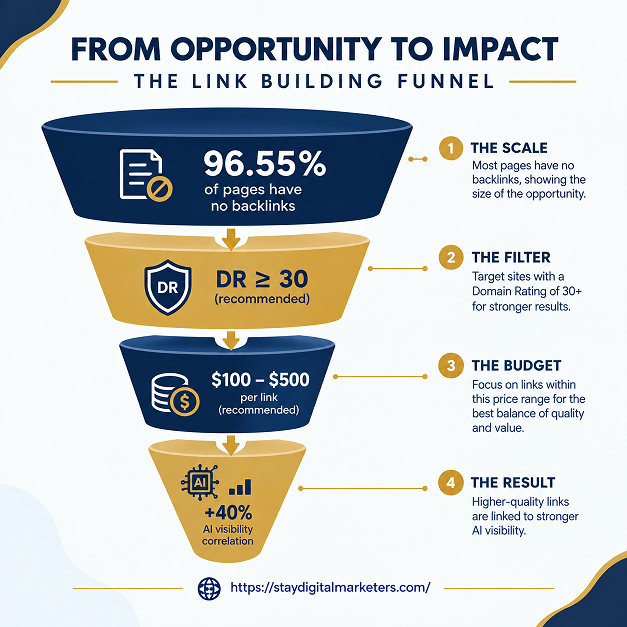
Only about 3.45 percent of web pages have any external backlinks at all, meaning 96.55 percent have none, according to 2026 backlink index analysis. That gap is precisely what makes a genuine link building‘ effort such a meaningful competitive advantage rather than a routine SEO task.
Yes. Multiple 2026 studies confirm the page ranking first for a given query carries roughly 3.8 times more backlinks than pages ranked two through ten for that same query, making backlink volume one of the more consistent correlations in organic search.
Digital PR consistently ranks first across multiple 2026 surveys, cited as the top-performing tactic by 34 to 48.6 percent of SEO professionals depending on the survey, ahead of guest posting, which trails at 16 to 18 percent in the same studies.
Most professionals set a floor. Reporter Outreach’s 2026 survey of 500 SEO professionals found 91 percent set a minimum Domain Rating before placing a link, and 52 percent require DR 50 or higher, making that threshold close to an industry norm.
Yes. Roughly two-thirds of links decay over time, lost to site redesigns, content removal, or domain changes, according to 2026 link monitoring data. A backlink profile needs ongoing monitoring to catch and reclaim these losses, not a one-time build-and-forget campaign.
Editorial.Link’s 2026 survey found the average acceptable price for a single high-quality backlink is $508.95, though the figure varies by niche competitiveness, referring domain authority, and whether the placement includes content creation.
Statistics like these are useful for building an internal budget case, but converting them into an actual backlink profile still requires outreach, vetting, and placement work. Stay Digital Marketers handles that execution layer directly, including guest posting, digital PR and press release distribution, SaaS backlinks, niche edits, multilingual backlinks, Wikipedia page creation, and Google Knowledge Panel creation, alongside complete SEO services, turning the thresholds in this article into placements that actually clear them.

Filza Taj is an MPhil in Human Resources-turned SEO Specialist, Content Strategist, and Digital Marketing Consultant with over 5 years of experience helping businesses in 30+ countries grow online. As the Founder of Stay Digital Marketers (staydigitalmarketers.com), she delivers results-driven solutions in link building, guest posting, PR distribution, niche edits, multilingual backlinks, and content marketing. She publishes daily SEO insights and actionable strategies to help brands strengthen their online presence, attract the right audience, and convert clicks into loyal customers.
Filza@staydigitalmarketers.com
Stay Digital Marketers
Need SEO, Link Building or Digital Marketing Services?
Request a Free Audit →