

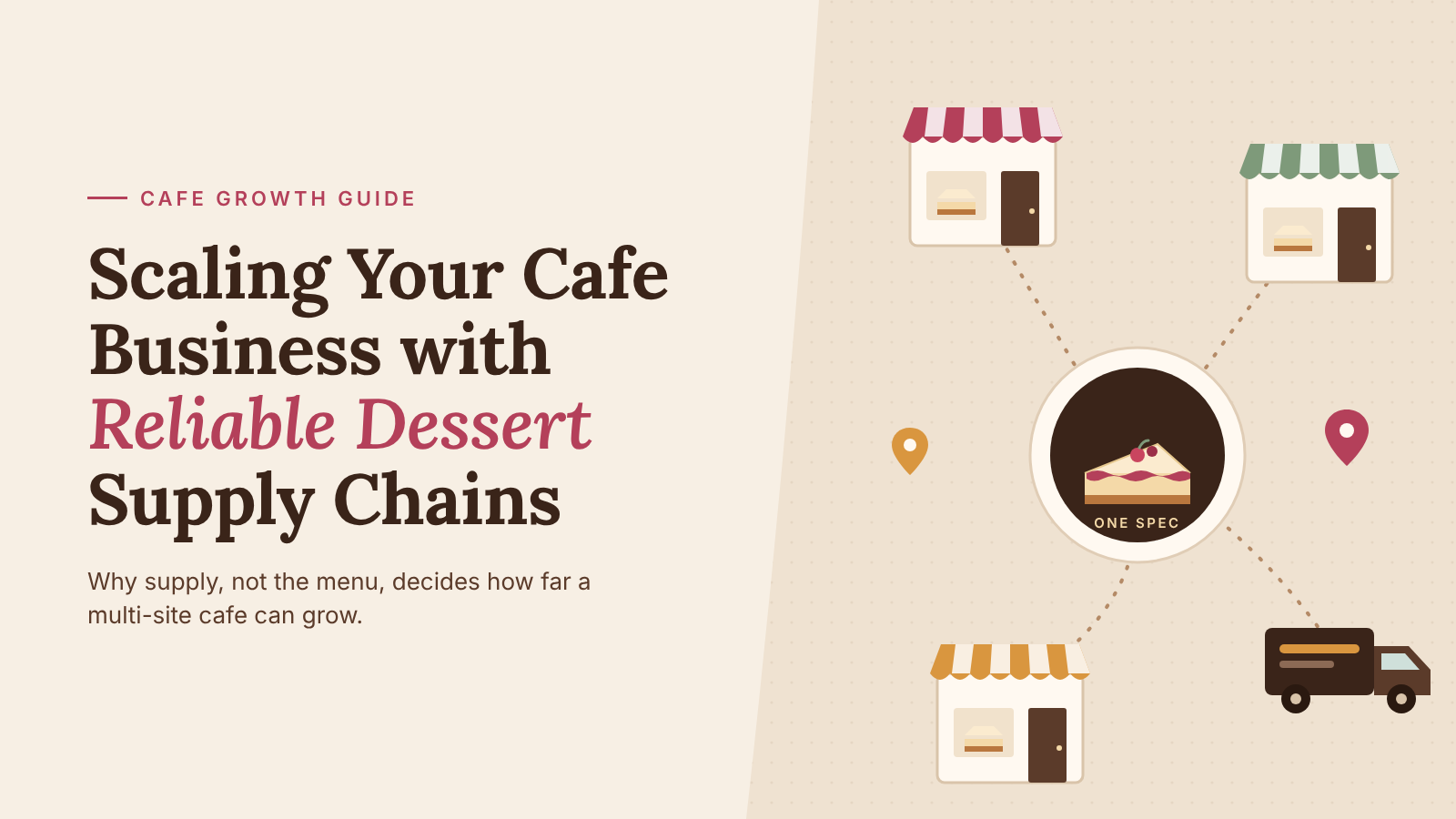
Most cafe owners imagine that growing from one venue to several is a question of concept. Find the formula that works, the thinking goes, then repeat it. In practice, the concept is rarely what breaks. What breaks is supply. The menu that ran beautifully across one kitchen starts to wobble the moment it depends on two, then three, then a distribution network holding it all together.
Dessert is often where this shows first. It is a category many venues still make or finish in-house, which is manageable at one site and quietly unmanageable across a group. As covers multiply, the informal arrangements that worked early on- a good local baker, a chef who knows the recipes, a delivery that usually turns up- become the exact points where a growing business loses consistency and time.
Understanding how a dessert supply chain behaves as you scale is one of the more useful things an operator can do before committing to the next site.
A single venue forgives a lot. The owner is usually on the floor, problems get solved in person, and a supply hiccup is absorbed by people who care about the outcome. That forgiveness does not travel.
At two or three sites, the owner cannot be everywhere, and the systems that were held together by attention start to show gaps. A dessert supply chain that depended on one person’s knowledge or one supplier’s goodwill becomes a risk the moment that person is at another venue or that supplier has a bad week. Growth does not create these weaknesses. It simply removes the slack that was hiding them.
Customers expect the same product at every location that carries your name. Meeting that expectation is harder than it sounds, because consistency is not a single decision. It is a property of the whole chain from production to plate.
For dessert, consistency across sites usually means a partner producing to a fixed specification, delivering reliably to every location, and offering enough shelf life that individual venues are not each solving stock on their own. This is where a professional wholesale dessert supplier earns its place over ad hoc arrangements. A dependable supplier turns “the cheesecake is a bit different at the new site” from a recurring complaint into a non-issue, because every venue is receiving the same product made the same way.
The cost of a fragile dessert supply chain is rarely a single dramatic failure. It is friction, spread across every week.
It is the manager phoning three suppliers to cover a shortfall. It is the retraining every time a site changes how it makes a product. It is the waste when each venue guesses its own demand with no shared view of stock. It is the slow erosion of quality as busy locations cut corners nobody is there to catch. None of these appear as a line item, and together they can quietly consume the margin that expansion was supposed to create. Foodservice desserts built for reliable supply exist precisely to take this friction out of the system, and a capable wholesale dessert supplier removes most of it by design rather than by heroics.
Two features of a supply arrangement matter more than any other when you scale: how widely it can deliver, and how long the product lasts once it arrives.
National or wide-area distribution means a new site in a new city is not a new supply problem. The same foodservice desserts arrive on the same terms wherever you open. Long, dependable shelf life means individual venues can hold stock without holding risk, order to a schedule rather than to a daily scramble, and absorb the uneven demand that comes with new locations finding their feet. Together, wide distribution and dependable shelf life turn foodservice desserts from a constraint on where you can grow business into something close to neutral. The dessert section stops being a reason not to open in a particular place.
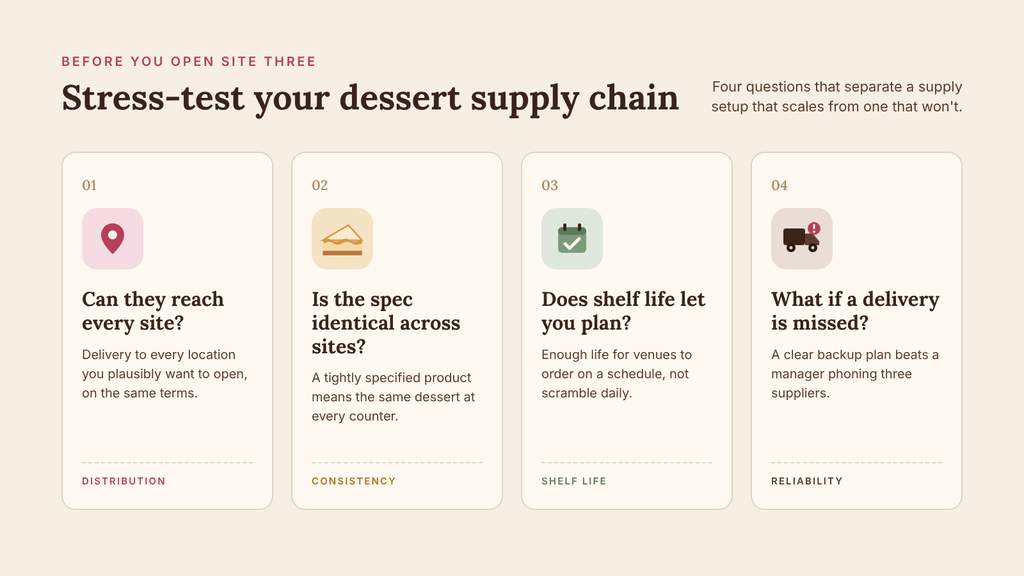
Before signing the next lease, it is worth stress-testing the chain behind your menu. A few questions separate a supply arrangement that will scale from one that will not.
Can this supplier deliver to every location I could plausibly open, on consistent terms? Is the product specified tightly enough that it is identical across sites? What is the shelf life, and does it give my venues room to plan rather than react? What happens when a delivery is missed? An established wholesale dessert supplier with national reach and a documented specification can answer all of these plainly. An informal arrangement usually cannot, and that gap is your answer. Priestley’s Gourmet Delights, which has supplied the Australian foodservice industry nationally since 1996, is one example of the kind of partner built for this, though the principle holds whoever you choose.
The operators who scale well tend to treat supply as part of the growth plan rather than something to sort out once the doors are open. They choose partners who can already reach where they intend to go, specify their products so consistency is built in, and design the dessert supply chain to carry more sites before they need it to.
Dessert is a small part of a cafe and an outsized source of this kind of friction. Getting the supply behind it right early, with a wholesale dessert supplier that can grow with you, is a quiet but real advantage when the pace of expansion picks up. Talk to a supplier who works at national scale about what your growth plan will actually ask of them.
A reliable supply chain keeps your dessert counter consistent, but customers still need to find each new location before they can enjoy it. As cafe groups expand into new suburbs, cities or even countries, online visibility becomes just as important as what arrives on the delivery truck. Partnering with a dependable agency like Stay Digital Marketers can help growing hospitality brands build that visibility through quality link building, local SEO and content that brings new customers through the door. For cafe brands reaching multilingual audiences or expanding internationally, multilingual link building helps each new market discover you as easily as your regulars already do. Just like your suppliers, the right SEO partner should be one you can count on as you grow.

Filza Taj is an MPhil in Human Resources-turned SEO Specialist, Content Strategist, and Digital Marketing Consultant with over 5 years of experience helping businesses in 30+ countries grow online. As the Founder of Stay Digital Marketers (staydigitalmarketers.com), she delivers results-driven solutions in link building, guest posting, PR distribution, niche edits, multilingual backlinks, and content marketing. She publishes daily SEO insights and actionable strategies to help brands strengthen their online presence, attract the right audience, and convert clicks into loyal customers.
Filza@staydigitalmarketers.com
Stay Digital Marketers
Need SEO, Link Building or Digital Marketing Services?
Request a Free Audit →