
Digital PR and journalist outreach platforms are tools that help you find reporters, pitch them, answer their source requests, and track the coverage you earn. They fall into four groups: journalist databases, outreach trackers, expert-matching services, and distribution or monitoring suites.
The goal is usually earned link velocity and brand mentions from news sites, which feed SEO and AI search visibility. Muck Rack, Cision, and Prowly sell databases. BuzzStream tracks outreach. Qwoted, Featured, Help a B2B Writer, and Source of Sources connect experts with reporters who are already looking for quotes.
Key Takeaways
Cision shut down Connectively, the rebranded HARO, on December 9, 2024. HARO changed hands several times before that, moving from its founder to Vocus and then to Cision. Its closure pushed practitioners toward smaller expert-matching services, most of which now offer a free tier.
The replacement market is fragmented. Source of Sources, created by HARO’s founder, sends queries by email. Help a B2B Writer lets sources pick topics and writers request quotes. Qwoted and Featured add profiles and matching. None of them work as a full replacement alone, which is why the framework below treats them as one job among four.
Three problems repeat across the pages that rank for this topic. First, many roundups come from vendors that sell one of the tools listed, so their own product tends to lead. Second, agency lists and tool lists are mixed together, which hides the fact that a database and a free query service solve different problems.
Third, they skip the biggest complaint practitioners have. In BuzzStream’s State of Digital PR 2026 survey of more than 150 professionals, 62.8% named outdated or incorrect journalist information as their top complaint about list-building tools. A roundup that ranks databases without addressing data accuracy misses the main buying risk. Pricing is the fourth weak spot: sources disagree widely, so this guide labels every figure as reported.
The Four-Job Platform Match assigns every tool to one of four jobs: find journalists, answer reporter requests, send and track pitches, and prove results. You buy for the job you need first, then add tools only when a gap appears.
Most small teams need one free Answer tool and one low-cost Send tool. Add a paid Find database only when manual list building starts costing more hours than the subscription.
Reviewing outreach campaigns across client work shows a repeated pattern: teams buy a large database first, then pitch a stale list. Answering live requests first builds coverage faster and costs less.
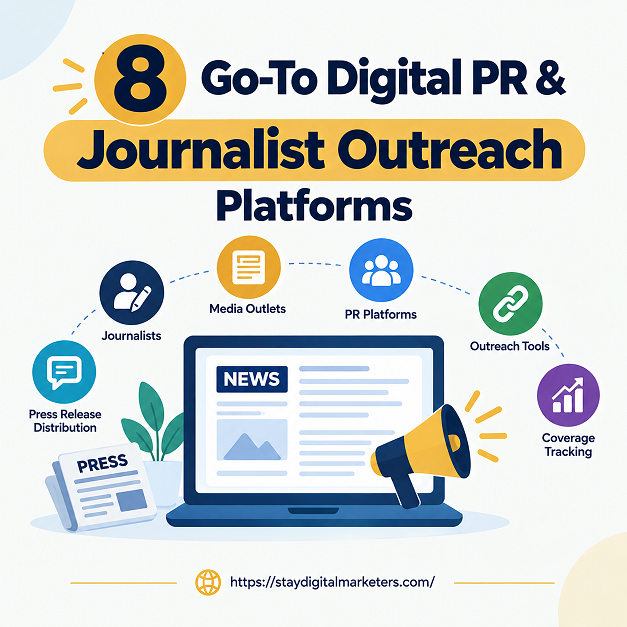
The eight platforms below cover all four jobs. Prices are reported figures, not quotes.
Muck Rack searches journalists by beat and includes contact details and a pitching tool. In BuzzStream’s 2026 survey, 46.6% of respondents named it for media list building, the top result. Reported pricing conflicts: Siege Media’s roundup cites about $5,000 per user yearly, while Prezly estimates about $10,000. Request a quote.
Cision is an enterprise PR suite with a media database reported at over 1.4 million contacts, plus PR Newswire distribution and analytics. Prezly estimates pricing starts around $7,200 per year. It suits large teams that want one vendor for finding, sending, and reporting.
Prowly pairs a database of over one million contacts with press release creation and a newsroom builder. Reported prices differ: $258 per month on annual billing in two roundups, and $369 per month in BuzzStream’s guide. Prezly also reports it is now the Semrush AI PR Toolkit, so check current packaging.
BuzzStream handles outreach emails, sequences, and contact tracking. Its ListIQ feature builds media lists from Google News. In its own survey, 52% of respondents named it the most-used outreach platform. BuzzStream also publishes that survey, so weigh the result accordingly. Its Starter plan is listed at $29 per month.
Qwoted connects PR professionals and experts with journalists seeking sources. Its Basic plan was reported as free with two pitches a month, and Pro at $99 per month. It works well when you have credentialed spokespeople ready to respond within hours.
Featured, formerly Terkel, connects publishers directly with experts. It is free for publishers. Expert plans were reported at a free Starter tier with three answers a month, then $39.80 and $79.20 monthly. Short, specific answers perform best on question-led requests.
Help a B2B Writer lets sources choose their areas of expertise, and writers then request quotes by topic. It is free. The trade-off is volume, since requests are narrower than on larger platforms.
Source of Sources, created by HARO’s founder Peter Shankman, sends media queries by email. It has no separate platform and is free. Scan each digest quickly and reply only where you have genuine expertise.
The table groups each tool by its main job and reported price. Figures are third-party reports and may have changed.
| Platform | Main job | Key detail | Reported price |
| Muck Rack | Find | Beat search, contacts, pitching | About $5,000 to $10,000 per year |
| Cision | Find and Prove | 1.4M+ contacts; PR Newswire | From about $7,200 per year (est.) |
| Prowly | Find and Send | 1M+ contacts; newsroom builder | $258 to $369 per month |
| BuzzStream | Send | Sequences and contact tracking | From $29 per month |
| Qwoted | Answer | Expert and journalist matching | Free Basic; Pro $99 per month |
| Featured | Answer | Formerly Terkel | Free Starter; $39.80 and up |
| Help a B2B Writer | Answer | Quotes requested by topic | Free |
| Source of Sources | Answer | Email query digest | Free |
Since 88% of journalists immediately discard pitches that miss their beat, according to Muck Rack’s State of Journalism 2026 report of 897 journalists, check three things before you press send:
Your pitch offers something concrete, such as original data, a named expert, or a ready image

A digital PR platform is software that helps you find journalists, send and track pitches, answer reporter requests, distribute news, or measure coverage. Most tools handle one or two of those jobs well, so teams usually combine a journalist database, an outreach tracker, and a free source-request service.
Cision shut down Connectively, the rebranded HARO, on December 9, 2024. Common replacements are Qwoted, Featured, Help a B2B Writer, and Source of Sources, which was created by HARO’s founder. Each connects experts with reporters, and all four offer a free option, though limits vary by plan.
Source of Sources and Help a B2B Writer are free. Qwoted and Featured also have free tiers: Qwoted’s Basic plan was reported at two pitches a month, and Featured’s expert Starter plan at three answers a month. Add BuzzStream’s reported $29 monthly Starter plan when you need to track outreach.
Costs range from free to five figures a year, and sources disagree. Muck Rack is reported between about $5,000 and $10,000 yearly, Cision from roughly $7,200, Prowly from $258 monthly, and Qwoted Pro at $99 monthly. Request a current quote before you budget, because these figures come from third-party roundups.
Relevance is the main reason. Muck Rack’s State of Journalism 2026 report, based on 897 journalists, found 88% immediately discard pitches that miss their beat. Journalists want pitches that fit their coverage, access to relevant sources, original data, and high-resolution images, so list accuracy matters more than volume.
Most teams see measurable results within six months. In BuzzStream’s State of Digital PR 2026 survey of more than 150 professionals, 85.2% said results arrive within six months and 51.4% said three to six months. About 81% reported securing first coverage within a week of pitching.
Platforms only deliver reporters and quotes. Earned links still depend on a story worth covering, sound targeting, and steady follow-through. Stay Digital Marketers assists brands with backlink-related services, including guest posting, press release distribution, SaaS backlinks, niche edits, multilingual backlinks, Wikipedia page creation, Google Knowledge Panel creation, and complete SEO services.
Pricing figures come from third-party roundups published between February 2025 and November 2025, so treat them as reported, not current. Confirm each price with the vendor before you buy.

Filza Taj is an MPhil in Human Resources-turned SEO Specialist, Content Strategist, and Digital Marketing Consultant with over 5 years of experience helping businesses in 30+ countries grow online. As the Founder of Stay Digital Marketers (staydigitalmarketers.com), she delivers results-driven solutions in link building, guest posting, PR distribution, niche edits, multilingual backlinks, and content marketing. She publishes daily SEO insights and actionable strategies to help brands strengthen their online presence, attract the right audience, and convert clicks into loyal customers.
Filza@staydigitalmarketers.com
Stay Digital Marketers
Need SEO, Link Building or Digital Marketing Services?
Request a Free Audit →