
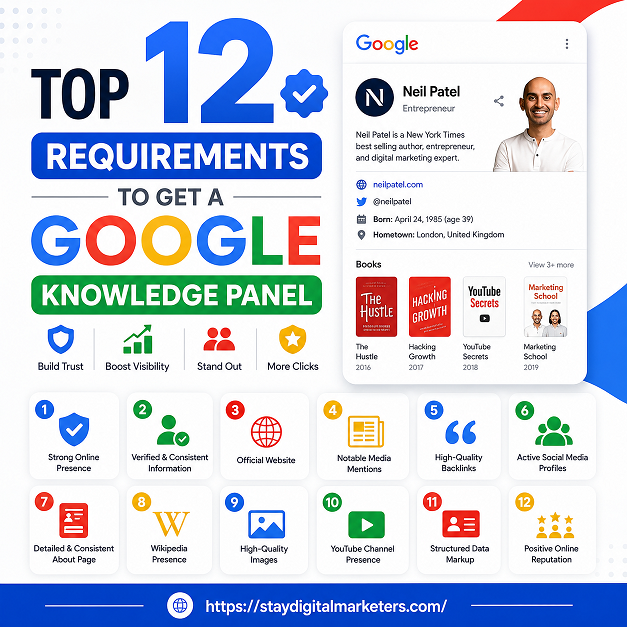
A Google Knowledge Panel is an information box that appears on the right side of Google’s search results when someone searches for a recognized entity. It displays key facts, images, social profiles, and a description pulled from Google’s Knowledge Graph. Getting one signals that Google considers your brand, person, or organization a verified, trustworthy entity worth surfacing prominently in search.
The challenge is that you cannot manually request a knowledge panel. Google generates them algorithmically based on how well it understands, confirms, and trusts your entity across multiple signals. The requirements listed here are the exact signals you need to strengthen.
A knowledge panel is generated when Google confidently identifies an entity in its Knowledge Graph, a massive database of real-world people, places, organizations, and things with verified attributes and relationships. Google pulls data from sources including Wikipedia, Wikidata, official websites, news publications, and social media profiles.
Having a knowledge panel delivers three measurable benefits. First, it claims significant SERP real estate without paid placement. Second, it boosts brand credibility because the panel functions as a third-party verification of your legitimacy. Third, it increases visibility in AI-driven search experiences. Since Google’s Gemini AI model, which powers AI Overviews and AI Mode, draws from the same Knowledge Graph, being a recognized entity improves the likelihood of being cited in AI-generated answers.
Google evaluates whether an entity exists clearly enough in the Knowledge Graph and whether surfacing a panel serves search intent. If the entity is ambiguous, poorly documented, or lacks corroboration across multiple authoritative sources, no panel appears. The process is ongoing. Panels can appear, update, or disappear as Google’s confidence in an entity changes.
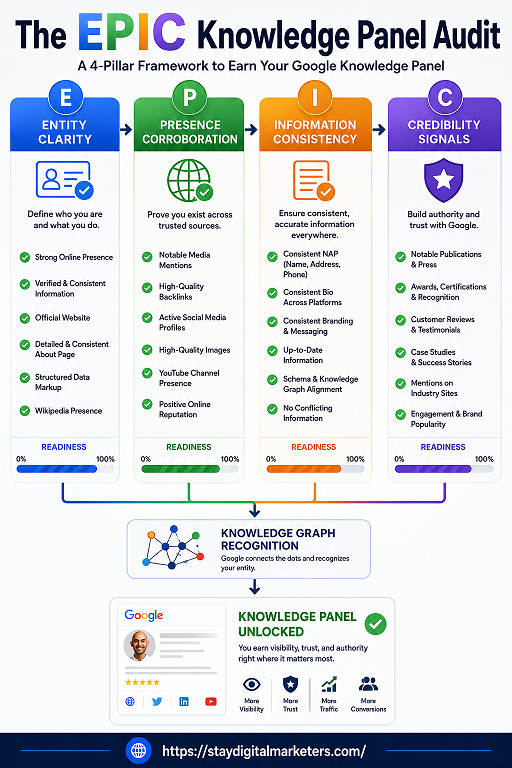
Before covering the twelve requirements individually, a useful diagnostic model is the EPIC Framework: Entity Clarity, Presence Corroboration, Information Consistency, and Credibility Signals. Every requirement below maps to one of these four pillars. Use this framework to audit where your gaps are before taking action.
| EPIC Pillar | What It Covers |
|---|---|
| Entity Clarity | How clearly Google can define and categorize your entity |
| Presence Corroboration | How many independent sources confirm your entity exists |
| Information Consistency | Whether your data matches across all platforms |
| Credibility Signals | How authoritative and trustworthy those sources are |
Your website’s About page is often Google’s first reference point for understanding who you are. It should unambiguously state the entity name, what it does, when it was founded, where it operates, and what makes it distinct. Use declarative statements such as “Company X is a B2B software provider founded in 2014” rather than vague marketing copy. Link to official social profiles from this page to help Google connect your entity across platforms.
Structured data in JSON-LD format is a direct signal to Google’s crawlers. For businesses, implement Organization schema on the homepage. For individuals, use Person schema. Both types should include the name, official URL, logo or image, description, founding date or birth date, social profile URLs, and Wikidata/Wikipedia links via the sameAs property. The sameAs field is particularly important because it explicitly tells Google that multiple URLs represent the same entity.
Validate the markup using Google’s Rich Results Test after implementation.
Wikidata is a publicly editable structured knowledge base that feeds directly into Google’s Knowledge Graph. Unlike Wikipedia, it has no strict notability requirements, making it accessible to most brands and public figures. Create an entry with complete property-value pairs: official website URL, founding date, industry, headquarters location, social profiles, and any awards or certifications. Add references (citations) to each statement using verifiable sources such as your official website or published press coverage. A well-maintained Wikidata entry is one of the most direct and actionable steps toward entity recognition.
Wikipedia is Google’s most trusted single source for entity data. A Wikipedia page dramatically increases the probability of receiving a knowledge panel. However, Wikipedia requires demonstrated notability through significant independent coverage in reliable secondary sources such as major news outlets, academic publications, or industry-recognized databases. Self-created pages or paid placement violates Wikipedia’s guidelines and will likely result in deletion. The realistic path is to earn media coverage first, then allow Wikipedia editors to create or approve a page organically.
NAP stands for Name, Address, and Phone Number. Broader entity consistency includes founding date, CEO name, product descriptions, and social handles. Discrepancies confuse Google’s entity resolution system. If your company is listed as “Company X Ltd.” on LinkedIn but “Co. X” on Crunchbase and “Company X” on your website, Google may treat these as separate entities or reduce confidence that any single record is authoritative. Audit every directory and platform listing and standardize the data precisely.
Google uses social media profiles to confirm an entity’s identity and extends knowledge panel data to include social links. Maintain active, complete profiles on platforms including LinkedIn, X (formerly Twitter), Facebook, Instagram, and YouTube where relevant. Use the exact same entity name and profile photo across all platforms. Verification badges on platforms add an additional layer of credibility. Google typically surfaces three to five social links in a knowledge panel when it detects clearly matching profiles.
Third-party directory listings serve as independent corroborating signals. For technology companies, this includes Crunchbase and G2. For public companies, Bloomberg and SEC filings. For agencies and service providers, platforms like Clutch or industry-specific association directories. The key is that these sources should be authoritative and independently maintained rather than general free-submission directories. Each listing that confirms the same entity with accurate details reinforces Google’s confidence.
Coverage in established news outlets and industry publications is one of the strongest credibility signals for the Knowledge Graph. A brand mentioned in TechCrunch, Forbes, Search Engine Journal, or regional newspapers of record is being confirmed by editorially independent sources. This type of coverage also increases the probability of Wikipedia notability. Aim for coverage that names the entity specifically, links to the official website, and discusses the entity substantively rather than in passing.
For businesses with a physical location, a fully completed and verified Google Business Profile provides structured, first-party entity data directly to Google. It confirms the business category, location, hours, and contact information. While a Google Business Profile alone will not generate a knowledge panel for a brand, it contributes to entity trust and can trigger knowledge panel-style displays for local entities. It also reduces NAP inconsistencies since Google’s own product holds the canonical data.
Publishing content that demonstrates expertise, discusses the entity’s activities, and earns links from other trusted sites builds what practitioners call “topical authority.” Blog posts, case studies, press releases, and thought leadership articles that reference the entity by name and are picked up or cited elsewhere reinforce the entity’s footprint. Internal content also helps because Google crawls it to extract attributes and statements about the entity during Knowledge Graph construction.
Backlinks to your domain from trusted, high-authority websites serve as votes of credibility that Google uses across both standard ranking and entity recognition. Links from media publications, government websites, educational institutions, and recognized industry bodies carry more signal weight than general web directories. The goal is not volume but relevance and authority. A single link from an industry-recognized publication carries more entity signal than fifty links from low-quality sites.
Once Google generates a knowledge panel for your entity, you can claim it through the “Claim this knowledge panel” option visible under the three-dot menu. The verification process requires confirming identity through official social accounts or corporate email. Verified representatives have their edit suggestions reviewed with higher priority, allowing them to correct inaccuracies and keep the panel data current. Claiming the panel does not give full editorial control but does give you a formal channel for feedback.
| Requirement | EPIC Pillar | Impact Level |
|---|---|---|
| Optimized About Page | Entity Clarity | High |
| Schema Markup (JSON-LD) | Entity Clarity | High |
| Wikidata Entry | Entity Clarity / Presence | Very High |
| Wikipedia Page | Credibility Signals | Very High |
| Consistent NAP Data | Information Consistency | High |
| Social Media Profiles | Presence Corroboration | Medium-High |
| Industry Directory Listings | Presence Corroboration | Medium |
| Press Coverage | Credibility Signals | Very High |
| Google Business Profile | Information Consistency | Medium |
| Entity-Rich Domain Content | Entity Clarity | Medium |
| Authoritative Backlinks | Credibility Signals | High |
| Panel Claim and Verification | Information Consistency | Medium |
There is no fixed timeline. Brands with strong Wikipedia pages, Wikidata entries, and press coverage can receive knowledge panels within weeks of completing entity optimization. Organizations starting from a weak baseline may wait six to twelve months or longer. The process is not linear because Google continuously updates its Knowledge Graph, meaning a panel can appear, vanish, or significantly change at any point. Regular monitoring of branded search queries is the most practical way to track progress.
Yes, but it is significantly harder. Wikipedia is Google’s primary reference for entity definitions and background, so the absence of a Wikipedia page means Google must build its understanding entirely from secondary sources. Brands that have achieved knowledge panels without Wikipedia typically have a very strong Wikidata presence, extensive press coverage, complete schema markup, and a dominant social media footprint. The combination of these signals can substitute for Wikipedia in some cases, but Wikipedia remains the single most impactful individual requirement.
What types of entities can get a Google Knowledge Panel? Google creates knowledge panels for people, organizations, places, products, creative works, and concepts that appear in the Knowledge Graph. Any entity that Google can clearly identify and verify is eligible, regardless of size.
Does having a knowledge panel improve Google rankings? Not directly. A knowledge panel reflects entity recognition rather than ranking authority. However, the same signals that produce a knowledge panel, including authoritative backlinks, press coverage, and structured data, also contribute to organic ranking performance.
Can a small business get a Google Knowledge Panel? Yes. Small and local businesses can receive knowledge panels, especially when they have a verified Google Business Profile, consistent NAP data, Wikidata entries, and a presence in local directories. The threshold for notability is lower for locally focused entities than for national brands.
How do you fix incorrect information in a knowledge panel? Claim the panel via the verification process, then use the “Suggest edits” function to flag inaccuracies. If incorrect data originates from a specific source such as Wikipedia or Wikidata, correcting it at the source often updates the panel faster than submitting feedback through Google directly.
Why did my Google Knowledge Panel disappear? Panels disappear when Google’s confidence in an entity drops below its threshold, often due to source changes, inconsistent data, or reduced search volume for the entity. Significant changes to a Wikipedia page, a Wikidata entry being flagged, or a website migration without proper redirects can all trigger removal.
Is there a manual submission process to request a knowledge panel? No. Google does not offer a direct application process for knowledge panels. The approach is entirely signal-based, requiring the optimization steps outlined in this article rather than a submission form.
What is the difference between a knowledge panel and a Google Business Profile? A Google Business Profile is a business owner-managed listing primarily for local search and Google Maps. A knowledge panel is algorithmically generated by Google’s Knowledge Graph and covers broader entities, including people, non-local organizations, and public figures. A business can have both simultaneously.
Brands working to build the entity signals needed for knowledge panel eligibility often benefit from coordinated digital PR and link-building support. Stay Digital Marketers works with businesses on exactly this type of foundational entity presence, including guest posting, press release distribution, SaaS backlinks, niche edits, Wikipedia page creation, and Google Knowledge Panel creation, giving brands a structured way to build the corroboration and credibility signals that Google’s Knowledge Graph responds to.

Filza Taj is an MPhil in Human Resources-turned SEO Specialist, Content Strategist, and Digital Marketing Consultant with over 5 years of experience helping businesses in 30+ countries grow online. As the Founder of Stay Digital Marketers (staydigitalmarketers.com), she delivers results-driven solutions in link building, guest posting, PR distribution, niche edits, multilingual backlinks, and content marketing. She publishes daily SEO insights and actionable strategies to help brands strengthen their online presence, attract the right audience, and convert clicks into loyal customers.
Filza@staydigitalmarketers.com
Stay Digital Marketers
Need SEO, Link Building or Digital Marketing Services?
Request a Free Audit →