
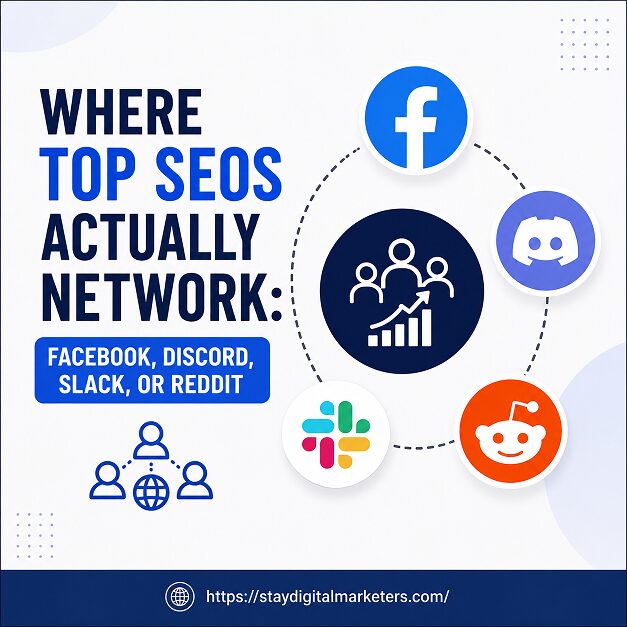
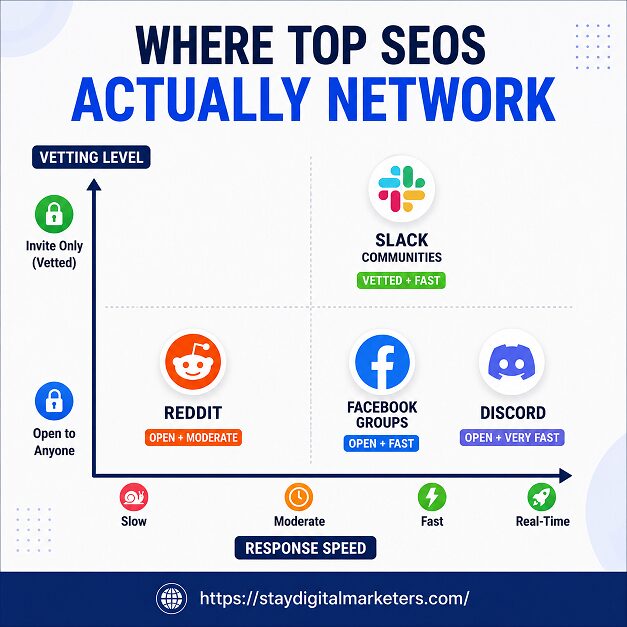
Top SEOs network across all four platforms, but they use them for different jobs. Facebook groups work best for fast, broad crowdsourcing. Slack communities are where vetted professionals build long-term relationships and trade real business opportunities. Discord serves niche, real-time technical discussion and voice-based problem solving. Reddit is the research and pattern-matching layer, useful for lurking and learning but weaker for direct relationship building.
Search engine optimization has always depended on relationships as much as rankings. Link building, guest posting, algorithm interpretation, and career growth all move faster inside a trusted network than they do through cold outreach or solo research. Four platforms currently host the bulk of that networking activity: Facebook groups, Slack communities, Discord servers, and Reddit. Each one has a different culture, a different vetting process, and a different pace, and understanding those differences is the real question behind “where do SEOs network,” not just which platform has the most members.
Key Takeaways
There is no single best platform. Slack communities such as Online Geniuses and Traffic Think Tank are generally considered the professional standard for building real business relationships, because members are vetted and conversations are threaded and searchable. Search engine optimization Facebook groups like SEO Signals Lab win on speed and volume for quick troubleshooting. Discord wins for live, informal, technical back-and-forth. Reddit wins for research, second opinions, and reading years of archived discussion without ever posting.
Experienced, working SEOs concentrate in a smaller number of vetted spaces rather than spreading across dozens of open groups. Application-gated Slack communities and a handful of long-running Facebook groups absorb most of that attention, because open communities with no screening tend to fill up with beginners asking the same questions and vendors pushing services.
That does not mean open communities are worthless. A large, unmoderated Facebook group is still useful for a quick gut check on a algorithm update or a fast poll of what other practitioners are seeing. It is just not where deeper professional relationships, referrals, and paid work tend to originate. Those form in smaller rooms where the same names show up week after week.
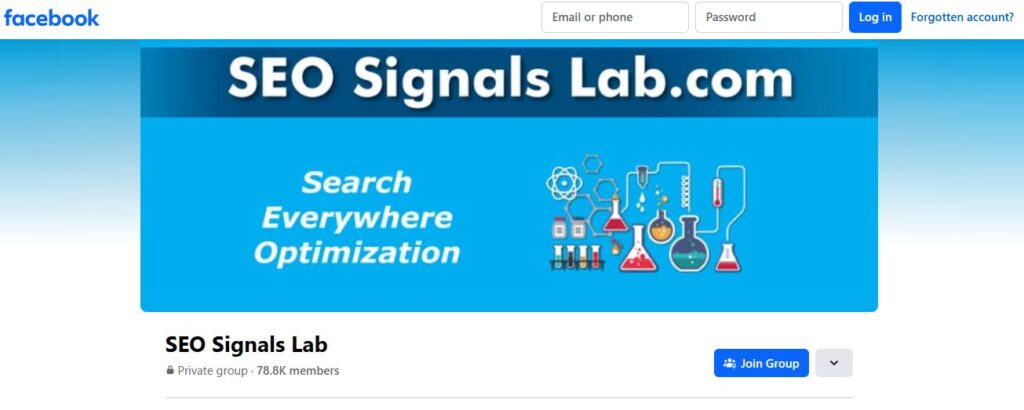
Yes, for speed and volume, but the value depends heavily on which group and how it is moderated. Facebook remains the largest pool of active SEO discussion by sheer headcount, and groups such as SEO Signals Lab, run by Steven Kang, have grown past 60,000 members with a reputation for getting a question answered within fifteen to twenty minutes. Ahrefs runs its own customer-only group, Ahrefs Insider, which stays smaller and more focused because membership is tied to actually using the product.
The biggest downside is signal-to-noise ratio. Large open groups attract link-exchange spam, service pitches, and repeat beginner questions, which pushes out substantive discussion. Group quality also depends entirely on how actively the admin moderates, since Facebook’s own algorithm does not surface the best answers the way a search engine does.
Beyond SEO Signals Lab and Ahrefs Insider, groups worth watching include niche-specific communities like Sisters in SEO, built for women and gender-diverse professionals in the industry, and product-specific groups tied to tools such as Surfer or Rank Math, where the vendor’s own team answers technical questions directly.
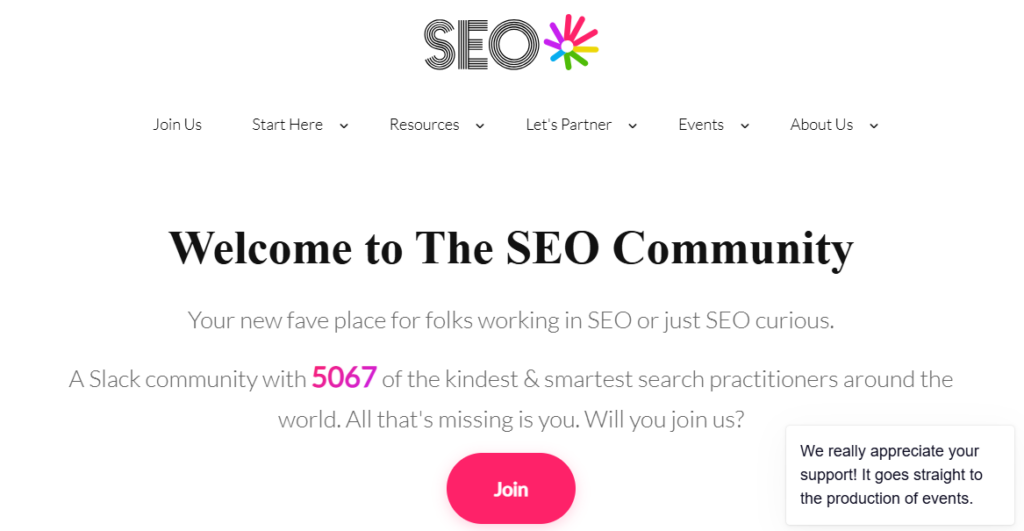
Slack communities are considered the professional standard because most of the serious ones require an application, which filters out low-effort members before they ever post. Threaded channels also make it easier to follow a specific conversation, such as link building or technical audits, without wading through unrelated chatter.
Online Geniuses is the largest example, a free, manually vetted community with more than 50,000 marketers across SEO, paid media, and analytics channels, plus a job board and regular expert Q&A sessions. Traffic Think Tank sits at the paid end of the spectrum, charging roughly $119 a month for a smaller, more filtered group built specifically for SEO practitioners rather than marketers generally. BigSEO began as a subreddit before migrating into a Slack workspace known for rejecting beginner questions in favor of advanced, practitioner-level discussion.
It depends on what is being purchased. A paid community is really purchasing filtration: fewer members, a stricter application process, and a culture where self-promotion is discouraged. For a freelancer or consultant trying to build referral relationships, that filtration often pays for itself through a single good introduction. For someone still learning fundamentals, a free community like Online Geniuses usually offers more than enough value without a subscription.
Most gated communities ask applicants to describe their current role, what they hope to get from the group, and sometimes a portfolio or site link. Reviews are manual, so approval can take anywhere from twenty-four hours to two weeks. Filling out the application with specific detail rather than generic phrasing meaningfully improves acceptance odds, since admins are screening for genuine practitioners over lead generators.
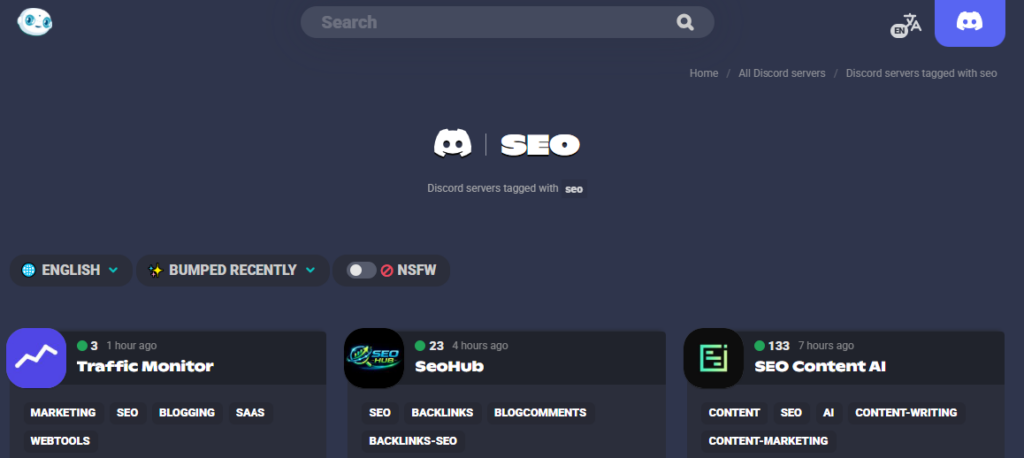
Discord is faster, more casual, and built around voice as much as text, which makes it better suited to live troubleshooting than long-form professional relationship building. Where a Slack thread might sit unanswered for a few hours, a Discord server with an active voice channel can produce a screen-share walkthrough of a Google Search Console issue in real time.
Server quality on Discord varies more widely than on Slack, since almost anyone can spin up a free server with a couple of channels and a vague description. The stronger SEO-focused servers, including communities built around AI search visibility and Generative Engine Optimization, tend to be smaller and newer than their Slack equivalents, reflecting the platform’s overall lag behind Slack for professional SEO networking.
Yes. Niche servers exist for ecommerce and Shopify SEO, for programmatic SEO builders, and increasingly for AI search optimization, where members trade tactics on structured data and entity clarity for getting cited inside AI Overviews and chatbot answers. These niche rooms tend to punch above their member count because the topic filter alone keeps out generalist chatter.
Discord’s culture skews younger and more gaming-adjacent by default, and many of its SEO-tagged servers double as storefronts for backlink or guest post sales rather than genuine discussion spaces. Working SEOs who want a professional tone and a searchable message history still lean toward Slack, reserving Discord for fast, informal help rather than career-level networking.
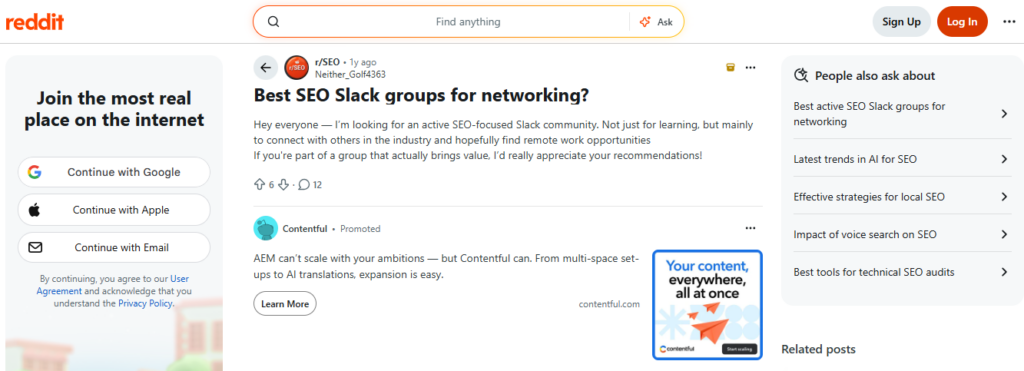
Reddit works best as a research and pattern-matching tool rather than a relationship-building platform. The r/SEO subreddit has grown past 330,000 members and functions as a searchable archive of case studies, algorithm-update reactions, and tool comparisons that anyone can read without an account or an application.
The anonymity that makes Reddit useful for candid opinions also limits its networking value. Usernames rarely map to real identities or LinkedIn profiles, so a helpful reply on Reddit is far less likely to turn into a client, a job lead, or a link exchange than the same reply posted in a Slack channel under a real name and profile photo.
Reddit is strongest for due diligence before joining a paid community, checking whether a tool or tactic actually works, and reading unfiltered opinions about vendors and services. Searching a subreddit for a specific tool name or technique often surfaces more candid feedback than a vendor’s own marketing pages ever will.
Choosing the right platform comes down to matching the room to the goal, not picking one platform and abandoning the rest. The MATCH framework below breaks that decision into five factors worth checking before joining any community.
M — Membership quality. Is the group vetted, or can anyone join with one click? Vetted rooms filter for practitioners; open rooms filter for volume.
A — Access model. Free, paid, or invite-only. Paid and invite-only communities trade cost or effort for a quieter, higher-signal room.
T — Tempo. Real-time platforms like Discord suit urgent technical questions. Threaded platforms like Slack suit deeper, ongoing discussion. Reddit suits async research with no expectation of a fast reply.
C — Culture. Some communities actively discourage self-promotion and service pitches. Others exist specifically for link exchanges and guest post swaps. Joining the wrong culture for the goal wastes both time and reputation.
H — History. Long-running communities such as Online Geniuses or the original BigSEO group have years of searchable archives and established norms. Newer servers, especially on Discord, are more of a gamble on quality and longevity.
Running a prospective community through these five checks before joining, rather than judging by member count alone, is the fastest way to avoid wasted time in a room that will not deliver on the reason for joining it.
The single highest-leverage habit across every platform is giving before asking. Members who answer questions, share results, and post genuine case studies get noticed and remembered far faster than members who only show up to ask for links or advice. Reading a community’s pinned rules and recent history before posting also avoids the two most common mistakes: repeating a question that was just answered, and pitching a service in a room that bans it.
Consistency matters more than volume. Checking in daily for ten minutes across one or two well-chosen communities outperforms joining a dozen groups and never engaging with any of them.
| Platform | Typical Cost | Vetting Level | Response Speed | Best Use Case |
| Facebook Groups | Free | Low to moderate | Fast (minutes to hours) | Quick troubleshooting, broad crowdsourcing |
| Slack Communities | Free to paid ($20 to $120+/month) | Moderate to high | Fast, threaded | Professional relationships, referrals, mentorship |
| Discord Servers | Mostly free | Low | Very fast, real-time | Live technical help, niche and AI search topics |
| Free | None (anonymous) | Moderate | Research, case studies, candid opinions |
Is Slack or Discord better for SEO networking? Slack is generally better for professional networking because of its vetting process and threaded, searchable channels. Discord is better for fast, informal, real-time technical help, especially around niche or emerging topics like AI search.
Are SEO Facebook groups still active in 2026? Yes. Groups like SEO Signals Lab and Ahrefs Insider remain highly active, with some receiving dozens of posts a day and typical response times under twenty minutes for straightforward questions.
How do I find good SEO communities to join? Start with well-known names such as Online Geniuses, Traffic Think Tank, and the r/SEO subreddit, then ask trusted colleagues which smaller or niche groups they actually use daily rather than just joined once.
Do I need to pay for a Slack community to see real value? No. Free communities like Online Geniuses offer substantial value, especially for people still building fundamentals. Paid communities mainly buy a smaller, more filtered room rather than fundamentally better information.
Is it worth joining multiple platforms for SEO networking? Yes, as long as each platform is used for what it does best. A common pattern is Reddit for research, a Facebook group for quick questions, and one vetted Slack community for deeper relationships, rather than trying to be active everywhere at once.
Can Discord replace Slack for professional SEO networking? Not yet for most practitioners. Discord’s SEO-focused servers tend to be newer, smaller, and more mixed in quality, with some functioning more as backlink marketplaces than discussion spaces. Slack still holds the larger share of long-running, professionally vetted communities.
What is the biggest mistake people make when joining SEO communities? Joining too many groups and engaging with none of them. A single well-chosen, actively used community delivers more networking value than a dozen groups sitting unread in a notifications tab.
Brands that want to strengthen their presence across these networking channels often work with specialized agencies to build the trust signals that make a profile worth linking to in the first place. Stay Digital Marketers is one such resource in this space, offering backlink-related services including guest posting, press release distribution, SaaS backlinks, niche edits, Wikipedia page creation, and Google Knowledge Panel creation, all of which support the kind of credibility that makes networking connections easier to convert into real opportunities.

Filza Taj is an MPhil in Human Resources-turned SEO Specialist, Content Strategist, and Digital Marketing Consultant with over 5 years of experience helping businesses in 30+ countries grow online. As the Founder of Stay Digital Marketers (staydigitalmarketers.com), she delivers results-driven solutions in link building, guest posting, PR distribution, niche edits, multilingual backlinks, and content marketing. She publishes daily SEO insights and actionable strategies to help brands strengthen their online presence, attract the right audience, and convert clicks into loyal customers.
Filza@staydigitalmarketers.com
Stay Digital Marketers
Need SEO, Link Building or Digital Marketing Services?
Request a Free Audit →