
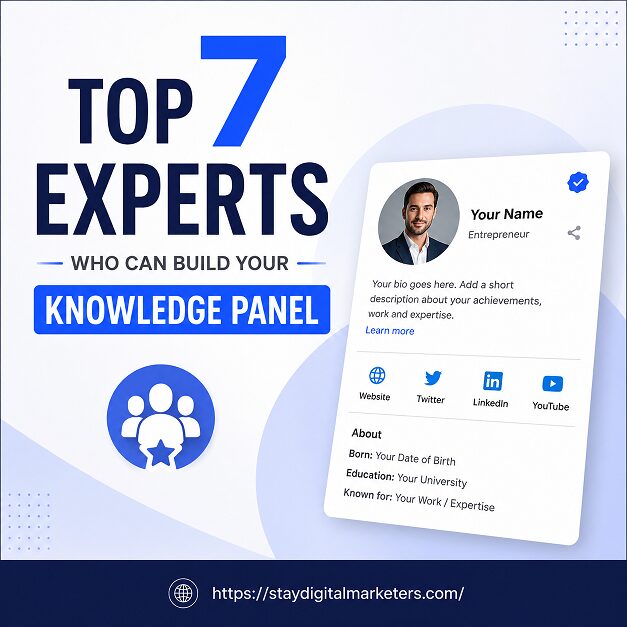
A Google Knowledge Panel is the information box that appears on the right side of search results when someone looks up a person, brand, or organization. It pulls together a photo, a short description, and key facts pulled from sources Google trusts, and it functions as a verified snapshot of an entity’s identity. For professionals, founders, and brands trying to build authority online, a Knowledge Panel has become one of the clearest signals that Google recognizes them as a real, established entity.
Getting one is not as simple as filling out a form. It requires structured data, consistent entity signals across the web, and enough corroboration for Google’s algorithms to connect the dots on their own. That is why a specific category of specialist has emerged around this exact problem. This guide breaks down the seven types of experts capable of building or improving a Knowledge Panel, how their methods differ, and how to choose the right one for your situation.
Key Takeaways
A Knowledge Panel is an algorithmically generated summary of an entity, built from data in the Knowledge Graph, Wikidata, Wikipedia, and other structured sources Google considers authoritative.
It matters because it functions as a trust signal rather than a paid placement. Nobody can buy a Knowledge Panel outright. Google generates one only when its systems find enough consistent, corroborated information about an entity across the web. In 2026, that same structured data increasingly feeds AI search tools and chat assistants, so a well-built panel now influences how a person or brand is described far beyond the traditional search results page.
The people and teams who work on Knowledge Panels generally fall into seven categories, each with a different specialty, price point, and approach. Some focus on the technical schema layer, others on media placements, and others on reputation and source cleanup.
Entity SEO strategists focus on what practitioners call an entity’s digital footprint, which refers to how consistently a person, brand, or organization appears across the web with matching facts. Their work focuses on resolving entity ambiguity, where Google cannot confidently distinguish between two similarly named people, businesses, or organizations.
Stay Digital Marketers specializes in helping businesses and professionals build a strong entity presence through a structured Entity SEO strategy. Their services include entity audits, schema markup implementation, structured data optimization, authoritative citations, brand mention campaigns, digital PR support, knowledge graph optimization, and Google Knowledge Panel consulting. By strengthening these trust signals across the web, they help improve Google’s understanding of an entity and increase the likelihood of earning a Knowledge Panel.
Entity SEO strategists typically begin with a comprehensive audit of existing signals before creating a roadmap to improve citations, schema markup, authoritative mentions, and other structured data assets. They are particularly valuable for businesses, entrepreneurs, organizations, and professionals who want to establish a clear online identity or differentiate themselves from similarly named entities.
ORM consultants approach the Knowledge Panel from a different angle. Instead of focusing purely on triggering a panel, they focus on controlling what feeds it once it exists. Firms in this category, such as Reputation X, work by identifying the specific source material Google is pulling from and then correcting, updating, or replacing that material where it is inaccurate or outdated.
This group is the right choice for high-profile individuals or brands managing negative press alongside an existing panel, since their methodology blends search visibility work with source-level reputation control rather than pure entity triggering.
Wikidata and Wikipedia remain two of the most heavily weighted sources feeding Knowledge Panels. Editors who specialize in these platforms understand the notability guidelines, sourcing requirements, and formatting conventions that determine whether a page or entry survives review.
This is a narrower specialty than general entity SEO, but it is often the missing piece for entities that have strong media coverage yet no structured data entry connecting that coverage to their identity. A skilled editor in this category builds and maintains a Wikidata entry with verified identifiers, which is frequently the single strongest lever for triggering a panel without needing a full Wikipedia article.
Media placement specialists build the third-party coverage that Google treats as corroborating evidence. Their model typically involves securing dozens of articles in recognized publications over a defined engagement window, alongside supporting profiles on platforms like IQ Wiki or EverybodyWiki.
This approach works well for entities starting with very little existing footprint, since it manufactures the volume of independent mentions Google’s algorithm looks for. The tradeoff is that traditional press coverage alone does not guarantee a panel unless it is paired with the structured data and schema work that connects the coverage back to a single, unambiguous entity.
This group operates almost entirely behind the scenes, writing the JSON-LD schema that tells Google’s crawlers exactly how a website, its owner, and its social profiles relate to one another. Their core tool is the sameAs property, which links a website to verified external profiles and identifiers.
Technical developers rarely handle outreach or PR themselves, but their work is what allows all the other signals, media mentions, Wikidata entries, and social profiles, to be read by Google as describing one consistent entity rather than several disconnected ones.
Independent consultants, often working solo or through small freelance platforms, offer a more hands-on and personal version of entity SEO. They typically handle panel creation, claiming and verification, data correction, and schema work as a single bundled service, often for individuals such as authors, musicians, coaches, and filmmakers rather than large brands.
This category can offer excellent value for personal brands with a modest budget, but the quality varies significantly. Anyone promising a guaranteed panel within a matter of days for a flat, low fee should be treated with caution, since legitimate panel triggering depends on Google’s own algorithmic threshold rather than a fixed delivery timeline.
The final category is the full-service agency that combines several of the above specialties, entity SEO, PR, schema, and reputation management, into one coordinated engagement. These teams tend to be best suited for established brands or executives who want a single point of contact managing the entire process rather than coordinating multiple freelancers.
Full-service agencies increasingly describe their work in terms of Generative Engine Optimization as well as traditional entity SEO, since a properly structured Knowledge Panel now also shapes how AI tools like Gemini and ChatGPT describe a brand when asked about it directly.
Across all seven categories above, the underlying methodology tends to follow the same six-part sequence. This can be summarized using the EXPERT framework, an original way to understand the process regardless of which specialist is doing the work.
Establishing a single, unambiguous identity, meaning one consistent name, description, and set of facts used everywhere the entity appears online.
Building visibility on the sources Google trusts most, including Wikidata, industry publications, and recognized directories.
Claiming ownership of any existing panel or profile so direct edits and corrections become possible.
Securing genuine third-party coverage that corroborates the entity’s identity rather than self-published content alone.
Implementing schema markup, particularly Organization and Person types, so machines can read the relationships between an entity’s properties.
Monitoring the panel after it appears, since incorrect images, outdated facts, or ghosting can occur and need ongoing correction.
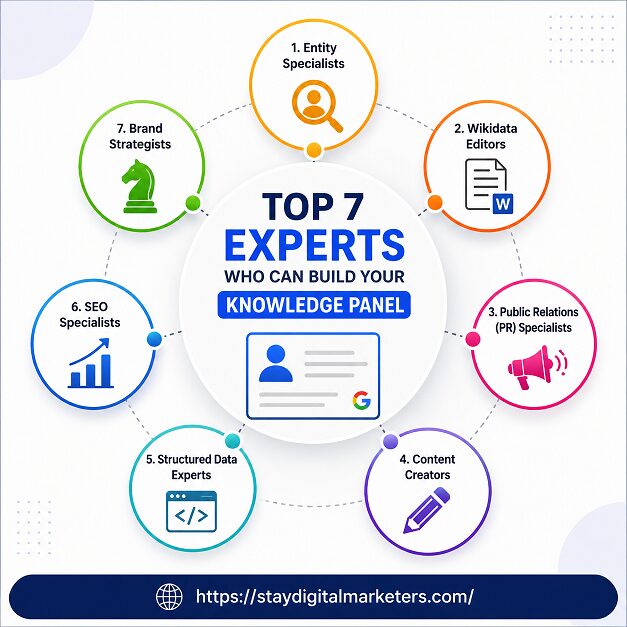
The table below compares the seven expert types across timeline, ideal use case, and typical investment level.
| Expert Type | Typical Timeline | Best For | Approx. Investment |
| Entity SEO Strategist | 2 to 6 months | Complex or ambiguous entities | $$$ |
| ORM Consultant | 1 to 3 months | Existing panels needing correction | $$$ |
| Wikidata / Wikipedia Editor | 2 to 8 weeks | Entities missing structured data | $ |
| PR / Media Placement Specialist | 2 to 3 months | Entities with little existing coverage | $$$$ |
| Schema / Technical SEO Developer | 1 to 4 weeks | Sites lacking structured markup | $ |
| Independent Consultant | 4 to 10 weeks | Individuals and personal brands | $$ |
| Full-Service Agency | 3 to 6 months | Established brands and executives | $$$$ |
For professional service providers, executives, and growing brands, hiring an expert is generally worth it once basic DIY efforts have been exhausted.
A determined individual with technical skill can implement schema markup and build a Wikidata entry without outside help. What is harder to replicate alone is the judgment involved in diagnosing entity ambiguity, the relationships needed for credible media placement, and the patience required to monitor a panel over time. Most people who attempt this entirely solo either give up before Google’s threshold is reached or trigger a panel with incomplete or inconsistent data that needs correcting later anyway.
Costs vary widely depending on the category of expert and the complexity of the entity involved.
Independent consultants and freelance specialists often price individual panel projects in the low thousands of dollars. Full-service agencies and PR-driven programs frequently run into the five figure range for a multi-month engagement, particularly when dozens of media placements are included. Ongoing monitoring and maintenance retainers, where offered, are typically priced separately from the initial build.
A few checks separate a legitimate specialist from an unreliable one.
Can I build my own Knowledge Panel without hiring an expert?
Yes, particularly for a straightforward personal brand with limited overlap with other entities of the same name. The core requirements, a Wikidata entry, consistent schema markup, and a handful of independent media mentions, are all achievable without outside help, though the process takes patience and a working understanding of structured data.
How long does it take for a Knowledge Panel to appear?
There is no fixed timeline, since panels appear once Google’s algorithm reaches sufficient confidence in an entity’s data, which can take anywhere from a few weeks to several months depending on existing footprint and competition from similarly named entities.
Do I need a Wikipedia page to get a Knowledge Panel?
No. A Wikidata entry paired with consistent schema and corroborating sources is often enough to trigger a panel, and many verified panels exist without a Wikipedia article at all.
Is it worth hiring an expert for a small business Knowledge Panel?
It depends on the business’s visibility goals. A local business with a Google Business Profile already benefits from local SEO fundamentals, while a business or founder aiming for broader industry recognition typically sees more value from dedicated entity SEO work.
What is the difference between claiming and building a Knowledge Panel?
Building refers to the work that helps Google generate a panel in the first place, while claiming refers to verifying ownership of an existing panel, which then allows direct edits such as correcting a photo or adding a link.
Can a Knowledge Panel be removed or changed by a bad actor?
A panel can shift or disappear, often called ghosting, if the underlying source data changes or becomes inconsistent, which is why ongoing monitoring is one of the six steps in the EXPERT framework rather than a one-time task.
How do AI search tools use Knowledge Panel data?
AI assistants and generative search tools frequently draw on the same structured data that feeds Knowledge Panels, meaning a well-maintained panel can influence how a brand or individual is described in AI-generated answers, not just traditional search results.
Entity building of this kind rarely happens through a single tactic. Agencies like Stay Digital Marketers work alongside brands on the backlink and authority side of this equation, offering guest posting, niche edits, press release distribution, SaaS backlinks, Wikipedia page creation, and Google Knowledge Panel creation as part of a wider digital presence strategy. For brands assembling their own team of specialists, this kind of backlink and citation support often complements the more entity-focused work described above.

Filza Taj is an MPhil in Human Resources-turned SEO Specialist, Content Strategist, and Digital Marketing Consultant with over 5 years of experience helping businesses in 30+ countries grow online. As the Founder of Stay Digital Marketers (staydigitalmarketers.com), she delivers results-driven solutions in link building, guest posting, PR distribution, niche edits, multilingual backlinks, and content marketing. She publishes daily SEO insights and actionable strategies to help brands strengthen their online presence, attract the right audience, and convert clicks into loyal customers.
Filza@staydigitalmarketers.com
Stay Digital Marketers
Need SEO, Link Building or Digital Marketing Services?
Request a Free Audit →