
Every time Google pushes a core update, the same recycled explanations circulate through comment sections, agency Slack channels, and worried client emails. Some of these ideas were half-true a decade ago. Others were never true at all. They persist because algorithm updates are opaque by design, and a plausible-sounding theory travels faster than a nuanced one.
An algorithm update, in Google’s own framing, is a change to the systems that decide which pages appear for a given search query. A core update recalibrates that evaluation broadly, adjusting how signals such as content quality, E-E-A-T, and technical performance are weighed against each other. A spam update is narrower: it targets specific manipulative tactics rather than reassessing quality across the board. Confusing the two is where several of the myths below take root.
This article works through five myths about algorithm updates that refuse to die, what current rollout and recovery data actually show, and what to do instead the next time your rankings move.
Key Takeaways
No. A ranking drop after a core update is not automatically a penalty, and treating it like one leads to the wrong fixes. A manual or algorithmic penalty targets a specific violation, such as paid links or cloaking, and is tied to an identifiable cause. A core update is different: it re-evaluates the entire index against updated quality signals, so a page can lose position even if nothing on that page changed. Google’s own guidance is blunt about this: there is nothing to fix in the sense of an infraction, because there was no infraction.
What actually happened is usually simpler and less personal. Competing pages were reassessed as better matches for the updated criteria, so they moved up while your page moved down by comparison. That distinction matters because a site owner chasing a nonexistent penalty tends to disavow healthy links, delete useful pages, or rewrite content that wasn’t the problem, while ignoring the structural quality gaps that actually are.
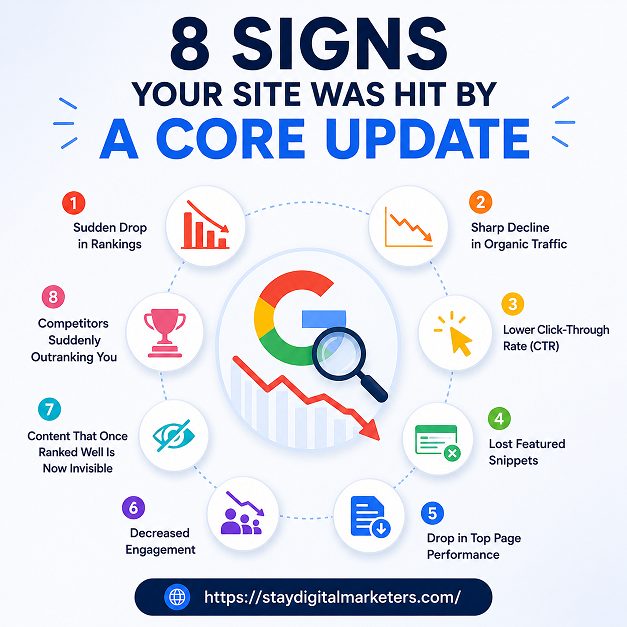
Core update rollouts themselves take longer than most people expect, which is part of why the panic sets in early. The March 2026 core update rolled out over 21 days, from March 18 to April 8, and industry trackers described it as the most volatile core update on record at that point. The May 2026 core update that followed took roughly 12 days to complete. Rankings can swing in both directions multiple times before a rollout finishes, so a dip in week one is not a verdict.
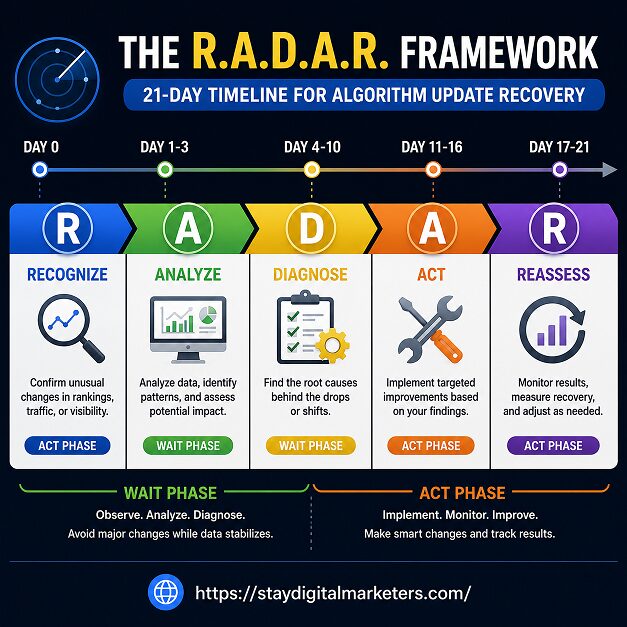
This is one of the more expensive myths, because it drives reactive decisions during the exact window when they’re least reliable. Most algorithm updates take one to three weeks to fully settle, and rankings fluctuate as Google tests and refines results during that period. Early movement inside a live rollout does not reflect the final outcome.
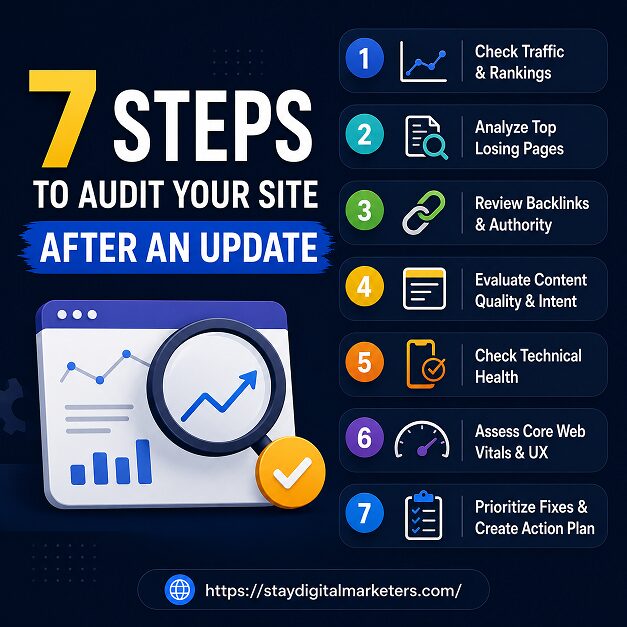
Google’s own advice is to avoid reactive technical changes during an active rollout and instead wait until the update is confirmed complete before auditing against content quality and user experience. Acting mid-rollout adds noise on top of noise: you can’t tell whether a subsequent shift was caused by your change or by the update continuing to settle, which makes the next update even harder to diagnose.
A simple five-step sequence keeps the response structured instead of reactive. Call it the R.A.D.A.R. framework, since the whole point is to observe carefully before reacting:
Site owners often assume recovery is a matter of undoing the last edit before the drop, as if the update were reacting to one specific change. In practice, recovery is rarely that literal. Sites see initial movement within two to six weeks of implementing genuine fixes, but full recovery frequently only becomes visible after the next core update rolls out and re-evaluates the page again.
Across client work over the past several core updates, a consistent pattern shows up: pages with clear authorship, updated statistics, and solid mobile performance hold their positions noticeably better than pages left untouched for a year or more, while pages that only had a “last updated” date bumped with no substantive changes underneath rarely move at all. Content freshness is judged by substance, not by a date stamp. Structural issues such as thin content or weak authorship signals typically take two to six months to fully resolve, and in cases tied to prior Helpful Content penalties, some sites reported recovery timelines stretching twelve to eighteen months.
Confirmation bias does most of the work here. Someone changes a title tag, sees a bump the following week, and credits the title tag rather than the dozen other things that shifted at the same time. Search algorithms weigh hundreds of factors differently depending on context, which makes it nearly impossible to isolate a single cause with certainty. Whichever explanation fits an existing belief tends to win, regardless of whether it’s the real driver.
It can feel personal when an entire industry reports losses in the same update, but a core update evaluates content quality and relevance broadly across the index rather than singling out a sector. When many sites in one niche move together, it usually means that niche’s content collectively matched the updated quality bar less well than a competing set of pages did, not that Google decided to punish the category.
This myth persists partly because outdated commentary stays online indefinitely. Articles written about a 2021 update still surface in searches about a 2026 update, mixing up cause and effect for readers trying to diagnose a current drop. Without a clear publication date in view, it’s easy to misattribute a pattern from years ago to what’s happening right now.
Google did not ban AI-generated content in the March or May 2026 core updates. What changed is that the algorithm has gotten measurably better at identifying content that lacks genuine human expertise, which mass-produced, unedited AI output often demonstrates through generic phrasing, shallow examples, and an absence of first-hand insight. The distinction is quality and originality, not the tool used to draft a first pass.
Separately, in May 2026 Google extended its spam policies to cover manipulation of AI Overviews and AI Mode results, the first time gaming an AI-generated answer was flagged as its own violation. That’s a narrower spam-policy change, not a blanket rule against AI-assisted writing, and conflating the two is exactly how this myth keeps circulating.
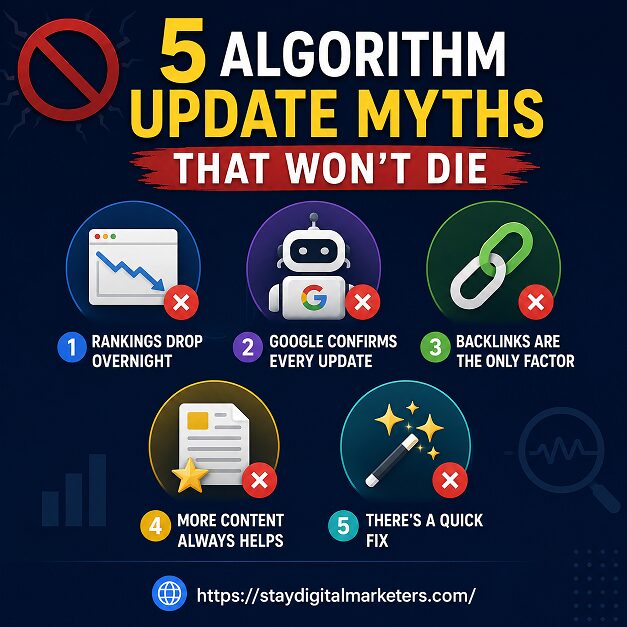
| The Myth | The Reality |
| A ranking drop always means a penalty | Core updates reassess quality broadly; most drops have no violation attached |
| React with big changes mid-rollout | Wait for rollout completion, then audit against quality signals |
| Recovery means undoing the last change | Recovery usually needs substantive, sustained quality improvements over months |
| Google is targeting your niche | Whole niches move together when content quality shifts collectively |
| AI content is now banned | Google targets low-expertise content and AI-answer manipulation, not AI drafting itself |
| Metric | Current Figure |
| March 2026 core update rollout length | 21 days (March 18 to April 8, 2026) |
| May 2026 core update rollout length | Roughly 12 days |
| Typical initial recovery movement | 2 to 6 weeks after genuine fixes |
| Structural issue recovery window | 2 to 6 months |
| Named Google updates per year | Roughly 8 to 12, plus thousands of minor unnamed adjustments |
Most core updates complete within one to three weeks, though some run longer. The March 2026 core update took 21 days, while May 2026 finished in about 12. Rankings can fluctuate throughout this window, so early movement doesn’t reflect the final result. Wait for official confirmation that rollout has ended before drawing conclusions.
Check the timing against confirmed rollout dates first, since correlation alone isn’t proof. Look at which specific pages and queries lost visibility rather than the site-wide average. If the drop lines up with a confirmed update and affects content-quality-related pages broadly, an update is the likely cause rather than a technical or manual issue.
Yes, though timelines vary widely. Initial movement often appears within two to six weeks of implementing real improvements, but full recovery frequently isn’t visible until the next core update reassesses the page. Some sites with deeper structural issues have reported recovery windows stretching well beyond a year.
Not by itself. Google evaluates freshness by substance, meaning new facts, corrected claims, or restructured content, not by a timestamp alone. Changing the date without changing the underlying content rarely produces any measurable ranking benefit and can look like a manipulation attempt if done repeatedly without real updates.
No. Spam updates target specific manipulative tactics, such as scaled content abuse or, as of May 2026, manipulation of AI Overview results. Core updates instead re-evaluate content quality and relevance broadly across the index. A site can be affected by one without being affected by the other.
Generally, no. Core updates rarely relate to link profiles directly, so disavowing reactively can remove links that were never a problem. Reserve disavow actions for confirmed spam-related link issues, and make any technical or link changes only after the rollout is confirmed complete and you’ve identified a genuine cause.
Google confirms roughly 8 to 12 named updates annually, spanning core updates, spam updates, and topic-specific changes, on top of thousands of smaller unnamed adjustments made continuously. The cadence for major core updates has shifted toward roughly every three to four months rather than the twice-yearly pattern seen in earlier years.
Treating each update as an isolated event, rather than part of a longer pattern, is what keeps these myths alive. The teams that adapt fastest are the ones tracking rollout dates, comparing affected page types against what’s actually changing in quality signals, and resisting the urge to act before a rollout finishes. Stay Digital Marketers has followed this pattern across the 2026 core update cycle and supports sites through recovery with backlink-focused services including guest posting, press release distribution, SaaS backlinks, niche edits, multilingual backlinks, Wikipedia page creation, and Google Knowledge Panel setup, alongside broader SEO work aimed at holding up through whatever the next update changes.

Filza Taj is an MPhil in Human Resources-turned SEO Specialist, Content Strategist, and Digital Marketing Consultant with over 5 years of experience helping businesses in 30+ countries grow online. As the Founder of Stay Digital Marketers (staydigitalmarketers.com), she delivers results-driven solutions in link building, guest posting, PR distribution, niche edits, multilingual backlinks, and content marketing. She publishes daily SEO insights and actionable strategies to help brands strengthen their online presence, attract the right audience, and convert clicks into loyal customers.
Filza@staydigitalmarketers.com
Stay Digital Marketers
Need SEO, Link Building or Digital Marketing Services?
Request a Free Audit →