
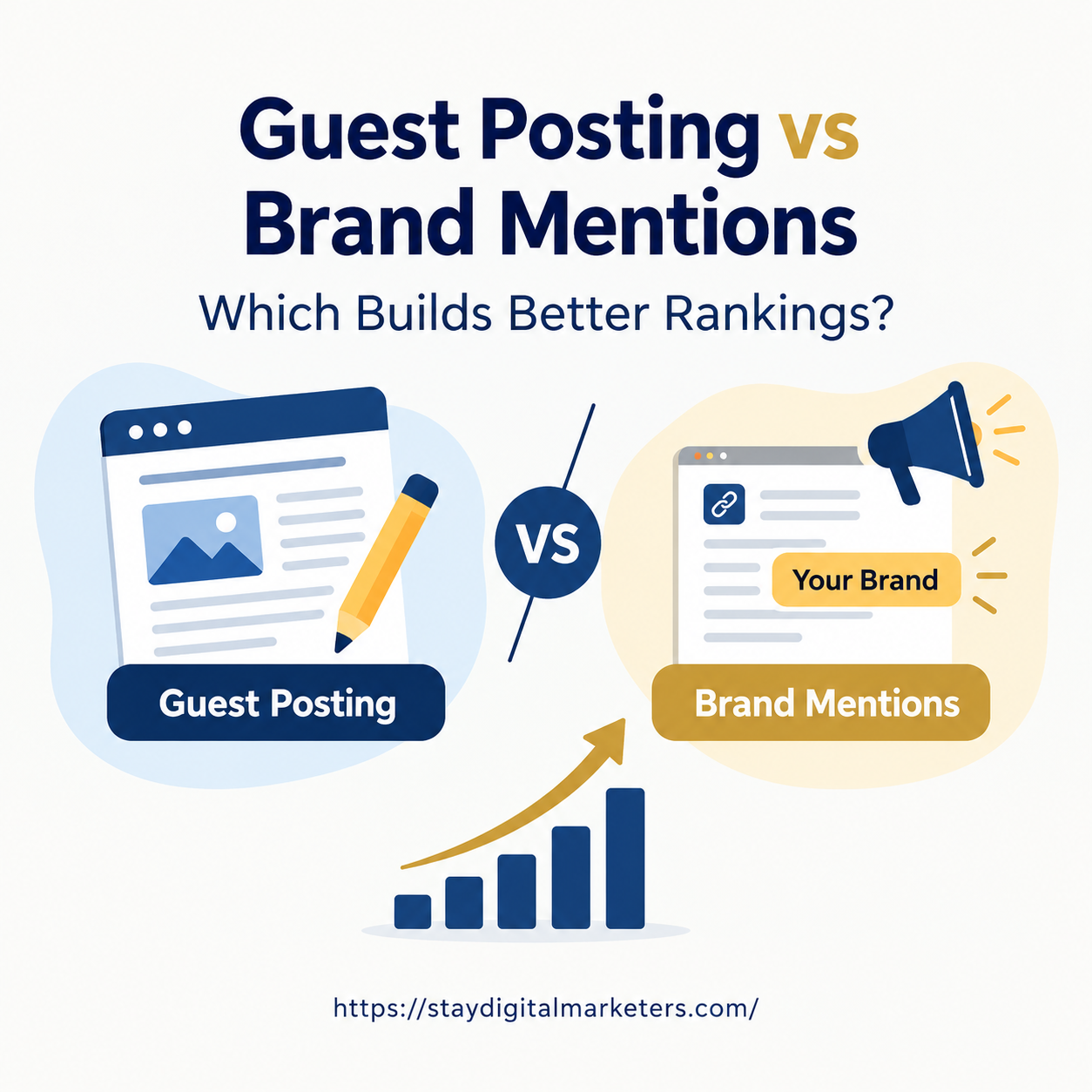
Guest posting is a tactic: you write an article for another website, usually with a link back to yours. A brand mention is a signal: your brand is named on another page, with or without a link. The two overlap, because a guest post can create both a link and a mention.
The topic involves several related entities: backlinks, unlinked mentions, anchor text, digital PR, the Knowledge Graph, AI Overviews, and the rel attributes sponsored and nofollow. Comparing a tactic with a signal is why many articles on this subject end up muddled, and why the question “which is better” has no single answer.
Key Takeaways
Linked placements have the clearer documented role in rankings, and unlinked mentions have the weaker one. No source reviewed shows that unlinked mentions improve Google rankings, while Google’s own spam policies treat manipulative links as a ranking issue.
John Mueller, as quoted by Infidigit, said that if there is no link, “there is no signal passing like any other links.” Infidigit does not date the remark, and the claim that mentions have “zero ranking influence” is Infidigit’s own reading. Mentions may still help people find you, which is a separate benefit.
I reviewed three of the four pages in the brief. The second link points to a Surfer article about refreshing old content, which does not discuss guest posts or mentions, so I left it out.
The shared gap is the evidence. All three treat AI visibility and Google rankings as one outcome, and none separates what is documented from what is correlated. This guide fills that gap with an evidence table and a method for choosing by goal.
The strongest study is from Ahrefs. It analyzed 75,000 brands and measured how factors correlated with brand mentions inside AI Overviews. Branded web mentions scored 0.664, branded anchors 0.527, branded search volume 0.392, and backlinks 0.218. Ahrefs notes that correlation is not causation, that about 26% of brands had zero AI Overview mentions, and that its factors ranged from moderate to very weak.
The study measures AI Overview visibility, not rankings. Observed across client work, teams often quote it as proof that mentions beat links for rankings, which it does not show. The table separates what each source supports.
| Claim | Evidence | What it measures | Reading |
| Unlinked mentions pass link signal | Mueller, as quoted by Infidigit | Google link signal | Documented as no |
| Mentions correlate with AI visibility | Ahrefs, 75,000 brands | AI Overview brand mentions | Correlation only |
| Mentions beat links for rankings | No source found | Google rankings | Unproven |
| Guest post links can be spam | Google spam policies | Policy risk | Documented |
Each option passes a different signal and carries a different risk.
| Option | Signal passed | Your control | Main risk |
| Guest post with link | Link and mention | High | Spam if anchors are optimized |
| Editorial linked mention | Link and mention | Low | Slow to earn |
| Unlinked mention | Mention only | Low | No link signal |
| Digital PR coverage | Link and mention | Medium | Uncertain outcome |
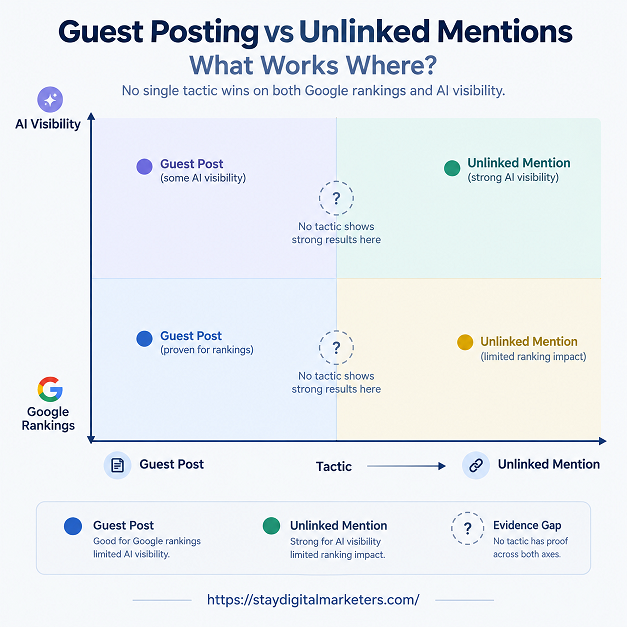
The Goal-Signal Match Method picks a tactic by the outcome you want, then checks it against the evidence. It has five steps.
Decide whether you want rankings, brand recognition in AI answers, referral traffic, or all three. Rankings point toward linked placements. Recognition points toward mentions.
Search for your brand name and common misspellings, and list who already mentions you. Turn unlinked mentions into linked ones by asking the publisher politely, pointing to the exact page and explaining why a link would help readers. Many publishers will agree when the request is specific and brief. Growthner also recommends starting with an audit, which holds up regardless of its sales angle.
Choose guest posts, digital PR, or community participation based on the goal. In practice, a guest post on a relevant publication works as both a link and a mention, so it serves two goals at once.
Google lists links with optimized anchor text in articles, guest posts, or press releases distributed on other sites as link spam. It also says links for sponsorship are acceptable when marked rel=”sponsored” or rel=”nofollow”. Use natural anchors and label paid placements.
Track referring domains, unlinked mentions, branded search impressions, and AI citations in separate columns. If you merge them into one score, you cannot tell which tactic worked. Review the columns at a fixed interval, such as monthly, and compare each against the baseline you recorded before the campaign began.
Match the tactic to the situation, not to a trend. These are practitioner judgments, not findings from a study.
In practice, young brands gain more from a handful of relevant placements than from a broad mention campaign, because few people search for them yet.
Teams that keep a simple log of each placement, its date, and whether it links can later explain what changed. Teams without one end up crediting whichever tactic ran last
A guest post is an article you write for another site, usually with a link back to yours. A brand mention is any reference to your brand on another page, linked or unlinked. A guest post can create a mention, but a mention does not require a guest post, so they are not true alternatives.
No source reviewed proves they do. John Mueller said an unlinked mention is not a link and passes no signal like one, as reported by Infidigit. Ahrefs found branded web mentions correlate with AI Overview brand visibility, but that measures AI mentions, not rankings, and shows correlation only.
They can, if the site is relevant, the content is useful, and the link is earned editorially. Google’s spam policies list optimized anchor text links in guest posts distributed on other sites as link spam. Use natural anchors, choose relevant publications, and label paid placements with rel sponsored.
The evidence is correlational. In Ahrefs’ study of 75,000 brands, branded web mentions correlated at 0.664 with AI Overview brand mentions and backlinks at 0.218. Ahrefs warns that correlation is not causation and that every factor showed moderate to weak results, so build both signals.
Yes, because they do different jobs. Linked placements support the link signal Google documents, while mentions support brand recognition across the web. A digital PR or guest post campaign can produce both, so measure referring domains, unlinked mentions, branded search, and AI citations separately.
Set up alerts for your brand name and common misspellings, review referring domains in a backlink tool, and watch branded search impressions in Google Search Console. Log each mention with its date, source, and whether it links. Compare against a baseline so you can see whether campaigns changed anything.
Links and mentions work best as a pair, with each measured on its own terms. Stay Digital Marketers assists brands with backlink-related services, including guest posting, press release distribution, SaaS backlinks, niche edits, multilingual backlinks, Wikipedia page creation, Google Knowledge Panel creation, and complete SEO services.

Filza Taj is an MPhil in Human Resources-turned SEO Specialist, Content Strategist, and Digital Marketing Consultant with over 5 years of experience helping businesses in 30+ countries grow online. As the Founder of Stay Digital Marketers (staydigitalmarketers.com), she delivers results-driven solutions in link building, guest posting, PR distribution, niche edits, multilingual backlinks, and content marketing. She publishes daily SEO insights and actionable strategies to help brands strengthen their online presence, attract the right audience, and convert clicks into loyal customers.
Filza@staydigitalmarketers.com
Stay Digital Marketers
Need SEO, Link Building or Digital Marketing Services?
Request a Free Audit →