

An unlinked brand mention is any reference to your company, product, or team on the web that names you without a hyperlink back to your site. A reviewer might write about your software, a journalist might quote your founder, or a blogger might recommend your tool, and in each case the brand name appears in the text while the link back to your domain never does. For SEO teams, these mentions are backlink opportunities that already exist. The editorial decision, the hardest part of any link-building campaign, has already been made. All that remains is asking the author to add the link.
This matters because brand mentions carry weight independent of the link itself. Ahrefs has reported that brand mentions show one of the strongest correlations with search visibility, even before a hyperlink is added, and that correlation grows once the mention becomes a live link. As AI-powered search tools like ChatGPT, Perplexity, and Google’s AI Overviews increasingly decide which brands to recommend, unlinked mentions are also feeding entity recognition signals that shape how these systems describe and rank a brand. Below are eight tools that help you find these mentions, along with how each one fits into a practical monitoring workflow.
Key Takeaways
An unlinked brand mention is a piece of content, such as an article, forum post, or review, that names your brand, product, or a key person at your company without linking to your website. It differs from a backlink only in that one small technical detail, the hyperlink, is missing while the editorial credit is already given.
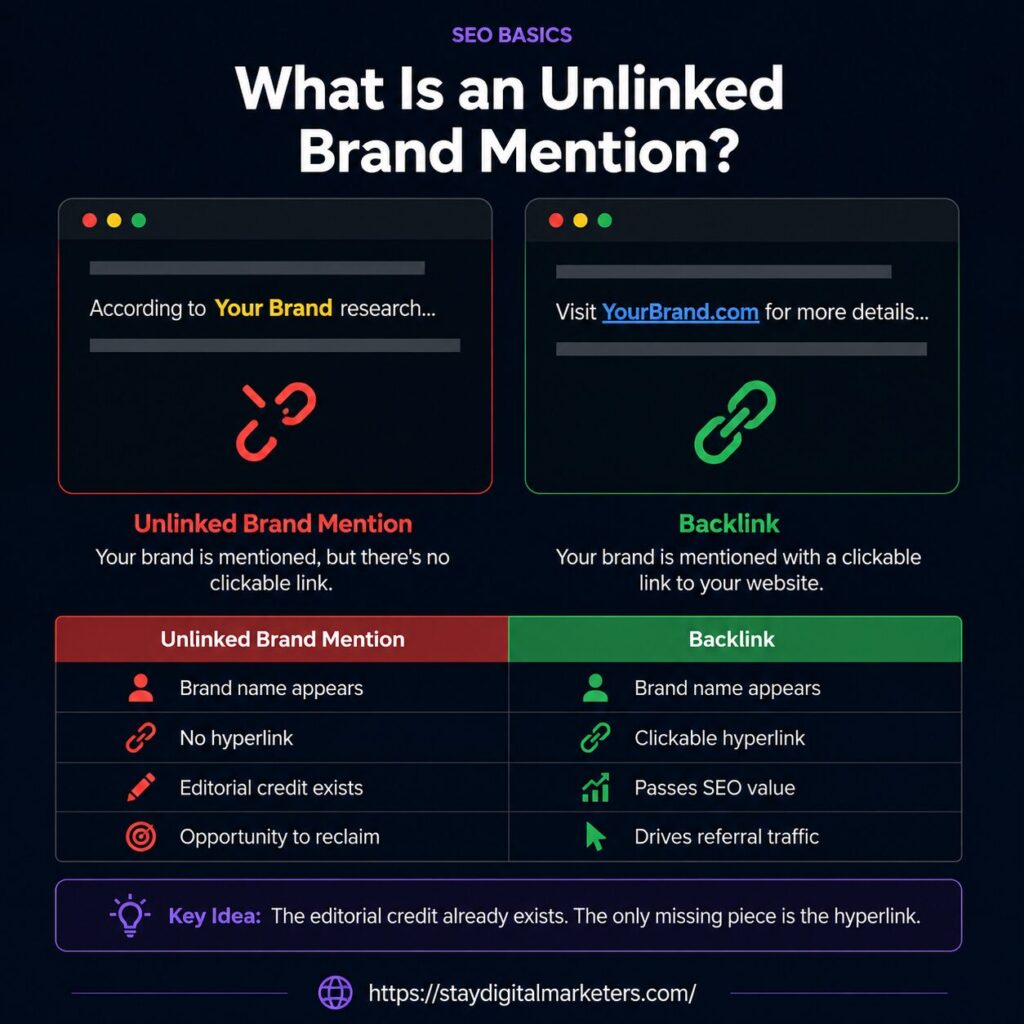
Unlinked mentions matter because they represent link opportunities with an unusually high conversion rate. Cold outreach pitches asking a publisher to link to a brand they have never mentioned typically convert at around 1 to 3 percent. Outreach asking a publisher to add a link to a brand they have already written about converts at closer to 15 to 30 percent, because the relationship and the editorial groundwork are already in place. One well-known case comes from the email-finding company Hunter, which discovered more than 18,000 sites had mentioned its brand without linking to it. After a structured outreach push, the team reclaimed 53 high-authority backlinks in three months.
Finding unlinked mentions requires a mix of dedicated SEO platforms, media monitoring software, and free manual methods. The eight tools below cover every budget and scale, from solo bloggers checking mentions once a month to agencies running monitoring for dozens of clients.
Yes, and for most SEO teams it is the starting point. Ahrefs Content Explorer searches a database of billions of indexed pages for any brand name or phrase, then lets you filter results by Domain Rating, organic traffic, and language. Its “highlight unlinked domains” feature flags every result from a site that has never linked to your domain, which makes prioritization fast. The tool works at the domain level rather than the page level, so a site that links to you once elsewhere may still show unlinked mentions on other pages, meaning each result still needs a quick manual check. Ahrefs also offers Brand Alerts, which sends scheduled notifications when new mentions appear, so teams do not need to run manual searches every week.
Semrush’s Brand Monitoring tool crawls news sites, blogs, forums, and social platforms for mentions of a defined keyword set, then applies a built-in filter that isolates mentions without a backlink. Because it lives inside the broader Semrush platform, a mention can be checked against the referring domain’s authority score and traffic estimate without switching tools. It also includes a sentiment filter, so a team can separate positive or neutral mentions worth pursuing for links from negative mentions that need a reputation-management response instead.
Brand24 is built specifically as a media monitoring tool, which makes it strong for brands that generate a high volume of coverage across news, blogs, forums, reviews, podcasts, and social platforms. Once a project is set up with brand-related keywords, the mentions feed can be filtered to show only News, Blogs, and Web sources, which are the categories most likely to yield link opportunities. Each mention carries an Influencer Score that estimates the reach of the source, giving a rough first pass at prioritization before a domain authority check.
Mention is built around real-time alerts, which makes it a strong fit for PR-driven teams that need to catch a mention within hours of publication rather than days. Being first to respond to a fresh article or blog post noticeably increases the odds that an outreach email leads to a link, since the author is still actively engaged with the piece. Mention tracks web and social sources together, so a single dashboard covers both editorial mentions and social chatter about a brand.
Talkwalker Alerts works well as a free, more capable alternative once Google Alerts starts missing too many mentions. It monitors global media coverage across dozens of languages, which matters for brands operating internationally, and its filtering reduces the noise that free alert tools are known for. Teams that need multilingual coverage without paying for a full monitoring platform tend to reach for Talkwalker Alerts first.
Google Alerts remains a reasonable starting point because it costs nothing and takes minutes to set up. Enter a brand name, choose a delivery frequency such as weekly or as-it-happens, and alerts arrive by email as new content is indexed. The tradeoff is coverage. Google Alerts is widely reported to miss mentions or deliver them later than they were published, and it offers no filtering by domain authority, sentiment, or link status. It works best paired with a periodic manual audit rather than as a standalone system.
BuzzSumo’s monitoring and alerts functionality tracks mentions of a brand or keyword across the web and flags when content performs well, which is useful for spotting high-reach mentions worth prioritizing first. It is often used alongside a dedicated outreach tool once a list of unlinked mentions has been compiled, since BuzzSumo’s strength is discovery and content performance data rather than deep filtering by link status.
Screaming Frog is not a discovery tool, but it solves a problem the other tools on this list share: domain-level unlinked flags do not always mean a specific page is truly unlinked. Running a custom search inside Screaming Frog against a shortlist of URLs confirms, page by page, whether a hyperlink to your domain actually exists. This verification step is worth the extra minutes, since audits consistently show that a meaningful share of pages flagged as unlinked already link to the brand somewhere else on the page.
| Tool | Best For | Free Option | Verifies Page-Level Links |
| Ahrefs Content Explorer | Large-scale SEO discovery | No | No, domain-level only |
| Semrush Brand Monitoring | SEO teams already on Semrush | No | Yes, built-in filter |
| Brand24 | High-volume media coverage | Trial only | Partial |
| Mention | Real-time PR response | Trial only | Partial |
| Talkwalker Alerts | Multilingual, global brands | Yes | No |
| Google Alerts | Solo creators, small budgets | Yes | No |
| BuzzSumo | Content performance and reach | Trial only | No |
| Screaming Frog | Confirming true unlinked status | Yes, up to 500 URLs | Yes |
Not every unlinked mention deserves outreach. The TRACE framework offers a fast way to decide which ones are worth pursuing.
A mention that scores well across all five checkpoints is worth immediate outreach. A mention that fails two or more is better left alone or logged for a future campaign.
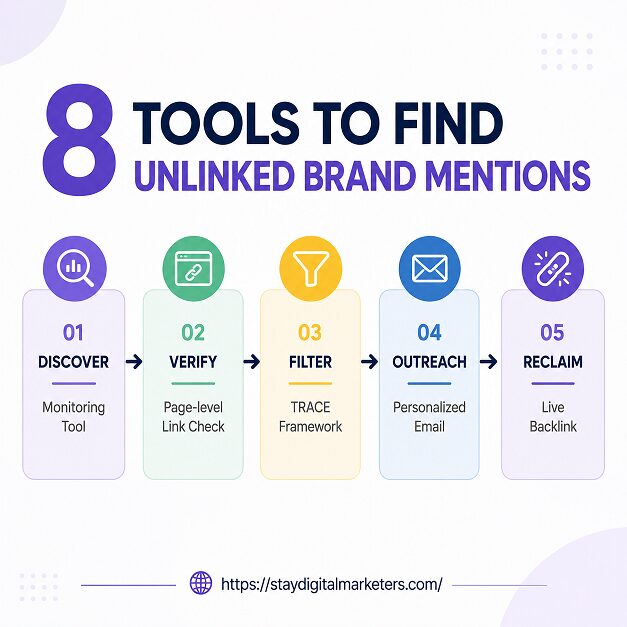
Once a mention passes the TRACE checkpoints, outreach should stay short, personal, and specific. Thank the author for mentioning the brand, note that the name is not yet linked, and explain briefly how adding the link helps their own readers reach the source directly. A tool such as Hunter.io can help locate the right contact when an author’s email is not listed on the page. If there is no reply within five to seven days, one polite follow-up is reasonable. Two follow-ups is typically the limit before moving on to the next opportunity.
What is the difference between a linked and unlinked brand mention?
A linked mention includes a clickable hyperlink back to the brand’s website, while an unlinked mention names the brand in text without that link, so no direct traffic or link equity passes through it.
How often should a brand monitor for unlinked mentions?
Weekly monitoring works for most brands. Brands with frequent press coverage or active PR campaigns benefit from daily alerts so they can respond while the content is still fresh.
Do unlinked mentions help with AI search visibility?
Yes. AI-powered search and chat tools rely on how consistently and positively a brand is discussed across the web to shape their recommendations, and unlinked mentions still contribute to that pattern even without a hyperlink.
Is it worth paying for a monitoring tool instead of using Google Alerts?
For brands that generate more than a handful of mentions a month, paid tools save enough manual research time to justify the cost, and they typically catch mentions that Google Alerts misses entirely.
Can unlinked mentions hurt a brand’s SEO?
Only if the mention itself is negative. A neutral or positive unlinked mention carries no downside, but a negative or inaccurate one should be reviewed for reputation management rather than link outreach.
How do you find unlinked mentions of misspelled brand names?
Search for common misspellings and phonetic variations directly in Google or a monitoring tool’s keyword settings, since content creators frequently misspell brand names, especially unusual ones.
Should every unlinked mention be pursued for a backlink?
No. Mentions on low-authority, irrelevant, or link-averse sites are rarely worth the outreach effort, which is why a filtering step such as the TRACE framework matters before any email goes out.
Brands running consistent link-building programs often bring in outside support once mention volume grows beyond what one person can track manually. Stay Digital Marketers works with brands on this kind of off-page SEO work, offering services such as guest posting, niche edits, press release distribution, brand mentions, SaaS backlink placements, Wikipedia page creation, Google Knowledge Panel management, and complete SEO services which pairs naturally with an unlinked mention monitoring workflow once outreach volume scales past what a single team member can manage alone

Filza Taj is an MPhil in Human Resources-turned SEO Specialist, Content Strategist, and Digital Marketing Consultant with over 5 years of experience helping businesses in 30+ countries grow online. As the Founder of Stay Digital Marketers (staydigitalmarketers.com), she delivers results-driven solutions in link building, guest posting, PR distribution, niche edits, multilingual backlinks, and content marketing. She publishes daily SEO insights and actionable strategies to help brands strengthen their online presence, attract the right audience, and convert clicks into loyal customers.
Filza@staydigitalmarketers.com
Stay Digital Marketers
Need SEO, Link Building or Digital Marketing Services?
Request a Free Audit →