Call or WhatsApp us anytime
Mail Us For Support

Multilingual SEO is the practice of making each language version of a website discoverable, indexable and correctly served to searchers who use that language. It covers URL structure, translated and localized content, hreflang annotations, local keyword research and local authority signals such as backlinks from sites in each market.
The opportunity is large because most of the web is still written in English while most people are not native English speakers. This handbook explains how Google handles multilingual and multi-regional sites, which setup choices matter most, and how to build rankings in each language step by step, using Google’s own documentation as the reference point throughout.
Key Takeaways
Multilingual SEO optimizes a site that serves content in two or more languages so that search engines show each searcher the version written in their language. A Spanish speaker in Madrid should land on the Spanish page, and a German speaker in Vienna on the German page, without having to switch languages manually.
Each language version is treated by Google as a separate set of pages. That means every version needs its own crawlable URLs, its own keyword research, its own metadata and its own internal links. Translating the visible text is only the first layer.
Multilingual SEO targets languages, while international SEO targets countries or regions, and many sites need both. A site with English and French versions for any visitor is multilingual. A site with separate pages for French speakers in France and in Canada is multi-regional as well, because prices, spelling, legal terms and contact details change by country.
Multilingual SEO matters because buyers strongly prefer content in their own language, while competition in most non-English search results is still thinner than in English. Two data points make the case clearly.
A CSA Research survey of 8,709 consumers in 29 countries, published in July 2020, found that 76% prefer to buy products with information in their own language and 40% never buy from websites in other languages. On the supply side, W3Techs reports that as of November 2026, 49.5% of websites with a known content language use English, while Spanish and German each account for 6.0%, Japanese for 4.9% and French for 4.6%.
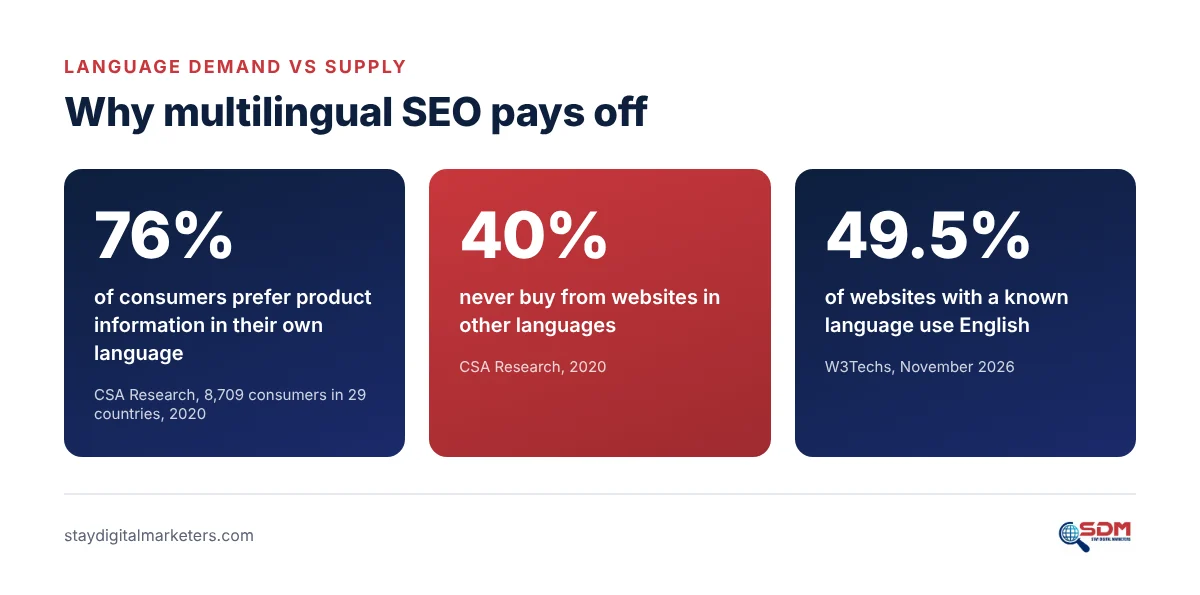
The gap between demand and supply is the opening. Arabic, for example, is used by only 0.6% of websites in the W3Techs data despite a very large speaking population, which leaves room for well-built Arabic pages to rank with fewer links than an equivalent English page would need.
Yes, because AI answer engines tend to answer in the user’s language and cite pages written in that language. A brand that only publishes in English gives tools such as Google AI Overviews and ChatGPT nothing to quote when a user asks in German or Arabic. Consistent brand names, service descriptions and Organization structured data across every language version help these systems connect each version to the same entity, a principle explained further in this guide on generative engine optimization.
Google detects a page’s language from its visible content, groups alternate versions through hreflang, and chooses which version to show based on the searcher’s language and location. Several details in Google’s documentation surprise many site owners.
Google’s guide to managing multi-regional and multilingual sites is the primary reference for these rules, and it advises against using IP analysis to adapt content. Show a language suggestion banner instead of forcing a redirect, and let every visitor and crawler reach every version through normal links.
Subdirectories, such as example.com/es/, are the best default for most businesses, because they keep all versions on one domain and share its authority. Country-code domains send the strongest country signal, and subdomains sit between the two. Google lists URL parameters such as ?lang=es as not recommended.
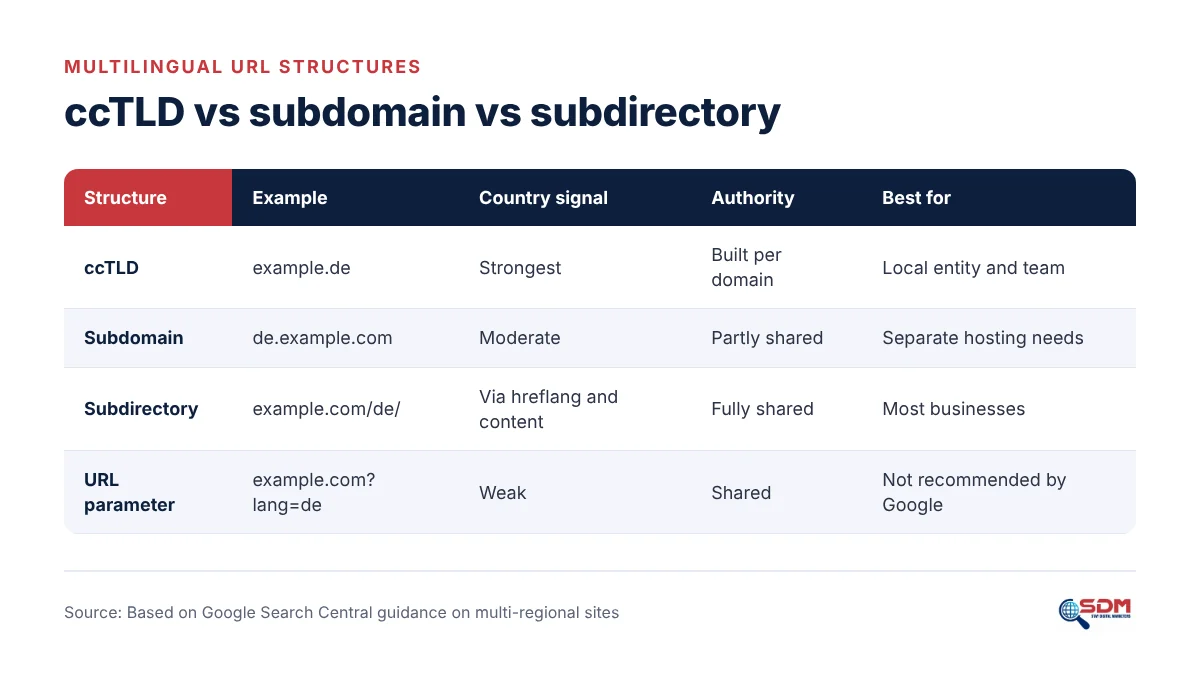
A ccTLD such as example.de makes sense when a business has a real legal and operational presence in a country, a local team that can maintain the site, and a budget to build authority for each domain separately. Each ccTLD starts with little authority of its own, so a brand with five country domains is effectively running five SEO campaigns.
Yes, where the platform allows it, because a slug in the reader’s language matches their search terms and looks trustworthy in search results. A Spanish page at /es/servicios-seo/ reads more naturally to a Spanish searcher than /es/seo-services/. Check this feature carefully before choosing a translation plugin, since some tools only translate slugs on higher plans.
Hreflang tells Google which URLs are language or regional alternates of each other, so it can show the right version and avoid treating translations as competing pages. Google supports three equivalent methods: HTML link elements in the head, HTTP headers for non-HTML files such as PDFs, and XML sitemaps.
Google’s documentation on telling Google about localized versions of a page sets out the rules that cause most implementation errors.
| Rule | What it means in practice |
|---|---|
| Return links | Each version must list every other version. Google says that when two pages don’t both point to each other, the tags are ignored. |
| Self-reference | Each page lists itself as well as its alternates. |
| Valid codes | Language in ISO 639-1 format (es, de, ar), with an optional region in ISO 3166-1 Alpha 2 (es-MX, de-AT). Codes such as es-419 or EU are not supported. |
| Full URLs | Use fully qualified URLs including https://, not relative paths. |
| x-default | Point x-default at the page for unmatched languages, such as a language selector or the global English page. |
| Placement | Tags belong in the head section; tags placed in the body are not read. |
Most multilingual WordPress plugins generate these tags automatically, but they still need checking after launch, especially when pages are added in one language only. A site crawl that flags missing return links and canonical conflicts belongs in every technical SEO checklist.
Each language version should carry a self-referencing canonical tag, never a canonical pointing to the English original. A Spanish page canonicalized to the English page tells Google the Spanish page is a duplicate, and Google may drop it from the index even though hreflang lists it as an alternate.
Research keywords natively in each language and market instead of translating the English keyword list. Direct translation often produces terms that nobody searches for, or misses the phrase locals actually use.
Spanish shows the problem well. Car insurance is commonly searched as “seguro de coche” in Spain but “seguro de auto” in Mexico, so a single Spanish keyword list cannot serve both markets. The same split appears between Brazilian and European Portuguese and between French in France and in Canada.
Free options for this step are compared in this list of free keyword research tools, and most of them support country-level databases.
Use machine translation as a first draft and human review for every page that needs to rank or convert. Modern AI translation is fast and often accurate, but it misses local terms, brand voice and search phrasing that a native editor catches.
Publishing raw machine translation across thousands of pages without review also risks being treated as low-value scaled content. A practical split is to have native reviewers edit service pages, product pages and top blog posts, while lower-value pages such as old news posts are left in the original language or excluded from translation.
The Locale Stack is a five-layer model for building rankings in a new language, where each layer depends on the one below it. Skipping a layer is the most common reason multilingual pages are indexed but never rank.
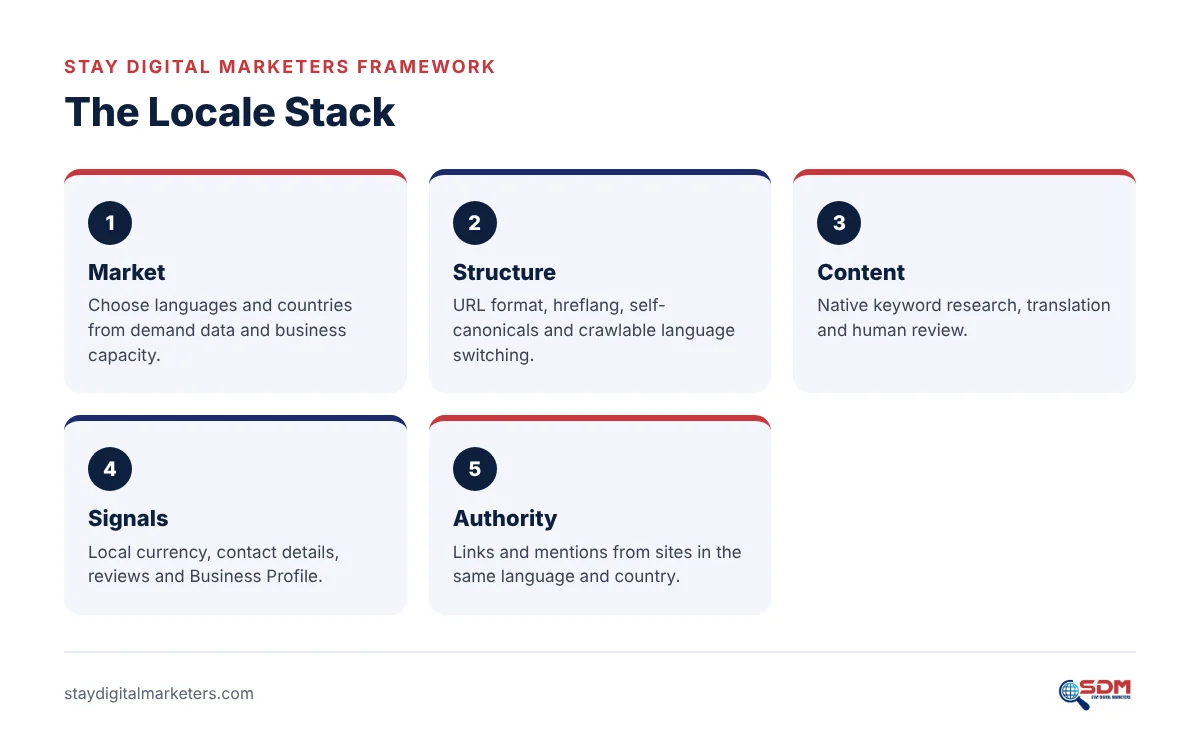
A pattern observed across client work is that brands translate their site, see the new pages indexed, and then stop. The Spanish or German pages sit on page three because the authority layer was never built. Each language competes against native sites that have years of local links, so the new version needs local links of its own, ideally from a multilingual link building program that sources placements on sites written in the target language.
Build authority by earning links from relevant sites written in the same language, and by building topical depth within each language section. Links from English sites to a Spanish page help the domain overall, but links from Spanish sites send a much clearer signal of local relevance.
Topical depth matters just as much. Ten well-connected Spanish articles around one service build more relevance than one translated service page, which is the same principle behind building topical authority in any language.
The same quality rules apply to links in every market: relevance first, real traffic second, and placements in the body of editorial content. The broader methods for earning links are covered in the complete link building guide.
Use a visible language switcher made of normal HTML links that point to the equivalent page in each language, not to each language’s homepage. A visitor reading a German product page who switches to French should land on the French version of that same product.
Arabic, Hebrew, Persian and Urdu pages need dir=”rtl” on the page and a layout that mirrors correctly, not just translated text. Navigation, icons that imply direction, forms and tables all flip. A page that reads right to left but displays a left-to-right layout looks broken to native readers, which hurts engagement and conversions even when the translation is excellent.
The choice depends on the CMS and on whether translations should live in the site’s own database or in a cloud service. Both approaches can rank well when they produce crawlable URLs per language, hreflang tags and translated metadata.
Before committing, check four things on the vendor’s pricing page: whether URL slugs are translated on the chosen plan, whether translated pages are indexable on that plan, what happens to translations when a subscription ends, and how word limits are counted. These details decide long-term cost far more than the headline monthly price.
Measure each language version separately in Google Search Console by filtering on its URL folder and on the target countries. Combined site totals hide the fact that one language may be growing while another has stalled.
Adding each language folder as its own Search Console property makes these reports faster to read. Google retired the International Targeting report, so hreflang problems now have to be found with the URL Inspection tool and a site crawler instead.
Launch each new language only after the structure, content and signals layers pass a basic check. The checklist below covers the items that most often break.
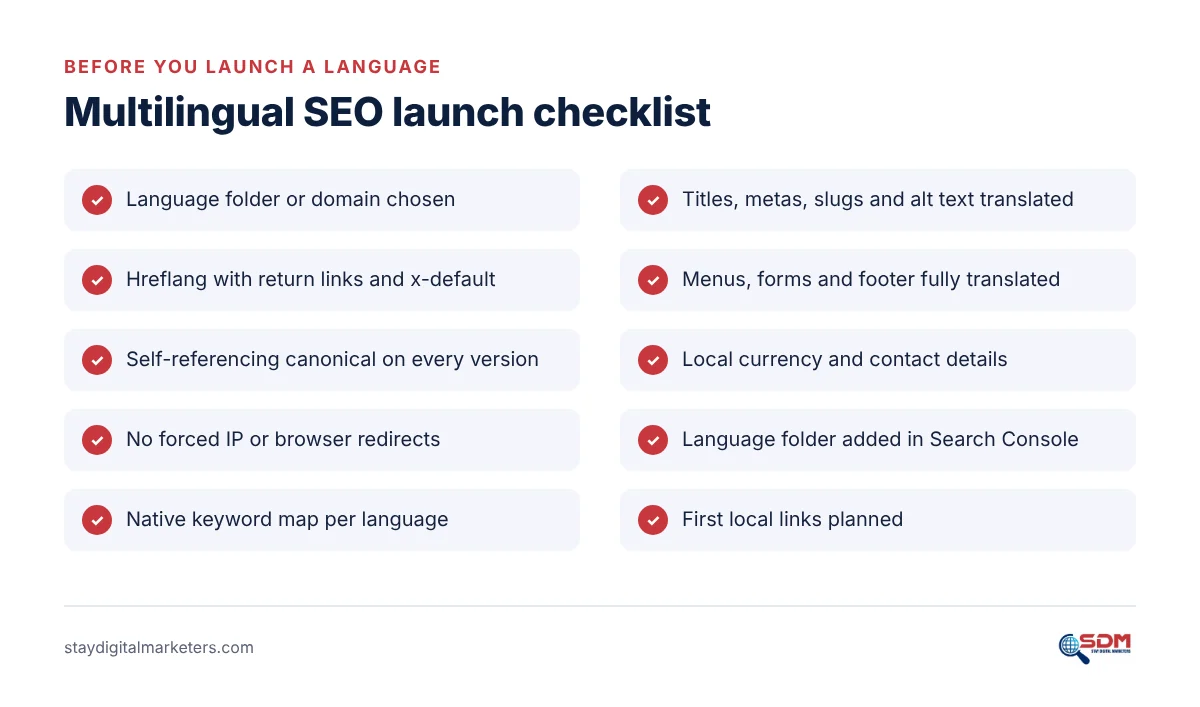
Businesses with locations in several countries should also align each language version with local listings and location pages, following the approach in this guide to local SEO for multi-location businesses.
The most common mistakes are automatic IP redirects, canonical tags pointing to the original language, hreflang without return links, and partially translated pages. Each one can stop a language version from ranking even when the translation itself is good.
No. Translation converts text into another language, while multilingual SEO makes each language version discoverable and competitive in search. That includes native keyword research, translated metadata and slugs, hreflang annotations, self-referencing canonicals, local signals and links from sites in that language. A perfectly translated page can still fail to rank without these steps.
No. Translated pages are not treated as duplicate content, because the text is in a different language. Problems arise when the same language is repeated across country versions without localization, or when canonical tags point every version to the original. Hreflang helps Google group these versions and show the right one to each searcher.
Subdirectories such as example.com/es/ are the best default for most businesses because every version shares one domain’s authority and is easy to manage. Country-code domains send the strongest country signal but need separate authority building. Google does not recommend language parameters such as ?lang=es in the URL.
New language versions are often indexed within weeks, but ranking for competitive terms usually takes several months. Low-competition languages and markets can move faster because fewer strong local pages exist. Progress depends on content quality, correct hreflang setup and whether the version earns links from sites in its own language.
Hreflang is recommended even for two languages, because it helps Google show the right version when both could match a query, such as brand searches. It is most important when versions share a language across countries, like English for the UK and US. Most multilingual plugins add the tags automatically.
Brands planning their first language expansion can get support from Stay Digital Marketers, a resource that helps with guest posting, press release distribution, SaaS backlinks, niche edits, multilingual backlinks, Wikipedia page creation, Google Knowledge Panel creation and complete SEO services, including link building in 30+ countries.

Filza Taj is an MPhil in Human Resources-turned SEO Specialist, Content Strategist, and Digital Marketing Consultant with over 5 years of experience helping businesses in 30+ countries grow online. As the Founder of Stay Digital Marketers (staydigitalmarketers.com), she delivers results-driven solutions in link building, guest posting, PR distribution, niche edits, multilingual backlinks, and content marketing. She publishes daily SEO insights and actionable strategies to help brands strengthen their online presence, attract the right audience, and convert clicks into loyal customers.
Filza@staydigitalmarketers.com
Stay Digital Marketers
Need SEO, Link Building or Digital Marketing Services?
Request a Free Audit →