
When a brand, person, or organization appears in Google search results, two of the most valuable visibility assets are a Wikipedia page and a Google Knowledge Panel. Both carry authority signals, both shape how audiences perceive an entity, and both feed into how AI systems such as Google AI Overviews, ChatGPT, and Perplexity answer questions. Yet they are fundamentally different in how they work, who controls them, and what they accomplish.
A Wikipedia page is an encyclopedic article published on the Wikimedia Foundation’s platform, written and maintained by volunteer editors according to strict notability and verifiability guidelines. A Google Knowledge Panel is a structured information box that appears on the right side of Google’s search results page, automatically generated by Google’s algorithms using data from sources including the Knowledge Graph, Wikipedia, and other structured databases.
Understanding the difference between these two assets matters deeply for brand managers, SEO practitioners, public relations professionals, and anyone responsible for how an entity appears across search and AI ecosystems.
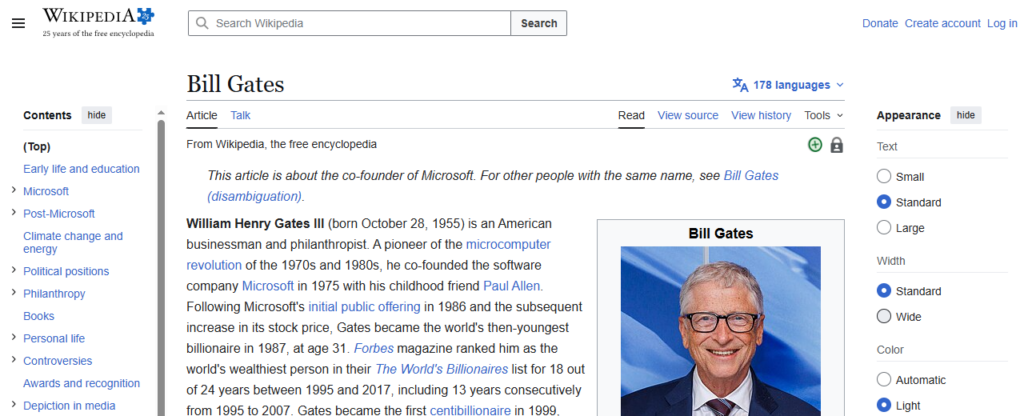
A Wikipedia page is a publicly editable encyclopedia article that lives on Wikipedia.org. It is written in neutral point of view, meaning it must present verifiable facts from independent, reliable sources without promotional language or original research.
Wikipedia pages are created and maintained by an open community of volunteer editors. The subject of an article has no editorial control over its content. If a business, person, or organization wants a Wikipedia presence, the article must be created by someone independent of that entity and must pass notability guidelines that require significant coverage in credible, third-party publications.
Key characteristics of a Wikipedia page include:
A Google Knowledge Panel is a structured information box that Google generates automatically for entities it recognizes as notable. It appears in the right column of desktop search results, or as a prominent card in mobile results, when a user searches for a recognized entity such as a company, person, place, or product.
Knowledge Panels pull information from the Knowledge Graph, a massive structured database Google has built by processing data from authoritative sources. Wikipedia is one of the most significant contributors to this data pool, but Google also draws from Wikidata, official websites, structured data markup, Google Business Profile, and other verified signals.
Once a Knowledge Panel exists for an entity, the subject can claim it through Google Search Console and suggest edits to specific fields. However, Google makes the final decision on what appears.
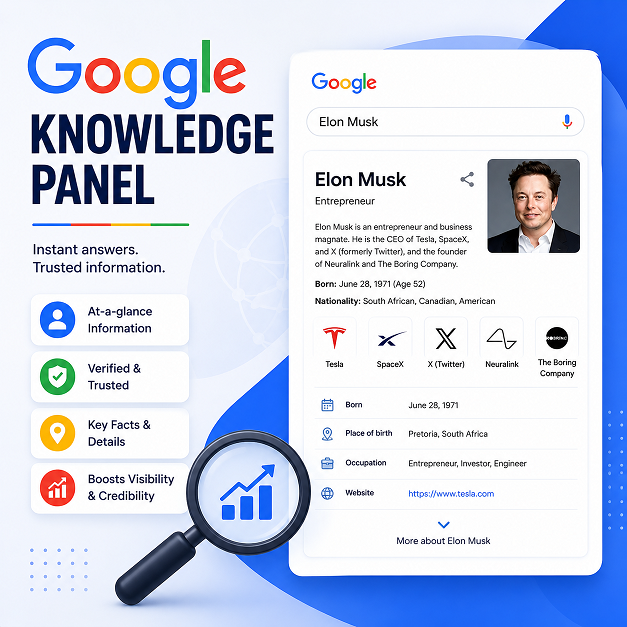
A Wikipedia page lives on Wikipedia.org and is accessible as a standalone web document. It has its own URL, can be linked to, cited, shared, and indexed independently by any search engine or AI system. A Google Knowledge Panel, by contrast, exists only within Google’s search results interface. It has no independent URL, cannot be directly linked to as a standalone resource, and vanishes the moment a user leaves the Google search environment.
This distinction matters for citation purposes. When journalists, researchers, or AI systems look for authoritative references, they can link to and extract content from a Wikipedia page. A Knowledge Panel does not function as a citable source in the same way.
Wikipedia content is written and controlled by volunteer editors under community governance rules. The subject of an article has no editorial rights, cannot add promotional content, and cannot remove accurate information they dislike. In contrast, the subject of a Knowledge Panel can claim it through Google Search Console and submit suggested edits to fields such as their description, logo, social media links, and contact information.
Even after claiming a Knowledge Panel, the subject does not have full editorial control. Google decides what changes to accept. Wikipedia offers no such pathway for the subject at all.
Wikipedia enforces strict notability criteria. To earn a Wikipedia page, an entity must have received significant coverage in reliable, independent, secondary sources. Wikipedia editors regularly delete articles that do not meet this standard, and articles for businesses or individuals without demonstrable third-party press coverage are typically rejected during review.
A Google Knowledge Panel does not follow the same formal notability threshold. Google may generate a Knowledge Panel for a local business, a niche musician, or a small-town politician based on structured data signals even if they have minimal press coverage. The entity simply needs to exist in Google’s data ecosystem in a sufficiently structured way.
Wikipedia is one of the primary training and retrieval sources for large language models including GPT-4, Gemini, and Claude. When AI systems answer questions about people, companies, events, or concepts, Wikipedia pages are frequently the underlying source. A well-maintained Wikipedia article significantly increases the likelihood that an AI system will describe an entity accurately and positively.
Knowledge Panels contribute to AI Overviews within Google Search specifically. Google’s generative search features pull structured data from Knowledge Graph entries to populate AI-generated summaries. However, the influence of a Knowledge Panel does not extend to external AI systems the way Wikipedia’s influence does.
For brands focused on AI visibility across multiple platforms, a Wikipedia page carries broader cross-platform authority than a Knowledge Panel.
A Wikipedia page, once established, is relatively stable. It may be edited by the community, but it persists unless the article is nominated for deletion and consensus supports removal. Deletion requires a formal process and must meet specific criteria such as loss of notability or discovery that the original sourcing was insufficient.
A Google Knowledge Panel can disappear without notice. Google can remove or stop generating a Knowledge Panel at any time if its algorithms determine the entity no longer meets the threshold for panel generation. Changes to Google’s Knowledge Graph or shifts in how Google processes entity data can cause panels to vanish, merge with other entities, or display incorrect information.
A Wikipedia page carries substantial long-term brand authority. It signals that an entity has been deemed notable enough by independent editors to warrant an encyclopedia entry. This signal is respected by journalists, researchers, investors, and general audiences. Many high-authority publications specifically cite Wikipedia as a reference, which creates secondary SEO value when Wikipedia links back to the brand’s official site.
A Knowledge Panel creates immediate visual authority in Google Search. When a branded search returns a Knowledge Panel, it signals to searchers that Google recognizes the entity as established. This can improve click-through rates on branded searches and reinforce trust during initial research phases. However, unlike Wikipedia, a Knowledge Panel does not carry citation value or contribute to academic or journalistic credibility outside of Google.
Wikipedia requires that every claim in an article be supported by a citation to a reliable, independent, secondary source. This means that brands must have legitimate press coverage in publications recognized by Wikipedia editors before a page can be created. Sources such as national newspapers, trade publications, peer-reviewed journals, and major digital media outlets are considered reliable. Press releases, the subject’s own website, and promotional content are not acceptable citations.
A Knowledge Panel has no visible citation structure in the same sense. Google synthesizes information from multiple sources and presents it without inline citations to the user. From the brand’s perspective, the underlying sources are important because they shape what Google includes in the panel, but the user-facing display does not require the same transparent sourcing model Wikipedia uses.
If a Wikipedia article contains inaccurate information, the subject cannot simply edit it themselves. They are expected to flag the issue on the article’s talk page and request that an independent editor review and correct it. Direct editing by a subject or a paid representative without disclosure violates Wikipedia’s conflict of interest guidelines and can result in editing restrictions.
If a Knowledge Panel contains incorrect information, the subject can use the feedback mechanism within the panel or access the claim process through Google Search Console to submit corrections. Google does not require the involvement of third-party editors, but it still reserves the right to accept or reject suggested changes. The correction process for a Knowledge Panel is generally faster and more direct than the Wikipedia editorial process.
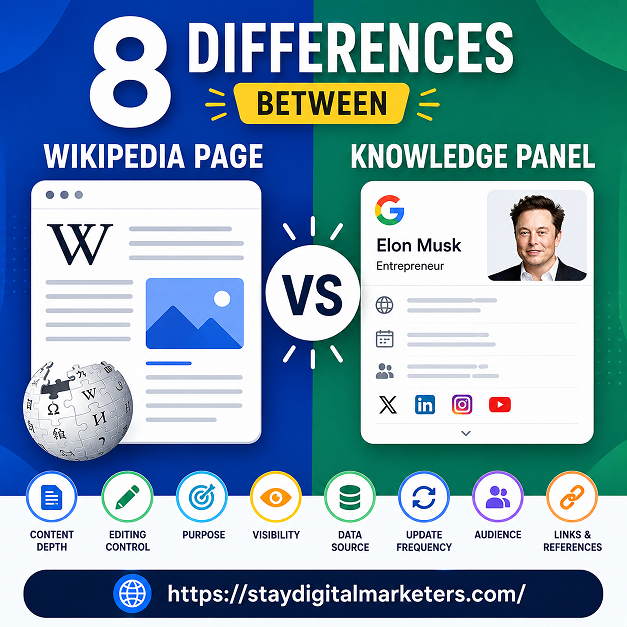
The table below summarizes the eight key differences for quick reference:
| Feature | Wikipedia Page | Google Knowledge Panel | Who Controls It |
| Created by | Volunteer editors | Google algorithm | Wikipedia / Google |
| Purpose | Encyclopedic reference | Quick SERP summary | Mixed |
| Editable by subject? | No (third-party only) | Claim & suggest edits | Partial |
| Notability required? | Yes, strict standards | Not always | Wikipedia enforces |
| Lives on Google SERP? | No | Yes | Google controls |
| Feeds AI answers? | Yes, heavily cited | Partial source | Both |
| Permanence | Stable if maintained | Can disappear | Varies |
| Brand authority signal | Strong, long-term | Immediate visibility | Complementary |
Practitioners managing entity presence across search and AI systems can use the WIKI-KP Alignment Framework to prioritize and sequence their efforts. The framework identifies four stages:
This sequence matters because Google’s Knowledge Graph is heavily informed by Wikipedia. Brands that build their Wikipedia presence first often find that a Knowledge Panel follows organically within weeks or months.
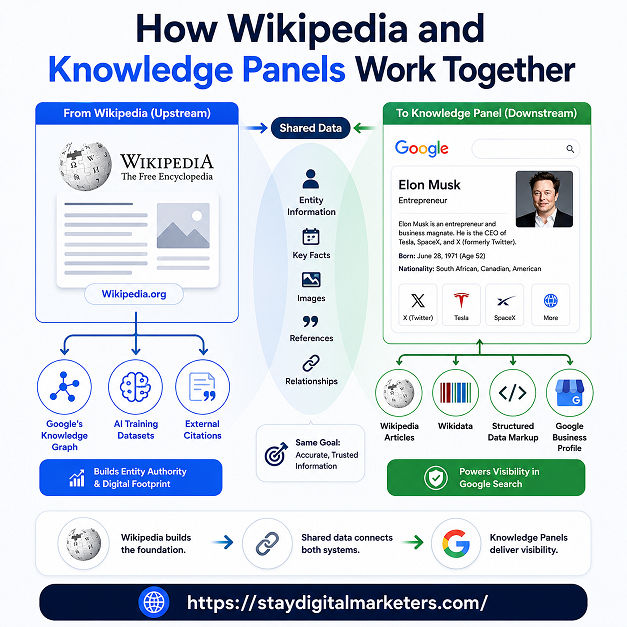
The answer depends on goals and timeline. For long-term authority building, AI visibility, and cross-platform credibility, a Wikipedia page is the stronger foundational asset. It feeds AI systems broadly, supports academic and journalistic references, and provides citation value that a Knowledge Panel cannot match.
For immediate search visibility and brand recognition on Google specifically, a Knowledge Panel delivers faster impact. It requires less infrastructure than Wikipedia and can be generated without a Wikipedia article, though having one significantly improves both the likelihood of panel generation and the accuracy of its content.
For most established brands and public figures, the most effective approach is not to choose between the two but to pursue both in a deliberate sequence, using third-party press coverage, Wikipedia article creation, and structured data implementation to reinforce each other.
Yes. A Wikipedia page is one of the strongest signals Google uses when deciding whether to generate a Knowledge Panel for an entity. While it is not the only factor, entities with Wikipedia pages are significantly more likely to have Knowledge Panels than those without. Google’s Knowledge Graph ingests data from Wikipedia and Wikidata to populate entity information, making Wikipedia a foundational input for panel generation.
Yes. Google can generate a Knowledge Panel for an entity that does not have a Wikipedia page, particularly for local businesses registered on Google Business Profile, public figures with strong structured data across the web, or organizations with verified Wikidata entries. However, without a Wikipedia page, the Knowledge Panel may be less detailed, less accurate, and more vulnerable to disappearing.
Any person or entity that meets Wikipedia’s notability guidelines is eligible for a Wikipedia page, but the page must be written by someone independent of the subject. Notability is typically demonstrated through significant coverage in reliable, third-party, secondary sources such as national newspapers, recognized trade publications, or major digital media. Self-promotional sources and press releases do not satisfy Wikipedia’s sourcing requirements.
Not directly without disclosure. Wikipedia’s conflict of interest guidelines require that anyone editing an article about themselves, their employer, or a client disclose that relationship. Undisclosed paid editing violates Wikipedia’s terms of use. Businesses can legally suggest corrections on the article’s talk page, but direct editing without disclosure risks sanctions and article flagging by the community.
There is no guaranteed timeline. Knowledge Panels can appear within days of an entity being established in Google’s Knowledge Graph, or they may take months of accumulated signals before triggering. The process is accelerated by having a Wikipedia page, a verified Google Business Profile, consistent structured data markup on the official website, active social profiles with consistent NAP data, and press coverage from authoritative sources.
A Wikipedia page does not directly pass link equity in the traditional SEO sense because Wikipedia links are marked as nofollow. However, the indirect SEO benefits are substantial. Wikipedia pages are cited and linked to by high-authority publications, which creates surrounding trust signals. Wikipedia is also one of the primary references Google uses to understand and classify entities, which can improve how the brand appears across search and AI-generated answers.
The entity that has claimed the Knowledge Panel can submit correction suggestions through Google Search Console using the feedback option. For unclaimed panels, users can use the feedback link visible at the bottom of the panel in search results. Google reviews these submissions and makes the final decision on updates. If the incorrect information originates from a Wikipedia article, correcting the Wikipedia source typically results in the Knowledge Panel updating within days to weeks.
For brands navigating entity establishment across search and AI environments, the combination of a Wikipedia page and a Google Knowledge Panel represents a dual-channel credibility infrastructure. Agencies such as Stay Digital Marketers support organizations in building the editorial presence required for both, offering services that include press release distribution to build third-party sourcing, Wikipedia page creation that meets community notability standards, and Google Knowledge Panel management to ensure entity data remains accurate and complete across the search ecosystem.

Filza Taj is an MPhil in Human Resources-turned SEO Specialist, Content Strategist, and Digital Marketing Consultant with over 5 years of experience helping businesses in 30+ countries grow online. As the Founder of Stay Digital Marketers (staydigitalmarketers.com), she delivers results-driven solutions in link building, guest posting, PR distribution, niche edits, multilingual backlinks, and content marketing. She publishes daily SEO insights and actionable strategies to help brands strengthen their online presence, attract the right audience, and convert clicks into loyal customers.
Filza@staydigitalmarketers.com
Stay Digital Marketers
Need SEO, Link Building or Digital Marketing Services?
Request a Free Audit →