
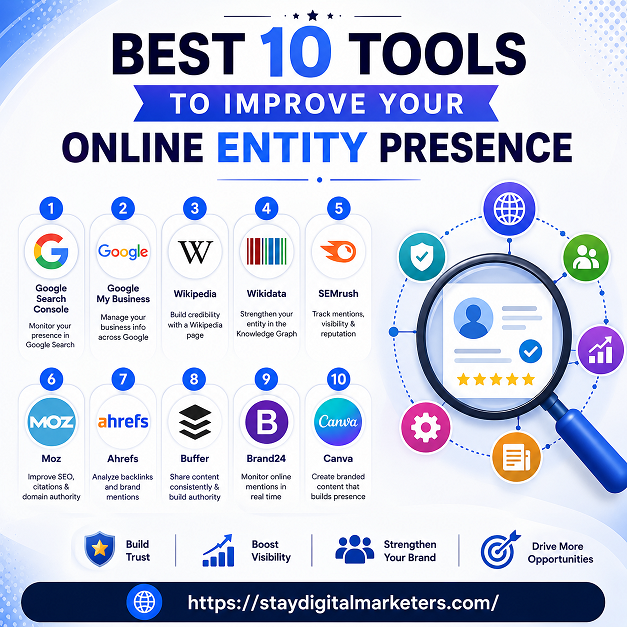
Online entity presence is no longer a technical SEO footnote. It is the foundation of how search engines, AI systems, and knowledge graphs understand, trust, and surface a brand. Whether a business appears in a Google Knowledge Panel, gets cited by ChatGPT, or ranks in AI Overviews depends on how clearly that brand is recognised as a defined entity across the web.
An entity, in the context of SEO, is any clearly identifiable person, place, brand, or concept that a search engine can connect to a network of facts, relationships, and references. Google’s Knowledge Graph contains over 500 billion facts about 5 billion entities, and brands that exist inside this graph carry a structural advantage that keywords alone cannot replicate. Improving your entity presence means building that recognition deliberately, with the right tools.
The following ten tools cover the full entity optimisation stack, from content creation and structured data to AI citation tracking and Knowledge Graph management. Each has been selected based on its ability to deliver measurable improvements in entity recognition, AI visibility, and brand authority.
Key Takeaways
Before choosing any tool for entity optimisation, practitioners should apply the VIPER scoring model to assess fit:
Tools that score strongly across all five dimensions offer the most complete path to improved entity presence. The list below covers tools that collectively address every VIPER pillar.
| Tool | Primary Use Case | Best For | AI Visibility | Pricing |
| Google Search Console | Performance & entity indexing | All brands | Core | Free |
| Semrush | Brand monitoring & authority | Mid-to-large brands | Advanced | From $140/mo |
| Surfer SEO | Entity-optimised content creation | Content teams | Strong | From $99/mo |
| InLinks | Entity mapping & interlinking | SEO specialists | Strong | From $49/mo |
| Google NLP API | Entity extraction & salience | Technical SEOs | Core | Free (limited) |
| SE Ranking | AI Overview tracking | Agencies | Advanced | From $65/mo |
| WordLift | Structured data & schema | Publishers, e-commerce | Strong | From $59/mo |
| Wikidata | Knowledge Graph entry management | Established brands | Foundational | Free |
| Mention.com | Brand mention monitoring | Brand managers | Moderate | From $41/mo |
| Keyword.com | AI rank & citation tracking | AI-first SEO teams | Cutting-edge | From $69/mo |
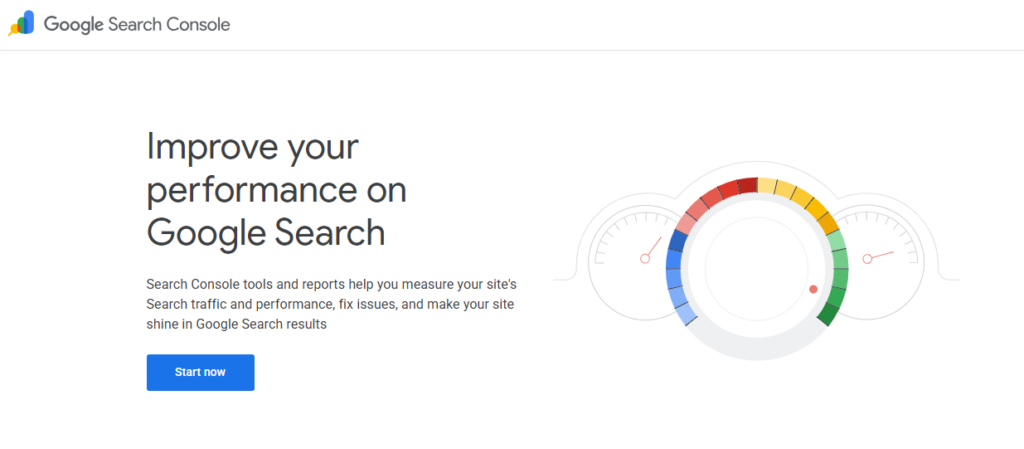
Google Search Console is the essential baseline. It shows how Google perceives a site’s pages, which queries trigger impressions, and whether structured data has been processed correctly. From an entity standpoint, the Search Console reveals whether Google connects a brand to the right queries and whether rich results from schema markup are being rendered.
The Performance and Coverage reports are the starting point for any entity audit. If a brand’s name does not appear in the queries driving branded impressions, there is likely a disambiguation problem worth addressing through structured data and third-party citations.
Best for: All brands building entity presence from the ground up. Free to use.
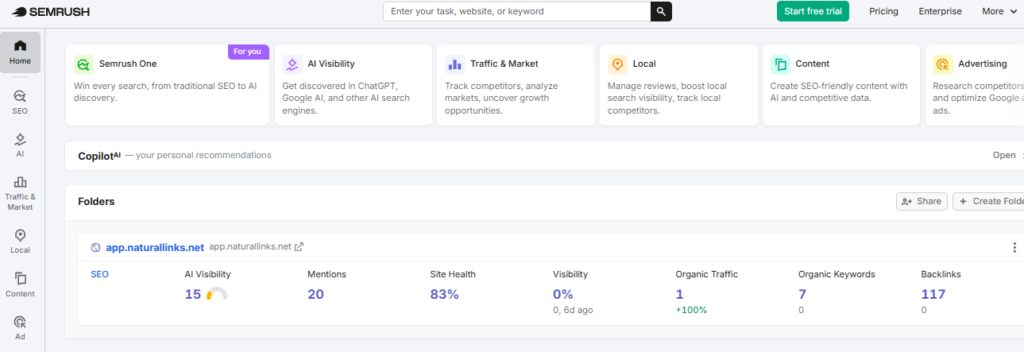
Semrush offers one of the most comprehensive toolsets for tracking brand entity signals. Its Brand Monitoring feature tracks unlinked brand mentions across the web, one of the strongest off-page signals for entity corroboration. The platform also provides Domain Authority analysis, backlink data, and competitive gap reports that identify where competitor entities are being cited but a brand is not.
A particularly valuable feature for entity SEO is the Topic Research tool, which maps semantic relationships around core topics. Understanding how a brand’s primary subject area connects to adjacent concepts helps content teams build topical clusters that reinforce entity relevance.
Research from Semrush’s own State of Content Marketing report found that brands with consistent topical content clusters achieved 55 percent higher organic traffic than those using isolated keyword targeting. That structural advantage is fundamentally an entity signal.
Surfer SEO has evolved into one of the most advanced entity-aware content editors on the market. Its right-panel entity tracker monitors which entities appear in top-ranking competitor content and prompts writers to include related concepts, terms, and facts that AI systems use to assess topical completeness.
The AI Tracker within Surfer shows how a brand appears across ChatGPT, Perplexity, and Google AI Overviews, including which pages are being cited and which competitor entities dominate specific prompts. The Mention Gap report is particularly practical: it surfaces prompts where competitors appear but a given brand does not, creating a direct action list for content teams.
For teams creating content at volume, Surfer’s integration of entity coverage scoring into the live editing workflow means every article is being optimised for AI extraction while it is being written, not retrofitted afterward.
InLinks takes a fundamentally entity-first approach to SEO. The platform uses natural language processing to extract entities from a site’s content, map them to Wikipedia and Wikidata entries for disambiguation, and then automatically create internal linking structures that reinforce those entity relationships.
What makes InLinks valuable is its entity salience reporting. Salience refers to how central a particular entity is to a piece of content. High entity salience for a brand’s core topic is one of the strongest signals Google’s NLP systems use to assess topical authority. InLinks surfaces this data in actionable dashboards rather than raw API output.
The tool is especially useful for brands managing large content libraries where manual entity auditing is impractical. Platforms like InLinks can process hundreds of pages and return a prioritised list of entity gaps within a single crawl.
The Google Natural Language API is the same technology Google uses to extract entities from web pages. Running content through this free tool shows exactly which entities Google identifies, their salience scores, and their Wikipedia knowledge base entries.
For SEOs, this is invaluable diagnostic information. If a brand’s About page does not surface the brand as the primary entity with high salience, it signals that the page needs stronger entity signals: clearer definitions, more structured data, and better topical focus. Any content that will be used to support entity claims, including About pages, author bios, and service descriptions, should be tested through this API before publication.
This tool sits at the intersection of technical SEO and entity strategy. It requires some technical comfort, but the insight it delivers is not available anywhere else.
SE Ranking has developed one of the most sophisticated AI Overview tracking features currently available. The platform treats the content and links inside AI Overviews as a separate SERP and tracks a brand’s presence within them independently of traditional rank positions.
This matters because a site can rank highly for a keyword in organic results but be entirely absent from the AI Overview that appears above those results. SE Ranking lets practitioners see which of their pages are being cited in AI Overviews, which competitors dominate those summaries, and how that visibility changes over time as content is updated.
The platform also integrates with Google Analytics 4 and provides social analytics through Planable, making it one of the few tools that connects entity presence in AI search to measurable traffic and conversion outcomes.
WordLift specialises in the implementation of schema markup and structured data, which are the primary technical mechanisms through which search engines confirm entity attributes. The platform automates the creation of JSON-LD markup for organisations, persons, products, and articles, and connects those schemas to corresponding Wikidata and DBpedia entries for external disambiguation.
Schema markup that connects a brand’s entity to the Knowledge Graph is one of the fastest ways to accelerate entity recognition. WordLift’s automation removes the technical barrier for teams without developer resources. Its Knowledge Graph builder also creates a machine-readable version of a site’s entity relationships, which AI crawlers can use to extract structured facts about a brand during indexing.
For e-commerce brands and publishers with large product or content catalogues, WordLift’s bulk schema generation is a significant time saver with direct entity visibility benefits.
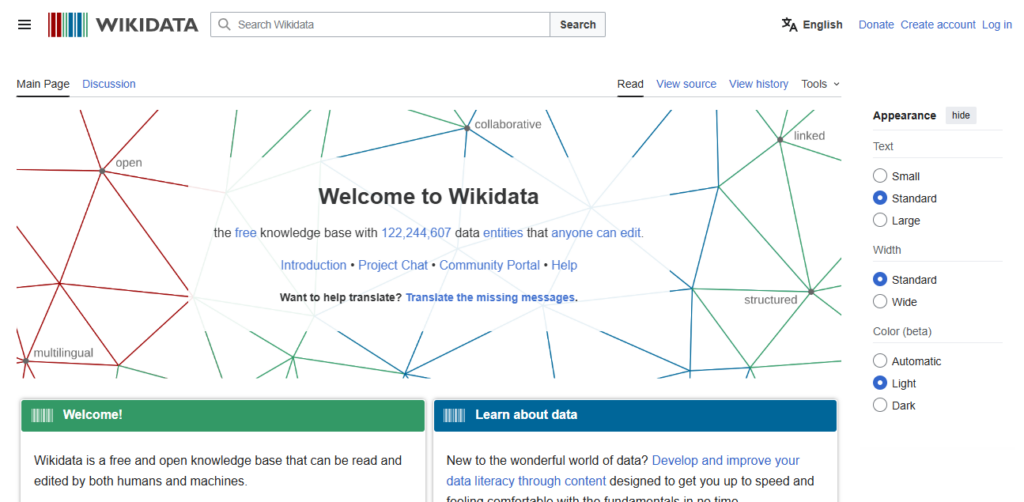
Wikidata is not a traditional SEO tool, but it is one of the most influential platforms for entity presence. Google’s Knowledge Graph draws heavily from Wikidata records when building entity profiles. A brand with a complete, well-structured Wikidata entry has a clear advantage in achieving Knowledge Panel appearance and AI citation consistency.
The critical elements of an effective Wikidata entity record include: instance of (what the entity is), industry, founding date, location, official website, social media links, and key personnel. Brands with sparse Wikidata records are harder for AI systems to disambiguate from similarly named entities, which directly reduces citation accuracy.
Managing a Wikidata entry requires understanding the platform’s editor interface, but the effort is well justified. It is one of the few places where a brand can directly contribute to the structured data that Google and AI language models use to identify and describe it.
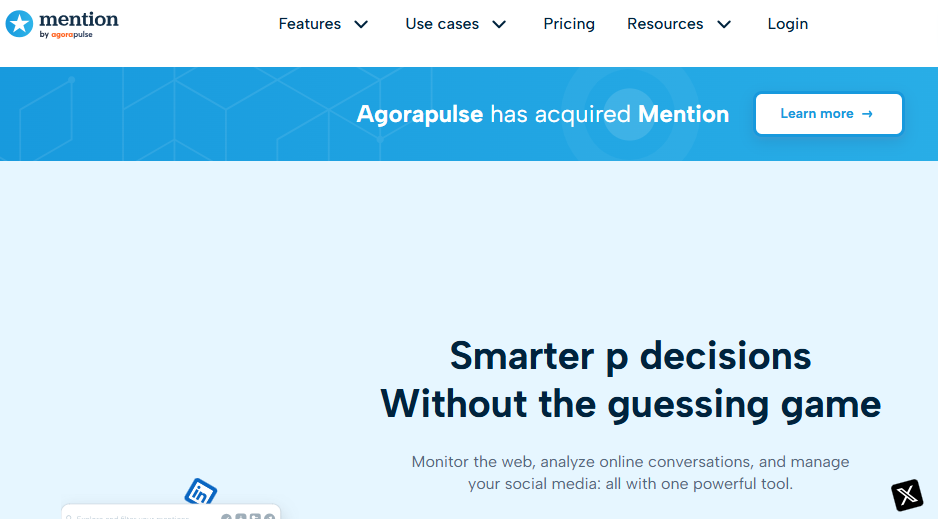
Brand mentions are one of the primary off-page signals used to corroborate entity existence. When a brand’s name appears consistently in relevant publications, reviews, podcasts, and forums without a link, search engines still register that co-occurrence as an entity signal. Mention.com tracks these unlinked mentions in real time across the web and social media.
The platform’s sentiment analysis layer adds an additional dimension: it shows not just where a brand is being mentioned, but whether the context is positive, negative, or neutral. Entity reputation is an increasingly important component of E-E-A-T signals, and consistent positive mentions in authoritative publications directly strengthen a brand’s entity trustworthiness.
Practitioners use Mention.com to identify both gaps (where a brand should be mentioned but is not) and opportunities (publications that frequently mention competitors but have never referenced their brand).
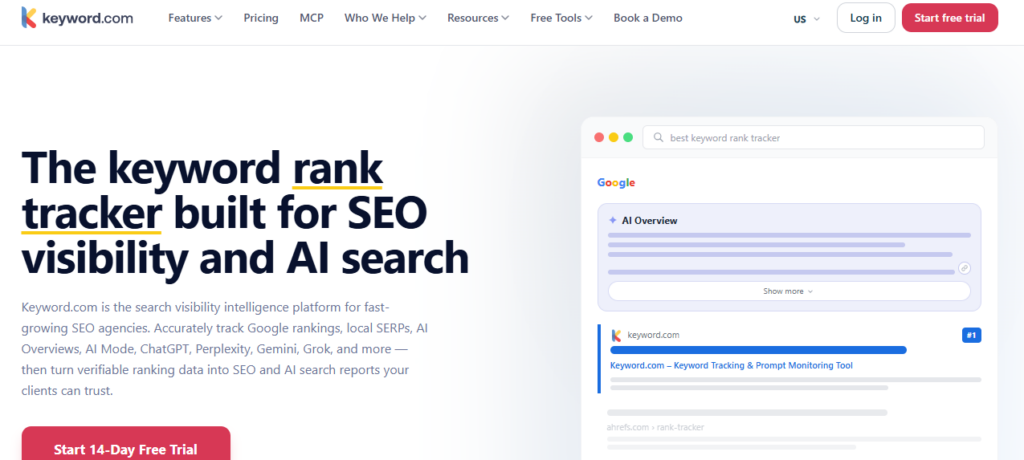
Keyword.com has positioned itself as a purpose-built tool for tracking entity visibility in the generative AI era. Its AI Rank Tracker monitors brand mentions and citations across Google AI Overviews, Gemini, ChatGPT, and other generative platforms, providing a consolidated view of how a brand’s entity is being represented across AI-generated answers.
What distinguishes Keyword.com from standard rank trackers is its citation frequency reporting: it shows which sources AI platforms are drawing from when referencing a brand, and how consistently a brand appears in responses to relevant prompts. This data is the closest available proxy for AI entity recognition strength.
As AI-generated answers continue to capture a larger share of search interactions, tools that measure presence within those answers become essential. A brand can hold strong traditional rankings while being effectively invisible in the AI layer. Keyword.com makes that gap visible.
Online entity presence refers to how clearly and consistently a brand, person, or organisation is understood and referenced by search engines and AI systems. Entities that are well-defined in the Knowledge Graph receive higher quality traffic, appear in AI-generated answers, and earn Knowledge Panel features. It matters because keyword rankings alone no longer determine visibility in AI-driven search environments.
Search for your brand name in Google and check whether a Knowledge Panel appears on the right side of the results. You can also use the Google NLP API to analyse your About page and see whether Google extracts your brand as a primary entity with a linked knowledge base entry. If no panel appears and no entity is extracted, your brand’s structured data and third-party citations need strengthening.
Keyword.com and SE Ranking are currently the strongest options for tracking brand citations in AI-generated answers. SE Ranking tracks AI Overview inclusions and treats them as a separate SERP. Keyword.com monitors citation frequency across ChatGPT, Gemini, and Google AI Overviews. Surfer’s AI Tracker also provides useful competitor citation gap analysis.
Structured data is necessary but not sufficient on its own. Schema markup signals entity attributes to search engines, but it needs to be corroborated by consistent off-page mentions, a Wikidata entry, Wikipedia references, and high-quality content that demonstrates topical authority. The strongest entity signals come from combining technical schema with broad third-party citation coverage.
Entity recognition typically evolves over months rather than days. Structured data implementations can show results in four to eight weeks as Googlebot re-crawls pages. Knowledge Graph entries, once corroborated by sufficient external references, can trigger Knowledge Panel features within three to six months. AI citation improvements tend to follow content and entity updates with a lag of two to four weeks depending on the platform’s crawl frequency.
Entity salience is a score indicating how central a particular entity is to a piece of content. A salience score close to 1.0 means the entity is the primary focus. To improve salience for a brand entity, create content that places the brand name in prominent positions (first paragraph, headings, conclusion), uses consistent brand terminology, and avoids diluting the page with too many competing entity references unrelated to the core topic.
Most practitioners will not need all ten simultaneously. A practical starting stack includes Google Search Console (free monitoring), the Google NLP API (entity extraction testing), one entity-aware content tool such as Surfer or InLinks, and a brand mention tracker such as Mention.com or Semrush. Add WordLift for structured data and Keyword.com or SE Ranking once AI visibility tracking becomes a priority.
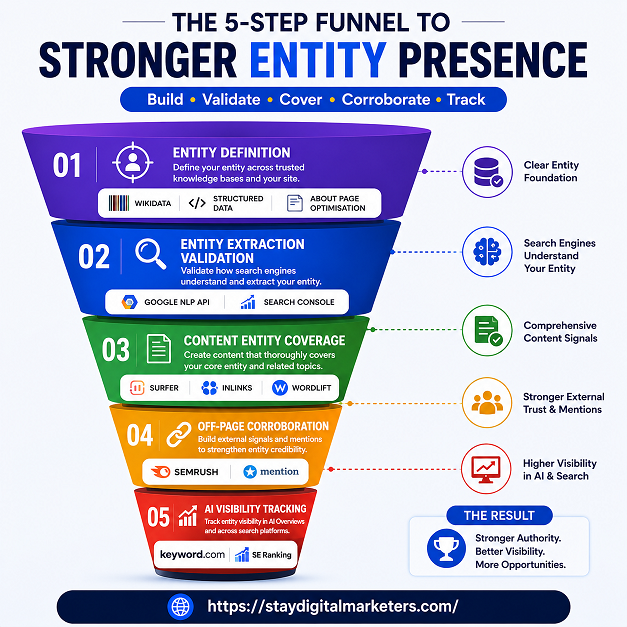
For brands working to establish a verifiable entity presence, the off-page dimension is often the slowest to build. Agencies such as Stay Digital Marketers specialise in the type of third-party citation work that accelerates this process, including guest posting on high-authority publications, brand mentions, press release distribution, niche edits, SaaS backlink acquisition, Wikipedia page creation, and Google Knowledge Panel management. These services address the corroboration layer that structured data alone cannot create, making them a practical complement to the tool-led strategies described in this article.

Filza Taj is an MPhil in Human Resources-turned SEO Specialist, Content Strategist, and Digital Marketing Consultant with over 5 years of experience helping businesses in 30+ countries grow online. As the Founder of Stay Digital Marketers (staydigitalmarketers.com), she delivers results-driven solutions in link building, guest posting, PR distribution, niche edits, multilingual backlinks, and content marketing. She publishes daily SEO insights and actionable strategies to help brands strengthen their online presence, attract the right audience, and convert clicks into loyal customers.
Filza@staydigitalmarketers.com
Stay Digital Marketers
Need SEO, Link Building or Digital Marketing Services?
Request a Free Audit →