
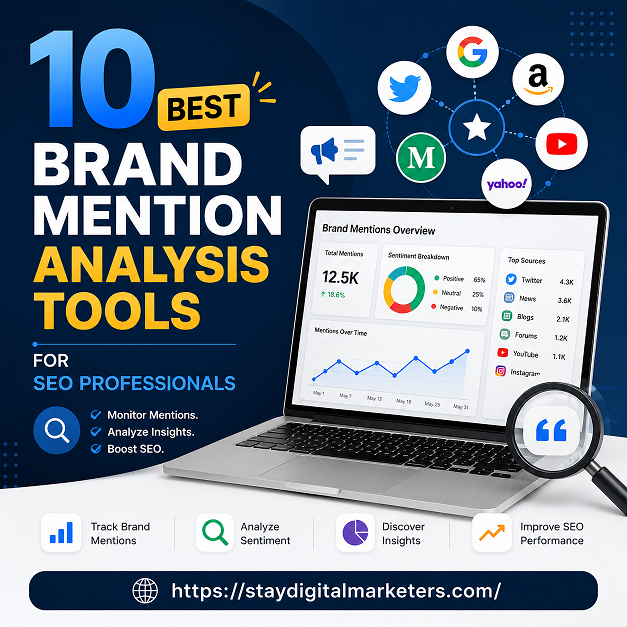
Brand mention analysis has shifted from a nice-to-have task to a core pillar of modern SEO strategy. When AI systems like ChatGPT, Perplexity, and Google AI Overviews synthesize responses using third-party content, where your brand appears, and how it is described directly influence organic discoverability, referral traffic, and audience trust.
Brand mention analysis tools are platforms that track, aggregate, and evaluate every instance your brand name (or a competitor’s) appears across the web, social media, news publications, forums, and increasingly, AI-generated search results. For SEO professionals managing reputation, link-building pipelines, and digital PR campaigns, these tools provide the data layer that informs almost every strategic decision.
This guide covers the ten best tools available in 2026, how they differ, and a practical framework for choosing the right one based on your specific workflow.
Key Takeaways
Brand mention analysis is the process of identifying, cataloguing, and evaluating all instances where your brand name appears across digital channels. These mentions range from full editorial reviews and news articles to Reddit comments, social posts, and citations within AI-generated answers.
From an SEO perspective, brand mentions carry weight in two distinct ways. Linked mentions pass direct equity through backlinks. Unlinked mentions, sometimes called implied links or co-citations, contribute to entity authority signals that search engines and AI models use to assess a brand’s credibility and relevance within its industry.
According to research published by Semrush, brands with consistent positive mention velocity across authoritative domains tend to recover faster from algorithm updates and appear more frequently in AI Overview summaries. The relationship between brand signal strength and organic visibility is no longer theoretical; it is measurable.
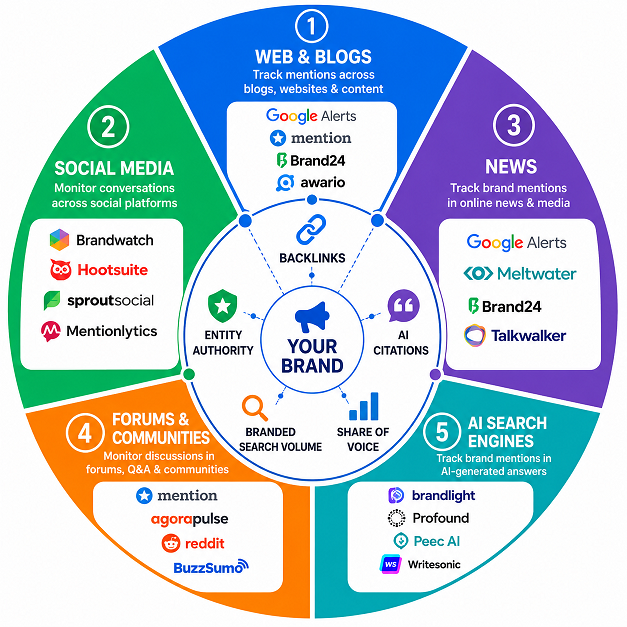
Most brand mention tools operate by crawling or monitoring specific data sources at scheduled intervals, then filtering results against your tracked keywords, brand names, or competitor terms. More advanced platforms add sentiment scoring, share-of-voice metrics, and AI visibility tracking on top of this base layer.
There are three core monitoring architectures in the market right now:
The most capable tools combine all three into a unified dashboard, which is why the category has become significantly more complex since 2023.
Before diving into individual tools, it helps to have a structured way to assess them. The TRACE framework provides five evaluation criteria that map directly to SEO use cases:
Use these five dimensions to score any tool before committing to a paid plan.
Best for: SEO professionals who need both backlink intelligence and AI search visibility in one platform.
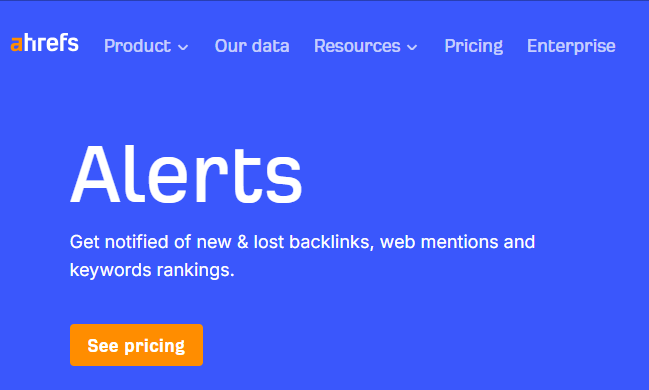
Ahrefs operates two distinct brand monitoring products. Ahrefs Alerts monitors new and lost backlinks, web mentions, and keyword rank changes. Brand Radar, launched as a premium add-on in late 2025, tracks how your brand appears within AI-generated results from ChatGPT, Perplexity, Google AI Overviews, and Microsoft Copilot, using a database of over 150 million monitored queries.
The combination is difficult to match for SEO teams. Alerts handles traditional web monitoring with the accuracy that Ahrefs’ backlink index, covering over 35 trillion known links, makes possible. Brand Radar then extends that coverage into the AI layer, showing placement position, citation frequency, and competitive share of voice within LLM responses.
The main limitation is cost. Brand Radar starts at $199 per month as an add-on to existing Ahrefs plans, which begin at $129 per month. For teams already using Ahrefs as their primary SEO platform, the incremental cost is justifiable. For those who are not, the combined investment is significant.
TRACE score highlights: Strong on tracking scope, real-time performance, and AI coverage. Excellent export integration.
Best for: Teams that want mention tracking embedded within a full SEO and competitive intelligence workflow.
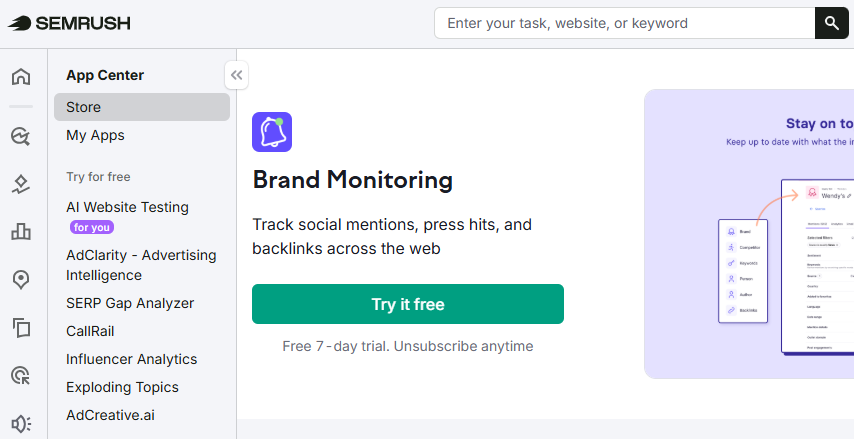
Semrush Brand Monitoring surfaces unlinked mentions across news sites, blogs, and social platforms and allows you to convert them into link opportunities directly within the interface. The integration with Semrush’s broader toolkit- keyword research, backlink audits, traffic analytics- means brand data does not exist in isolation; it feeds directly into content and outreach decisions.
Semrush has also expanded into LLM monitoring, tracking brand citations in AI-generated answers as part of its broader AI Visibility product. For SEO professionals managing large content portfolios, the ability to correlate traditional rank positions with AI mention frequency in a single platform is a clear operational advantage.
Pricing scales with plan level, starting at $139.95 per month for the Pro plan.
Best for: Mid-market teams that need strong web and social monitoring without enterprise-level spend.
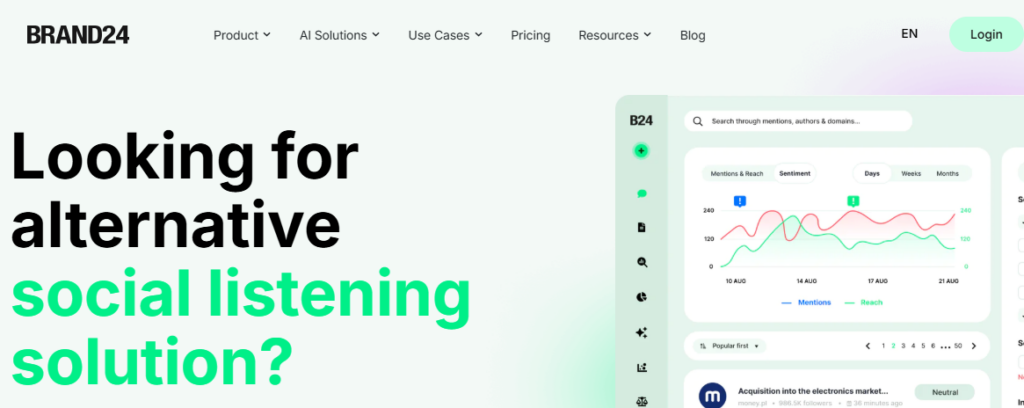
Brand24 crawls a wide range of sources including news sites, blogs, podcasts, review platforms, and social media channels. Its AI-powered sentiment analysis categorizes mentions as positive, negative, or neutral, and the Presence Score feature gives brands a single metric for tracking overall mention health over time.
A key differentiator is coverage of niche forums and smaller publications that many enterprise tools miss. For brands in specialized verticals, SaaS, ecommerce, and professional services, this breadth matters. Brand24’s Individual plan currently sits at $199 per month (or $149 on annual billing), positioning it as accessible for growing teams.
One area where Brand24 trails the leaders is AI search visibility. It detects AI-influenced brand mentions across the web and AI summaries, but does not yet offer the dedicated prompt-level LLM tracking that tools like Brand Radar or SE Ranking provide.
Best for: SEO professionals who need granular AI visibility data alongside traditional rank tracking.
SE Ranking has built what is arguably the most detailed AI search tracking toolkit available at its price point. The platform tracks brand appearances across Google AI Overviews, AI Mode, Gemini, Perplexity, and ChatGPT. It shows which search queries trigger AI answers that feature your brand, whether you are mentioned or linked, exact placement data including top-3 positions in AI results, and cached copies of AI answers so you can see exactly how your brand is presented in context.
Historical trend data makes it possible to measure the impact of specific content changes or PR efforts on AI visibility over time, a capability that most tools in this category lack entirely. For SEO teams navigating the shift from blue-link rankings to AI-answer placements, SE Ranking provides the most actionable data set in the mid-market segment.
Best for: Enterprise PR and communications teams with substantial brand monitoring budgets.
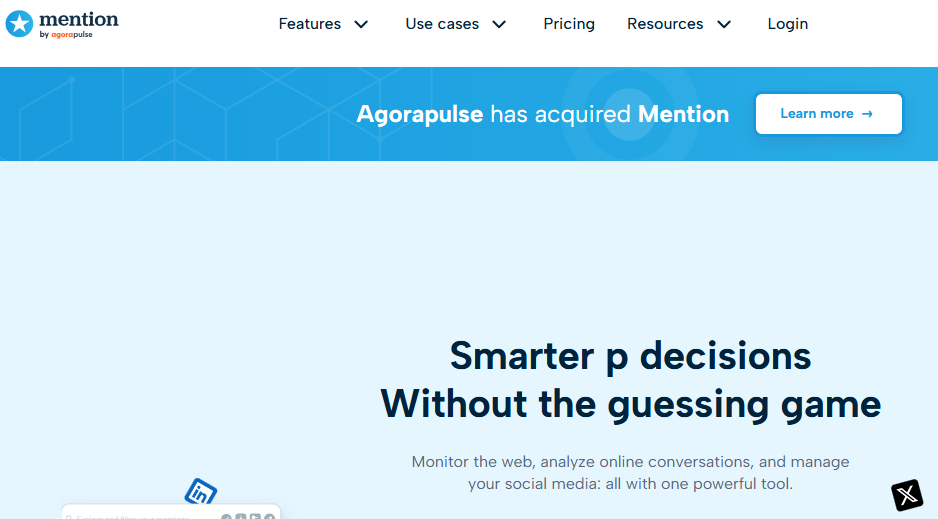
Mention monitors the web, social media, and news in real time, with Boolean search operators that allow highly refined tracking rules. The platform integrates with Slack, Salesforce, and most major CRM systems, making it practical for large teams where mention data feeds into multiple workflows simultaneously.
One important market shift: Mention retired its self-serve pricing tiers (Solo, Pro, ProPlus) in mid-2025. The platform now operates exclusively through its Company Plan at $599 per month, effectively repositioning it as an enterprise product. Teams that previously used Mention’s more affordable tiers have largely migrated to Brand24 or Ahrefs Alerts.
The removal of its social publishing and response features in January 2026 also means teams must now pair Mention with a separate social management tool, which adds complexity and cost.
Best for: Large consumer brands that need social listening, influencer tracking, and brand monitoring under one roof.
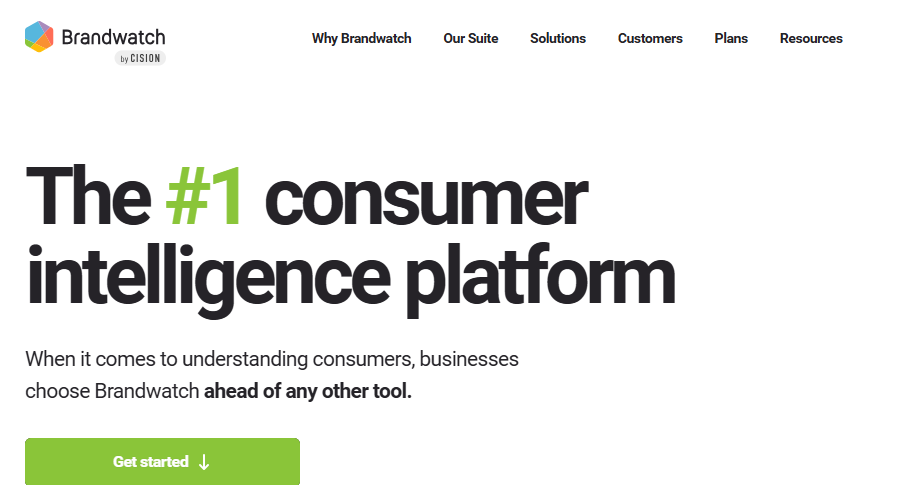
Brandwatch processes data from Facebook, Instagram, LinkedIn, X, Reddit, WhatsApp, YouTube, and a wide range of web sources. Its AI analysis layer identifies trends, influential voices, and emerging narratives around a brand before they gain mainstream momentum, a capability particularly valuable for crisis communications and product launch monitoring.
Enterprise clients including Nestlé and Toyota have used Brandwatch for market intelligence beyond pure SEO, covering audience segmentation, campaign analysis, and influencer identification from a database of over 30 million creators. All plans are custom-priced through a sales engagement, which makes it inaccessible for smaller teams but well-suited for organizations with complex, multi-market monitoring requirements.
Best for: Social media marketing teams that need brand monitoring integrated with scheduling, analytics, and team workflows.
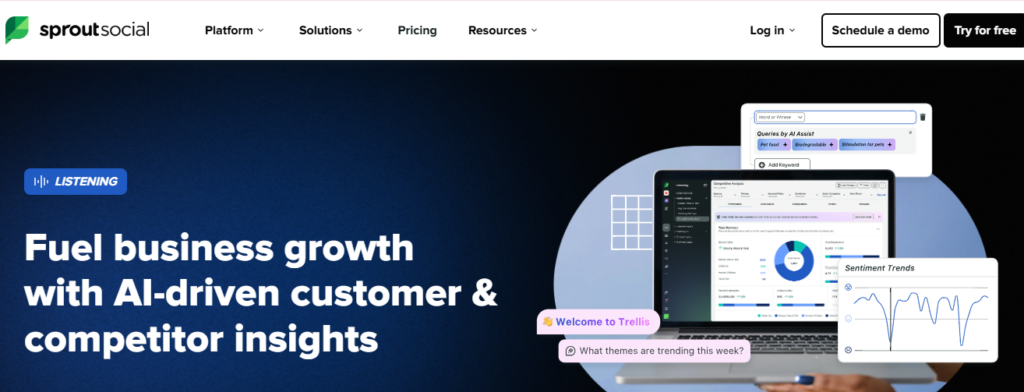
Sprout Social’s listening feature uses AI to track how people discuss your brand and competitors across social platforms. The templated monitoring setups, covering brand health, competitor benchmarking, campaign analysis, and event monitoring, reduce configuration time significantly compared to building custom Boolean queries from scratch.
The platform is designed for social media managers rather than pure SEO professionals, but the competitive benchmarking data it produces feeds usefully into broader brand strategy. For teams that already use Sprout Social for social media management, the listening add-on provides incrementally valuable data without requiring a separate tool investment.
Pricing begins at $79 per month per seat for the Essentials plan, with listening features available from the Standard plan at $199 per month per seat.
Best for: Small SEO agencies and consultants who need real-time monitoring across web and social at a lower price point.
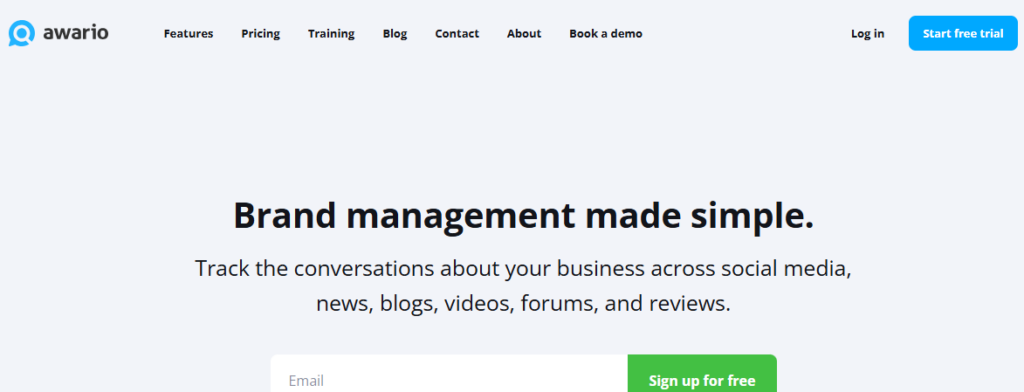
Awario monitors news sites, blogs, Reddit, and social platforms in near-real time, with Boolean search support for precise tracking. Its Mention Feed provides a chronological stream of new mentions, while the Leads feature identifies conversations where users express buying intent related to your brand category, useful for sales-adjacent SEO teams.
Awario’s pricing starts significantly lower than most competitors, with plans accessible for individual practitioners and small agencies. The trade-off is data depth: Awario’s index does not match Ahrefs or Brand24 in breadth, and it does not yet offer dedicated AI search engine tracking.
Best for: SEO teams focused specifically on tracking AI search visibility at a more accessible price than Ahrefs Brand Radar.
Peec AI monitors brand appearances inside AI search engines, including ChatGPT, Perplexity, and Google AI Overviews. Unlike traditional web crawlers, Peec AI submits tracked prompts directly to these platforms and records whether and how your brand appears in the generated responses.
The tool is significantly cheaper than Brand Radar. Starter plans begin at $95 per month and include a conversational chat interface that allows you to query your monitoring data directly without navigating multiple dashboard views. For brands focused specifically on AI search visibility rather than broad web monitoring, Peec AI delivers substantial value relative to its cost.
The limitation is scope. Peec AI covers the AI search layer well, but does not replace a full-spectrum brand monitoring platform for teams that also need social and news coverage.
Best for: Individual practitioners and small teams who need basic brand mention alerts at zero cost.
Google Alerts remains the most widely used free brand monitoring tool available. Users set keyword-based alerts and receive email notifications when Google indexes new content matching those terms. For bootstrapped teams or those testing brand monitoring workflows before investing in paid tools, Google Alerts provides a viable starting point.
The limitations are well-documented. Google Alerts misses a significant percentage of web mentions due to indexing delays and crawler gaps. It provides no sentiment analysis, no competitive benchmarking, no social media monitoring, and no AI search coverage. For any SEO professional managing a brand with meaningful online presence, Google Alerts should be treated as a supplementary signal at best, not a primary monitoring system.
| Tool | Web Monitoring | Social Monitoring | AI Search Coverage | Starting Price | Best For |
|---|---|---|---|---|---|
| Ahrefs Alerts + Brand Radar | Yes | Limited | Yes (ChatGPT, Perplexity, Gemini, Copilot) | $129/mo + $199/mo add-on | SEO pros needing full-stack coverage |
| Semrush Brand Monitoring | Yes | Yes | Yes (AI Visibility add-on) | $139.95/mo | Integrated SEO + brand workflows |
| Brand24 | Yes | Yes | Partial | $149/mo (annual) | Mid-market teams, wide source coverage |
| SE Ranking | Yes | Limited | Yes (AI Mode, Gemini, Perplexity, ChatGPT) | $52/mo | AI rank tracking + traditional SEO |
| Mention | Yes | Yes | No | $599/mo | Enterprise PR teams |
| Brandwatch | Yes | Yes | No | Custom | Large consumer brands |
| Sprout Social | Limited | Yes | No | $199/mo/seat | Social-first marketing teams |
| Awario | Yes | Yes | No | $29/mo | Small agencies, consultants |
| Peec AI | No | No | Yes (ChatGPT, Perplexity, AI Overviews) | $95/mo | AI-only visibility tracking |
| Google Alerts | Partial | No | No | Free | Basic supplementary alerts |
The right tool depends on where your monitoring gaps actually exist. Most SEO professionals should think through three sequential questions.
What surfaces are you trying to cover? If your priority is traditional web and backlink monitoring, Ahrefs Alerts and Semrush Brand Monitoring cover this comprehensively. If AI search visibility is the primary concern, SE Ranking and Peec AI offer deeper prompt-level data at a more accessible price than Ahrefs Brand Radar.
How large is your team and how complex is your reporting requirement? Solo practitioners and small agencies rarely need the infrastructure of Brandwatch or enterprise Mention. Brand24, Awario, or Peec AI will meet the core needs at a fraction of the cost. Larger teams with cross-functional reporting requirements benefit from tools that connect natively to Slack, Salesforce, or BI platforms.
Is AI search visibility a current priority or a future consideration? If your audience is actively using ChatGPT and Perplexity as discovery channels, which the data suggests is true for technology, SaaS, finance, and health verticals, AI tracking is not optional. Tools without this capability will leave a significant monitoring blind spot.
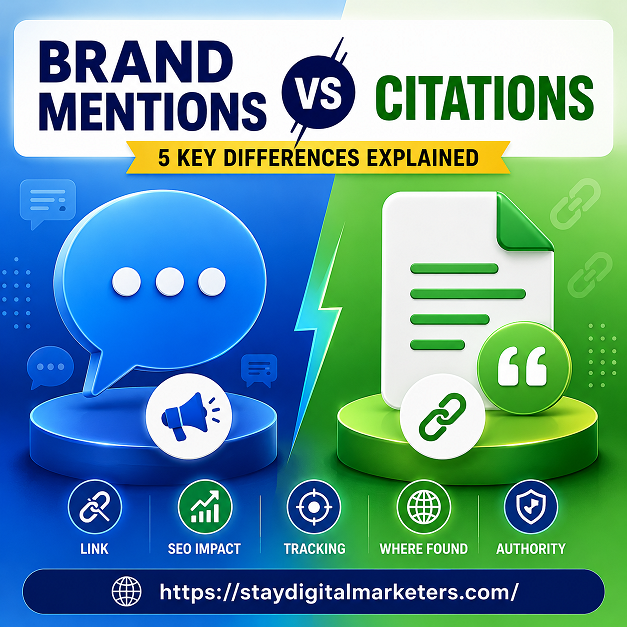
This distinction matters for SEO strategy. A backlink is a hyperlink from an external domain pointing to your site; it passes link equity and is directly measurable in tools like Ahrefs or Semrush. A brand mention is any reference to your brand name, whether linked or not.
Unlinked brand mentions matter because search engines use them as entity signals, evidence that a brand is recognized and discussed within a specific topic space. AI systems rely on them even more heavily, since LLMs are trained on text corpora in which your brand’s presence and described attributes shape how the model represents you in its generated answers.
Converting unlinked mentions into backlinks is one of the highest-ROI outreach tactics for SEO professionals, which is why tools like Semrush Brand Monitoring and Ahrefs Alerts are worth the investment for link-building teams.
Google has never confirmed that unlinked mentions directly influence PageRank. However, several lines of evidence suggest they contribute to entity authority, which does affect how Google understands and ranks brand-related queries. The Google API leak in 2024 surfaced documentation referencing entity associations and co-citation patterns as ranking inputs, lending credibility to what SEO practitioners had observed empirically for years.
More concretely, brand mentions drive ranking improvements indirectly through several mechanisms: they generate referral traffic that improves engagement signals, they increase branded search volume which correlates strongly with organic authority, and they expand the pool of pages from which you can pursue backlink conversion outreach.
What is the best free brand mention tool? Google Alerts is the most widely used free option, but Ahrefs and Awario both offer limited free tiers. For teams that need reliable free monitoring, combining Google Alerts with periodic manual searches on Reddit and relevant forums provides reasonable basic coverage.
How do brand mentions in AI search results affect SEO? AI search engines like ChatGPT and Perplexity source responses from web content they have crawled or retrieved. Brands mentioned positively and frequently in authoritative sources are more likely to appear in AI-generated answers. This creates a compounding effect: more quality mentions lead to more AI citations, which drive more branded search volume, which strengthens overall organic authority.
What is share of voice in brand monitoring? Share of voice measures the percentage of total brand mentions in a category or topic space that belong to your brand versus competitors. A brand with 35% share of voice in a category with 10,000 monthly mentions is discussed nearly 3,500 times, while a competitor at 15% share of voice generates around 1,500 mentions. Tracking share of voice over time reveals whether content and PR efforts are effectively expanding brand presence relative to competitors.
Do I need separate tools for web and AI brand monitoring? In 2026, many teams are running two parallel systems: a traditional web and social monitoring tool for backlink opportunities and reputation management, and a dedicated AI visibility tracker for LLM presence. SE Ranking and Ahrefs Brand Radar are among the few platforms attempting to unify both layers, which reduces tool sprawl for teams that can justify the investment.
How often should brand mentions be monitored? High-traffic brands with significant PR activity should monitor in real time or near-real time. Most mid-market brands find daily digest alerts sufficient for managing mentions and identifying link opportunities. Weekly monitoring is acceptable for smaller brands in low-velocity industries, though it risks missing time-sensitive reputation issues.
What is sentiment analysis in brand monitoring? Sentiment analysis is the AI-powered classification of brand mentions as positive, negative, or neutral based on the language surrounding the brand name. Advanced tools like Brand24 and Sprout Social use natural language processing to score individual mentions and aggregate sentiment trends over time, making it possible to measure the emotional tone of brand coverage across sources.
Can brand mention tools track competitors as well? Yes. Most tools covered in this guide allow you to track competitor brand names alongside your own. This competitive benchmarking reveals relative mention volume, sentiment differences, and the sources where competitors are receiving coverage that you are not, identifying both link-building opportunities and content gaps.
For teams working to build brand authority through content and off-page signals, agencies like Stay Digital Marketers offer supporting services that complement monitoring workflows, including guest posting, press release distribution, niche edits, brand mentions, and digital PR placements that create the kind of authoritative brand mentions these tools are designed to track. Establishing a consistent flow of quality mentions across relevant publications gives monitoring platforms the signal data needed to show meaningful visibility trends over time.

Filza Taj is an MPhil in Human Resources-turned SEO Specialist, Content Strategist, and Digital Marketing Consultant with over 5 years of experience helping businesses in 30+ countries grow online. As the Founder of Stay Digital Marketers (staydigitalmarketers.com), she delivers results-driven solutions in link building, guest posting, PR distribution, niche edits, multilingual backlinks, and content marketing. She publishes daily SEO insights and actionable strategies to help brands strengthen their online presence, attract the right audience, and convert clicks into loyal customers.
Filza@staydigitalmarketers.com
Stay Digital Marketers
Need SEO, Link Building or Digital Marketing Services?
Request a Free Audit →