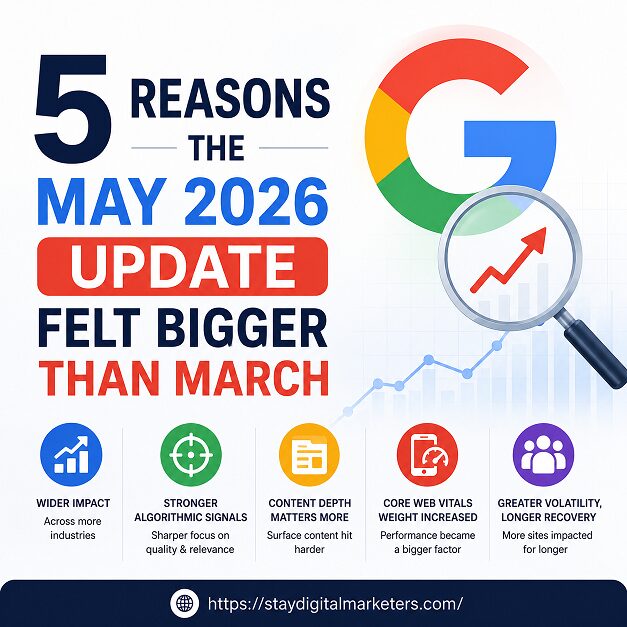

Google’s May 2026 core update rolled out from May 21 to June 2, 2026, and by every independent tracker that watched it, it hit harder than the March update that preceded it. A core update is a broad, periodic change to Google’s ranking systems, not a targeted penalty. It re-evaluates how well existing content across the entire web satisfies real search queries, which means a ranking drop reflects a shift in relative quality against competitors, not a rule you broke.
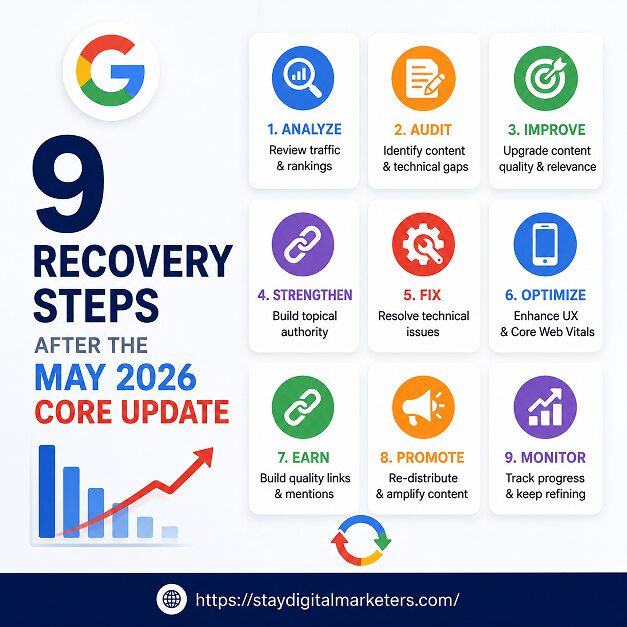
This matters for anyone running organic search as a channel because the same systems that generate classic blue-link rankings also feed Google’s AI Overviews and AI Mode, through retrieval mechanisms pulled from the same index. A site can lose position and lose AI citation at the same time, from the same rollout. The nine steps below walk through how to confirm the impact, diagnose it correctly, and prioritize the fixes that carry the most weight before the next core update arrives.
Key Takeaways
Short answer: Google’s May 2026 core update ran 11 days and 21 hours, from May 21 to June 2, 2026, and produced heavier ranking volatility than the March 2026 update, according to cross-vertical tracking from SEO analyst Glenn Gabe.
The rollout was not a single smooth curve. Rank trackers recorded three distinct volatility spikes: the weekend of May 23, a sharp spike on May 30, and a final burst on June 2, the day Google confirmed completion through its Search Status Dashboard. Industry analysis compiled after the rollout found that only 20.5 percent of top three URLs held their exact position, and 24.1 percent of pages that were previously in the top ten fell out of the top 100 entirely, a steeper fall-off than the December 2025 update produced.
Google’s own description of the update stayed identical to prior releases: a regular update designed to better surface relevant, satisfying content for searchers from all types of sites. No new recovery guidance accompanied it. That consistency is useful information in itself. It confirms the update was evaluating the same helpfulness and trust signals Google has been signaling for years, just recalibrated at a broader scale.
A clean comparison window opened around June 9, roughly a week after the rollout finished, once residual post-update noise had settled. Before that point, day-to-day ranking swings are part of the rollout itself and will mislead any before-and-after judgment. The reliable method is to compare Google Search Console performance data from May 7 through May 20, the pre-rollout baseline, against June 3 onward, segmented by page and by query rather than viewed as a site-wide average.
Across the client work our SEO production team has reviewed, the sites that recover fastest from a core update follow a consistent sequence rather than reacting page by page. That pattern is the basis for the SHIFT framework used below: Snapshot the damage precisely, Hold off on reactive edits, Isolate the pages that carry real commercial weight, Fix helpfulness and trust signals in priority order, and Track results into the next update cycle. The nine steps that follow expand each stage into a concrete action.
Before changing anything, verify the timing. Pull the exact dates your traffic or rankings shifted and line them up against May 21 through June 2. If the drop started earlier, in April for instance, it may be residual movement from the March update or an unrelated technical issue, not this one. Misattributing the cause is the single most common reason recovery plans target the wrong pages.
Resist the urge to rewrite content mid-rollout. Rankings genuinely bounce during a core update as Google’s systems test and reweight signals, and a page that looks lost on May 30 can recover on its own by June 2 without any intervention. Editing during that window adds noise that makes real diagnosis harder later. Wait for the post-rollout window that opened around June 9 before drawing conclusions.
Not every page that dropped was actually targeted. Some movement is collateral, caused by a competitor’s page improving rather than a quality problem on your end. Build a simple spreadsheet of affected URLs with prior and current position, clicks, and impressions, then flag which pages show a genuine step-change tied to the rollout dates versus gradual drift that predates the update.
Group affected pages by type, service pages, blog content, location pages, product pages, since each responds to different fixes. Directional data from this rollout showed original sources, established brands, and content demonstrating first-hand expertise gaining ground, while thin aggregators, scaled AI-generated translations, and commodity content built for search engines rather than readers lost the most.
Google publishes a standing list of questions for exactly this situation. Apply them honestly to each affected page: Does it provide original analysis rather than rewriting other sources? Does it cover the topic completely enough that a reader would not need to open a second tab? Would it be the kind of page someone bookmarks or recommends? Pages that fail several of these questions are the ones to prioritize for a rewrite, not a light edit.
Experience, expertise, authoritativeness, and trustworthiness remain the framework Google’s quality raters use to judge whether a page deserves to rank. Practical fixes include naming a clear author with visible credentials, backing claims with named sources, keeping factual details current, and making sure the site has a genuine About page and contact information. Off-page trust, brand mentions, citations from other sites, and links earned rather than built, reinforces the same signal from outside your domain.
Technical SEO rarely causes a core update drop by itself, but it acts as a tiebreaker when content quality is otherwise close to a competitor’s. Analysis of sites affected by this rollout found that pages with Largest Contentful Paint above 3 seconds lost roughly 23 percent more traffic than faster competitors publishing comparable content. Prioritize LCP, INP, and CLS scores on the pages you are already rewriting, since the content and technical fixes compound each other.
Not every affected page deserves equal attention. Start with the highest-authority, highest commercial-intent pages that took a real drop, from position one or two down to page two or beyond, rather than a small drift. AI Overviews now concentrate click-through disproportionately near the very top of the results page, so restoring a flagship page to position one returns more value today than it would have in past years. Spread effort thin across every affected URL and none of them recover fast enough to matter.
Google is explicit that some pages will not show movement until the next broad core update reprocesses the site. Based on the 2026 cadence so far, March and then May, the next core update is expected in the third quarter, likely August or September. Treat the weeks between now and then as a preparation window: keep improving the pages you have flagged, monitor Search Console for early signals, and avoid the temptation to declare a fix has failed after only a few weeks.
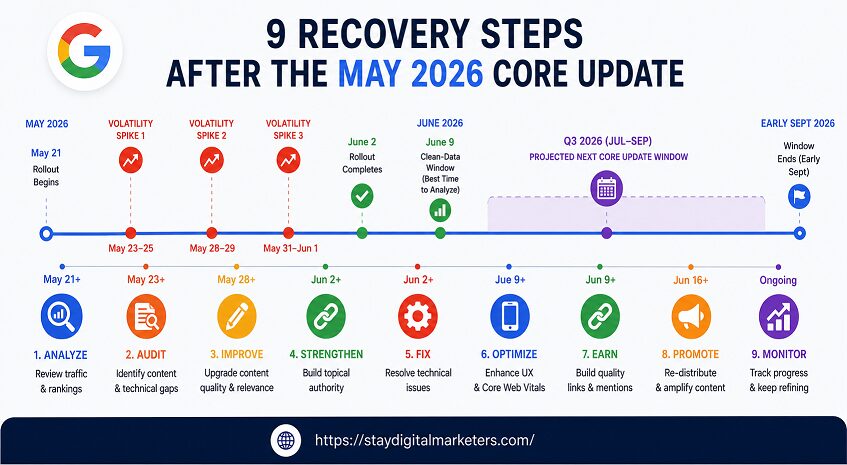
Timelines are genuinely probabilistic, and Google has been direct that there is no guarantee a specific change produces a noticeable effect on its own. The table below reflects the general pattern practitioners have observed across recent core updates, including this one.
| Timeframe | What to Expect | Recommended Action |
| Week 1 to 2 (during rollout) | High volatility, rankings swing daily and can revert on their own | Diagnose only, do not edit live pages |
| Week 3 to 4 (post-rollout) | Clean data window opens, true impact becomes visible by page and query | Segment affected pages and begin priority fixes |
| Month 2 to 3 | Some pages show partial recovery from smaller, unannounced signal adjustments | Continue E-E-A-T and technical fixes, monitor weekly |
| Next core update (Q3 2026) | Larger, more complete recovery typically arrives here for improved pages | Have improvements live and stable well before rollout begins |
Deleting or drastically pruning content should be a last resort reserved for pages that were built for search engines rather than readers, not a first response to a ranking drop. For everything else, improving beats deleting. A page that fails Google’s helpfulness questions gains more from a genuine rewrite, deeper original analysis, updated facts, a clearer structure, than from waiting passively. Pages that already score well on those questions and simply lost ground to a stronger competitor are better candidates for incremental strengthening: added detail, fresher data, better internal linking, rather than a full rebuild.
Yes, and this is the part most standard recovery advice misses. Google’s AI features pull from the same core ranking and quality systems, retrieving pages through the same index that blue-link results draw from. A core update that reweights those systems can simultaneously change which pages get cited inside AI Overviews and AI Mode, separate from where a page ranks in traditional results. A page can hold its ranking position and still lose AI citation, or the reverse. Track both surfaces during recovery, not rankings alone.
It is Google’s second confirmed broad core update of 2026, a scheduled recalibration of how ranking systems evaluate content quality and relevance across the web. It rolled out from May 21 to June 2, 2026, and produced heavier volatility than the March 2026 update that preceded it, according to independent SEO analysis.
The rollout lasted 11 days and 21 hours, starting May 21 and finishing June 2, 2026, slightly ahead of the up-to-two-weeks window Google had signaled at launch. Google confirmed completion through its Search Status Dashboard rather than issuing separate recovery guidance.
Compare Search Console data from May 7 through May 20 against June 3 onward, by page and query, not site-wide. A genuine hit shows a step-change across many pages starting during the rollout and persisting afterward. Rule out crawl errors, manual actions, or seasonal demand shifts first.
Generally no. Google treats deletion as a last resort for content built purely for search engines rather than readers. Most affected pages recover faster through genuine improvement, deeper original analysis, updated facts, stronger structure, than through removal, which simply forfeits any ranking equity the page had built.
Recovery is gradual and not guaranteed on a fixed schedule. Some sites see partial movement within four to eight weeks from smaller signal adjustments, while more complete recovery for genuinely improved pages typically arrives with the next broad core update, expected around Q3 2026.
It matters more as a tiebreaker than a primary cause. Pages with Largest Contentful Paint above 3 seconds lost roughly 23 percent more traffic in this update than faster competitors with comparable content, so Core Web Vitals fixes are worth pairing with content improvements rather than pursuing alone.
Based on the 2026 cadence so far, March and then May, the next broad core update is expected in the third quarter, likely August or September. Treat the intervening weeks as preparation time to have priority page fixes live and stable before that rollout begins.
For businesses working through this kind of recovery, building genuine off-page trust often matters as much as the on-page fixes. Stay Digital Marketers works with brands on the backlink and entity side of that equation, including guest posting, niche edits, press release distribution, SaaS backlinks, Wikipedia page creation, and Google Knowledge Panel support, the kind of authority signals that compound alongside stronger content rather than replacing it.

Filza Taj is an MPhil in Human Resources-turned SEO Specialist, Content Strategist, and Digital Marketing Consultant with over 5 years of experience helping businesses in 30+ countries grow online. As the Founder of Stay Digital Marketers (staydigitalmarketers.com), she delivers results-driven solutions in link building, guest posting, PR distribution, niche edits, multilingual backlinks, and content marketing. She publishes daily SEO insights and actionable strategies to help brands strengthen their online presence, attract the right audience, and convert clicks into loyal customers.
Filza@staydigitalmarketers.com
Stay Digital Marketers
Need SEO, Link Building or Digital Marketing Services?
Request a Free Audit →