
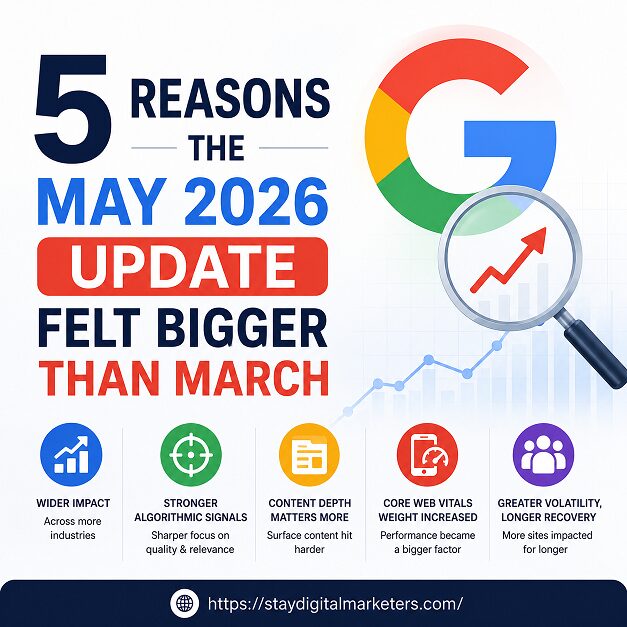
Google closed out the May 2026 core update on June 2, 2026, and across search forums, client calls, and rank tracker dashboards, the same sentence kept surfacing: this one felt bigger. Not louder in terms of Google’s messaging, since the dashboard language was nearly identical to March, but bigger in the way it actually landed on sites, schedules, and nerves.
The May 2026 core update ran from May 21 through June 2, roughly twelve days, and followed the March 2026 core update, which wrapped on April 8 after its own twelve-day rollout. On paper, two updates of similar length, similar phrasing, similar Google guidance. In practice, May hit differently, and there are five clear, verifiable reasons why.
Key Takeaways
The short answer: the gap between updates shrank sharply, the update landed on top of unresolved March volatility, it overlapped with a major AI Search push from Google I/O, tracking tools recorded some of the highest volatility readings on record, and the pattern it reinforced, favoring first-party sources over aggregators, was already destabilizing entire categories of sites. Each of these compounds the others, which is why May did not feel like a routine follow-up.
The March 2026 core update completed on April 8. May 2026 began rolling out on May 21. That is a 43 day gap between the two, or roughly six weeks, which is the tightest interval between two distinct broad core updates since the November to December 2024 pairing, an interval many analysts treat as one extended calibration event rather than two separate updates.
For comparison, the minimum gap between core updates in 2025 ran closer to thirteen weeks. Site owners who budget a full quarter to diagnose a core update, test fixes, and wait for the next data cycle were given six weeks instead. That compression alone changes how the update is experienced, even before looking at what changed inside the algorithm.
A core update rollout does not end the moment the dashboard says complete. Rankings continue to settle, traffic normalizes unevenly across pages, and most SEO teams need several weeks just to separate real signal from short-term noise. When the next update arrives before that settling period finishes, the two events blur together, and the site owner experiences one long stretch of instability rather than two discrete, measurable events.
Many domains that lost visibility in March had not fully stabilized by the time May began. The March update was, by several tracking measures, one of the more volatile core updates on record, and sites still working through recovery had roughly six weeks, not six months, to make the kind of substantial content and authority improvements Google’s own guidance describes.
That timing matters. A site mid-recovery in April was still absorbing March’s re-ranking when a second wave of signal changes arrived in May. For teams that had just started to see partial recovery, the second update reset the clock before they had confirmation their fixes were even working.
The May 2026 core update rolled out roughly one day after Google I/O 2026 concluded, an event where Google announced a wave of AI and Search related features. Around the same window, Google’s AI Mode reportedly crossed one billion monthly users, and a broader Gemini model deployment rolled out into Search. None of that is confirmed by Google as a direct input into the core update’s ranking systems, but the timing meant three separate sources of change, the core update itself, a major AI Mode expansion, and shifting click behavior around AI Overviews, were all moving at once.
That overlap makes clean attribution difficult. A site that lost visibility in late May cannot always tell whether the core update, an AI Overview absorbing a query that used to send a click, or a genuine content quality reassessment was the primary cause. When three variables move together, the update feels heavier than its ranking mechanics alone would suggest.
When only one variable changes, cause and effect are traceable. When a core update, an AI feature rollout, and a search interface change all land within days of each other, site owners see combined volatility without a clear label for which piece caused which drop. That ambiguity itself contributes to why May felt larger, even in cases where the core update’s direct impact on a given site was moderate.
Independent of the AI overlap, the raw volatility numbers back up the perception that May hit harder. Industry tracking around the March update, which set the baseline for comparison, showed 79.5 percent of top three search results changing position, according to SE Ranking, up from 66.8 percent in December 2025 and the highest single update reading in that dataset. Roughly 24.1 percent of pages holding a top ten position dropped entirely out of the top 100 results during that same window, per SE Ranking’s analysis. Reports around the May rollout described renewed and, in places, sharper volatility spikes across multiple days of the update window, including notable movement close to the official completion date.
Pages that had stabilized after March showed fresh movement in the final days of May’s rollout, often without any corresponding content or technical change on the site’s side, a strong signal that the shift was systemic rather than page specific.
Google published no companion blog post and no new guidance for either the March or May update, relying instead on the same short Search Status Dashboard language for both. That silence is itself informative. When Google repeats identical language across two updates without new direction, the most defensible reading is that the second update reinforces the first rather than charting a new course.
The March pattern, based on cross tool analysis from sources including Sistrix and Amsive, showed brand owned and institutional destination sites gaining visibility while aggregator style sites, including OTAs, job boards, and comparison platforms, lost ground. Reference and dictionary style sites also lost visibility even without any quality issue, a pattern several analysts link to AI Overviews increasingly answering short informational queries directly. If May extended that same pattern rather than resetting it, sites already absorbing an aggregator penalty from March faced a second wave of the same pressure, compounding rather than diluting the impact.
Working across client accounts through both update cycles, one pattern became reliable enough to formalize into a scoring method. The SOURCE framework rates a page on six factors tied directly to the first-party versus aggregator distinction that both updates rewarded and punished.
Pages scoring low across most of these factors, particularly Ownership and Uniqueness, were consistently the pages that lost visibility across both the March and May cycles in the accounts reviewed for this analysis. Pages scoring high held steady or gained, even during the higher volatility windows of late May.
| Metric | March 2026 Update | May 2026 Update |
| Rollout start | March 27, 2026 | May 21, 2026 |
| Rollout end | April 8, 2026 | June 2, 2026 |
| Rollout duration | Approx. 12 days | Approx. 12 days |
| Gap from prior update | Roughly 10 weeks | 43 days (6.1 weeks) |
| Top-3 SERP shift | 79.5% (SE Ranking) | Renewed, sharper volatility reported |
| Concurrent Google event | Simultaneous spam update | Google I/O + AI Mode expansion |
| New official guidance | None beyond dashboard note | None beyond dashboard note |
| Pattern direction | First-party rewarded, aggregators at risk | Same pattern reinforced |
Google’s long-standing advice remains the starting point, there is no specific fix for a core update loss, and negative movement does not automatically mean something is wrong with a page. But the compressed 2026 cadence changes the practical response. Waiting a full quarter to diagnose and correct is no longer realistic when updates are landing six weeks apart. The more durable approach is treating first-party authority, direct expertise, and reduced reliance on aggregated or republished content as ongoing infrastructure, not a response to a single ranking drop.
Generally, no. Reactive changes made while an update is still rolling out are difficult to evaluate, since the ranking signal has not settled and any movement could reflect the update itself rather than the edit. The stronger move is documenting what changed on the site, waiting for the rollout to fully complete, and then comparing before and after data with a clear window on each side.
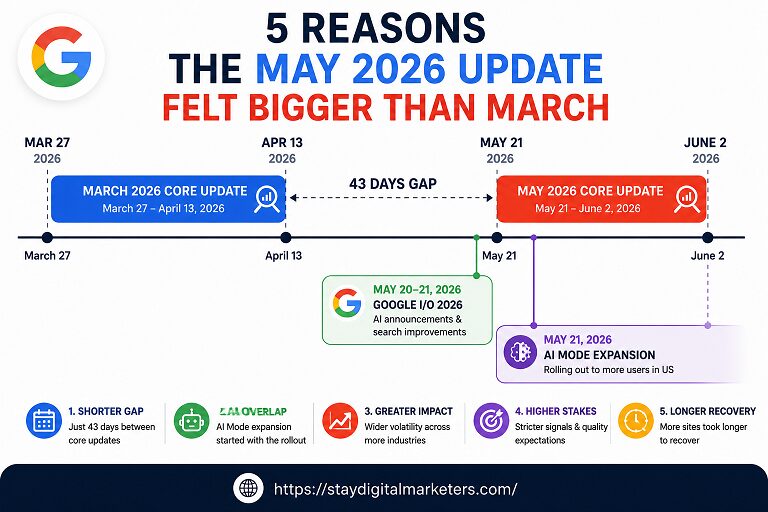
The May 2026 core update rolled out over approximately twelve days, beginning May 21, 2026 and completing June 2, 2026. That matches the March 2026 update’s own twelve day rollout window, meaning the duration was similar even though the impact felt larger to many site owners.
Five factors combined: a compressed 43 day gap since March, sites still absorbing March’s volatility, overlap with Google I/O and AI Mode expansion, higher volatility readings in tracking tools, and a reinforced first-party versus aggregator pattern that compounded losses rather than resetting them.
There is no evidence of a broad reversal. Google used identical dashboard language for both updates and issued no new guidance, which most analysts read as May reinforcing March’s direction rather than correcting it.
May 2026 was the second confirmed broad core update of 2026, following the March 2026 update. Based on the accelerating cadence between the two, several analysts project the year could see more updates than usual, though Google has not confirmed any future schedule.
Google has not confirmed a direct link between the core update’s ranking mechanics and AI Overviews or AI Mode. The two developments overlapped in timing, which made it harder for site owners to isolate the core update’s specific impact from broader search interface changes.
Sites functioning primarily as aggregators or intermediaries, including comparison platforms and republished reference content, carried the highest risk. Sites that own their underlying product, service, or original data were comparatively more stable across both update cycles.
It is generally better to wait. Rankings have not settled during an active rollout, so changes made mid update are hard to evaluate. Document planned changes, wait for the rollout to complete, then compare performance across a stable before and after window.
Watching client rankings through consecutive volatility windows has made one thing clear, the sites that treated March as a one-time event were the ones caught off guard by May. The sites that instead used March’s data to strengthen first-party authority and reduce reliance on aggregated content entered May’s window with far less exposure. That distinction, more than any single ranking factor, is what separated stable accounts from volatile ones across this stretch.
Firms that specialize in entity and authority building, including Stay Digital Marketers, work with this exact pattern regularly, helping brands strengthen first-party trust signals through services such as guest posting, niche edits, press release distribution, SaaS backlinks, brand mentions, Wikipedia page creation, Google Knowledge Panel creation, and complete SEO solutions, all of which reinforce the kind of ownership and institutional trust signals that recent core updates have consistently rewarded.

Filza Taj is an MPhil in Human Resources-turned SEO Specialist, Content Strategist, and Digital Marketing Consultant with over 5 years of experience helping businesses in 30+ countries grow online. As the Founder of Stay Digital Marketers (staydigitalmarketers.com), she delivers results-driven solutions in link building, guest posting, PR distribution, niche edits, multilingual backlinks, and content marketing. She publishes daily SEO insights and actionable strategies to help brands strengthen their online presence, attract the right audience, and convert clicks into loyal customers.
Filza@staydigitalmarketers.com
Stay Digital Marketers
Need SEO, Link Building or Digital Marketing Services?
Request a Free Audit →