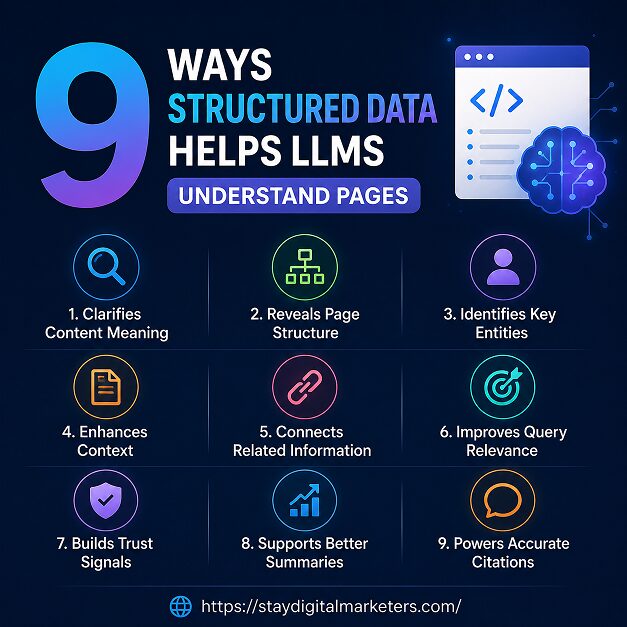

Schema markup is structured data, most commonly written in JSON-LD, that declares explicit facts about a page instead of leaving an AI system to infer them from prose. Schema.org, the shared vocabulary behind it, was founded jointly by Google, Microsoft, Yahoo, and Yandex in 2011 and now covers hundreds of content types.
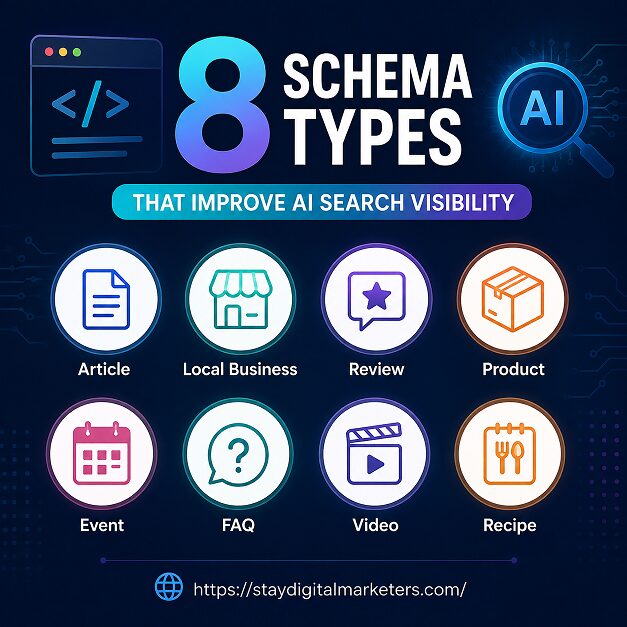
Not every one of those types carries equal weight for AI search. Backlinko’s analysis of first-page Google results found that at least 72 percent already carry some form of schema, which means a site without it is now the exception rather than the norm among ranking pages. The eight types below cover the entities and content formats that do the most work for AI citation and visibility specifically.
Key Takeaways
Organization schema establishes a business as a real, identifiable entity: its name, logo, founding details, and verified social profiles. AI platforms use it to confirm a source is a genuine organization rather than an anonymous page before citing it, and it typically feeds Google’s Knowledge Panel when someone searches a brand name directly.
Person schema attaches a real, credentialed individual to content through jobTitle, worksFor, and sameAs links to verifiable profiles. For E-E-A-T evaluation, especially on topics where expertise matters, this is the schema type that turns an anonymous byline into a machine-readable claim of expertise an AI system can cross-reference.
Article schema tells AI systems what type of content a page contains, who wrote it, and when it was last updated. The dateModified field carries particular weight as a freshness signal. A page with accurate, current dateModified values is treated as more trustworthy than an identical page with stale or missing timestamps.
Product schema, combined with Offer and AggregateRating, gives AI systems the structured price, availability, and rating data they need to answer shopping and comparison queries. When an AI assistant recommends a product, it is drawing on exactly this kind of structured field rather than parsing marketing copy for a price.
LocalBusiness schema extends Organization with address, hours, and service area data that powers near-me and location-based AI responses. For any business with a physical presence or a defined service area, this is the schema type that connects the entity to a place, not just a name.
Service schema fills the gap Organization and Product both miss: what a business actually does. It links back to the provider Organization and includes serviceType and areaServed, giving AI comparison engines structured data to answer what does this company offer without inferring it from a page full of marketing language.
FAQPage schema structures question and answer content as extractable pairs. Its role has changed significantly, covered in detail below, but it remains one of the clearest ways to hand an AI system a self-contained, citable answer.
BreadcrumbList schema maps a page’s position in a site’s hierarchy, replacing a raw URL in search results with a readable path. It sits in the highest adoption tier of any schema type measured, largely because CMS platforms and SEO plugins generate it automatically, and it helps both crawlers and AI systems understand how a site is organized.
Most current guides on this topic either recommend FAQPage without qualification or reference an outdated version of the story. Google first restricted FAQ rich results in 2023, limiting the visual search feature to established government and health sites. That much is reasonably well known.
What is missing from even the more recently updated guides is the second stage. On May 7, 2026, Google added a full deprecation notice to its FAQ structured data developer documentation. Search Console reporting for FAQ rich results retires in June 2026, and the API retires in August. This is a materially different situation from a 2023 eligibility restriction, and it changes the honest case for implementing FAQPage schema in 2026.
The schema is not worthless. It sits in the 1 million to 10 million domain adoption tier per Google and Schema.org’s own usage data, and the underlying Question and Answer structure may still help AI systems parse Q&A content during response generation. Implement it as a parsing aid for genuinely Q&A-shaped content, not as a route to a search-results feature that no longer exists in any meaningful form.
Google and Schema.org jointly published the first official, crawl-scale usage dataset in June 2026, covering 958 Types and 4,587 Predicates across millions of domains. It shows real measured adoption rather than the citation-lift claims that circulate without published methodology.
| Schema type | Domain adoption tier (May 2026) | Primary AI search role |
|---|---|---|
| Organization | 10 million+ | Establishes the entity every other type references back to |
| Person | 10 million+ | Attaches verifiable expertise to content |
| Article / BlogPosting | 1 million to 10 million | Signals content type, authorship, and freshness |
| Product | 1 million to 10 million | Feeds AI shopping and comparison answers |
| LocalBusiness | 1 million to 10 million | Powers location and near-me AI responses |
| FAQPage | 1 million to 10 million | Parsing aid for Q&A extraction, no SERP rich result |
| Service | 100,000 to 1 million | Clarifies offerings for comparison queries |
| BreadcrumbList | 10 million+ | Maps site hierarchy for crawlers and AI systems |
Practitioners auditing client sites across industries see a consistent pattern: Organization and BreadcrumbList are usually present, since CMS platforms generate them by default, while Person and Service schema are the two most often missing entirely, even on sites where the underlying page content clearly supports them.
Implementing eight schema types as disconnected blocks produces a weaker signal than linking them into one entity graph. Call this the Entity Chain: Organization sits at the root, since every other type should reference back to it. Person schema links to Organization through worksFor. Article, Product, and Service schema each link to both Organization and, where relevant, the Person who created or provides them. LocalBusiness extends Organization with place data. FAQPage and BreadcrumbList attach to the page itself rather than the entity chain, but still benefit from sitting on a page whose other schema is properly linked.
The practical test: pick any schema block on a page and ask whether it references another entity on the site through a shared @id, or whether it stands alone. A page where every block cross-references the others gives AI systems one coherent object to evaluate. A page with eight isolated blocks gives it eight separate, weaker claims.
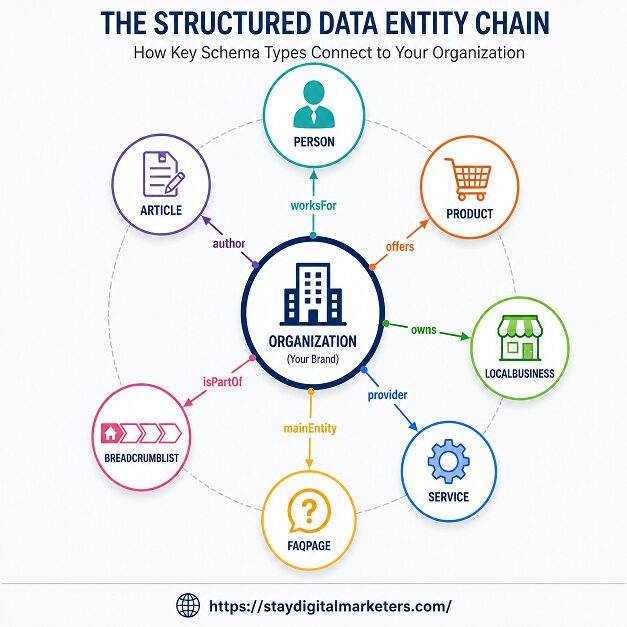
Organization schema matters most as a starting point, since it establishes the entity every other schema type references. Person, Article, and Product schema build on that foundation depending on the site. There is no single type that outweighs having a correctly linked set across the whole site.
The FAQ rich result was already limited to government and health sites in 2023, then Google added a full deprecation notice to its FAQ documentation in May 2026, retiring Search Console reporting in June and the API in August. The Q&A structure may still aid AI parsing, but no SERP feature remains to earn.
No. Organization, Person, Article, and BreadcrumbList apply broadly. Product and LocalBusiness only apply if the business sells physical goods or serves a specific location. Service fits professional and B2B sites better than e-commerce. Match each type to what the page actually is before implementing it.
Backlinko’s analysis found that at least 72 percent of pages on Google’s first page use some type of schema markup. That figure reflects correlation with ranking position, not proof that schema itself caused the ranking, but it shows how standard structured data has become among established pages.
Yes, and it is standard practice. A product page commonly combines Product, Offer, Review, and BreadcrumbList schema. A blog post combines Article, Person, and Organization schema. Linking these through shared @id references is what turns separate blocks into one coherent entity graph.
Run individual pages through Google’s Rich Results Test and the Schema.org validator to see what is currently detected and whether it is valid. For a broader audit across many pages, Google Search Console’s Enhancements section shows which schema types Google has processed sitewide and flags errors.
These eight schema types work best as a connected set rather than a checklist implemented in isolation. Agencies working on backlink and content visibility strategy, including Stay Digital Marketers, generally treat schema the same way across client sites: establish Organization and Person first since they anchor everything else, add the content and commercial types that match what the site actually offers, and keep every block linked and current rather than treating each one as a separate task to check off.

Filza Taj is an MPhil in Human Resources-turned SEO Specialist, Content Strategist, and Digital Marketing Consultant with over 5 years of experience helping businesses in 30+ countries grow online. As the Founder of Stay Digital Marketers (staydigitalmarketers.com), she delivers results-driven solutions in link building, guest posting, PR distribution, niche edits, multilingual backlinks, and content marketing. She publishes daily SEO insights and actionable strategies to help brands strengthen their online presence, attract the right audience, and convert clicks into loyal customers.
Filza@staydigitalmarketers.com
Stay Digital Marketers
Need SEO, Link Building or Digital Marketing Services?
Request a Free Audit →