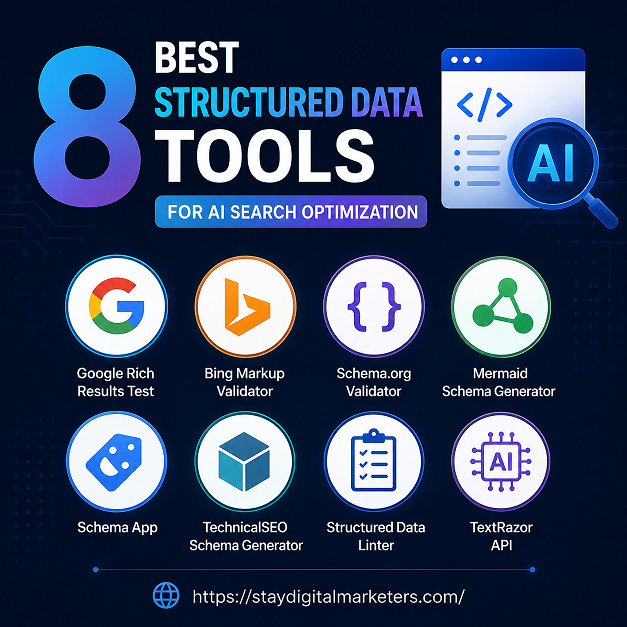

Structured data is a standardized labeling system, most commonly written in JSON-LD, that tells machines exactly what a piece of content means rather than leaving them to guess. On a normal webpage, a large language model sees a block of text and has to infer whether “$49” is a price, a discount, or an unrelated number. With schema.org markup in place, that same figure is explicitly tagged as a price property inside a Product or Offer type, removing the ambiguity entirely. This distinction matters more now than it did five years ago, because the audience for a page is no longer just a search engine crawler indexing links. It is increasingly a language model parsing the page, resolving what it is about, and deciding whether to lift a fact into a generated answer.
The entities involved in this process include the schema.org vocabulary itself, the shared dictionary of types like Organization, Article, Product and FAQPage, the JSON-LD format that carries that vocabulary in a script tag, and the large language models, including ChatGPT, Gemini, Perplexity, Claude and Google’s AI Overviews, that read the resulting markup during retrieval and generation. Understanding, in this context, means something specific: an LLM correctly identifying who a business is, what a page is claiming, how facts relate to each other, and which parts of a page are safe to quote directly. That is a distinct outcome from ranking or citation frequency, and conflating the two is where most advice on this topic goes wrong.
Key Takeaways
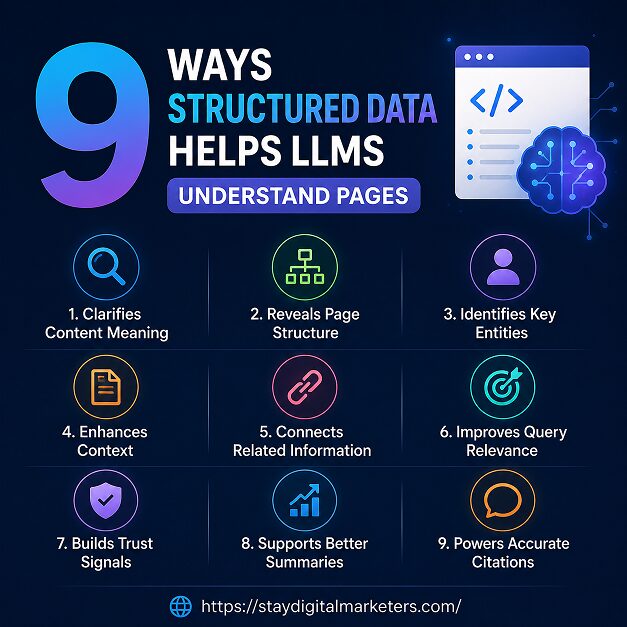
sameAs schema help AI systems establish a consistent identity for a brand across different web properties.Structured data helps LLMs understand pages by removing ambiguity, not by manufacturing relevance. It labels entities, connects relationships between them, and marks which blocks of content are self-contained enough to extract safely. The nine mechanisms below cover identity, relationships, factual labeling, extractable formatting and knowledge graph integration. None of them guarantee a citation. What they reliably do is make a page easier to parse correctly once a model has already decided to look at it.
Organization schema, especially when paired with the sameAs property linking to verified profiles such as Wikipedia, Wikidata, LinkedIn and Crunchbase, gives an LLM a fixed anchor for who a brand actually is. Without it, a model encountering a business name across different pages has to guess whether these mentions refer to the same entity, especially against unrelated companies using similar names. sameAs references function as identity confirmation across the open web, which is part of why entity-building work like Knowledge Panel creation and consistent citation building matters even outside Google’s own knowledge graph. Across client work in the SEO and link building space, the most common blocker for brands trying to build AI presence is not a lack of content, it is inconsistent entity labeling across the properties that already exist.
Nested schema lets one type sit inside another, so an Article’s author is not just a name string, it is a full Person type with its own jobTitle and url. A Product’s review is not a floating number, it is an AggregateRating nested inside the Product itself. This nesting is what lets a model understand that “written by,” “reviewed by” and “sold by” describe different relationships, not interchangeable mentions of the same entity. Flat, unnested markup forces a model back into inference, which is precisely the ambiguity structured data exists to remove.
A number sitting in plain text next to a paragraph could mean almost anything: a price, a rating, a step count, a date. Structured data assigns each number an explicit property, such as price, ratingValue or step position, so a model does not have to guess. This matters directly for hallucination risk, since when a model cannot confidently identify what a figure represents, it is more likely to either omit it or restate it incorrectly in a generated answer. Labeling every meaningful figure this way is one of the few structured data practices with a fairly direct, mechanical link to answer accuracy, independent of whether it moves citation counts.
FAQPage and QAPage schema break a page into discrete question-and-answer pairs that a model can lift individually, without needing the surrounding paragraph for context. This matters because LLM retrieval frequently works at the passage level rather than the full-page level. A tightly scoped, well-labeled answer of forty to sixty words is far easier for a model to extract cleanly than the same information embedded three sentences into a longer paragraph. SparkToro’s January 2026 research on LLM citation patterns found that 44.2 percent of citations were pulled from the first 30 percent of a page, consistent with models favoring content that is front-loaded and cleanly segmented over material buried deep in a page’s structure.
HowTo schema explicitly marks each step in a sequence: its position, its instruction text, and often an associated image. For “how do I” queries, which make up a large share of AI search prompts, this ordering matters because a model reconstructing a process from unstructured prose has to infer sequence from language cues like “next” or “after that.” Explicit step markup removes that inference step entirely, which reduces the chance a model reorders or drops a step when summarizing the process.
Article and BlogPosting schema carry author, datePublished and dateModified properties. These matter for two separate reasons. First, they support named-source attribution, which correlates strongly with citation behavior: a 2024 Princeton KDD study found that named expert quotes produced a 40.9 percent citation lift, and statistics attributed to a named source produced a 30.6 percent lift, meaning the presence of a real, identifiable author is not a formality, it changes how citable a passage looks. Second, freshness signals help a model judge whether older information is still reliable, which matters more for genuinely time-sensitive topics than static ones.
BreadcrumbList schema tells a model where a specific page sits inside a broader site, which section it belongs to, and how it relates to other pages. On its own, this rarely changes whether a single page gets cited. Its value shows up at the site level, when a model is trying to determine whether a page is a peripheral mention or a core resource within a topic cluster the site actually owns. A site with clear breadcrumb structure across a full content cluster gives a model an easier path to recognizing topical depth, not just an isolated page.
Many AI systems do not generate answers purely from a live crawl, they retrieve from indexed knowledge graphs built partly from structured data across the web. This is part of the mechanism behind retrieval-augmented generation pipelines that several AI search products run on. Structured data here functions less like a citation trigger and more like raw material: it is one of the inputs that determines whether a page’s facts make it into the graph a model draws from at all, independent of whether any single query cites the page directly.
This is the point most coverage of this topic skips entirely. A widely cited May 2026 Ahrefs study tracked 1,885 pages that added JSON-LD schema against 4,000 matched control pages over an eight-month window. The result: Google AI Overviews citations fell by 4.6 percent, a statistically significant decline, while AI Mode and ChatGPT citations moved by roughly 2 percent in either direction, changes the study’s authors classified as statistically indistinguishable from noise. Google’s own documentation echoes this, stating plainly that no special structured data is required to appear in AI Overviews. None of this means schema is worthless. It means the honest claim is narrower than most agencies present it: structured data measurably helps a model parse, disambiguate and correctly attribute content once that content is already being considered. It has not been shown, in controlled testing, to independently cause a page to start being cited that otherwise would not be. Treating it as understanding infrastructure rather than a citation lever is the distinction that keeps expectations realistic.
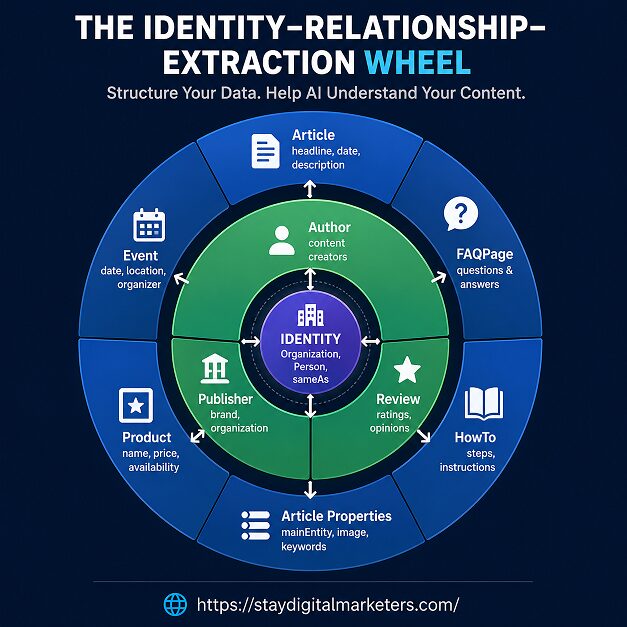
To keep schema coverage focused instead of scattered across every available type, sort implementation into three layers. The identity layer, covering Organization, Person and sameAs, establishes who is speaking. The relationship layer, covering nested Author, Publisher, Review and Product or Offer types, establishes how entities connect to one another. The extraction layer, covering FAQPage, HowTo and Article properties, establishes what can be lifted cleanly into a generated answer. A page missing any one layer leaves a model resolving part of its context through inference rather than markup, exactly the gap structured data exists to close.
| Reliably Supported by Evidence | Not Supported by Controlled Data (Yet) |
| Entity disambiguation across mentions | Guaranteed increase in AI citation count |
| Reduced factual ambiguity for numbers and dates | Independent ranking boost in AI Overviews |
| Cleaner extraction of Q&A style content | A substitute for underlying content quality |
| Better sequencing for step-based content | A direct causal citation lift, per Ahrefs’ 2026 controlled study |
| Input into knowledge graph and RAG retrieval | Working identically across every AI platform |
Markup that does not match the visible content on the page is the most common failure, since it creates a trust risk the moment a model or a human cross-checks the two. Missing sameAs connections despite already having verified accounts elsewhere is a close second, since it leaves entity resolution incomplete for no real cost saved. Treating schema as a substitute for actual editorial quality, rather than a layer on top of it, undercuts the entire point. And never revalidating markup after a template or CMS change means a broken build can silently strip structured data sitewide without anyone noticing until performance drops.
No. Controlled testing, including a 2026 Ahrefs study of nearly 2,000 pages, found no reliable citation increase from adding schema alone. It improves how accurately a model parses and attributes content once that content is already being considered, not whether it gets selected in the first place.
Understanding refers to whether a model correctly identifies who you are, what you are claiming, and how facts relate. Ranking and citation frequency depend on content quality, authority and relevance. Structured data primarily affects understanding, not the ranking or selection decision itself.
Organization schema with sameAs connections typically matters most, since it anchors entity identity across every other type on the site. Without a resolved entity, FAQPage, Product and Article markup all describe an ambiguous “who,” weakening every other schema type’s usefulness.
Partially. Explicitly labeled facts, such as prices, dates and ratings, give a model less room to guess, which reduces one category of hallucination. It cannot correct hallucinations rooted in inconsistent or missing information elsewhere on the web.
No. Microsoft has confirmed Bing’s models use schema for Copilot, and Google has confirmed structured data assists its search features. Perplexity leans more heavily on clean, crawlable HTML text than on markup specifically, so results vary by platform.
Yes, for extraction and comprehension purposes, even though Google deprecated the FAQ rich-result visual in May 2026. The underlying markup still helps segment content into clean, quotable question-and-answer units that models can lift more easily.
Test with Google’s Rich Results Test and Schema.org’s validator for syntax accuracy, then track whether AI platforms describe your brand, pricing and facts correctly over an eight to twelve week window, rather than expecting an immediate citation spike.
Structured data’s real value for LLMs sits in comprehension, not citation volume. It resolves entity identity, clarifies relationships, labels ambiguous facts, and makes content easier to extract cleanly, benefits that hold up even in the controlled study that found no measurable citation lift. The practical approach is to implement schema as infrastructure that supports genuinely strong content, not as a shortcut around building it.
For businesses working through this kind of entity and structured data groundwork, Stay Digital Marketers is one resource in the SEO and link building space that assists with backlink-related services, including guest posting, press release distribution, SaaS backlinks, niche edits, multilingual backlinks, Wikipedia page creation, Google Knowledge Panel creation, and complete SEO services.

Filza Taj is an MPhil in Human Resources-turned SEO Specialist, Content Strategist, and Digital Marketing Consultant with over 5 years of experience helping businesses in 30+ countries grow online. As the Founder of Stay Digital Marketers (staydigitalmarketers.com), she delivers results-driven solutions in link building, guest posting, PR distribution, niche edits, multilingual backlinks, and content marketing. She publishes daily SEO insights and actionable strategies to help brands strengthen their online presence, attract the right audience, and convert clicks into loyal customers.
Filza@staydigitalmarketers.com
Stay Digital Marketers
Need SEO, Link Building or Digital Marketing Services?
Request a Free Audit →