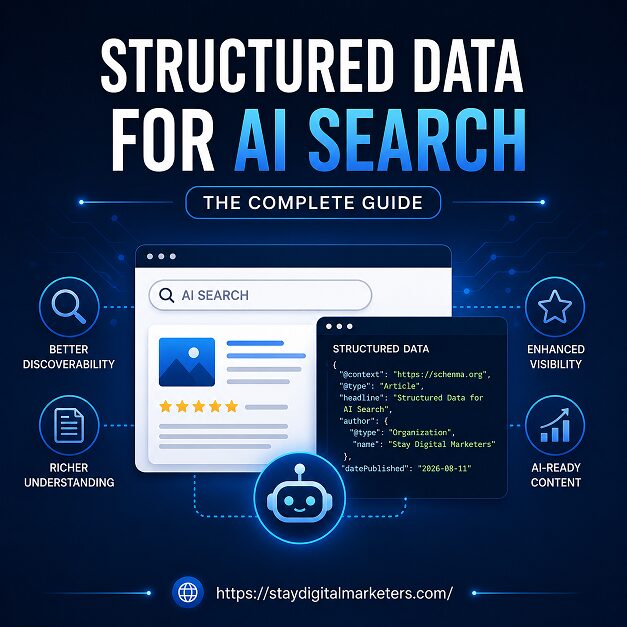

Structured data is machine-readable markup, most commonly JSON-LD, that declares explicit facts about a page instead of leaving an AI system to infer them from prose. It tells a crawler what type of content a page contains, who wrote it, when it was published, and what questions it answers, without requiring the model to guess.
What it is not is a standalone citation strategy. The five fixes below matter, but the biggest recent Semrush study on this topic found structured data ranked last among five content qualities positively associated with AI citations, and two widely referenced guides on this exact topic have not caught up with a schema change that landed in May 2026. Both gaps are worth fixing before the technical work below.
“`htmlKey Takeaways
Yes, but less than most schema-first guides suggest, and the honest answer changes what you should fix first.
Semrush analyzed 11,882 prompts across ChatGPT Search, Google AI Mode, and Perplexity, comparing 304,805 URLs that AI platforms cited against 921,614 URLs ranking on Google for related keywords. Structured data elements showed a positive association with citation, but the weakest of five qualities measured.
| Content signal | Association with AI citation |
| Clarity and summarization | +32.83% |
| E-E-A-T signals | +30.64% |
| Q&A format | +25.45% |
| Section structure | +22.91% |
| Structured data elements | +21.60% |
The practical read: structured data reinforces content that is already clear, well-sourced, and directly formatted for Q&A. It is not a substitute for those qualities. A page with flawless schema wrapped around vague, unstructured prose will underperform a plainly written page that answers the question directly, even without a single schema block.
Ranked by what actually moves the needle, starting with the fix that has the clearest documented payoff.
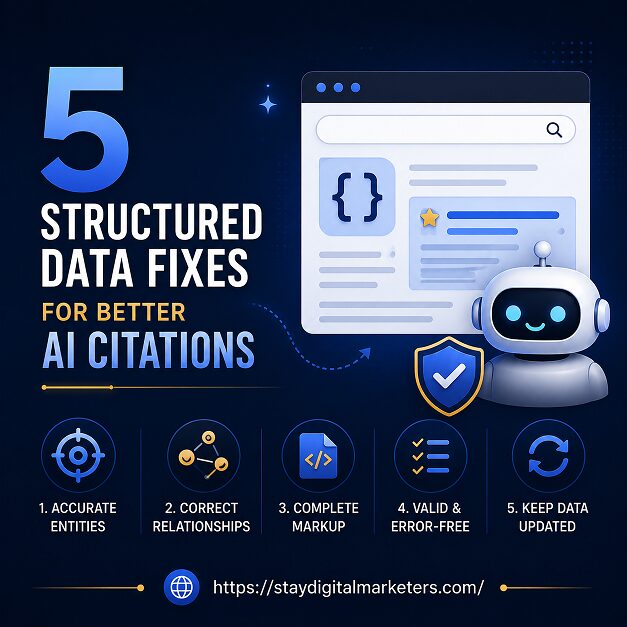
Run every page with existing schema through Google’s Rich Results Test and the Schema.org validator. Malformed JSON-LD is typically ignored entirely rather than partially processed, so a page with broken FAQPage markup gets no benefit from it at all, the same as a page with no schema. This is the fix with the clearest, least disputed payoff, since it recovers value you already tried to create rather than chasing a new one.
Common validation failures worth checking specifically: a Question without a matching acceptedAnswer, a dateModified value that predates datePublished, and required properties left blank because a plugin generated the block automatically without prompting for them. None of these throw a visible error on the page itself, which is exactly why they go unnoticed until a validator flags them.
Update the dateModified field in Article schema every time the page content changes substantively, and keep price or availability fields in Product schema synced to what is actually on the page. AI systems use these fields as freshness signals. A schema block that says a page was last updated months ago while the visible text reflects a recent change signals staleness that undermines the very credibility schema is meant to establish.
Connect your Article, Person, and Organization schema through shared @id references rather than publishing them as disconnected blocks. An Article that links to its Author’s Person schema, which in turn links to verifiable sameAs profiles, gives AI systems an entity chain to cross-reference rather than isolated claims. This is sound technical hygiene regardless of how much lift any single implementation produces, since specific multiplier figures for this technique circulate without published methodology behind them.
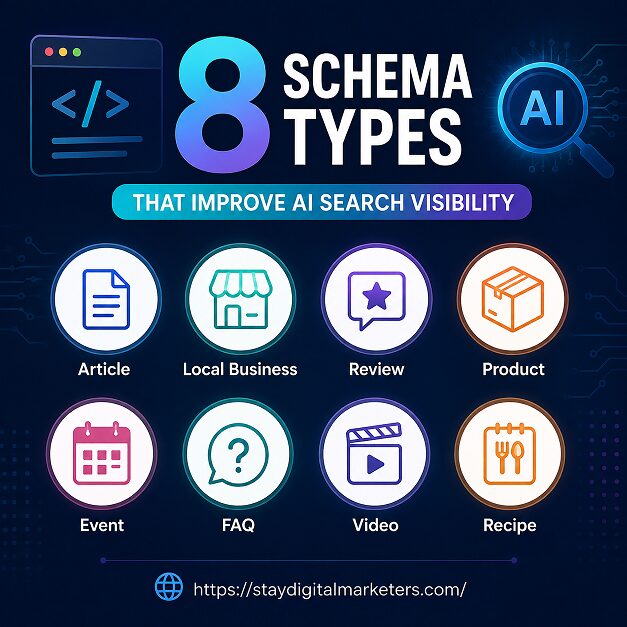
Two widely read guides on this exact topic still recommend FAQPage as the single highest-impact schema type, one of them published after the change below. On May 7, 2026, Google added a deprecation notice to its FAQ structured data documentation. Search Console reporting for FAQ rich results retires in June 2026 and the API retires in August. The SERP feature that made FAQ schema attractive for years is gone.
The schema itself is not worthless. Millions of domains still carry FAQPage markup, and the underlying Question and Answer structure may still help AI systems parse Q&A content during response generation. What changed is the reason to implement it. Keep FAQ schema on pages where the content genuinely fits a Q&A format, and stop treating it as a route to a search-results feature that no longer exists.
This is the fix the other four guides skip. Structured data ranked lowest of five positive citation signals in Semrush’s study, well behind clarity and summarization, E-E-A-T signals, Q&A format, and section structure, all of which live in the visible text, not the markup. Before adding or fixing a schema block, check whether the underlying paragraph actually leads with a direct answer, states expertise plainly, and is broken into scannable sections. Schema describes what is already there. It does not compensate for prose that buries the answer three paragraphs down.
A useful test before touching any markup: read the paragraph the schema is meant to describe, and check whether it would work as a direct citation on its own, with no schema attached. If the answer is buried after two paragraphs of setup, fix the paragraph first. The schema fix afterward takes minutes. The rewrite is where the actual citation gain comes from.
Most schema guides treat structured data as step one. Based on the measured association strength in Semrush’s citation study, it belongs closer to the last rung. Call this the Citation Signal Ladder, ordered from strongest measured association to weakest:
Working top to bottom means the schema work in Fixes 1 through 4 has something worth describing by the time you apply it. Working bottom to top, the common pattern in schema-first guides, means polishing markup around content that was never structured to be cited in the first place.
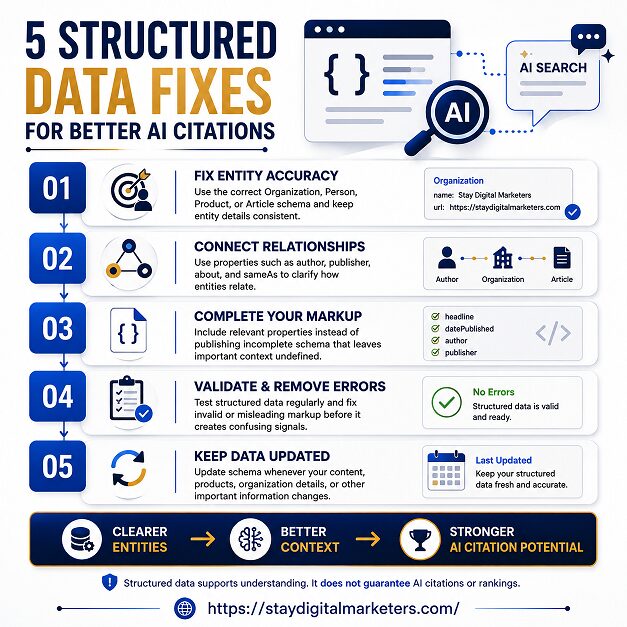
Fix 1 and Fix 2 belong on every page carrying any schema at all, since broken or stale markup is a pure loss with no offsetting benefit. Fixes 3 through 5 deserve more selective effort: prioritize your highest-traffic content and any page where the visible text already ranks well organically but underperforms in AI citations, since that gap is exactly where a structured data fix has room to help.
Practitioners running technical audits across client sites see the same pattern repeatedly: FAQ schema installed during a site build years ago, never revisited as Google’s rich result support changed, sitting next to prose that never actually leads with a direct answer. Fixing the schema without fixing the paragraph above it rarely moves the number people are trying to move.
Fixing broken or malformed schema first has the biggest impact, since invalid markup is typically ignored entirely rather than partially processed. Beyond that, no single schema fix outweighs the plain-text quality of your content. Semrush’s citation study ranks structured data behind clarity, E-E-A-T signals, Q&A formatting, and section structure.
The FAQ rich result itself is retiring. Google added a deprecation notice to FAQ structured data documentation on May 7, 2026, with Search Console reporting retiring in June and the API in August. The underlying Question and Answer structure may still aid AI parsing, but it no longer earns the SERP feature it once did.
Linking related schema types through shared entity references is good technical practice, since it gives AI systems a coherent picture instead of isolated blocks. Specific multiplier claims for this technique circulate without published methodology, so treat it as sound hygiene rather than a guaranteed citation multiplier.
Letting schema drift out of sync with the visible page. A dateModified field that says a page was updated in May while the content itself changed in July signals staleness to AI systems even when the writing is current. Update markup as part of the same workflow as content changes, not separately.
No. Google’s Rich Results Test and the Schema.org validator identify most errors in plain language, and CMS plugins like Yoast, Rank Math, or Schema Pro handle common schema types without custom code. Developer involvement becomes useful mainly for entity linking across many pages at scale.
Quarterly at minimum, with immediate updates whenever the underlying content changes substantively, such as a price change, a staff update, or a content refresh. Schema that no longer matches what is visible on the page is one of the more common reasons AI systems reduce confidence in a site’s markup over time.
Structured data fixes are worth doing, but they work best as reinforcement for content that already answers questions clearly and establishes expertise in plain text. Agencies working on backlink and content visibility strategy, including Stay Digital Marketers, generally sequence this the same way: fix broken markup and stale dates first since that recovers value at no cost, then invest in entity linking and format-specific schema only on pages where the underlying writing already earns the citation the markup is meant to reinforce.

Filza Taj is an MPhil in Human Resources-turned SEO Specialist, Content Strategist, and Digital Marketing Consultant with over 5 years of experience helping businesses in 30+ countries grow online. As the Founder of Stay Digital Marketers (staydigitalmarketers.com), she delivers results-driven solutions in link building, guest posting, PR distribution, niche edits, multilingual backlinks, and content marketing. She publishes daily SEO insights and actionable strategies to help brands strengthen their online presence, attract the right audience, and convert clicks into loyal customers.
Filza@staydigitalmarketers.com
Stay Digital Marketers
Need SEO, Link Building or Digital Marketing Services?
Request a Free Audit →