
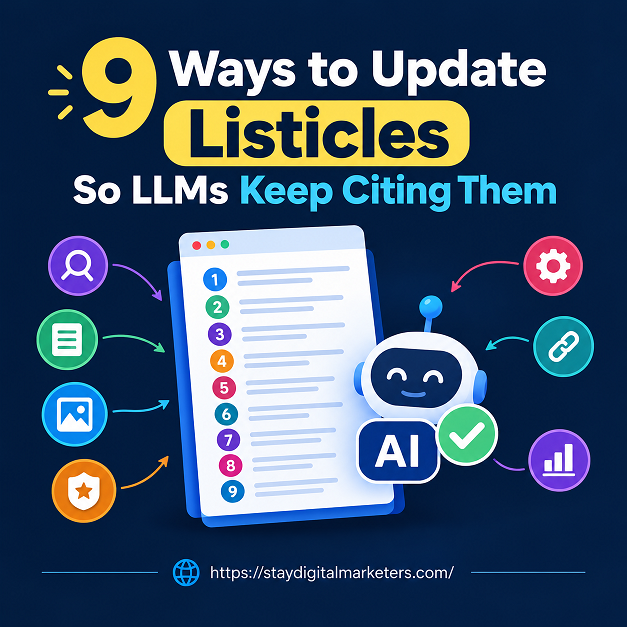
A listicle stops getting cited by LLMs when the model’s confidence that the page still reflects current, accurate information drops, not simply because time has passed. ChatGPT, Perplexity, and Google’s AI Overviews all weigh freshness as part of retrieval-augmented generation, the process of retrieving candidate pages and extracting passages to build an answer, and a page that reads as stale gets passed over in favor of a newer or more recently verified source, even if it once earned citations reliably. Updating a listicle for LLM citation means more than editing a publish date. It means changing the content itself in ways a model can detect as genuinely current.
The short answer is that a listicle keeps its citations by combining substantive content changes, ranking shifts backed by real reasons, fresh data points, and current fan-out coverage, with a visible and honest update signal, not by relying on a cosmetic date change alone.
Key Takeaways
No, and this is the detail most update guidance skips. An Ahrefs study found AI assistants prefer content that is 25.7 percent fresher than the URLs typically found in organic search results, and a separate analysis found content labeled as updated within the last two hours was cited 38 percent more often than content a month old covering the same topic. Freshness clearly matters, particularly on Perplexity, where it accounts for roughly 40 percent of ranking factors according to ConvertMate’s research.
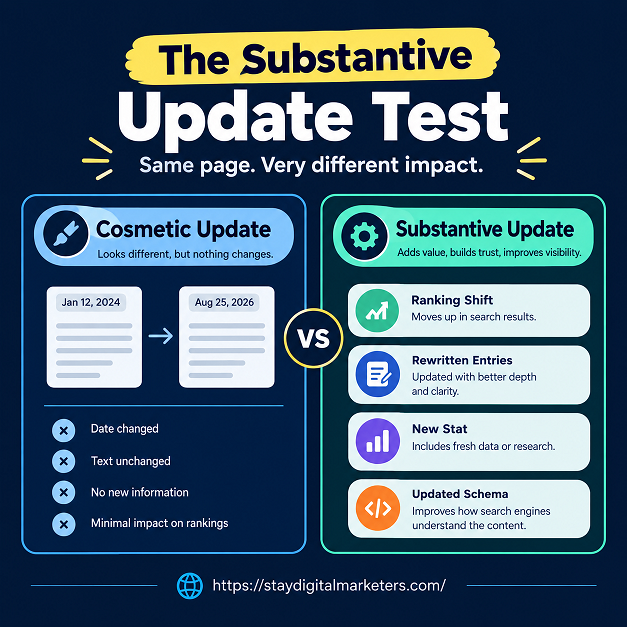
But the same research is explicit about what does not work: changing a publish date or adding “updated today” without meaningfully editing the underlying text. AI systems can detect that mismatch between a fresh-looking date and unchanged content, and treat the page as stale regardless of the label. None of the general “how to get cited” guides available on this topic apply that distinction specifically to listicles, where the temptation to simply reorder items or bump the year in the title without real edits is especially strong. The nine tactics below are built around making updates that are real, not cosmetic.
A ranking shift should trace back to something that actually happened, a pricing change, a new feature, a competitor’s product update, rather than a reshuffle done purely to make the page look revised. Reordering without cause is exactly the kind of cosmetic change AI systems can flag as inconsistent with genuinely updated content.
Updating the introduction while leaving every entry description untouched is one of the most common shortcuts, and it is also one of the easiest for a model to detect as superficial. Meaningfully revising the language in at least half the entries, not just correcting typos, gives the page enough genuinely new text to register as updated rather than relabeled.
Original data points make content safer for a model to reuse. A Princeton GEO study testing nine optimization methods across 10,000 queries found that adding statistics or direct quotations increased AI visibility by 30 to 40 percent on its own, and a separate Ahrefs analysis found 67 percent of ChatGPT’s top 1,000 cited pages drew from original research or first-hand data. Each update cycle is a chance to add one new verified figure, whether it is a fresh price point, a usage statistic, or an updated comparison metric.
Search Engine Land found that 72.4 percent of pages ChatGPT cites contain a short, direct answer, roughly 20 to 25 words, immediately after a question-based heading. When an entry’s underlying facts change, that capsule needs updating first, since it is usually the exact passage a model lifts into its answer. An outdated capsule sitting above updated detail below it creates the same kind of mismatch that undermines freshness signals.
AI systems break a prompt into related sub-queries, pricing, alternatives, drawbacks, and search each one separately. Surfer’s own analysis found that ranking for these fan-out sub-queries makes a page 49 percent more likely to be cited than ranking for the main query alone, and ranking for both the main query and its fan-outs makes a page 161 percent more likely to appear in AI answers. An update pass should revisit whatever pricing, alternatives, or limitations sections exist alongside the ranking itself, since those are the sections most likely to go stale first.
A visible, dated update signal matters, but only when it reflects a real change. Pairing the date with a short note on what changed, a one-line changelog, gives both readers and AI systems a concrete signal to verify against, rather than an unverifiable claim of recency.
Schema markup can deliver up to a 10 percent visibility boost on Perplexity, according to ConvertMate’s research, but only when it accurately reflects the page. After a content update, the dateModified field, any Product or Review schema tied to individual entries, and FAQ schema should all be checked against the new content rather than left pointing at outdated details from the previous version.
Brands with active, current profiles on review platforms like G2, Trustpilot, and Capterra have roughly a three times higher chance of being cited by ChatGPT, per SERanking’s research, since these platforms aggregate signals AI systems use to assess credibility. If a listicle references review counts, ratings, or third-party recognition for any entry, those figures need to be checked and updated alongside the on-page content, not left as a snapshot from the original publish date.
Pricing pages, tool comparisons, and “best of” categories with frequent product changes need updates monthly or quarterly, since freshness bias is strongest for exactly this type of evolving content. Evergreen categories built around stable definitions or frameworks can go longer between updates without losing citation eligibility, since AI models will still reuse accurate older material when the underlying facts have not changed.
Reviewing update cycles across a range of client listicles shows a consistent split: pages refreshed on a fixed schedule with real content changes tend to hold or regain citation share within weeks, while pages that only receive a date bump tend to keep declining at roughly the same rate they were declining before the “update.”
Structural updates, tightening answer capsules, fixing schema, adding a data point, can start influencing AI visibility within days. Building broader authority through original data, topical depth, and consistent third-party validation typically compounds over three to six months. A realistic cadence pairs light monthly checks on volatile facts, pricing, availability, ratings, with a deeper quarterly pass that revisits rankings, rewrites entries, and refreshes fan-out coverage.
Four checks separate a genuine update from one that only looks fresh on the surface.
A listicle that fails more than one of these checks is a cosmetic update, the kind AI systems are increasingly able to detect and discount. Passing all four is a reasonable bar for calling an update genuine.
| Update Action | Source | Typical Effect |
| Add original stats or quotes | Princeton GEO study, 10,000 queries | +30-40% AI visibility |
| Cover fan-out sub-queries | Surfer’s fan-out analysis | +49% to +161% higher citation odds |
| Keep content genuinely fresh | Ahrefs / ConvertMate | AI-cited pages run ~25.7% fresher than typical organic results |
| Maintain accurate schema | ConvertMate research | Up to +10% visibility boost on Perplexity |
| Refresh review-platform presence | SERanking research | ~3x higher citation chance on ChatGPT |
Not on its own. AI systems can detect when a publish date changes but the underlying text does not, and treat the page as stale anyway. Content labeled as updated within the last two hours was cited 38 percent more often than month-old content, but only when the update was substantive.
It depends on the category. Pricing pages and fast-changing tool comparisons benefit from monthly or quarterly updates, since freshness accounts for roughly 40 percent of Perplexity’s ranking factors. Evergreen, definition-based listicles can go longer between updates without losing citation eligibility.
Yes. A Princeton GEO study testing nine optimization methods across 10,000 queries found that adding statistics or direct quotations increased AI visibility by 30 to 40 percent on its own. A separate analysis found 67 percent of ChatGPT’s top cited pages draw from original research or first-hand data.
No. A ranking should only shift when something real changed, a price, a feature, a competitor’s release, not on a fixed schedule for appearance. Reordering without a stated reason is a cosmetic change that AI systems can flag as inconsistent with a genuine update.
Yes, substantially. Ranking for fan-out sub-queries like pricing or alternatives makes a page 49 percent more likely to be cited than ranking for the main query alone, and covering both the main query and its fan-outs makes a page 161 percent more likely to appear in AI answers.
Yes. Schema markup can deliver up to a 10 percent visibility boost on Perplexity, but only when it accurately reflects current content. The dateModified field and any Product, Review, or FAQ schema tied to updated entries should be checked during every content update.
A listicle’s update signal works alongside, not instead of, the external validation that builds AI trust in a domain over time. Stay Digital Marketers works with brands on that surrounding layer, including guest posting, digital PR and press release distribution, SaaS backlinks, niche edits, multilingual backlinks, Wikipedia page creation, and Google Knowledge Panel creation, alongside broader SEO services, so a well-maintained listicle sits on a domain with the outside credibility to make its updates count.

Filza Taj is an MPhil in Human Resources-turned SEO Specialist, Content Strategist, and Digital Marketing Consultant with over 5 years of experience helping businesses in 30+ countries grow online. As the Founder of Stay Digital Marketers (staydigitalmarketers.com), she delivers results-driven solutions in link building, guest posting, PR distribution, niche edits, multilingual backlinks, and content marketing. She publishes daily SEO insights and actionable strategies to help brands strengthen their online presence, attract the right audience, and convert clicks into loyal customers.
Filza@staydigitalmarketers.com
Stay Digital Marketers
Need SEO, Link Building or Digital Marketing Services?
Request a Free Audit →