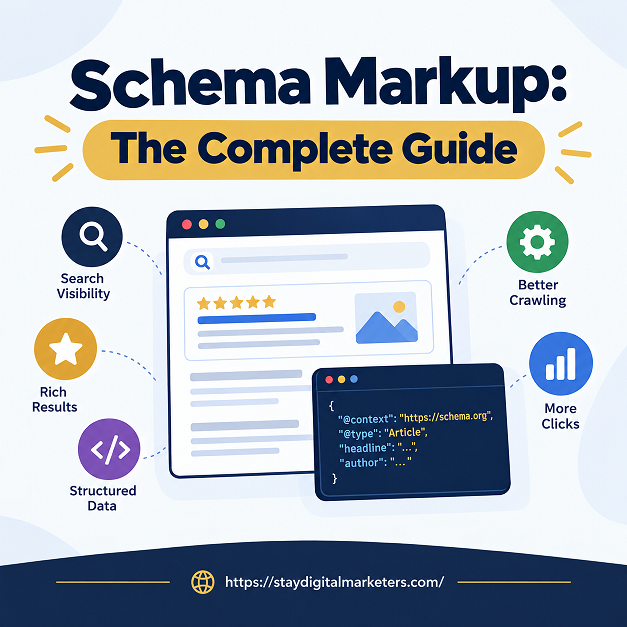

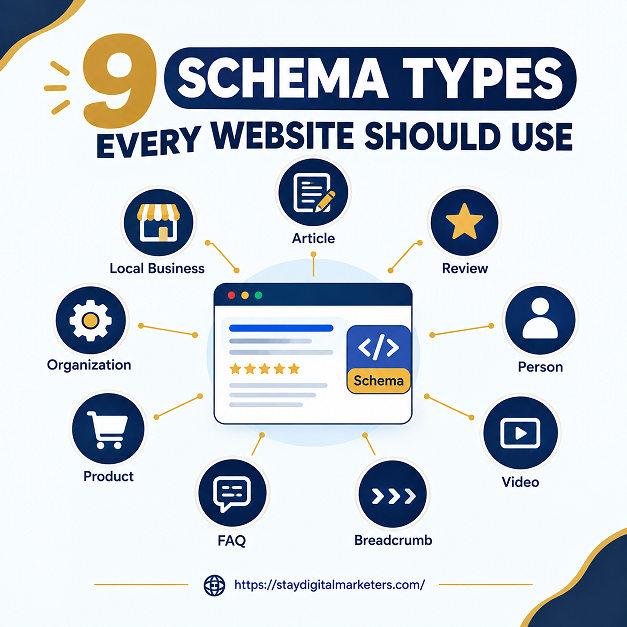
The most important schema types for a website are the ones that describe who the site belongs to, what it offers, and why a visitor or an AI system should trust it. Schema.org defines several hundred types in total, but most websites need only a small, deliberate subset, applied accurately, rather than broad coverage across every type the vocabulary supports. Nine types cover the vast majority of what a typical business, content, or ecommerce site actually needs, and implementing them correctly matters more than chasing every niche type technically available.
The short answer is that Organization schema comes first for every site, followed by a small set of content or offering-specific types, Article, Product, or Service, and a final layer of trust-building types like Review and FAQPage. The nine types below are organized around exactly that logic rather than presented as an arbitrary list, so a reader can map the framework onto their own site rather than working through an undifferentiated catalog of every schema type Google has ever supported.
Key Takeaways
Comprehensive schema catalogs covering 20 or more types are genuinely useful as reference material, but they answer a different question than most site owners are actually asking. A catalog explains what each type does. It rarely explains which handful of types apply to a typical site, or why implementing niche types like Car, Recipe, or Music schema adds nothing for a business that sells neither cars, recipes, nor music. Working through such a list often leaves a site owner more uncertain than when they started, unsure which of the twenty-plus options actually deserve implementation time.
None of the widely available guides on this topic curate a working list scoped to general applicability. This article does that deliberately: the nine types below were chosen because they apply, in some combination, to nearly every website, not because they represent the full breadth of what Schema.org technically supports. A site that implements these nine accurately will generally outperform one that implements fifteen types inconsistently.
Organization schema establishes a site’s basic identity: legal name, logo, official URL, and links to verified social profiles. It belongs on every website regardless of industry, since every other schema type on this list assumes this identity layer already exists and is accurate. This is also the schema type most closely tied to a brand’s eligibility for a Google Knowledge Panel, making it worth getting right before layering on anything more specific.
LocalBusiness schema extends Organization schema with address, service area, hours, and accepted payment methods, essential for any business tied to a physical location or defined service radius. A business without this markup is harder for local search and AI-driven local recommendations to place correctly, particularly for map-based and near-me style queries that depend on structured location data.
Person schema names the individuals behind a site’s content or services, their role, credentials, and areas of expertise. It matters most on author bio pages and professional service sites, where it directly supports the experience and expertise components of Google’s E-E-A-T framework. Sites that skip this type often find their content harder to attribute confidently, since without it a byline is just text rather than a verifiable, structured claim of authorship.
Article or BlogPosting schema labels headline, author, and publish date for editorial content, supporting both featured snippet eligibility and the byline-level signals AI systems weigh when assessing whether a source is current and credible. Any site publishing blog posts, news, or long-form guides should treat this as close to mandatory rather than optional.
Product schema, paired with Offer and Brand markup, gives price, availability, and specifications for anything a site sells, letting that information appear accurately in shopping results and AI-generated comparisons rather than being guessed at from unstructured page text. Ecommerce sites without this markup are effectively invisible to the structured comparison features AI shopping tools increasingly rely on.
Service schema describes what a business does rather than what it sells as a physical good, covering scope, service area, and offering name. It is the WHAT-layer counterpart to Product schema for any business built around delivering a service rather than shipping an item, from consulting firms to local trades.
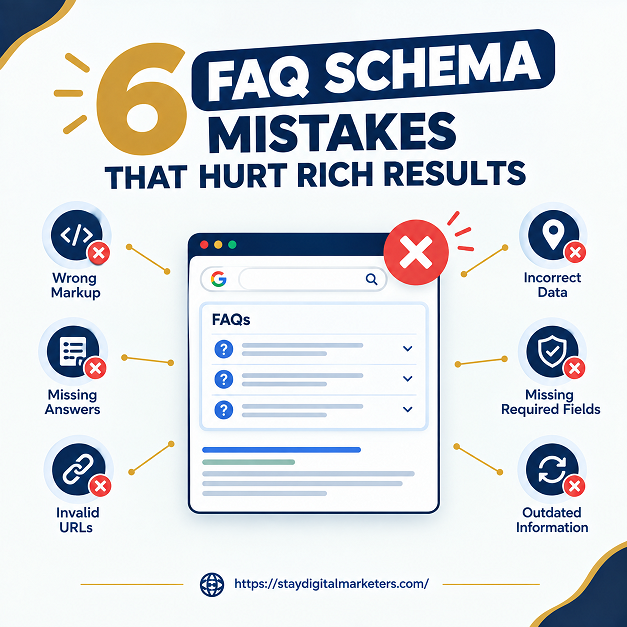
FAQPage schema structures genuine question-and-answer content for direct extraction. Google fully deprecated the visual FAQ rich result in Search as of May 2026, but AI engines still parse the underlying schema to extract question-and-answer pairs for their own citations, so the markup retains real value beyond the search-results snippet it used to generate.
Review schema surfaces star ratings and excerpt text as a trust signal, most effective once a business has accumulated a meaningful volume of genuine reviews rather than one or two that make the markup look sparse instead of credible. Implementing it too early, before real review volume exists, can undercut the trust it is meant to build.
BreadcrumbList schema clarifies a page’s position within a site’s overall structure, a signal that helps both search engines and AI systems understand site architecture and page relationships, even on a small site with a limited page count. It is one of the simplest types on this list to implement and one of the most commonly skipped.
| Site Type | Always Needed | Needed If Applicable |
| Local service business | Organization, LocalBusiness, FAQPage, BreadcrumbList | Review, Person |
| Ecommerce store | Organization, Product, Review, BreadcrumbList | FAQPage, Person |
| Content or media site | Organization, Article, Person, BreadcrumbList | FAQPage, Review |
| B2B SaaS or agency | Organization, Service, Article, FAQPage | Review, Person, BreadcrumbList |
The nine schema types below fall into three groups of three, a structure worth naming directly since it doubles as a completeness check for any site’s markup.
A site missing an entire category, no WHO schema at all, for instance, has a structural gap worth fixing before adding more depth to the categories already covered.
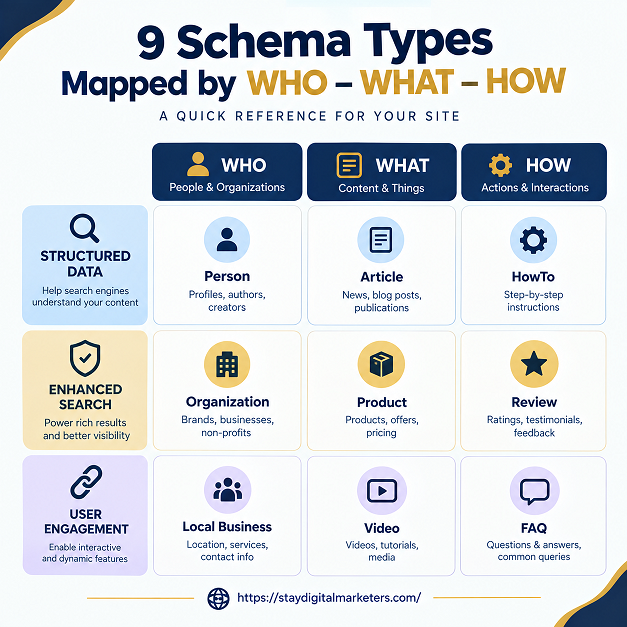
Organization schema is the one universal requirement, since it establishes basic brand identity for every site type. Beyond that, the right mix depends on whether the site sells products, publishes content, offers local services, or some combination of the three.
A few well-chosen, accurate types outperform many poorly maintained ones. Implementing a schema type the page doesn’t genuinely support, or leaving fields incomplete, creates more risk than benefit, since mismatched or sparse markup can undermine trust rather than build it.
No, unless the blog sells something directly. A content-focused site is better served by Article, Person, and FAQPage schema, which describe editorial content and author credibility, rather than Product schema, which is built specifically for items available for purchase.
Generally no. Review and AggregateRating schema work best once a business has a meaningful volume of genuine reviews, since a page showing a rating based on only one or two reviews can look sparse or unconvincing rather than building the trust the schema is meant to signal.
Yes, more than many site owners assume. Breadcrumb schema clarifies a page’s position within a site’s structure for both search engines and AI systems, which helps with navigation understanding even on a small site with only a handful of pages.
Person schema, since it establishes the identity, credentials, and expertise behind content or a business, directly supporting the experience and expertise components of Google’s E-E-A-T framework, particularly on author bio pages and professional service sites.
These nine schema types make a site easier for search engines and AI systems to understand, but understanding alone does not build the authority that gets a well-structured page actually cited. Stay Digital Marketers works on that authority layer directly, including guest posting, press release distribution, SaaS backlinks, niche edits, multilingual backlinks, Wikipedia page creation, and Google Knowledge Panel creation, alongside complete SEO services, so accurate schema and real off-page authority reinforce each other rather than working in isolation.

Filza Taj is an MPhil in Human Resources-turned SEO Specialist, Content Strategist, and Digital Marketing Consultant with over 5 years of experience helping businesses in 30+ countries grow online. As the Founder of Stay Digital Marketers (staydigitalmarketers.com), she delivers results-driven solutions in link building, guest posting, PR distribution, niche edits, multilingual backlinks, and content marketing. She publishes daily SEO insights and actionable strategies to help brands strengthen their online presence, attract the right audience, and convert clicks into loyal customers.
Filza@staydigitalmarketers.com
Stay Digital Marketers
Need SEO, Link Building or Digital Marketing Services?
Request a Free Audit →