
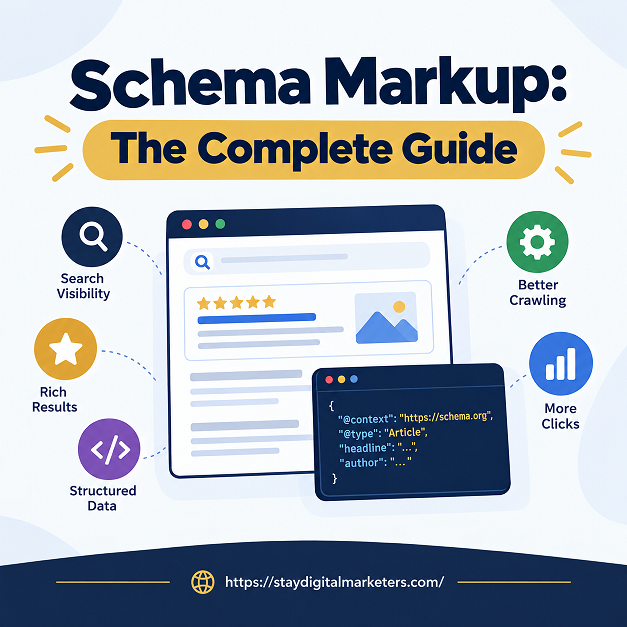
Schema markup is code, most commonly written in JSON-LD, added to a webpage to label its content in a standardized format that machines can parse without guessing. It identifies entities such as products, articles, people, and organizations, then defines properties for each one, a price, an author, a business address, so search engines and AI systems understand exactly what a page contains rather than inferring it from unstructured text. The vocabulary itself comes from Schema.org, a shared standard maintained jointly by Google, Bing, Yahoo, and Yandex, which is why the same markup works consistently across different search and AI platforms rather than needing a separate version for each one.
The short answer is that schema markup helps a page qualify for rich results in classic search, such as star ratings or FAQ snippets, and gives AI systems cleaner, more reliable facts to extract when building an answer. It does not directly cause higher rankings or guaranteed AI citations on its own, a distinction the rest of this guide covers in detail, since conflating the two leads to wasted effort chasing a quick citation lift schema was never built to deliver.
Key Takeaways
Several widely read guides on this exact topic state plainly that no large-scale study has tested whether adding schema markup increases AI citations, then stop there. That claim is now out of date. Ahrefs ran a controlled test in 2026 tracking 1,885 pages that added JSON-LD schema against 4,000 matched control pages over 30 days. ChatGPT citations moved 2.2 percent and Google AI Mode moved 2.4 percent, neither a meaningful lift, while AI Overview citations declined 4.6 percent, though that drop could not be clearly attributed to the schema change itself since both groups were already trending downward beforehand.
A separate, larger Ahrefs analysis of six million URLs found pages cited by AI carry JSON-LD almost three times more often than uncited pages. Read alongside the controlled test, the pattern becomes clear: schema correlates with AI citation because well-resourced, well-structured sites tend to use it, not because adding a script tag causes a citation on its own. Schema still has real value for building long-term entity associations inside Google’s Knowledge Graph, but it is not the fast citation lever some guides imply, and treating it as one misallocates effort that would do more good improving the actual content.
JSON-LD is Google’s recommended format, sitting as a single script block in the page’s head rather than being woven through the visible HTML. Microdata and RDFa embed markup directly inside HTML tags, which makes them harder to maintain since a template change can silently break the structured data along with it. JSON-LD usage climbed to roughly 41 percent of websites in 2026, up from about 34 percent in 2022, a shift driven partly by how much easier it is to generate, audit, and update without touching visible page content.
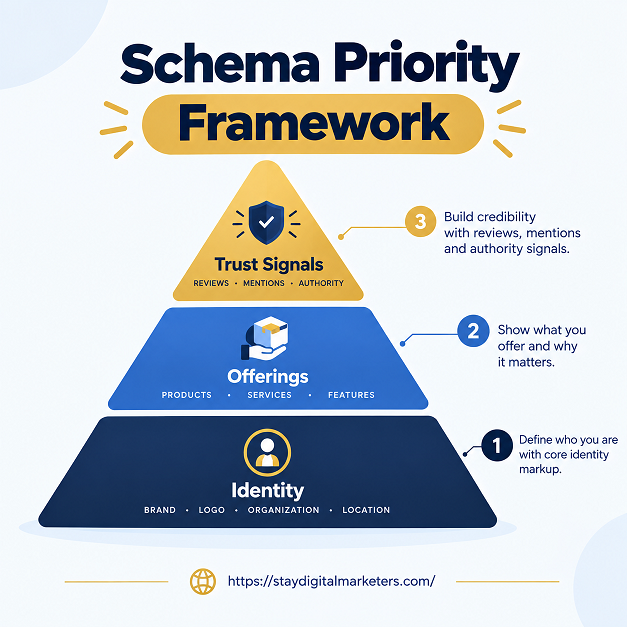
These establish core identity: business name, logo, contact details, and, for LocalBusiness specifically, address, hours, and service area. Backlinko’s analysis found at least 72 percent of first-page Google results carry some form of schema, and identity-level markup is typically the first type any site implements.
Product schema, paired with Offer and Brand markup, lets price, availability, and specifications appear accurately in both traditional shopping results and AI-generated comparisons, which matters directly for ecommerce sites competing inside AI shopping interfaces that now pull structured product data to build comparison answers.
Article or BlogPosting schema labels headline, author, and publish date, information that supports both featured snippet eligibility and the byline-level trust signals AI systems weigh when assessing a source.
FAQPage schema structures question-and-answer content for direct extraction. Google fully deprecated the visual FAQ rich result in Search as of May 2026, but AI engines still parse the underlying schema to extract question-and-answer pairs for their own citations, so the markup keeps its value even where the search-results snippet disappeared.
Review schema surfaces star ratings and excerpt text as a trust signal, useful once a business has accumulated enough genuine reviews to make the markup meaningful rather than sparse.
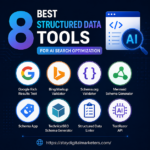
Google’s Rich Results Test checks whether a page qualifies for the specific rich result types Google currently supports. The Schema.org Validator checks markup against the full specification regardless of what Google uses today. Google Search Console’s Enhancements report tracks errors and eligible pages at scale across an entire site, which matters once schema is implemented across more than a handful of pages. Running all three, rather than relying on just one, catches the different classes of errors each tool is built to find.
| Schema Type | Use Case | Implementation Priority |
| Organization | Establishes brand identity: name, logo, contact details, social profiles | First, for every business site |
| LocalBusiness | Adds location, hours, service area for geographically bound businesses | First, for local and multi-location businesses |
| Product / Offer | Shows price, availability, and specs for ecommerce listings | First, for ecommerce sites |
| Article / BlogPosting | Labels headline, author, and publish date for editorial content | Second, for content-driven sites |
| FAQPage | Structures question-and-answer content for direct extraction | Second, where genuine FAQ content exists |
| Review / AggregateRating | Surfaces star ratings and review counts as trust signals | Third, once review volume is meaningful |
Most guidance lists schema types alphabetically or by popularity, which is not the same as by usefulness. A simpler sequence works better: identity first, offerings second, trust signals third.
Skipping straight to trust-signal schema without a solid identity layer underneath it is one of the more common sequencing mistakes site owners make when implementing structured data for the first time
Schema markup is code added to a webpage that labels its content in a standardized format, such as identifying a price, an author, or a business address, so search engines and AI systems can parse the page’s meaning without guessing from unstructured text.
No. A controlled Ahrefs test tracking 1,885 pages that added schema against 4,000 matched control pages found no meaningful citation lift on ChatGPT or Google AI Mode after 30 days. Schema aids machine comprehension but does not directly cause AI citation on its own.
JSON-LD is Google’s recommended format, since it sits in a single script block in the page head rather than being woven through visible HTML like microdata or RDFa. That separation makes JSON-LD easier to generate, audit, and update without touching the page’s visible content.
Organization or LocalBusiness schema, since both establish the core identity Google and AI systems need before any other markup adds useful context. Product, Article, or FAQPage schema should follow only after that foundational identity layer is in place and accurate.
Yes, though its role has narrowed. Google fully deprecated the visual FAQ rich result in Search as of May 2026, but AI engines still parse FAQPage schema to extract question-and-answer pairs for their own citations, so the markup retains value even without the search-results snippet.
Use Google’s Rich Results Test to confirm eligibility for supported rich result types, the Schema.org Validator to check against the full specification, and Google Search Console’s Enhancements report to monitor errors across the whole site over time.
Schema markup makes a page easier to understand, but understanding is not the same as authority, and AI systems weigh both. Stay Digital Marketers works on the authority side of that equation, including guest posting, press release distribution, SaaS backlinks, niche edits, multilingual backlinks, Wikipedia page creation, and Google Knowledge Panel creation, alongside complete SEO services, so a well-structured page also carries the off-page signals that give AI systems a reason to trust and cite it.

Filza Taj is an MPhil in Human Resources-turned SEO Specialist, Content Strategist, and Digital Marketing Consultant with over 5 years of experience helping businesses in 30+ countries grow online. As the Founder of Stay Digital Marketers (staydigitalmarketers.com), she delivers results-driven solutions in link building, guest posting, PR distribution, niche edits, multilingual backlinks, and content marketing. She publishes daily SEO insights and actionable strategies to help brands strengthen their online presence, attract the right audience, and convert clicks into loyal customers.
Filza@staydigitalmarketers.com
Stay Digital Marketers
Need SEO, Link Building or Digital Marketing Services?
Request a Free Audit →