
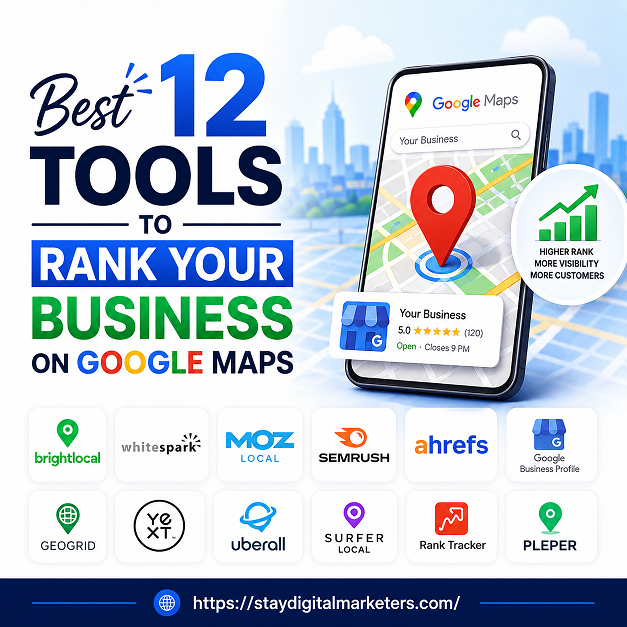
Getting your business to appear in the Google Maps Local Pack, the top three results shown alongside a map, is one of the highest-leverage moves in local marketing. According to data cited by Scrap.io, over one billion people use Google Maps every month, and 86% of them are actively looking up local businesses. More telling: 76% of people who search “near me” walk into a store within 24 hours.
The challenge is that just claiming a Google Business Profile (GBP) is not enough. Google ranks local listings based on three core signals: relevance, proximity, and prominence, and each of those signals can be improved with the right toolset. This article breaks down the 12 best tools practitioners use to rank on Google Maps, what each one actually does, and how to decide which combination fits your situation.
Before pulling out a credit card, it helps to understand the ranking lever each tool category addresses:
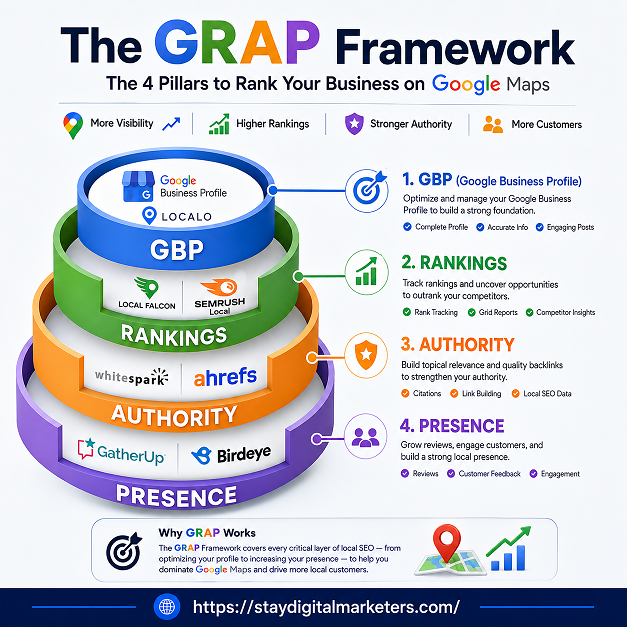
The GRAP Framework (GBP, Rankings, Authority, and Presence) is a practical way to assign each tool to a phase of your Google Maps optimization strategy. Tools that touch GBP come first, then ranking visibility, then authority-building through citations and backlinks, and finally online presence through reviews and social proof.
What it does: This is the non-negotiable starting point. GBP is Google’s own platform for managing how your business appears on Search and Maps. Completing every section, category, service, hours, photos, description, and Q&A directly improves your relevance score in the local algorithm.
Why it matters: Google rewards businesses that treat their GBP as a living asset. Regular photo uploads, weekly posts, and active Q&A responses all signal that the listing is managed and trustworthy. Neglecting the profile after initial setup is a common mistake that stalls rankings.
Best for: Every local business, regardless of size.
What it does: BrightLocal is one of the most widely used all-in-one local SEO platforms. It covers citation tracking, manual directory submissions, local rank tracking, review monitoring, and audit reporting. Its Local Search Grid visualizes how a business ranks across a map grid at the neighborhood level, which is essential for understanding true geographic visibility.
Why it matters: BrightLocal’s hybrid model, software plus managed submission services, means agencies and in-house teams can use the same platform. Plans start at $39/month per location, and the platform holds a 4.8 out of 5 star rating from over 1,200 users, according to its own review data.
Best for: Agencies and multi-location businesses that need comprehensive audits and client reporting.
What it does: Whitespark specializes in citation building, with over 15 years of experience in local search. The tool identifies where competitors are listed and shows which directories are missing from a business’s citation profile. Rank tracking starts at $14/month, and profile management is available from $1/month per location.
Why it matters: NAP consistency across directories remains a foundational trust signal. Whitespark uses manual citation submissions rather than automated syndication, which results in higher-quality placements and fewer errors. Their citation audit tool is particularly useful for cleaning up duplicate or incorrect listings that silently harm rankings.
Best for: Businesses and agencies where citation gaps are the primary ranking bottleneck.
What it does: Local Falcon is a geo-grid rank tracking tool that shows exactly where a business ranks on Google Maps across a grid of geographic points. Instead of tracking a single search result, it maps visibility across an entire city or service area.
Why it matters: Proximity is a key Google Maps ranking factor, and a business that ranks #1 in one neighborhood may not appear at all three miles away. Local Falcon makes this visible, allowing practitioners to understand coverage gaps and prioritize optimization efforts accordingly. A free plan is available with limited credits.
Best for: Service-area businesses and any multi-location brand that needs geographic rank visualization.
What it does: Semrush Local is an add-on module within the Semrush ecosystem. It includes listing management, local position tracking by city or ZIP code, GBP integration, and competitor insights. The standalone Map Rank Tracker tool is available from $30/month with 4,000 credits.
Why it matters: For teams already using Semrush for organic SEO, the local module consolidates workflows. Being able to see local and national keyword data side by side makes it easier to understand how organic rankings influence local pack performance, a relationship Google itself acknowledges.
Best for: SEO professionals who want local and organic data within a single platform.
What it does: Moz Local automates business listing management across major platforms including Google, Yelp, Facebook, and Apple Maps. It pushes updates from a central dashboard, syncs with the GBP API, and flags inconsistencies across directories.
Why it matters: Keeping listings consistent across dozens of platforms manually is impractical, especially for multi-location businesses. Moz Local handles the distribution layer so that when hours change or a location moves, updates propagate automatically rather than sitting outdated for months.
Best for: Businesses with multiple locations that need automated listing syndication at scale.
What it does: Yext connects to a large publisher network and syncs business information across hundreds of directories, apps, and platforms in real time. It is particularly strong for enterprise clients managing hundreds or thousands of locations.
Why it matters: At scale, manual listing management is not viable. Yext’s direct API connections with publishers, rather than just data aggregators, result in faster updates and more accurate syndication. The tradeoff is a higher price point, which makes it less practical for small businesses.
Best for: Enterprise brands and franchise networks with high location volumes.

What it does: Local Viking offers advanced geo-grid rank tracking alongside Google Business Profile management. Its scheduled reporting and GBP automation features reduce manual work while maintaining regular profile activity, a factor that influences how Google’s algorithm evaluates profile engagement.
Why it matters: Consistent GBP activity (posts, updates, photo uploads) is something many businesses set up once and forget. Local Viking automates this cadence while also providing the geo-grid visibility data needed to measure results over time.
Best for: Agencies managing multiple GBP accounts who need automation and geo-grid tracking in one tool.

What it does: Localo is an AI-guided local SEO tool built for small and medium businesses. It provides step-by-step GBP audit tasks, keyword suggestions, and competitive analysis in a format that doesn’t require deep SEO expertise to act on.
Why it matters: Many SMB owners know they need to optimize their GBP but don’t know where to start or what to prioritize. Localo’s to-do list format removes that friction and guides users through the ranking factors most likely to move the needle. It is priced per location with a free trial available.
Best for: Small business owners and freelancers who are managing local SEO themselves without a dedicated specialist.

What it does: While Ahrefs is primarily an organic SEO tool, its backlink analysis, keyword research, and competitor research features are directly relevant to Google Maps rankings. Google’s own documentation states that prominence, one of its three local ranking factors, is based partly on links and mentions from across the web.
Why it matters: A business’s organic search ranking and its local pack ranking are correlated. Earning local backlinks (from city websites, chamber directories, local news outlets, or event coverage) improves domain authority and feeds the prominence signal. Ahrefs helps identify which local link opportunities competitors have capitalized on that a business hasn’t yet pursued.
Best for: Practitioners doing active local link building as part of a broader Maps optimization strategy.
What it does: GatherUp is a review acquisition and management platform that automates the process of requesting, collecting, and responding to customer reviews across Google, Yelp, Facebook, and other platforms. It supports SMS and email outreach and provides reporting on review volume and sentiment trends.
Why it matters: Google explicitly states that review counts and ratings factor into local search rankings. A business with 15 reviews and a 4.2 rating consistently loses ground to a competitor with 200 reviews and a 4.6 rating, all else being equal. A systematic review generation process is not optional for competitive markets.
Best for: Service businesses and retail locations where staff-customer interaction creates natural review opportunities.
What it does: Birdeye is an enterprise-grade reputation management platform that handles review monitoring, AI-generated review responses, customer surveys, and social proof automation. It integrates with CRMs and POS systems to trigger review requests at the right moment in the customer journey.
Why it matters: Large businesses and franchise brands cannot manually respond to every review across dozens or hundreds of locations. Birdeye’s AI response tools maintain active engagement at scale, which signals to Google that the listing is monitored and professionally managed. Consistent review responses are also a publicly visible trust signal for potential customers reading profiles before making a decision.
Best for: Multi-location businesses and franchise brands that need reputation management at enterprise scale.
| Tool | Primary Function | Best For | Starting Price |
|---|---|---|---|
| Google Business Profile | GBP management | All businesses | Free |
| BrightLocal | All-in-one local SEO | Agencies, SMBs | $39/month |
| Whitespark | Citation building | Citation-focused campaigns | $14/month |
| Local Falcon | Geo-grid rank tracking | Service area businesses | Free credits |
| Semrush Local | Local + organic SEO | Full SEO teams | $30/month (add-on) |
| Moz Local | Listing automation | Multi-location | Contact for pricing |
| Yext | Enterprise listings | Franchise/enterprise | Enterprise pricing |
| Local Viking | GBP automation + geo-grid | Agencies | Low monthly cost |
| Localo | AI-guided GBP audits | SMB owners | Per location |
| Ahrefs | Local link building | Link building campaigns | $129/month |
| GatherUp | Review acquisition | Service businesses | Contact for pricing |
| Birdeye | Enterprise reputation | Franchise brands | Enterprise pricing |
Google Maps rankings are determined by three factors: relevance, distance, and prominence. No single tool addresses all three, which is why practitioners who rely on just one tool tend to plateau. The highest-performing local listings typically combine a well-maintained GBP (relevance), consistent citations across directories (proximity and trust), an active review profile (prominence), and local backlinks (organic authority). Using five to six tools across these categories, rather than one tool trying to do everything, usually produces better results for competitive markets.
Improvement timelines vary significantly by market and starting position. Citation cleanup and GBP optimization typically produce visible movement within four to twelve weeks. Building review volume and earning local backlinks takes longer, often six months or more in competitive industries. The mistake most businesses make is treating optimization as a one-time task. Google’s algorithm rewards ongoing activity, new photos, regular posts, fresh reviews, and updated information over static profiles that have not been touched since initial setup.
Yes, meaningfully. Google Business Profile itself is free and is the single most impactful tool on this list. Local Falcon’s free tier provides enough grid credits to audit visibility across a city. Semrush’s Map Rank Tracker free plan covers two keyword scans per month. For a business just starting out, combining the free GBP manager with a low-cost rank tracker like Whitespark and a systematic review strategy can produce significant ranking improvements without a large budget. Paid tools earn their cost primarily when the volume of locations, competitors, or reporting needs exceeds what free plans can handle.
Choosing tools based on budget alone leads to poor resource allocation. A better approach is to audit the current ranking gap first, then match tools to the specific deficiencies found. The GRAP prioritization model works as follows:
Working through this sequence before purchasing tools prevents the common situation where a business pays for a comprehensive platform but only uses ten percent of its features because the foundational issues were never identified.
What is the best free tool to rank on Google Maps? Google Business Profile is the most impactful free tool. Keeping it fully complete, regularly updated with photos and posts, and actively managing the Q&A section directly improves relevance signals that Google uses in local rankings.
How many tools do I need to rank on Google Maps? Most competitive local SEO campaigns use three to five tools covering GBP management, citation tracking, rank visualization, and review generation. Using one all-in-one platform like BrightLocal often covers most needs for single-location businesses and small agencies.
Does having more Google reviews help with Google Maps rankings? Yes. Google explicitly states that review counts and positive ratings factor into local search rankings. Beyond rankings, businesses with more reviews also receive higher click-through rates in the Local Pack, which reinforces their visibility over time.
What is a geo-grid rank tracker? A geo-grid rank tracker shows how a business ranks in Google Maps across multiple geographic points, typically displayed as a grid over a map. Tools like Local Falcon and BrightLocal’s Local Search Grid provide this view, which is far more useful than a single-point rank check for understanding true local visibility.
Can I rank on Google Maps without a website? Technically yes, but practically it weakens performance. Google notes that a business’s organic web ranking is a factor in local prominence, and a website with local landing pages, schema markup, and local keyword targeting supports GBP rankings. Businesses without a website typically underperform against competitors who have one, especially in higher-competition markets.
How often should I update my Google Business Profile? At minimum, monthly. More actively managed profiles, with new photos weekly, posts every one to two weeks, and consistent Q&A responses, tend to perform better in markets where competitors are doing the same. Regular activity signals to Google that the listing is current and trustworthy.
Is Semrush good for local SEO? Semrush is strong for local SEO when used by teams already working within the Semrush ecosystem. Its local add-on provides city-level rank tracking and GBP integration, and its organic research tools complement local link building. It is less cost-effective for businesses that only need local SEO features without the full organic SEO suite.
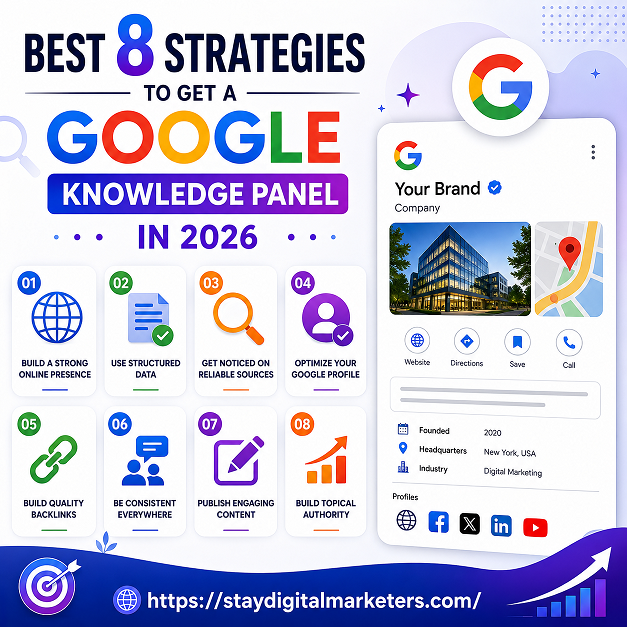
Teams working on broader digital authority for local businesses, including building citations, earning local press mentions, and establishing knowledge panel presence, often work with specialized services that handle the off-page infrastructure. Stay Digital Marketers is one such resource in this space, covering services like guest posting, press release distribution, niche edits, SaaS backlinks, Wikipedia page creation, and Google Knowledge Panel creation, which complement the on-platform optimization work described throughout this article.

Filza Taj is an MPhil in Human Resources-turned SEO Specialist, Content Strategist, and Digital Marketing Consultant with over 5 years of experience helping businesses in 30+ countries grow online. As the Founder of Stay Digital Marketers (staydigitalmarketers.com), she delivers results-driven solutions in link building, guest posting, PR distribution, niche edits, multilingual backlinks, and content marketing. She publishes daily SEO insights and actionable strategies to help brands strengthen their online presence, attract the right audience, and convert clicks into loyal customers.
Filza@staydigitalmarketers.com
Stay Digital Marketers
Need SEO, Link Building or Digital Marketing Services?
Request a Free Audit →