

Mention is the stronger pick for real-time brand tracking, while BuzzSumo wins for content research and influencer discovery. Most growing brands eventually need both, just for different jobs.
Brand tracking means keeping watch over where and how a brand, product, or person is mentioned across the web and social platforms. Mention and BuzzSumo are two of the most searched tools for this job, but they were built to solve different problems. Mention focuses on catching every mention as it happens. BuzzSumo focuses on understanding which content and creators are already driving conversation in a niche.
This guide compares both platforms across monitoring depth, content research, pricing, and real user feedback, then closes with a simple framework for choosing the right one for a specific goal. Let’s have a deeper look what are exactly brand mentions.
Key Takeaways
Mention is a media monitoring and social listening platform. It scans web pages, news sites, forums, and social networks for keyword matches and sends alerts when a brand, competitor, or topic is mentioned.
The platform is built around three core jobs: catching mentions quickly, showing where a brand’s share of voice stands against competitors, and giving PR and social teams a single inbox to respond from. It draws from a very large index of sources, which is why agencies handling reputation management and crisis response tend to favor it.
BuzzSumo is a content discovery and content marketing platform. Instead of centering the product around alerts, it centers it around research: which articles and posts are getting the most engagement, which headlines and formats are working right now, and which creators are influential in a given niche.
BuzzSumo does include mention alerts and backlink tracking, but these sit alongside its content analyzer, trending topics feed, and influencer search rather than being the main product. Content marketers, SEO teams, and PR staff researching guest post or interview opportunities are its core users.

The short answer: Mention is a listening tool first, BuzzSumo is a research tool first. The difference shows up clearly in three areas.
Mention updates on a near real-time basis and is designed to catch a mention within minutes across web and social sources. BuzzSumo updates its mention and alert data frequently, but it is not built for instant social listening, so there can be a short lag compared with a dedicated monitoring platform.
BuzzSumo’s content analyzer breaks down what topics, headlines, and formats perform best in a niche, and it can compare a brand’s content against competitors. Mention does not offer this level of content performance analysis, since its dashboard is oriented around conversation volume and sentiment rather than content engagement.
BuzzSumo includes filters to find influencers by niche, platform, and reach, which supports PR outreach and link building campaigns. Mention does not have a comparable influencer discovery layer built into its core plans.
For pure brand mention tracking, Mention has the edge. Its monitoring engine is purpose built to surface a mention as soon as it appears, whether the source links back to the brand or not, and it organizes results by sentiment and reach so a PR or social team can prioritize a response.
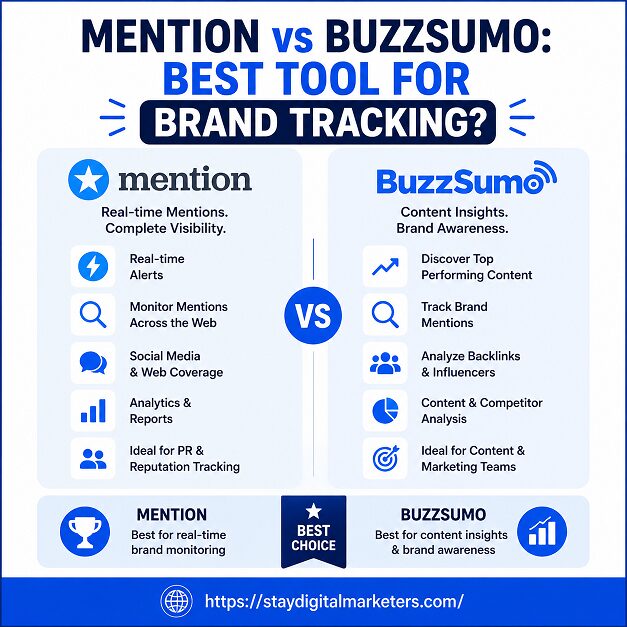
BuzzSumo can also alert on brand and competitor mentions, and it layers in engagement data that shows how much traction each mention is getting. That extra context is useful, but it comes at the cost of monitoring speed and source breadth.
Pricing structures differ enough to influence the decision on their own. Mention’s plans are generally positioned for individuals and small teams at the entry level, then scale up for agencies that need more monitoring volume and seats. BuzzSumo’s plans start higher, since its Content Creation, PR & Comms, and Suite tiers are built around broader research and outreach needs rather than monitoring alone, according to pricing data published by Capterra.
Independent review platforms including G2 and TrustRadius have noted that reviewers commonly describe BuzzSumo as easier to set up and administer, while some Mention users have cited a steeper cost relative to the number of search terms included on lower plans.
| Category | Mention | BuzzSumo |
| Core purpose | Real-time web and social listening | Content discovery and performance research |
| Source coverage | Over a billion web and social sources | Millions of articles, posts, and shares |
| Alert speed | Near real-time keyword alerts | Frequent but not instant updates |
| Unlinked mention detection | Built for this use case | Available but secondary to content data |
| Content and headline analysis | Limited | Strong, with engagement and format data |
| Influencer discovery | Not a core feature | Built-in filters by niche, reach, and platform |
| Entry pricing | Lower starting tiers for small teams | Higher starting tiers, scaling for agencies |
| Best for | PR, reputation, and crisis monitoring | Content strategy, SEO, and influencer outreach |
Yes, for this specific job BuzzSumo is the more complete tool. Its content analyzer surfaces the highest performing articles, posts, and formats in a niche, its trending topics feed helps content teams plan ahead of demand, and its influencer search speeds up outreach for guest posts, interviews, and PR placements. Mention was not designed to answer these questions, so teams that rely on it for monitoring often pair it with a separate content research tool.
Mention is generally more reliable for unlinked mention detection because catching every reference to a keyword, with or without a link, sits at the center of its product. This matters for link building teams that want to find unlinked mentions worth converting into backlinks, and for reputation teams that need to see a mention regardless of whether the author credited the source with a link.
BuzzSumo can surface unlinked mentions too, particularly through its backlink and mention alert features, but this function plays a supporting role next to its content and influencer tools rather than being the primary use case.
Feedback aggregated on review platforms such as G2 and TrustRadius shows a fairly consistent pattern. Reviewers tend to rate BuzzSumo higher for ease of use, onboarding, and ongoing product support. Reviewers who compared the two directly have also noted that Mention can feel expensive relative to the number of keywords or search terms included on its lower tiers.
At the same time, users who need dedicated social listening and PR monitoring continue to choose Mention specifically because of its monitoring depth and alert speed, features that fall outside BuzzSumo’s core focus.
Choosing between these two tools comes down to matching the platform to the actual job. The SCOPE method breaks that decision into five questions.
Running a brand through these five questions usually makes the right choice obvious within a few minutes, without needing to trial both platforms in full.
For agencies and larger in-house teams, yes. Mention covers the listening layer: catching mentions, tracking sentiment, and flagging reputation issues as they happen. BuzzSumo covers the strategy layer: understanding what content works, who the relevant influencers are, and where outreach opportunities exist. Running both tools in parallel closes the gap that either platform leaves on its own, though smaller teams with a single clear priority can usually start with just one.
Brand monitoring and off-page SEO overlap more than most marketers expect. An unlinked mention caught through a monitoring tool is often a ready-made backlink opportunity, since the site has already referenced the brand and only needs a follow-up outreach email to add a link. This is one reason agencies that manage guest posting, niche edits, and digital PR campaigns keep a monitoring tool running alongside their outreach workflow.
Mention is generally the stronger choice for pure brand tracking because it is built around real-time keyword alerts across a very large pool of web and social sources. BuzzSumo tracks mentions too, but its strength lies in content and engagement analysis rather than instant listening.
Yes, for content strategy work. BuzzSumo shows which headlines, formats, and topics perform well in a niche, and it surfaces influencers and competitor content. Mention was not built for this kind of content research.
Many marketing and PR teams do. Mention handles the listening and alerting side, while BuzzSumo supports the content planning and influencer outreach side. Used together, they cover both reactive monitoring and proactive content strategy.
Mention typically has lower entry-level pricing, which makes it more accessible for freelancers, solo marketers, and small businesses that mainly need monitoring. BuzzSumo’s plans are priced for teams that need deeper content and influencer data.
Yes. Mention is built to surface brand mentions even when no hyperlink is attached, which makes it useful for reputation monitoring and for finding unlinked mention link-building opportunities.
Not in the strictest sense. BuzzSumo updates mentions and alerts frequently, but there can be a short delay compared with tools purpose-built for instant social listening, such as Mention.
Reviewers on independent comparison sites have generally rated BuzzSumo as easier to set up and administer, while Mention’s interface leans toward dedicated monitoring dashboards that take a little longer to configure for first-time users.
Once a brand has a monitoring workflow in place, the next step is usually converting mentions and outreach opportunities into real authority signals. Agencies such as Stay Digital Marketers work within this space, supporting brands with guest posting, niche edits, press release distribution, SaaS backlinks, brand mentions, Wikipedia page creation, and Google Knowledge Panel creation, which gives monitoring data a clear place to go once an opportunity has been identified.

Filza Taj is an MPhil in Human Resources-turned SEO Specialist, Content Strategist, and Digital Marketing Consultant with over 5 years of experience helping businesses in 30+ countries grow online. As the Founder of Stay Digital Marketers (staydigitalmarketers.com), she delivers results-driven solutions in link building, guest posting, PR distribution, niche edits, multilingual backlinks, and content marketing. She publishes daily SEO insights and actionable strategies to help brands strengthen their online presence, attract the right audience, and convert clicks into loyal customers.
Filza@staydigitalmarketers.com
Stay Digital Marketers
Need SEO, Link Building or Digital Marketing Services?
Request a Free Audit →