
A diagnostic guide for confirming and responding to a Google core update impact
A core update is a broad change Google makes to its main search ranking systems, released several times a year to improve how relevance and content quality are judged across the entire index. Unlike a manual action, which targets one site for a specific violation, a core update reassesses the web at large, so a ranking swing after one rolls out is rarely personal. It is Google recalibrating what “good” looks like, and pages that were previously borderline can move up or down as a result.
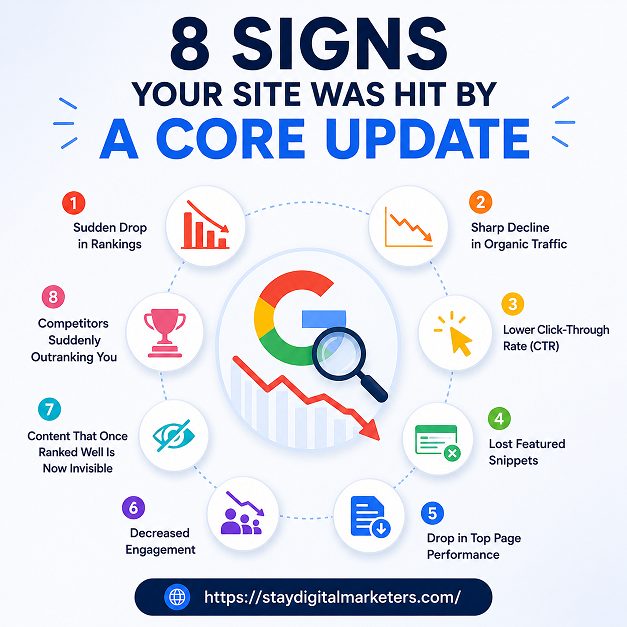
The tricky part is telling a genuine core update hit apart from ordinary ranking noise, a seasonal dip, or a technical mistake. The signs below are the same checks used to separate real algorithmic impact from coincidence, drawn from how these reviews are typically conducted across client accounts, so a site owner can diagnose a drop with the same discipline an SEO practitioner would use.
Key Takeaways
Google runs core updates against its E-E-A-T principles: experience, expertise, authoritativeness, and trustworthiness. The update does not single out a website by name. Instead, it changes how signals are weighted across billions of pages, which means a site can lose rankings without having done anything technically wrong. It simply stops looking as strong relative to what is now being rewarded.
Confusion usually comes from timing. Traffic naturally rises and falls with seasonality, promotions, competitor activity, and site changes made around the same time as a rollout. A site owner who spots a dip and immediately blames “the algorithm” without checking the calendar of confirmed updates is often chasing the wrong fix. The eight signs that follow are built to rule that confusion out.
The first and most basic check is timing. Google announces core updates publicly and posts them to its search status dashboard, along with a rollout window that typically runs one to two weeks. The May 2026 core update, for example, launched on May 21, 2026, and Google marked it complete on June 2, 2026, a rollout of roughly twelve days. If a traffic or ranking change on a site began inside that window and not before it, that is the first real signal of a core update hit rather than an unrelated event.
Matching the date is not optional. A drop that started two weeks before a core update was even announced is not a core update hit, no matter how much the timing feels close. Pull up the exact rollout start and end dates from Google’s own status dashboard before drawing any conclusion.
Core updates rarely single out one URL. When a site is genuinely affected, the drop typically shows up across many pages or an entire content category at once, not as an isolated dip on a single blog post. In Google Analytics 4, this shows up as a sitewide decline in the Traffic Acquisition report, and in Engagement, the Landing Page view will show the same downward pattern repeated across a cluster of related URLs rather than one outlier.
If only one page lost visibility while everything else held steady, the more likely explanations are a content freshness issue on that specific page, a competitor publishing something stronger, or a technical error like a broken canonical tag, not a core update.
Clicks can drop for reasons that have nothing to do with rankings, including seasonality, a shift toward zero-click search features, or increased ad density on a results page. The more reliable core update signal sits in the Average Position metric inside Google Search Console’s Performance report. If average position is sliding downward for a broad set of queries over the same window as a confirmed rollout, that is a stronger and more specific indicator than a raw traffic number.
Segment this by query and by page rather than looking at the sitewide total. A genuine core update impact tends to show a step change across many queries at once that begins during the rollout and persists afterward, rather than a single query drifting a position or two, which is closer to ordinary fluctuation.
Core updates behave like a rolling wave rather than a single switch flip. The first few days of any rollout are the noisiest and least reliable, since rankings can shift, partially reverse, and shift again before settling. Data from the May 2026 core update showed exactly this kind of pattern, with SEMrush’s Sensor tool recording a peak volatility score of 7.0 out of 10, classified as high, across multiple distinct spikes during the twelve day rollout before volatility dropped back down after completion.
A real hit is one where the ranking loss is still present roughly a week after the update is marked complete, not just during the volatile rollout days. Google itself recommends waiting about a week past the official completion date before drawing firm conclusions, since early-rollout swings often correct themselves as the update fully propagates.
When a core update is genuinely responsible, the pages that slip first tend to share a pattern: thin word counts relative to the query’s complexity, generic explanations that could apply to any site, and little sign of direct, first-hand knowledge of the topic. Reporting from the May 2026 rollout repeatedly pointed to informational content lacking real depth and AI-generated pages without meaningful human editing as being among the categories that lost visibility earliest and most consistently.
This is a useful diagnostic on its own. Pull a list of the URLs that dropped and read them the way a skeptical searcher would. Pages that read like a rewritten summary of what is already ranking, rather than something written from direct experience with the topic, are the ones most exposed.
A core update loss is rarely a mystery once the new top-ranking pages are studied directly. Pull the current top results for the affected queries and compare them against what used to rank. In most confirmed core update cases, the pages that moved up show more specific detail, clearer sourcing, direct examples, or a more comprehensive answer to the underlying question than what previously held the position.
If the newly ranking pages look thinner, less accurate, or less useful, the drop is less likely to be a straightforward quality reassessment and more likely tied to a different cause, such as a technical issue, a link change, or a shift in how the query itself is being interpreted.
Not every query type is affected equally by a given core update. Some rollouts weight informational relevance more heavily, while others recalibrate how commercial and transactional intent is judged. When the affected pages on a site cluster around service pages, product categories, or other queries tied directly to revenue, that concentration itself is a meaningful signal, because it points to a specific part of the ranking system being retuned rather than a general, unexplained decline.
Segmenting Search Console data by query intent, not just by page, usually reveals this pattern quickly. A sitewide dashboard number can hide the fact that ninety percent of the real damage sits inside one query category.
The final sign is really a process of elimination. Before settling on “core update” as the explanation, rule out the alternatives. Check the backlink profile in Search Console for a sudden loss of high-authority referring domains or a spike in spammy links. Confirm that no manual action notice has been issued under Security and Manual Actions. Verify that crawling, indexing, site speed, and mobile usability haven’t quietly broken around the same time.
If backlinks are stable, no manual action exists, technical health checks out clean, and everything else lines up with the confirmed rollout window, a core update is the remaining and most likely explanation.
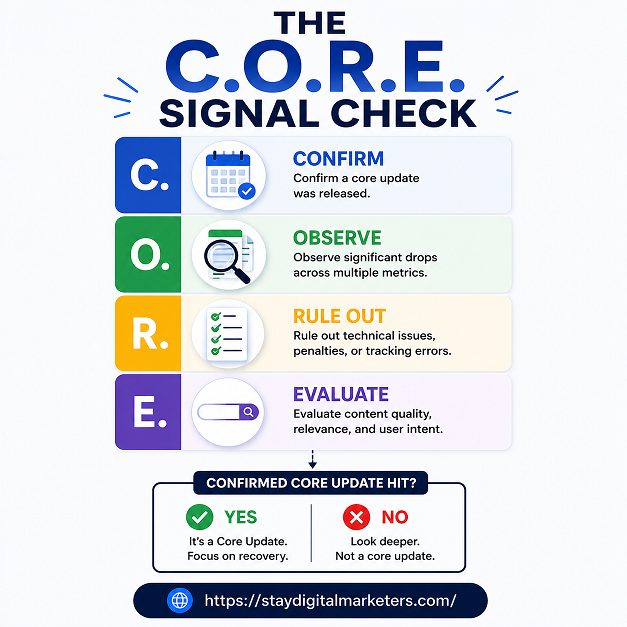
Rather than working through the eight signs in a scattered order, the C.O.R.E. Signal Check condenses them into a four-step sequence that can be run on any site in under an hour.
Confirm the calendar. Match the exact start and end dates of the drop against Google’s published rollout window, not a rough guess of “sometime last month.”
Observe the breadth. Check whether the decline spans multiple pages and query types in GA4 and Search Console, rather than a single URL.
Rule out other causes. Walk through backlinks, manual actions, and technical health before accepting the core update explanation.
Evaluate the query pattern. Identify whether the losses cluster around informational or commercial intent, and study what is now outranking the site to understand what shifted.
A site that clears all four checkpoints has a confirmed core update hit and can move directly into a recovery plan instead of guessing at the cause.
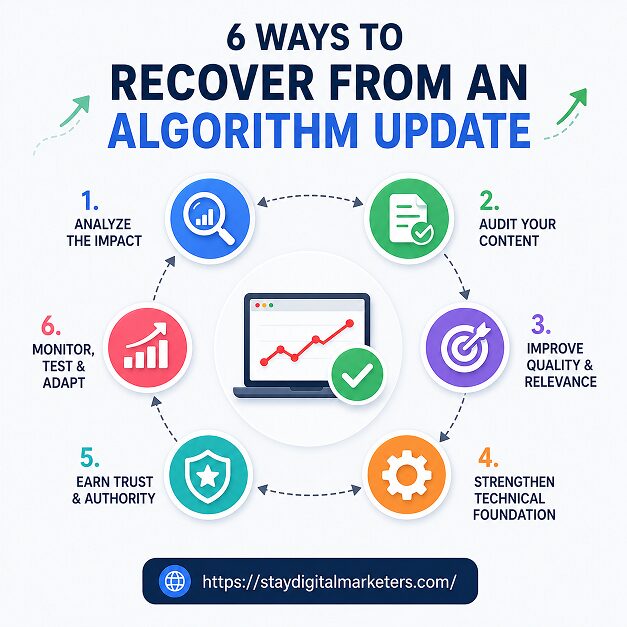
Once a core update is confirmed as the cause, the instinct to rewrite everything immediately is usually the wrong one, especially inside the still-volatile rollout window itself. The more reliable sequence is to wait for the update to fully complete, let roughly a week of clean data accumulate, then prioritize the highest-value pages that lost visibility first rather than trying to fix the entire site at once. Improve depth, add direct evidence of experience with the topic, and close the specific gaps found when comparing against the pages that are now outranking the site.
Recovery is not guaranteed on any fixed timeline. Some sites regain lost ground within weeks of a follow-up update; others need to wait for the next core update cycle before improvements are reflected in rankings. Consistent monitoring after each future rollout is the only way to know for certain whether the changes worked.
The table below condenses the eight signs into a fast side-by-side check.
| Signal | Likely Core Update Hit | Likely Unrelated Cause |
| Timing | Starts inside a confirmed rollout window | Starts before the update was announced |
| Scope | Spans many pages or a content category | Isolated to one URL |
| Search Console | Average position falls for many queries | Clicks fall but position holds |
| Persistence | Loss holds a week after completion | Bounces back within days |
| Content pattern | Thin or generic pages lose ground first | No clear content pattern |
| Backlinks | Profile unchanged | Sudden loss of referring domains |
| Manual actions | None on record | Manual action notice present |
Compare the exact date your traffic or rankings dropped against Google’s published rollout dates for that update. If the decline started inside the window, spans multiple pages, and holds after the rollout completes, it is very likely a core update impact rather than an unrelated issue.
There is no fixed timeline. Some sites see partial recovery within the same rollout as signals settle, while others need to wait for a future core update before quality improvements are reflected. Consistent, patient content improvement matters more than speed.
Yes. Core updates commonly affect specific content categories, page types, or query intents rather than an entire domain uniformly. Checking Search Console by page and query segment, not just the sitewide total, usually reveals which section was actually impacted.
A manual action is a targeted penalty applied to one site for a specific policy violation, and it appears as a notice inside Search Console under Security and Manual Actions. A core update is a broad, automatic recalibration that affects the entire index and never comes with a site-specific notice.
It is usually better to wait. Rankings during an active rollout can shift and partially reverse before settling, so changes made mid-rollout are hard to evaluate accurately. Most practitioners recommend waiting about a week after the update is marked complete before making significant edits.
Not necessarily. It often means the content is no longer as strong relative to what else exists for that query today. Studying the pages now outranking yours usually shows a specific, fixable gap in depth, evidence, or clarity rather than a wholesale quality failure.
Google posts every confirmed core update, along with its start date, rollout window, and completion date, on the Google Search Status Dashboard. That is the most reliable source to check before attributing any ranking change to an update.
A core update hit is identifiable, not mysterious, once the timing, breadth, persistence, and query pattern are checked in sequence rather than assumed from a single traffic graph. Sites that treat a ranking drop as a diagnostic exercise, working through these eight signs methodically, tend to reach the right conclusion and the right fix far faster than sites that react to the first dip they notice.
For teams that need this kind of update tracking and content recovery work handled consistently across a portfolio of sites, agencies like Stay Digital Marketers support that process alongside broader off-page and authority-building work, including guest posting, niche edits, press release distribution, SaaS backlinks, and Google Knowledge Panel creation, all aimed at strengthening the trust and authority signals that core updates are designed to reward.

Filza Taj is an MPhil in Human Resources-turned SEO Specialist, Content Strategist, and Digital Marketing Consultant with over 5 years of experience helping businesses in 30+ countries grow online. As the Founder of Stay Digital Marketers (staydigitalmarketers.com), she delivers results-driven solutions in link building, guest posting, PR distribution, niche edits, multilingual backlinks, and content marketing. She publishes daily SEO insights and actionable strategies to help brands strengthen their online presence, attract the right audience, and convert clicks into loyal customers.
Filza@staydigitalmarketers.com
Stay Digital Marketers
Need SEO, Link Building or Digital Marketing Services?
Request a Free Audit →