
No, and this changes what “rank well” can honestly mean for this topic. Google removed HowTo rich results from mobile search in August 2023 and from desktop in September 2023. As of 2026, HowTo schema produces zero visual enhancement on any surface in Google Search, making it one of the longest-dead structured data types still actively recommended by many current guides, including several still ranking for this exact query. HowTo remains a valid Schema.org type, and Google has confirmed leaving the markup on a page causes no errors, but there is no rich result left for it to earn, regardless of how precisely the markup follows Google’s technical specification.
That reframes this article’s actual job. “Ranking well” for HowTo content in 2026 has nothing to do with a visual SERP feature that has not existed for three years. It means the underlying page, the step-by-step content itself, ranks well organically because it is comprehensive and well-structured, and increasingly, that the same structure makes it easier for AI systems to extract and cite. The five examples below are built around that distinction, since presenting HowTo schema as a rich-result lever would be repeating a claim that stopped being true in 2023, three years before this article was written.
Key Takeaways
Two things, neither of them a rich result. First, classic organic ranking: comprehensive, clearly sequenced instructional content tends to satisfy search intent for procedural queries better than thin or poorly organized alternatives, which supports ranking through ordinary relevance and content quality signals, not through schema. Second, AI extraction: AI systems including ChatGPT and Google’s own AI Overviews can still parse HowTo schema to identify discrete steps, similar to how FAQPage schema continues feeding AI citations even after losing its own Google rich result in May 2026. Neither pathway rewards the schema tag itself; both reward the quality of what the schema is describing.
Reviewing how-to content performance across a range of client pages shows this pattern clearly: pages that rank and get cited well are the ones where each step could stand alone as a complete instruction, not the ones that simply wrapped existing paragraph content in HowTo tags after the fact to chase a rich result that, in most cases, had already stopped working years before the page was built. That distinction, content quality versus markup presence, is the single most useful thing a team evaluating its existing how-to content can check first.
Four checks determine whether how-to content has genuine ranking and citation value independent of the schema wrapped around it.
Content passing all four tends to rank and get cited well regardless of whether HowTo schema is present at all, which is the clearest evidence that the content, not the markup, is doing the actual work.
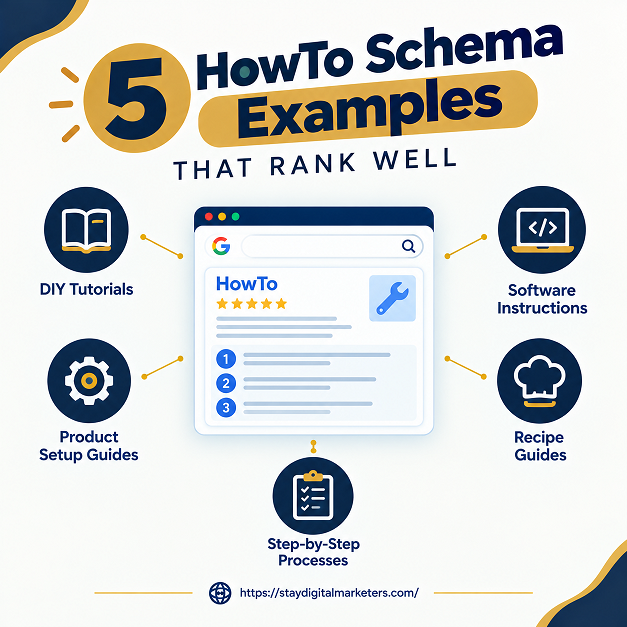
Step-by-step installation or configuration guides, setting up a development environment, connecting an integration, configuring account settings, rank well because each step maps to a specific, verifiable action a reader can complete before moving on. HowTo schema here should mirror the page exactly: one schema step per visible instruction, with tool names and version numbers included rather than paraphrased generically, since a vague step description gives an AI system less to extract confidently.
Furniture assembly, home repair, and craft instructions rank well when steps include specific measurements, tool requirements, and time estimates rather than vague descriptions. This category benefits most from accurate step images referenced in the schema, since visual confirmation at each stage is often what separates a genuinely useful guide from a thin one.
Diagnostic, branching content, “if this happens, try this”, ranks well because it answers a high-intent, often urgent query more precisely than a generic overview. HowTo schema works best here when each step represents a single diagnostic action rather than bundling multiple possible fixes into one step, which keeps the structure genuinely sequential rather than a disguised list. Readers searching for a fix are usually mid-problem, so clarity at each individual step matters more here than in almost any other how-to category.
Business or administrative processes, filing a specific form, setting up a workflow across multiple tools, rank well when they break a genuinely complex process into an accurate number of stages rather than compressing it into three oversimplified steps that leave out what a reader actually needs to know at each stage. Naming the specific tool, form, or system at each stage, rather than describing the action generically, is what typically separates a page that ranks from one that reads as filler.
Exercise routines and structured daily or weekly plans rank well when each step specifies duration, repetition, or intensity rather than a generic instruction to “exercise regularly.” This category also tends to pair well with Video schema alongside HowTo, since demonstrating a movement often communicates more than text alone.
Yes, selectively, but with the reward correctly understood. Implementing HowTo schema does not earn a rich result and never will under the current deprecation, so it should not be prioritized as a ranking or CTR lever. It remains worth adding to genuinely step-based content because it gives AI systems a clean, structured version of the instructions to extract from, and because building content around clear, standalone steps tends to produce better organic content regardless of whether the schema is present. Teams still adding HowTo schema purely to chase a rich result are optimizing for a reward that has not existed since 2023, and that effort is better redirected toward the content quality the Structural Value Test above actually measures.
| Schema Type | Rich Result Status in 2026 | Still Worth Implementing? |
| HowTo | Fully deprecated on all surfaces since September 2023 | Yes, for AI extraction and content structure only |
| FAQPage | Deprecated on all surfaces since May 7, 2026 | Yes, for AI extraction and content structure only |
| Recipe | Still active and generating rich results | Yes, for both rich results and AI extraction |
| Product / Review | Still active and generating rich results | Yes, for both rich results and AI extraction |
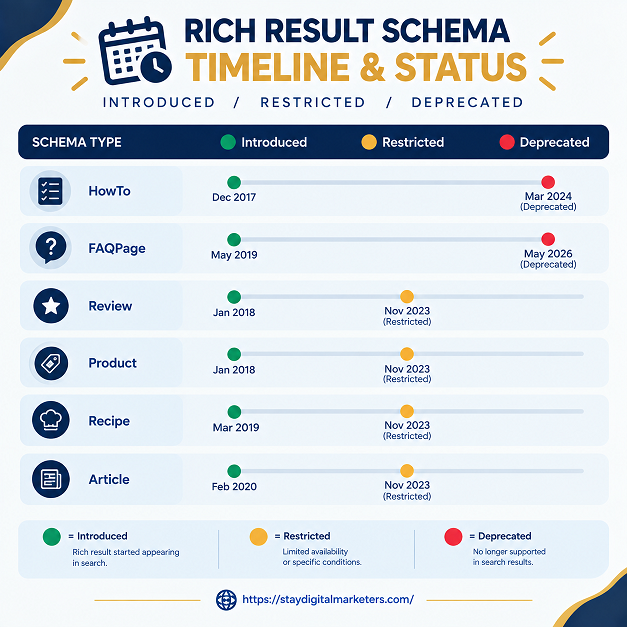
No. Google removed HowTo rich results from mobile in August 2023 and from desktop in September 2023. As of 2026, HowTo schema produces zero visual rich result on any surface, making it one of the longest-deprecated structured data types still widely implemented.
Not necessarily. HowTo remains a valid Schema.org type, and Google has confirmed unused structured data causes no errors. The better question is whether the underlying step-by-step content is genuinely useful and whether AI systems appear to reference it, independent of the defunct rich result.
Not directly. HowTo schema itself is not a ranking factor and no longer earns any visual SERP enhancement. Pages built around HowTo schema tend to rank well because the underlying content is comprehensive and well-structured, not because of the markup itself.
Yes, in a limited way. AI systems can still parse HowTo schema to extract sequential steps for their own answers, similar to how FAQPage schema continues to feed AI citations after losing its Google rich result. The markup supports extraction even without a visual reward in classic search.
Recipe schema remains an active, functioning rich result type in Google Search, while HowTo does not. A cooking instruction page should generally use Recipe schema rather than HowTo schema, since Recipe still earns a working visual enhancement that HowTo has not produced since 2023.
Well-structured how-to content has steps that work as standalone units, cover genuinely sequential actions rather than an arbitrary list, and include specific details like tools, materials, or time estimates that a generic listicle would not contain.
Well-structured how-to content still earns organic visibility and AI citation, but that visibility compounds fastest on a domain that also carries broader topical authority and outside validation. Stay Digital Marketers works on that surrounding layer, including guest posting, press release distribution, SaaS backlinks, niche edits, multilingual backlinks, Wikipedia page creation, and Google Knowledge Panel creation, alongside complete SEO services, so genuinely useful instructional content sits on a domain built to help it actually get found.

Filza Taj is an MPhil in Human Resources-turned SEO Specialist, Content Strategist, and Digital Marketing Consultant with over 5 years of experience helping businesses in 30+ countries grow online. As the Founder of Stay Digital Marketers (staydigitalmarketers.com), she delivers results-driven solutions in link building, guest posting, PR distribution, niche edits, multilingual backlinks, and content marketing. She publishes daily SEO insights and actionable strategies to help brands strengthen their online presence, attract the right audience, and convert clicks into loyal customers.
Filza@staydigitalmarketers.com
Stay Digital Marketers
Need SEO, Link Building or Digital Marketing Services?
Request a Free Audit →