
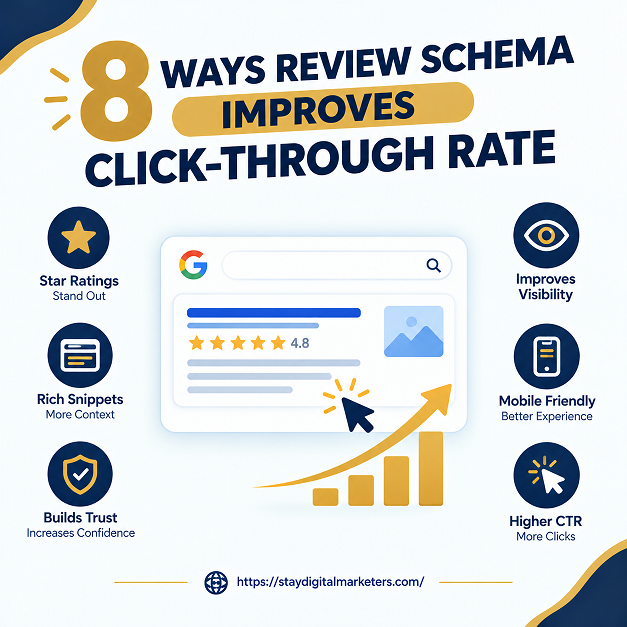
Review schema is structured data, typically Review or AggregateRating markup, added to a page to describe genuine customer ratings and feedback in a format Google can parse and potentially display as a star rating rich result. It improves click-through rate primarily through visual differentiation: a listing with gold stars and a review count stands out against a page of plain text results, and that visual contrast, not any direct ranking boost, is what drives the additional clicks. Review schema is not itself a ranking factor, a distinction Google has confirmed directly, though the CTR gains it produces can feed back into performance indirectly over time.
The short answer is that review schema improves CTR through several distinct mechanisms, not just one: visual interruption, social proof, volume signaling, and increasingly, influence on how AI systems select and compare options. The eight ways below break down each mechanism individually, since treating review schema as a single undifferentiated CTR lever misses how much of its effect depends on execution details most guides skip, particularly around which claimed statistics are actually trustworthy enough to plan a strategy around.
Key Takeaways
Most guides on this exact topic repeat a 35 percent CTR increase figure for review rich snippets as an established fact. Tracing that number back rarely turns up a named study, a sample size, or a publication behind it. At least one more careful source flags this directly, describing the commonly cited range as a vendor estimate and noting that most of these figures come from agencies and SEO tool companies with a product to sell, suggesting a more honestly hedged range closer to 20 to 30 percent.
That does not mean review schema has no CTR effect. Google’s own published case studies show real, named examples: Rotten Tomatoes measured a 25 percent higher CTR on pages using structured data, and Nestle reported an 82 percent increase specifically for pages appearing as rich results. The difference between these figures and the ubiquitous 35 percent claim is sourcing: one traces to Google’s own documentation, the other traces to nothing verifiable. None of the widely available guides on this topic make that distinction for readers deciding how much weight to put on any single number.
Three questions determine whether review schema is likely to survive Google’s review of it, rather than getting the rich result stripped under the structured data spam policy.
Failing any of these three does not tank a page’s organic ranking. It typically triggers removal of the rich result itself, the stars and review count disappear while the underlying blue link and ranking usually remain intact, a distinction many teams misunderstand when reacting to a lost rich result.
Gold stars break the visual monotony of a search results page built almost entirely from plain blue links and black text. That contrast alone draws the eye before a searcher reads a single word of the listing’s title or description, which is the most immediate and mechanical driver of the CTR lift review schema produces.
A star rating communicates that other people have already validated the business or product, reducing the perceived risk of clicking through. This social proof effect works even when a searcher does not consciously register the exact rating number, since the presence of stars alone signals an established, reviewed entity.
The number displayed alongside the stars, “243 reviews” for instance, communicates volume and establishment independent of the rating itself. A 4.6-star rating backed by hundreds of reviews reads as more trustworthy than the same rating backed by three, even though the schema markup mechanics are identical in both cases.
A rich result’s CTR advantage does not depend on holding the top search position. A listing with stars ranking third can out-click a plain listing ranking first, since the visual advantage competes directly against ranking position rather than only compounding on top of it.
Sustained higher CTR at a given position is one of many behavioral signals Google’s systems may factor into how a page performs over time, though this remains an indirect, correlational relationship rather than a confirmed direct mechanism. Review schema’s CTR lift, in other words, may compound slowly rather than acting as an instant ranking lever, which is why results from adding review schema often take weeks to show up clearly in traffic reporting.
Review schema paired with Product schema on the same listing can produce a combined rich result showing price, availability, and star rating together, multiplying the visual differentiation beyond what either schema type produces alone. Reviewing ecommerce client listings across a range of categories shows this stacking effect consistently outperforming single-schema implementations in practice.
In local search results and map-adjacent listings, star ratings help a business stand out against competitors in the same immediate area, where searchers are often comparing several similar options within seconds. LocalBusiness schema combined with genuine review data gives a local listing a visual edge in exactly the comparison-heavy context where it matters most.
As AI systems increasingly synthesize comparison answers rather than returning a plain list of links, accurately marked-up review data becomes one of the structured signals those systems can pull from when describing an option’s reputation. This extends review schema’s original CTR-driving purpose into a newer role: influencing which option an AI system frames favorably when a user asks for a recommendation rather than a search result.
| Claimed CTR Lift | Source Type | How Much to Trust It |
| 35% CTR increase | Repeated across many vendor and SEO tool blogs with no named study | Low, treat as an unverified industry figure |
| 20-30% CTR uplift | Flagged explicitly by at least one source as a vendor estimate range | Low to moderate, more honestly hedged than the 35% figure |
| 25% higher CTR (Rotten Tomatoes) | Google’s own published case study | High, named source and named site |
| 82% higher CTR (Nestle) | Google’s own published case study | High, named source and named site |
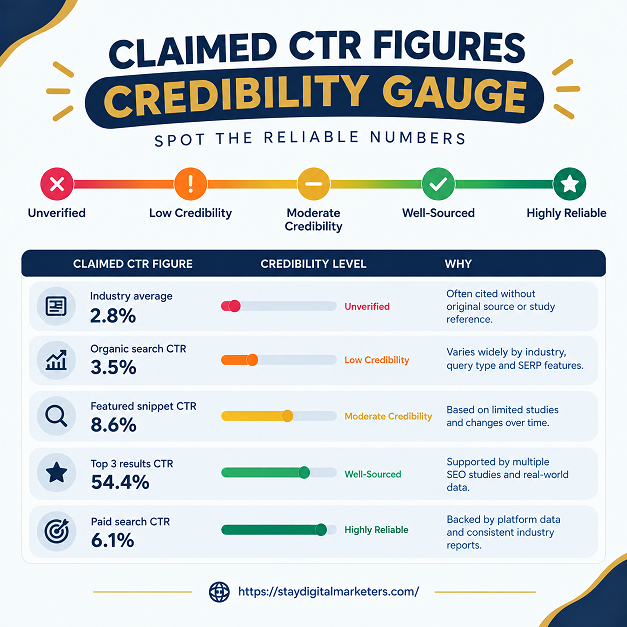
That figure is repeated across many SEO and vendor blogs but rarely traces to a named study or sample size. At least one source explicitly flags it as a vendor estimate, suggesting a more honest range closer to 20 to 30 percent, still unverified but more cautiously framed.
No. Google has confirmed structured data itself is not a direct ranking factor. Review schema earns eligibility for a star rating rich result, and the resulting CTR lift can indirectly correlate with better performance over time, but the schema does not directly move rankings on its own.
No. Google’s guidelines require reviews to come from independent third parties, not the business itself. Self-written or solicited-and-edited reviews used in AggregateRating markup violate Google’s structured data policies and risk having the rich result removed entirely.
Google’s structured data spam policy removes the rich result, the stars and review count disappear from the listing, while the underlying organic ranking and blue link typically remain unaffected. The penalty revokes the enhancement, not the page’s base search visibility.
Technically one valid review can trigger a rating display if the schema is implemented correctly, though Google’s systems tend to favor listings with a steadier, larger volume of reviews for consistent display across different searches and devices.
Yes. Google’s guidelines require that any review or rating marked up in schema actually appears as visible content on that page. Pulling in an aggregate rating from a third-party platform without displaying the underlying reviews on-page is a policy violation.
Review schema earns its CTR advantage only when the underlying reputation it displays is genuine, which depends on real reviews accumulating across a business’s own site and third-party platforms alike. Stay Digital Marketers works on the broader visibility layer that supports that reputation, including guest posting, press release distribution, SaaS backlinks, niche edits, multilingual backlinks, Wikipedia page creation, and Google Knowledge Panel creation, alongside complete SEO services, so the trust review schema displays is backed by real, earned visibility elsewhere.

Filza Taj is an MPhil in Human Resources-turned SEO Specialist, Content Strategist, and Digital Marketing Consultant with over 5 years of experience helping businesses in 30+ countries grow online. As the Founder of Stay Digital Marketers (staydigitalmarketers.com), she delivers results-driven solutions in link building, guest posting, PR distribution, niche edits, multilingual backlinks, and content marketing. She publishes daily SEO insights and actionable strategies to help brands strengthen their online presence, attract the right audience, and convert clicks into loyal customers.
Filza@staydigitalmarketers.com
Stay Digital Marketers
Need SEO, Link Building or Digital Marketing Services?
Request a Free Audit →