Call or WhatsApp us anytime
Mail Us For Support

Multilingual link building is the process of earning backlinks from websites written in the same language as each translated version of your site, such as Spanish sites linking to your Spanish pages. These links tell search engines that each language version is relevant and trusted in its own market, which translated content alone cannot do.
This guide explains how to build a multilingual link building strategy, and how to plan, source and vet links in four major markets: Spanish, German, French and Arabic. Each market has its own domains, publishing customs and labelling rules for sponsored content, and understanding them is what separates links that move local rankings from links that only look good in a report.
Key Takeaways
Translated pages compete against native sites that have years of local links, so they need authority from their own language and country to rank. Links from English sites help the domain overall, but they send a weak signal about relevance to Spanish, German, French or Arabic searchers.
Google lists links from local sites among the signals it uses to understand which country a page targets, alongside ccTLDs, hreflang, local addresses and currencies, in its guide to managing multi-regional and multilingual sites. A Spanish page linked from respected Spanish and Mexican sites therefore carries both authority and a clear market signal.
Usually yes, because far fewer websites publish in most languages than in English. W3Techs data from November 2026 shows English on 49.5% of websites with a known content language, compared with 6.0% for Spanish, 6.0% for German, 4.6% for French and 0.6% for Arabic. Fewer competing pages often means fewer links are needed to reach page one.
Country-code domains are where much of the local web lives, so link prospecting in each language should start with that market’s ccTLDs. Verisign’s Domain Name Industry Brief, released in July 2026, counted 401.6 million domain registrations at the end of the second quarter of 2026, of which 148.6 million were country-code domains.
The same Verisign release ranks the ten largest ccTLDs as .cn, .de, .uk, .ru, .nl, .br, .fr, .au, .in and .eu. Germany’s .de is the second largest, which reflects how much German-language publishing happens on local domains. The same approach to country domains is used in this guide to guest posting on .ca websites.
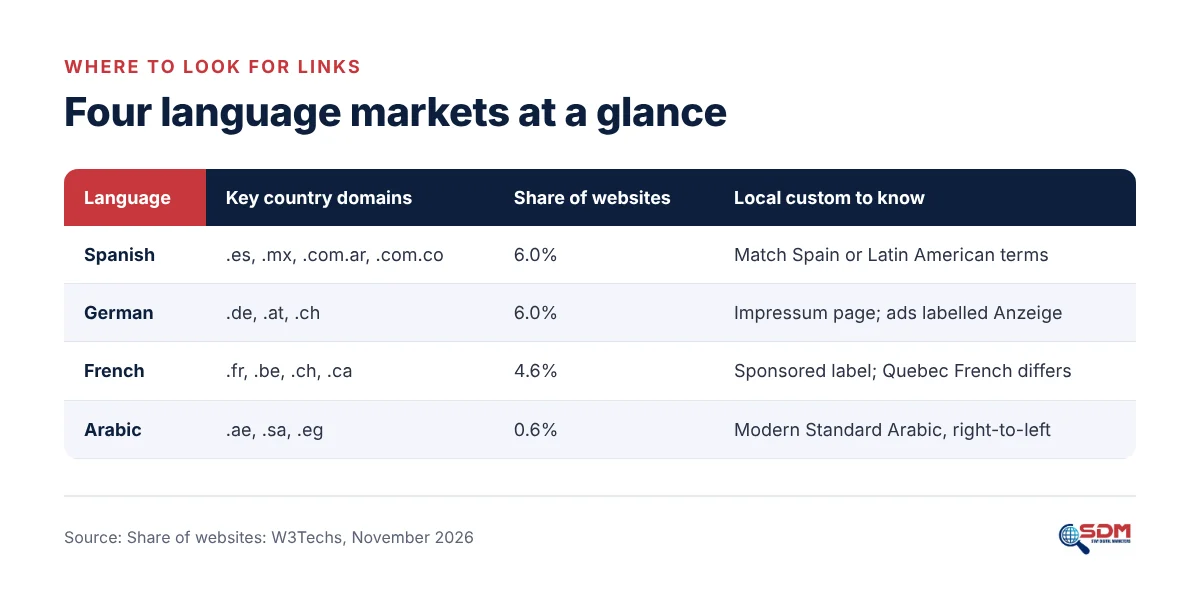
Treat Spanish as several markets, not one: Spain (.es), Mexico (.com.mx and .mx), Argentina (.com.ar), Colombia (.com.co) and US Hispanic audiences each have their own publishers and vocabulary. A Spanish page targeting Mexico benefits most from Mexican sites.
German publishers expect formal, detailed and well-sourced content, and they label paid content clearly. The German-speaking market spans Germany (.de), Austria (.at) and Switzerland (.ch), where Swiss German readers also use some different vocabulary and spelling.
French link building should separate France (.fr) from Belgium (.be), Switzerland (.ch) and Canada (.ca), since each has its own publications and Quebec French differs in vocabulary. French editors respond well to well-written, culturally adapted content and less well to direct translations of English articles.
Arabic link building focuses on publishers in the Gulf, such as the UAE (.ae) and Saudi Arabia (.sa), and in Egypt (.eg), with content written in Modern Standard Arabic for most formal publications. With only 0.6% of websites using Arabic in the W3Techs data, strong Arabic pages often face far less competition than their English equivalents.
Vet foreign sites by organic traffic from the target country, topical relevance and editorial quality, not by Domain Rating alone. Many high-DR sites in other languages get most of their traffic from unrelated countries or publish content on every topic for a fee.
These checks follow the same quality principles explained in this guide to how Google judges backlink quality, applied to each market.
The Local Authority Loop is a five-step cycle for earning links in a new language, repeated each month for each market. It moves from competitor research to measurement so each round improves the next.
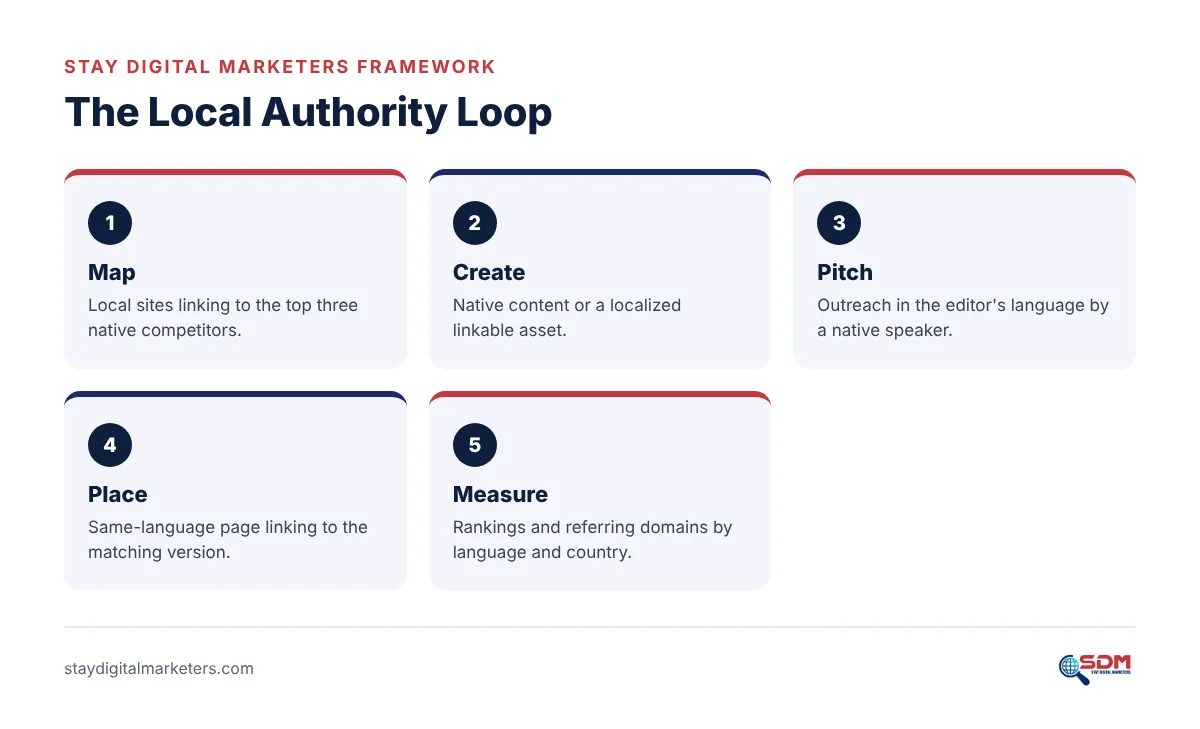
A pattern observed across client work is that brands send English outreach emails to foreign publishers and get few replies, then conclude the market is closed. The same campaign written by a native speaker usually gets a far better response, because editors judge the pitch as a sample of the content they will receive. Teams that want to run this in-house can adapt the structure of these link building methods to each language.
Guest posts, local digital PR, translated linkable assets and local business listings work best, because each one places your brand on sites that local searchers already trust. The mix depends on the market and budget.
Brands that would rather hand off sourcing, native writing and outreach can use a dedicated multilingual link building service.
The language setup those links depend on, from hreflang to native keyword research, is covered in the multilingual SEO handbook.
Yes. Links from sites in the same language as the linked page are among the clearest signals of local relevance, and Google lists links from local sites as a country signal. A Spanish page linked from relevant Spanish sites usually gains more than it would from English links of similar authority.
No. A link from a Spanish site should point to the matching Spanish page, ideally with Spanish anchor text. Pointing foreign-language links at English pages wastes the language signal and sends visitors to content they may not read, which also hurts conversions and engagement on the site.
There is no fixed number. Check how many relevant referring domains point to the top three native competitors for your main keyword in that market, then close the gap with links of similar relevance. Lower-competition languages, such as Arabic in many industries, often need fewer links.
It is not recommended. Editors on reputable foreign sites recognize machine-translated text quickly and often reject it. Native writers produce natural phrasing, local terms and correct formality, which improves acceptance rates and makes the link more credible. Machine translation can help with research, not the final article.
No. Google’s link spam policies apply in every language, so paid placements that pass ranking credit should be qualified with rel=”sponsored” or rel=”nofollow”. Many European publishers label sponsored content by law, using terms such as “Anzeige” in German or “article sponsorisé” in French.
Stay Digital Marketers maintains a link building database covering 30+ countries and is one resource that helps brands with guest posting, press release distribution, SaaS backlinks, niche edits, multilingual backlinks, Wikipedia page creation, Google Knowledge Panel creation and complete SEO services in the languages their customers search in.

Filza Taj is an MPhil in Human Resources-turned SEO Specialist, Content Strategist, and Digital Marketing Consultant with over 5 years of experience helping businesses in 30+ countries grow online. As the Founder of Stay Digital Marketers (staydigitalmarketers.com), she delivers results-driven solutions in link building, guest posting, PR distribution, niche edits, multilingual backlinks, and content marketing. She publishes daily SEO insights and actionable strategies to help brands strengthen their online presence, attract the right audience, and convert clicks into loyal customers.
Filza@staydigitalmarketers.com
Stay Digital Marketers
Grow Your Brand on Google, in AI Answers and on Autopilot
SEO, Link Building and AI Automation by Stay Digital Marketers
Get Your Growth Plan →