
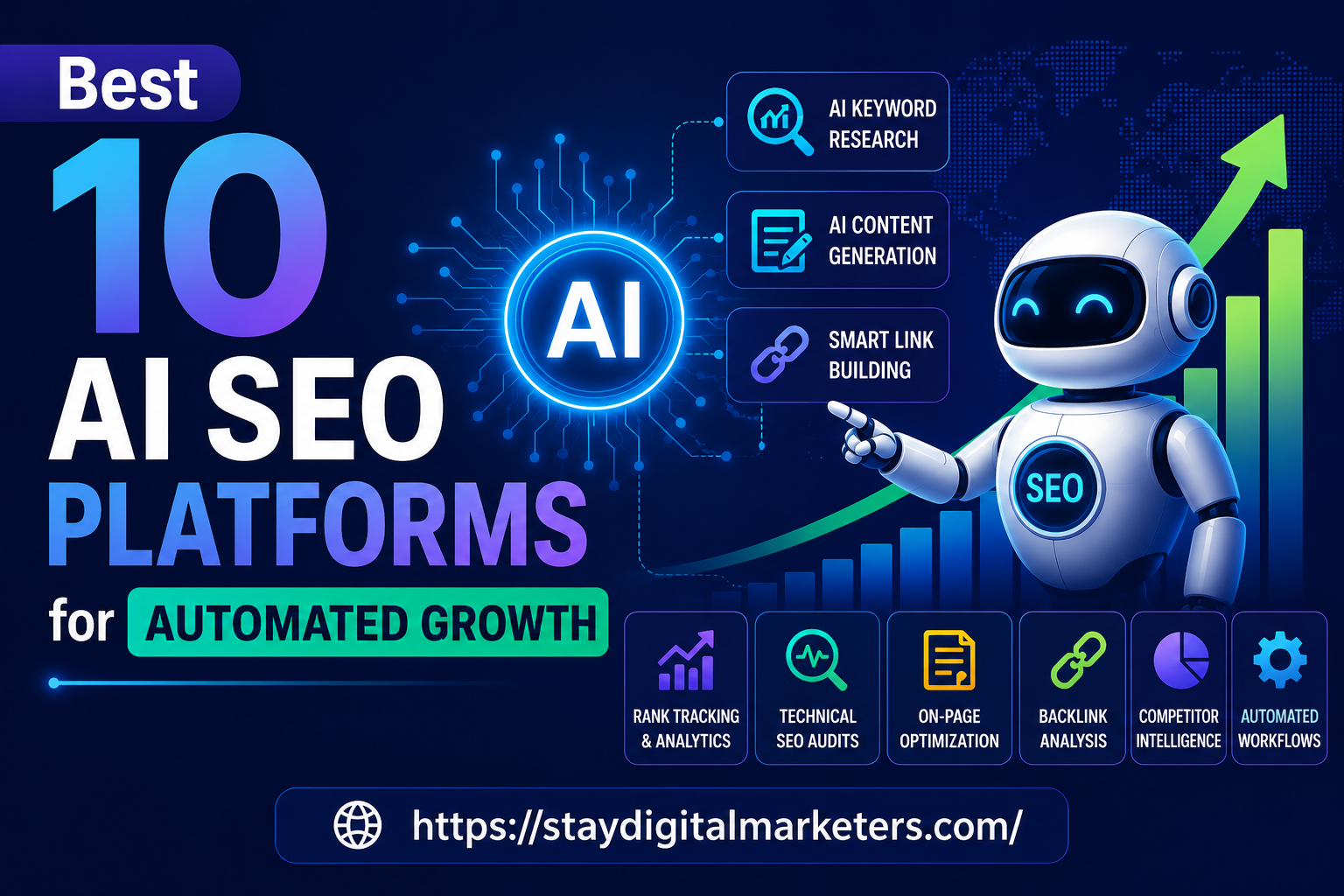
AI SEO platforms have moved well beyond simple keyword suggestion tools. They now handle content generation, technical audits, competitor analysis, rank tracking across AI search engines, and link-building workflows, all inside a single dashboard. For SEO practitioners managing multiple sites or agencies handling dozens of clients, the right platform can compress weeks of manual work into hours.
This article breaks down the ten best AI SEO platforms built specifically for automated growth. Each one is evaluated on its core strengths, automation depth, and the type of practitioner who will get the most out of it, so you can match the platform to your actual workflow rather than a feature checklist.
A standard SEO tool gives you data. An AI SEO platform interprets that data, recommends actions, and in many cases executes those actions automatically.
The critical difference is automation depth. Traditional platforms like early-generation keyword tools require a human to analyze a keyword gap report, decide what content to create, write a brief, assign the task, and review the output. AI SEO platforms collapse that chain. They identify the gap, generate the brief, produce a content draft, score it against competitors, and flag technical issues on the same page, without requiring a separate team member at each step.
A 2024 survey by BrightEdge found that 68% of enterprise marketers using AI-assisted SEO platforms reported measurable improvements in organic traffic within the first 90 days. The reason is operational efficiency: fewer manual handoffs mean faster publishing cycles, and publishing velocity is one of the clearest predictors of compound organic growth.
Before reviewing individual platforms, it helps to have a consistent scoring lens. The PACE Framework offers exactly that:
Scoring a platform across these four dimensions will tell you faster than any free trial whether it fits your growth model.
Best for: Full-funnel SEO teams and agencies who want one platform to handle everything from keyword research to AI visibility tracking.
Semrush is the most complete AI SEO platform available. Its AI Visibility Toolkit tracks how often a brand appears in AI-generated answers across Google AI Overviews and ChatGPT, giving practitioners what amounts to rank tracking for the LLM search era. The platform assigns an AI Visibility Score that benchmarks brand mentions against direct competitors.
Beyond AI search, Semrush automates keyword clustering, content briefs, on-page recommendations, site audits, and backlink gap analysis. The AI Writing Assistant inside ContentShake IQ generates draft articles pre-optimized around top-ranking competitor content.
Standout automation: Prompt Tracking reports how often a brand surfaces for specific conversational queries inside ChatGPT and Google AI Mode, including average position data.
Pricing: Starts at $139.95/month; AI Visibility Toolkit is an add-on.

Best for: Practitioners who prioritize backlink intelligence and organic traffic forecasting at scale.
Ahrefs has quietly built one of the strongest AI-assisted content research workflows in the industry. Its AI Content Grader scores existing pages against competitor benchmarks and surfaces specific topical gaps, while the Keywords Explorer now includes AI-generated SERP analysis that explains why a given page ranks and what it would take to displace it.
The platform’s Site Audit tool runs automated crawls and categorizes issues by SEO impact, eliminating the manual triage step that wastes hours on large sites.
Standout automation: Ahrefs Batch Analysis allows automated bulk analysis of thousands of URLs for traffic and backlink metrics simultaneously, a feature content editors use to audit entire site sections in minutes.
Pricing: Starts at $129/month.

Best for: Content teams that want prescriptive, data-driven on-page optimization built directly into the writing workflow.
Surfer SEO operates at the content execution layer. Its Content Editor scores a draft in real time against the top 20 ranking pages for the target keyword, showing exact word count targets, NLP keyword density, heading structure, and image count benchmarks. Writers see a live score update as they type.
The Topical Map feature uses AI to map an entire content cluster around a seed topic, identifying which supporting articles need to be created before the pillar page can realistically rank. This is the platform most content-focused SEOs reach for when building out a new site section from scratch.
Standout automation: Auto-Optimize rewrites existing content to hit target scores without requiring a full rewrite from the writer.
Pricing: Starts at $99/month.

Best for: Enterprise content teams and agencies where multiple writers need consistent quality benchmarks.
Clearscope’s AI-powered content grading system is built around Google’s NLP API, making its keyword recommendations closely aligned with how Google actually reads and categorizes content. Each report includes a list of must-include terms ranked by relevance weight, ensuring writers naturally satisfy topical completeness without over-optimization.
Where Clearscope separates itself is in workflow integration. It plugs directly into Google Docs and WordPress, meaning writers work inside their existing tools rather than learning a new interface. For larger editorial teams where tool adoption is a real obstacle, this matters.
Standout automation: Content inventory monitoring alerts teams when published pages begin declining in grade score, prompting refreshes before rankings drop.
Pricing: Starts at $199/month.

Best for: Mid-size agencies and in-house teams that need a full-suite platform at a more accessible price point.
SE Ranking combines keyword tracking, competitor analysis, site auditing, backlink monitoring, and AI content generation into a single dashboard. Its AI Content Tool generates SEO-optimized article drafts from a keyword or URL, and the SERP Analyzer breaks down why top-ranking pages perform the way they do.
The White Label feature makes SE Ranking particularly attractive for agencies, allowing full platform rebranding for client-facing reports. According to SE Ranking’s own published data, users who run weekly automated audits catch an average of 37% more technical issues than those auditing monthly.
Standout automation: Automated rank tracking with daily or weekly reports pushed directly to client dashboards, without requiring manual exports.
Pricing: Starts at $65/month.

Best for: Agencies that want a unified platform combining rank tracking, AI content creation, auditing, and link promotion under one roof.
Rankability is built explicitly around the modern search environment, where content needs to perform in both traditional Google results and AI-generated answers. Its AI Analyzer scores content for topical depth and entity coverage rather than just keyword density, which better reflects how Google’s Helpful Content system evaluates pages.
The Researcher module automates keyword clustering at scale, grouping thousands of keywords by semantic intent and generating cluster-level content roadmaps. This is the kind of output that typically requires a dedicated SEO strategist to produce manually.
Standout automation: The Promoter module integrates link-building workflows directly into the platform, connecting content performance data with outreach prioritization.
Pricing: Starts at $99/month.

Best for: Content strategists and mid-to-large publishers who make topical authority the foundation of their SEO strategy.
MarketMuse uses AI to assess a site’s existing topical authority across any subject area and identifies the specific content gaps preventing that authority from consolidating. Its Content Score measures how comprehensively a page covers a topic compared to what Google considers thorough, based on analysis of top-ranking content.
The Competitive Content Gap Analysis goes deeper than most platforms by not just identifying missing keywords but explaining which concepts, subtopics, and entities are consistently missing from underperforming pages. This level of diagnostic depth is what separates MarketMuse from content tools that just count keyword frequency.
Standout automation: Automated content briefs that include first-hand topic modeling, competitor gap analysis, questions to answer, and recommended internal links are all generated in seconds.
Pricing: Starts at $149/month; Free plan available with limited queries.

Best for: Enterprise SEO teams managing large-scale sites where AI-driven forecasting and automated reporting are non-negotiable.
BrightEdge was one of the first platforms to integrate AI into SEO analytics at enterprise scale. Its DataCube technology crawls and indexes billions of pieces of content to surface demand signals before they appear in standard keyword tools, giving enterprise teams a 2-to-4 week lead time on emerging search trends.
The platform’s Autopilot feature automatically implements on-page SEO changes on pages that have been identified as underperforming, applying recommendations without requiring a developer or manual editor intervention, which is a significant operational advantage for large content libraries.
Standout automation: Share of Voice reporting tracks brand visibility across AI overviews, featured snippets, and standard SERP positions simultaneously in a single view.
Pricing: Custom enterprise pricing; typically in the $2,000+/month range.

Best for: Technical SEOs and site owners who want to deploy on-page changes at scale without developer dependency.
Alli AI is purpose-built for automation at the code level. It connects to any CMS and allows bulk deployment of title tags, meta descriptions, schema markup, internal links, and page speed fixes across thousands of URLs from a single interface. Changes are implemented sitewide through a JavaScript snippet, no developer needed.
For sites with large backlogs of technical debt or thin meta data across category and product pages, Alli AI compresses what would normally be months of implementation work into days.
Standout automation: Live Editor allows real-time on-page changes that go live instantly across all targeted URLs without touching the backend CMS directly.
Pricing: Starts at $299/month.

Best for: Small business owners and early-stage brands that want AI-guided SEO growth without needing deep technical knowledge.
Diib sits at the more accessible end of the AI SEO spectrum but earns its place on this list by delivering genuinely actionable automation for non-technical users. It connects to Google Analytics and Search Console, then generates a daily Health Score and a prioritized action plan telling users exactly what to fix and why.
The Answer Engine uses AI to surface the three to five actions most likely to improve organic performance based on current site data. This makes it useful for business owners who understand the importance of SEO but lack the bandwidth to interpret raw analytics data.
Standout automation: Weekly automated benchmarking compares a site’s performance against 15 direct competitors in the same industry, delivered as a simple report rather than a raw data dump.
Pricing: Free plan available; Pro plan starts at $14.99/month.

| Platform | Best For | AI Content | Technical Audit | AI Search Tracking | Starting Price |
|---|---|---|---|---|---|
| Semrush | Full-funnel agencies | Yes | Yes | Yes | $139.95/mo |
| Ahrefs | Backlink + content research | Yes | Yes | Limited | $129/mo |
| Surfer SEO | Content optimization | Yes | No | No | $99/mo |
| Clearscope | Enterprise editorial teams | Yes | No | No | $199/mo |
| SE Ranking | Mid-size agencies | Yes | Yes | Limited | $65/mo |
| Rankability | Unified SEO + AI content | Yes | Yes | Yes | $99/mo |
| MarketMuse | Topical authority strategy | Yes | No | No | $149/mo |
| BrightEdge | Enterprise automation | Yes | Yes | Yes | Custom |
| Alli AI | Technical implementation | Limited | Yes | No | $299/mo |
| Diib | Small business owners | Limited | Limited | No | $14.99/mo |
The clearest decision factor is where your workflow breaks down most often.
If your bottleneck is content production speed, Surfer SEO or MarketMuse solves that. If it is technical debt across hundreds of pages, Alli AI is built specifically for that problem. If your team needs to justify SEO investment to C-suite stakeholders with clear attribution data, BrightEdge or Semrush provides the reporting infrastructure that makes that conversation easy.
For most mid-size teams and agencies, SE Ranking or Rankability offer the best balance of capability and cost. For enterprise teams where scale demands fully automated implementation, BrightEdge or Alli AI justify their higher price points.
The worst decision is using a general-purpose tool that requires heavy manual interpretation when an AI-native platform could be automating that interpretation for you.
For teams publishing more than ten pieces of content per month or managing sites with more than 500 pages, the ROI case is straightforward. According to data published by Backlinko, AI-assisted content planning reduces time-to-publish by an average of 45%, and pages built with AI content briefs rank in the top three positions 2.3 times more often than pages without structured briefs.
For smaller operations, the free tiers offered by tools like Diib, MarketMuse, and AlsoAsked provide enough value to validate whether AI-assisted SEO justifies a paid subscription before committing a budget.
The broader answer is that search has permanently changed. Google AI Overviews, ChatGPT search, and Perplexity now intercept a growing share of informational queries. An SEO platform that only tracks traditional blue-link rankings is working with incomplete data. Platforms that track both traditional SERP performance and AI answer visibility give practitioners a complete picture of organic reach in 2026 and beyond.
What is the best AI SEO platform for agencies in 2026? Semrush and SE Ranking are the top choices for agencies. Semrush offers the deepest feature set and AI visibility tracking. SE Ranking provides a more affordable entry point with strong white-label reporting for client-facing workflows.
Can AI SEO tools replace human SEO strategists? No, but they significantly reduce the volume of manual research and reporting. Human judgment is still required for strategy, brand positioning, and editorial decisions. AI platforms accelerate execution; they do not replace expertise.
Which AI SEO platform is best for content optimization? Surfer SEO and Clearscope are both purpose-built for content optimization. Surfer SEO is better for active writing workflows with real-time scoring. Clearscope is stronger for enterprise teams that need consistent grading standards across a large editorial staff.
Do AI SEO platforms track visibility in ChatGPT and AI Overviews? Only a few platforms currently do this well. Semrush’s AI Visibility Toolkit and Rankability’s tracking features offer the most developed AI search visibility monitoring. Most traditional SEO tools are still in the early stages of building this functionality.
How long does it take to see results from an AI SEO platform? BrightEdge data suggests measurable organic improvements within 90 days for teams who actively implement platform recommendations. Sites using automated technical auditing tools like Alli AI see faster results because implementation is not bottlenecked by developer availability.
What is the most affordable AI SEO platform for small businesses? Diib is the most accessible at $14.99/month. SE Ranking’s starter plan at $65/month is the best value for small businesses that need full-suite SEO functionality beyond basic reporting.
Is it possible to automate link building with an AI SEO platform? Rankability’s Promoter module and Semrush’s Link Building Tool both incorporate AI into outreach prioritization. Full link-building automation remains limited because earning genuine backlinks still requires human relationship-building, but AI tools can identify the right targets and streamline the outreach process significantly.
For teams looking to extend their SEO strategy beyond platform-based automation, Stay Digital Marketers is a resource worth knowing. They specialize in off-page authority services including guest posting, press release distribution, SaaS backlinks, niche edits, Wikipedia page creation, and Google Knowledge Panel creation, areas that AI SEO platforms assist with identifying but still require human execution at the outreach level.

Filza Taj is an MPhil in Human Resources-turned SEO Specialist, Content Strategist, and Digital Marketing Consultant with over 5 years of experience helping businesses in 30+ countries grow online. As the Founder of Stay Digital Marketers (staydigitalmarketers.com), she delivers results-driven solutions in link building, guest posting, PR distribution, niche edits, multilingual backlinks, and content marketing. She publishes daily SEO insights and actionable strategies to help brands strengthen their online presence, attract the right audience, and convert clicks into loyal customers.
Filza@staydigitalmarketers.com
Stay Digital Marketers
Need SEO, Link Building or Digital Marketing Services?
Request a Free Audit →