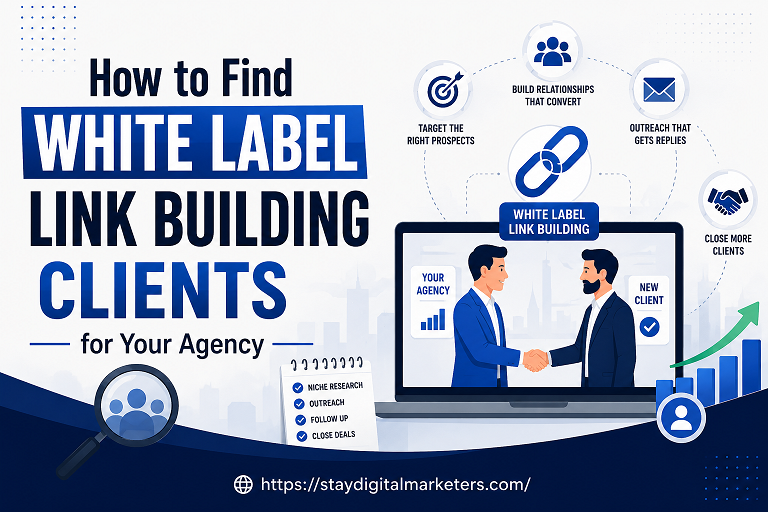

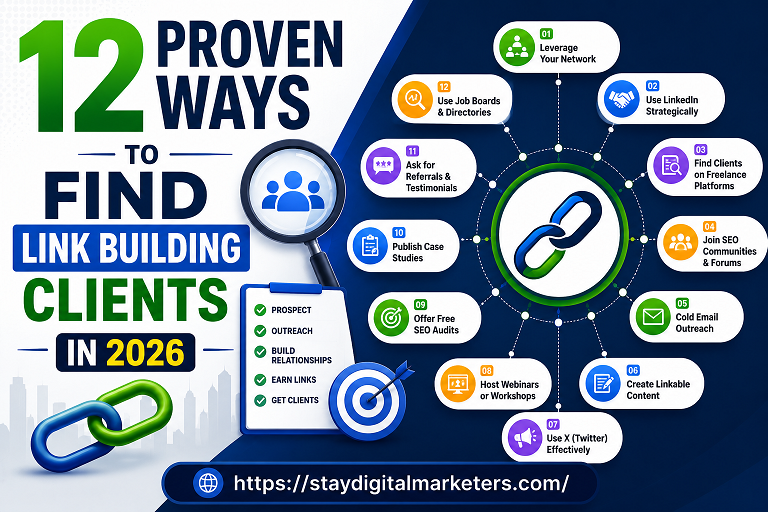
Finding link-building clients is one of the most persistent challenges for SEO freelancers, agencies, and link-building consultants. The market has matured significantly. Businesses are better educated about backlinks, competition among service providers has intensified, and buyers have grown more selective. The question is no longer whether link-building services are in demand; they are, but how to consistently get in front of the right decision-makers and convert them into paying clients.
This guide covers 12 proven methods to find link-building clients in 2026, including outbound tactics, inbound strategies, platform-based prospecting, and relationship-driven approaches. Each method is grounded in what works at a practitioner level, not theory.
Before diving into acquisition channels, it helps to define the target. A link building client is typically a business owner, marketing manager, SEO lead, or agency looking to improve organic search rankings through authoritative backlinks. They may be running their link building in-house and struggling with execution, or they may be a digital agency looking to white-label the work.
The best-fit clients are those who already understand that backlinks drive rankings, have a content-ready website, and have a budget for ongoing link acquisition. Targeting this segment reduces sales friction significantly.
LinkedIn remains the highest-ROI outbound channel for B2B SEO services in 2026. The platform’s search filters allow for surgical targeting by job title, industry, company size, and geography.
The approach that works best is not the generic “I noticed your website” cold message. Instead, lead with a specific observation about the prospect’s backlink profile or a competitor gap. Use tools like Ahrefs or Semrush to pull quick data points before reaching out. A message that opens with “Your competitor [Brand] has 40+ referring domains you’re missing from SaaS review sites” is far more compelling than a generic pitch.
Key steps for LinkedIn prospecting:
Cold email still works when executed with precision. The failure rate is high for generic blasts, but personalized cold email campaigns targeting qualified lists consistently generate leads for link building services.
The framework that converts is the Problem-Proof-Pitch (PPP) structure. The email opens by naming a specific SEO problem the prospect likely has, provides a quick proof point (a result, case study, or data comparison), and ends with a low-commitment call-to-action such as a 15-minute call or a free backlink audit.
Segmenting the list by industry matters. A company in the legal, finance, or healthcare space has different link building needs and price sensitivity than an e-commerce brand or a SaaS startup. Tailoring messaging by vertical consistently improves reply rates.
Tools like Apollo, Hunter.io, and Instantly are commonly used to source emails, verify deliverability, and automate follow-up sequences without triggering spam filters.
Yes, and this is the most underutilized acquisition strategy. Ranking for keywords like “link building services,” “buy guest posts,” “niche edits service,” or “white label link building” generates warm inbound leads who are already in buying mode.
The investment is higher upfront, but the ROI compounds over time. A practitioner who ranks on page one for commercial SEO service terms effectively runs a 24/7 lead generation machine without ongoing ad spend.
The key is to rank for long-tail, high-intent variants that larger agencies overlook. Terms like “link building for SaaS companies,” “guest posting service for finance blogs,” or “white label link building for agencies” attract niche-qualified buyers with specific needs.
Communities are where trust is built at scale. Active participation in SEO Slack groups, Facebook groups, LinkedIn communities, and forums like Reddit’s r/SEO or BlackHatWorld (for white-hat discussions) creates ongoing visibility among potential buyers.
The dynamic that works is contribution before solicitation. Practitioners who consistently answer questions, share results, and offer insight without immediately pitching become the natural first recommendation when someone in the community asks for a link building provider.
Niche communities often yield better results than large generic ones. A tight-knit SaaS marketing Slack channel or a paid membership community for e-commerce founders will expose a practitioner to buyers with authority and budget, not just other service providers.
White-label and sub-contracting partnerships with digital agencies are one of the most scalable and predictable client acquisition channels. Agencies that offer SEO but lack in-house link building capacity are a perfect fit.
A single agency partnership can generate the equivalent of five to ten individual client accounts, with recurring monthly volume. The sales cycle is shorter because the agency already understands the value of backlinks and does not need to be educated.
To establish these partnerships, approach agencies with a clear white-label offering: branded reporting, reliable turnaround times, and a clear pricing structure. Attending digital marketing meetups, agency-focused events, and reaching out to agencies directly on LinkedIn are the most effective entry points.
Platforms like Upwork, Fiverr Pro, and PeoplePerHour generate consistent inbound demand for link building services, particularly from clients who are cost-conscious or testing providers before committing to a retainer.
The platform economy has a ceiling; margins are lower, and clients sourced here often have smaller budgets. However, they serve an important purpose: building a review portfolio, refining a service offering, and creating a pipeline of clients who can be migrated to direct retainers over time.
The competitive moat on these platforms is built through specialization. A generalist link builder struggles to stand out. A specialist in SaaS link building, real estate backlinks, or DR 50+ guest posts for fintech companies gets noticed immediately.
Sharing proprietary data, case studies, and real link-building results on social platforms builds credibility and attracts inbound inquiries. In 2026, short-form content on X (formerly Twitter) and LinkedIn that documents specific outcomes, such as a 30% increase in referring domains over 90 days or a domain rating improvement from 18 to 42, draws attention from precisely the people who need those results.
Consistency is the differentiator. A practitioner who posts twice a week about link building, including real examples, outreach templates, and niche-specific tactics, builds a following of SEO professionals and marketing managers. A portion of that audience will become clients.
Case studies are the most persuasive sales asset in the link building industry. A documented story that walks from initial backlink profile, through the strategy applied, to measurable ranking and traffic improvements removes virtually all buyer skepticism.
The case study format that converts best includes: the client’s industry and starting position, the specific link types acquired, the timeline, and the measurable outcome tied to organic traffic or ranking movement. Numbers do the heavy lifting here — specificity is what separates a compelling case study from a generic testimonial.
Repurposing case studies across LinkedIn, email outreach, proposal decks, and website landing pages multiplies their impact without requiring additional effort.
Live events, both in-person and virtual, create high-trust environments where relationships convert faster than cold digital outreach. Events like BrightonSEO, MozCon, Ahrefs Evolve, and local SEO meetups attract marketing decision-makers who are actively looking to improve their search performance.
The goal at these events is not to pitch immediately. The goal is to become a memorable presence, exchange contact information, and follow up with a personalized message that references a specific conversation. This warm lead converts at a far higher rate than any cold outreach.
Speaking at these events, even a short lightning talk or a panel contribution, establishes authority and generates inbound interest from attendees.
A structured referral program is one of the highest-quality sources of new clients because referred prospects arrive pre-sold. Existing clients who are happy with results are the most valuable business development asset a link building provider has.
The program does not need to be complex. A simple flat fee or percentage commission for introductions that convert into paying clients is sufficient. What matters is making it easy for referrers to describe the service and making the referral process frictionless.
Previous clients who have moved on are also an often-overlooked source of referrals. Staying in touch with former clients through occasional value-add emails or check-ins keeps the relationship warm and top of mind.
Job boards are an underrated prospecting channel. Companies that post for an “SEO Specialist,” “Link Builder,” or “Outreach Manager” are actively trying to solve the exact problem link building services address. These are warm prospects who have identified the need and have budget allocated.
Reaching out to the hiring manager directly, not to apply for the job, but to position outsourced link building as a faster, more cost-effective solution than hiring in-house, works well when the message is framed around their specific situation.
Relevant job boards to monitor include LinkedIn Jobs, Indeed, Wellfound (for startups), and niche SEO job boards. Setting up alerts for relevant keywords ensures timely outreach before the position is filled.
Guest appearances on SEO podcasts, digital marketing shows, and industry-specific podcasts reach concentrated audiences of the exact decision-makers most likely to buy link building services. A single episode that covers a specific framework, a case study, or a niche perspective on link building can generate multiple qualified inquiries.
The long-form format creates perceived authority that no cold outreach can replicate. A prospect who has listened to a 45-minute conversation on link building strategy arrives with far more trust than one who received a cold LinkedIn message.
Pitching podcast hosts is a proactive strategy, not a passive one. Identifying shows whose audiences overlap with the ideal client profile — B2B SaaS marketers, agency owners, e-commerce operators, and sending a clear, specific pitch about the value a guest appearance would provide for their listeners is the approach that gets bookings.
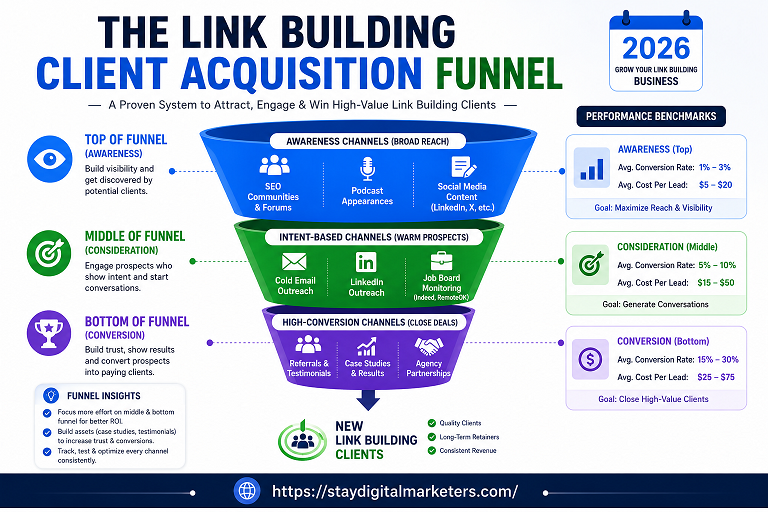
To systematize client acquisition, consider the CLIF framework, a four-stage model built specifically for link building service providers:
C: Credibility Assets: Build case studies, publish results, rank for relevant keywords, and maintain an active professional presence before outreach begins.
L: Lead Sources: Run two to three acquisition channels simultaneously (for example, LinkedIn outreach, cold email, and community participation) to maintain a consistent pipeline.
I: Intent Signals: Prioritize prospects who show buying intent, those posting about backlinks, hiring for SEO roles, or actively asking for recommendations in communities.
F: Follow-Through System: Use a CRM or simple tracking sheet to ensure every prospect is followed up with at least twice, with a value-add message rather than a repetitive pitch.
Practitioners who work through all four stages systematically outperform those who rely on any single tactic.
| Channel | Lead Quality | Cost | Time to Results | Scalability |
|---|---|---|---|---|
| LinkedIn Outreach | High | Low | 2–4 weeks | Moderate |
| Cold Email | Medium | Low | 2–6 weeks | High |
| Ranking Own Website | Very High | Medium | 3–6 months | Very High |
| SEO Communities | High | Low | 1–3 months | Moderate |
| Agency Partnerships | Very High | Low | 1–2 months | High |
| Freelance Platforms | Medium | Low | Immediate | Moderate |
| Social Content | Medium | Low | 2–4 months | High |
| Referral Programs | Very High | Low | Ongoing | Moderate |
| Job Board Monitoring | High | Low | 1–3 weeks | Low |
| Conference Networking | High | Medium | 1–3 months | Low |
| Podcast Guesting | High | Low | 1–3 months | Moderate |
| Case Study Publishing | High | Low | 2–4 months | High |
How long does it take to find the first link-building client? With consistent outbound effort, five to ten targeted messages per day on LinkedIn or email, most practitioners land their first client within two to four weeks. Inbound channels, such as ranking or community participation, take longer but produce higher-quality leads.
What is the easiest way to find link building clients as a beginner? Freelance platforms like Upwork and community participation are the most accessible starting points. They require no existing reputation and allow for portfolio building before transitioning to higher-ticket direct outreach.
How much should I charge to attract link building clients? Pricing varies significantly by link type and niche. Guest posting services typically range from $150 to $1,500 per link depending on domain authority and niche. Positioning around a specific niche (SaaS, finance, health) justifies premium pricing more easily than a generalist offering.
Do I need a website to get link building clients? Not initially, but a website becomes essential once volume picking up. A simple one-page site with a case study, clear service offering, and contact form significantly improves conversion when prospects look you up after an outreach message.
How do I retain link building clients long-term? Transparent reporting, consistent delivery, and proactively sharing results are the primary retention drivers. Monthly reports that tie link acquisition directly to ranking and traffic changes reduce churn and increase referral likelihood.
What industries are the best for link building services? SaaS, finance, legal, health and wellness, and e-commerce are consistently strong verticals because they have competitive search landscapes, understand the value of backlinks, and have the budget for ongoing campaigns.
Is white-label link building a good way to grow? Yes. White-label arrangements with established agencies provide predictable recurring revenue and remove the need to build a direct audience from scratch. They are particularly effective for practitioners in the early-to-mid growth stage of their business.
Consistently finding link building clients in 2026 requires a portfolio approach. No single channel provides enough volume or reliability on its own. The most successful practitioners combine one or two outbound tactics for immediate pipeline with one or two inbound strategies for long-term compounding growth. Documenting results, specializing by niche, and investing in credibility assets early separates those who struggle to fill their calendar from those who operate with a waitlist.
For practitioners looking to supplement their client acquisition with a reliable link-delivery infrastructure, Stay Digital Marketers is an industry resource worth knowing about. The team works with agencies and brands on backlink-related services, including guest posting, press release distribution, SaaS backlinks, niche edits, Wikipedia page creation, and Google Knowledge Panel creation, the kind of full-service coverage that helps both solo practitioners and agencies scale their output without compromising quality.

Filza Taj is an MPhil in Human Resources-turned SEO Specialist, Content Strategist, and Digital Marketing Consultant with over 5 years of experience helping businesses in 30+ countries grow online. As the Founder of Stay Digital Marketers (staydigitalmarketers.com), she delivers results-driven solutions in link building, guest posting, PR distribution, niche edits, multilingual backlinks, and content marketing. She publishes daily SEO insights and actionable strategies to help brands strengthen their online presence, attract the right audience, and convert clicks into loyal customers.
Filza@staydigitalmarketers.com
Stay Digital Marketers
Need SEO, Link Building or Digital Marketing Services?
Request a Free Audit →