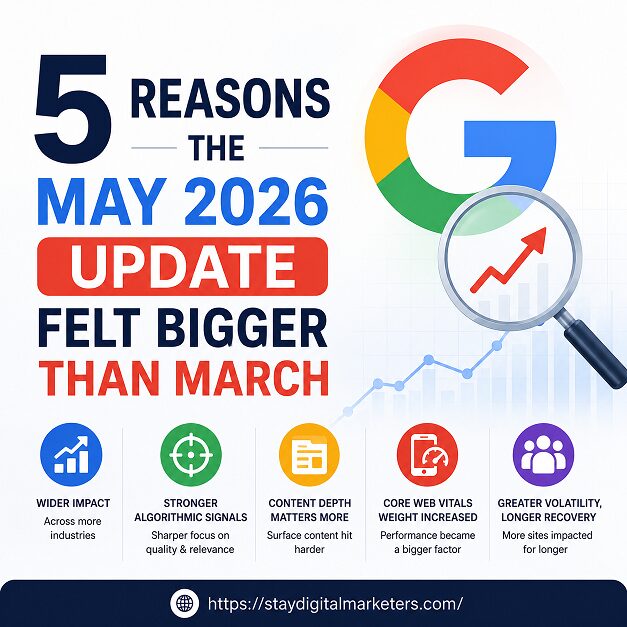

The most recent Google core update rolled out between May 21 and June 2, 2026, running just under twelve days before settling. It followed the March 2026 core update by about six weeks, a tighter gap than the industry had grown used to. Google releases these broad updates a few times a year to recalibrate how its ranking systems evaluate relevance, trust, and content quality across the entire index, not to punish specific sites for specific violations.
That distinction matters. A core update is not a manual penalty and it does not target link schemes or keyword stuffing the way a spam update does. It reassesses which pages best satisfy a given search intent, and when that reassessment shifts, some sites gain visibility while others lose it, often without any change having been made to the affected pages themselves.
Key Takeaways
Most site owners do not get a direct notification saying “you were impacted.” Instead, the signs show up scattered across analytics, Search Console, and SERP behavior, and they are easy to misread individually. Looking at them together is what turns a vague feeling of “something changed” into a confirmed diagnosis.
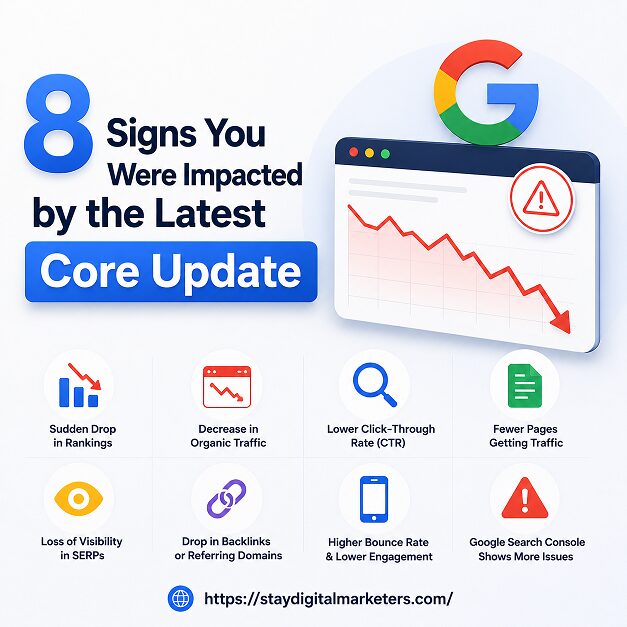
A single keyword dropping a few spots is normal fluctuation. A core update impact looks different: entire topic clusters or content types shift together, often within the same 48 to 72 hour window that lines up with the update’s rollout dates. If your blog posts on one subtopic all slide while product pages hold steady, that pattern points to a quality or relevance reassessment rather than random noise.
When traffic falls and there is no crawl error, no deindexing issue, and no seasonal dip to explain it, a core update is the first place to look. Compare the affected date range against the confirmed rollout window rather than a single day, since single-day movement during an active rollout is notoriously unreliable.
This is the sign practitioners tend to miss. Traffic can stay flat while the mix of keywords driving it changes entirely, pulling in visitors with weaker intent match. If conversions or lead quality drop while sessions barely move, the update likely reshuffled which queries you rank for, not just where you rank.
A sudden rise in bounce rate or drop in average time on page, especially across pages that previously performed well, suggests Google is now sending a different type of searcher to that content, or that a competitor’s page is now judged to satisfy the query better. Either way, it is a downstream symptom of a ranking or SERP feature change tied to the update.
Core updates increasingly reshape which sources get pulled into AI Overviews and featured snippets, not just the traditional ten blue links. If a page that used to anchor a snippet or AI summary suddenly disappears from that placement while still ranking on page one, that is a direct, visible marker of the update’s effect on content evaluation, separate from position tracking alone.
Search Console’s Performance report often shows the clearest fingerprint. Watch for a visible step change in impressions or clicks that begins on the update’s start date and stabilizes near its end date. Google’s own guidance points to the days immediately after a rollout completes as the earliest reliable window for a clean before-and-after comparison, since single-day swings during the rollout itself can mislead.
If your rankings fall while a small set of competitors in the same niche rise during the identical window, that is a strong signal the update reweighted a quality factor those competitors happen to satisfy better right now. Tracking two or three direct competitors alongside your own site turns an ambiguous drop into a comparative, evidence-backed read.
Pages that were reliably indexed within days may start taking longer, or previously indexed pages may quietly drop out of the index without a manual removal. This is less common than ranking shifts but tends to hit sites where the update reassessed overall site quality rather than individual page relevance.
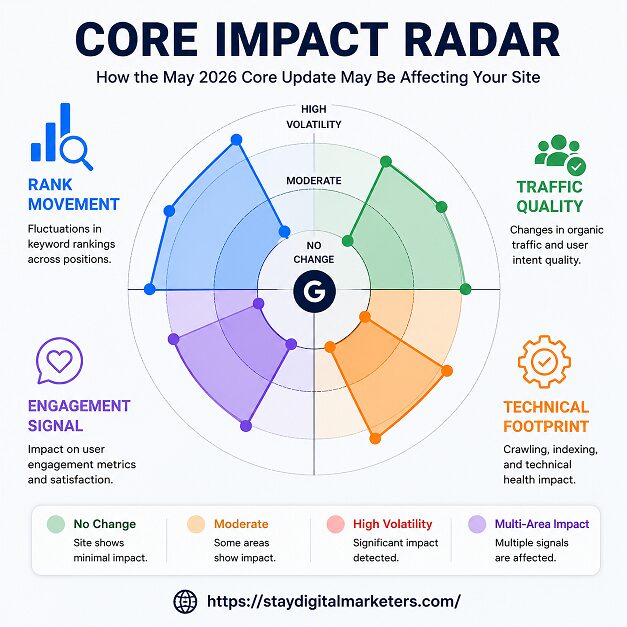
Checking these eight signs one at a time is slow and easy to second-guess. The Core Impact Radar groups them into four quadrants so a practitioner can scan a site’s health in minutes rather than hours.
| Radar Quadrant | Signs Covered |
| Rank Movement | Sign 1: Clustered keyword shifts | Sign 7: Competitor divergence |
| Traffic Quality | Sign 2: Organic traffic decline | Sign 3: Falling conversions |
| Engagement Signal | Sign 4: Bounce rate shifts | Sign 5: Lost snippet or AI Overview placement |
| Technical Footprint | Sign 6: Search Console volatility | Sign 8: Indexing behavior changes |
A site showing movement in three or four quadrants during a confirmed rollout window has almost certainly been impacted by the core update itself. A site showing movement in only one quadrant more likely has a separate, unrelated issue worth investigating on its own.
| Core Update | Rollout Window | Duration | Notable Pattern |
| March 2026 | March 27 to April 8 | 12 days | Short rollout, no named focus area |
| May 2026 | May 21 to June 2 | ~12 days | Second confirmed core update of 2026, volatile mid-rollout swings |
| December 2025 | December 11 to December 29 | 18 days | Longer rollout, broad industry impact despite no advance warning |
| June 2025 | June 30 to July 17 | 17 days | Preceded a quieter second half of the year |
Google has not confirmed a fixed schedule, but the pattern across 2025 and 2026 points to roughly three to four months between broad core updates. Based on that cadence, the next one is expected sometime in the third quarter of 2026, likely August or September.
Google’s own position is that there is no specific checklist to reverse a core update drop, and a negative shift does not automatically mean something is broken. The more productive move is to revisit the site against Google’s content quality guidance rather than trying to reverse-engineer the exact algorithmic change. In practice, that means auditing thin or outdated pages, strengthening first-hand expertise and sourcing, and giving the site time to be recrawled and reassessed rather than making reactive edits within days of a drop.
Across client audits run after recent rollouts, a recurring pattern shows up: sites that lost visibility often had content answering a query at a surface level without demonstrating direct experience with the topic, while sites that held steady or gained ground tended to pair clear answers with specific, verifiable detail. That gap, more than any single technical fix, tends to separate recoveries from prolonged declines.
If the Core Impact Radar shows movement in only the Technical Footprint quadrant, prioritize a crawl and indexing audit before touching content, since the cause is more likely mechanical than qualitative.
The most recent confirmed core update rolled out from May 21 to June 2, 2026. It followed the March 2026 core update by about six weeks, a shorter gap than the typical three to four month cadence Google has followed in recent years.
Google recommends waiting until the rollout fully completes before drawing conclusions, since rankings can swing during the update itself. A reliable comparison window usually opens about a week after the rollout ends, once rankings settle into a stable pattern.
Not inherently. Core updates reassess relevance and quality signals, and pages can recover in a later update once content improvements are made and recrawled. Full recovery most often coincides with the next broad core update rather than happening gradually in between.
Search Console shows impression and click volatility clearly, but it should be paired with rankings and conversion data. Relying on Search Console alone can miss engagement-based signs like bounce rate shifts or lost AI Overview placement that live outside that report.
No. Reactive edits made within days of a rollout are hard to evaluate properly, since the update itself is still causing volatility. A more reliable approach is auditing content quality against Google’s guidelines and making deliberate improvements once the rollout has fully settled.
A core update recalibrates how relevance and quality are judged across the whole index. A spam update specifically targets sites violating webmaster guidelines, such as manipulative link schemes. The two can roll out close together but address different problems.
Based on the cadence seen across 2025 and 2026, the next broad core update is projected for the third quarter of 2026, most likely August or September, though Google has not confirmed an exact date.
Across the site audits and recovery reviews handled in link building and content work, one theme keeps surfacing after every major rollout: agencies that treat a core update as a diagnostic event, not an emergency, tend to build stronger, more durable strategies for their clients. Stay Digital Marketers works with brands on this kind of post-update content and authority building, including guest posting, niche edits, press release distribution, SaaS backlinks, Wikipedia page creation, and Google Knowledge Panel support, as part of a broader approach to staying resilient through algorithm changes rather than reacting to each one individually.

Filza Taj is an MPhil in Human Resources-turned SEO Specialist, Content Strategist, and Digital Marketing Consultant with over 5 years of experience helping businesses in 30+ countries grow online. As the Founder of Stay Digital Marketers (staydigitalmarketers.com), she delivers results-driven solutions in link building, guest posting, PR distribution, niche edits, multilingual backlinks, and content marketing. She publishes daily SEO insights and actionable strategies to help brands strengthen their online presence, attract the right audience, and convert clicks into loyal customers.
Filza@staydigitalmarketers.com
Stay Digital Marketers
Need SEO, Link Building or Digital Marketing Services?
Request a Free Audit →