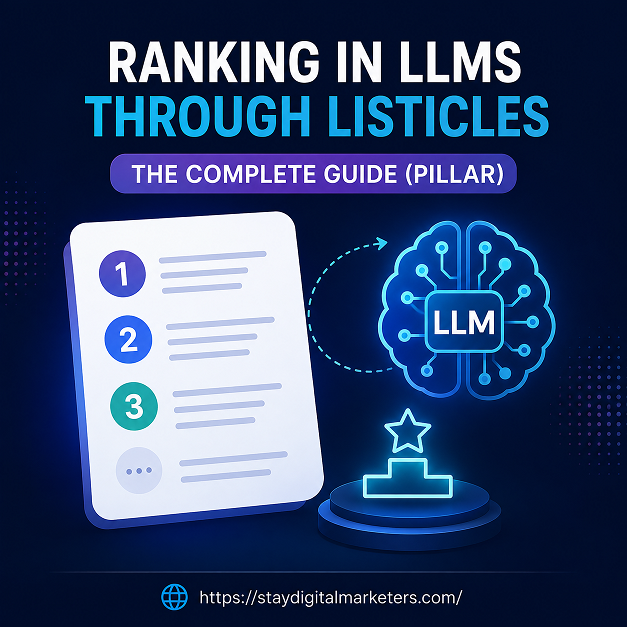

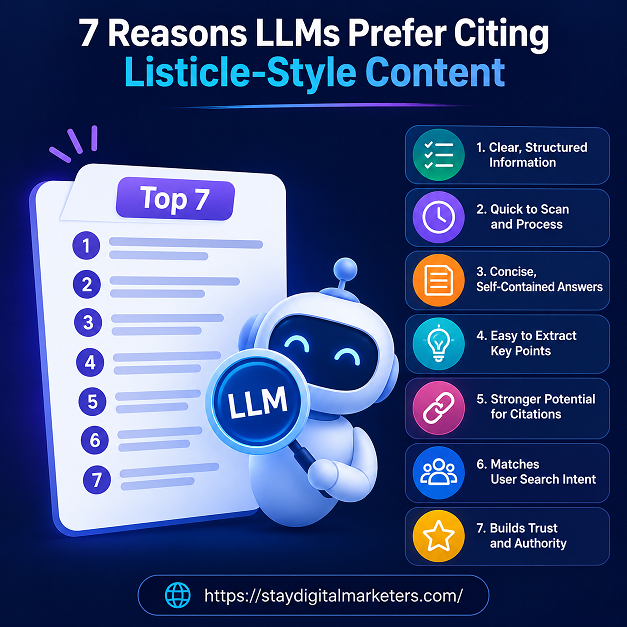
LLMs prefer citing listicle-style content because the format concentrates comparison, structure, and evidence into a shape that is fast to extract and easy to reassemble into a synthesized answer. A listicle in this context is any ranked or grouped list, “7 Best Project Management Tools” or “10 Ways to Reduce Churn,” built around comparison rather than a single narrative argument. ChatGPT, Gemini, Perplexity, Copilot, and Google’s AI Mode and AI Overviews all pull from this format disproportionately when answering comparison, recommendation, and how-many-options questions.
The short answer is that listicles win citations because they package pre-organized comparisons, credentialed sourcing, and scannable structure into one page, removing work the model would otherwise have to do itself by pulling facts from several unstructured sources.
Key Takeaways
Two credible 2026 datasets report very different numbers, and reconciling them matters more than repeating either one in isolation. Evertune’s analysis of the 25,000 most-cited URLs across six LLMs, published through Search Engine Land in May 2026, found that half of the most-cited URLs were listicles and that 63 percent of nearly 400 million citations pointed to listicle-format pages. Separately, rocketblue’s analysis of 1.2 million citations across eight LLMs, classifying content by type rather than by citation volume, found listicle-format content made up only 9 to 15 percent of citations depending on the model.
The gap is a methodology difference, not a contradiction. Evertune measured which URLs received the most total citations, and listicles concentrate citations because one comparison page gets referenced repeatedly across many related prompts. rocketblue classified every individual citation by content type across a much broader, less curated pool, where guides, blogs, and single-topic pages fill most of the volume even though listicles capture a disproportionate share of the top spots. In practice, that means a brand does not need most of its content to be listicles. It needs the listicles it does publish to be strong enough to become one of the small number of pages that absorb repeat citations.
A single well-built “best X” page tends to answer dozens of related prompt variations, “best X for beginners,” “best X under $50,” “best X 2026,” so models reuse it repeatedly instead of retrieving a new source each time. That repeat-use pattern is why listicles account for such an outsized share of total citation volume even though they remain a minority of all content types published on the web.
Among listicles Evertune reviewed, ranked formats such as “Top 5 CRM Tools” made up 71 to 86 percent of citations depending on the model, while unranked lists such as “7 Ways to Save on Groceries” trailed as a distant second. A ranked list has already resolved the comparison, which lines up with how retrieval-based generation works: the model retrieves a source, then reassembles its claims rather than independently judging which option is best.
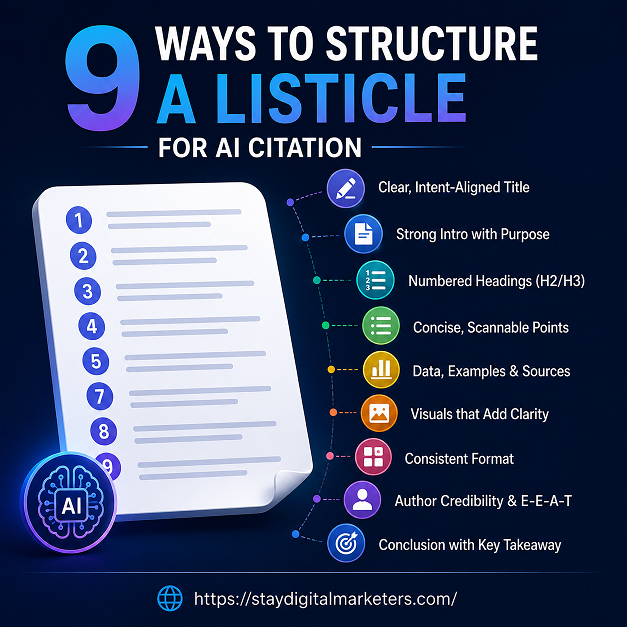
Heavily cited pages across Evertune’s six-model dataset typically ran 1,000 to 2,000 words, averaged 18 words per sentence, and used consistent H2 and H3 structure throughout. rocketblue’s separate analysis found 71 percent of cited content sits at “moderate” depth, not shallow, not exhaustive, with only 4.28 percent classified as truly in-depth. Listicles land naturally in that range because each entry is a self-contained unit rather than one continuous argument that has to justify its own length.
Structured, scannable formatting shows up in 90.62 percent of content LLMs cite, according to rocketblue’s review of more than a million citations. Numbered and bulleted lists map directly onto how a model segments a page into extractable claims, so a listicle’s native structure removes the parsing ambiguity that a dense paragraph of prose introduces.
For brand and product queries specifically, listicles compare options head-to-head on price, features, and materials, a format ChatGPT now surfaces directly inside its shopping interface. When a query already implies comparison, “best X for Y,” a listicle matches the query’s underlying intent more closely than a single-product page or a narrative article can.
Fresh content appeared in 57.78 percent of cited pages in rocketblue’s analysis, and disclosed author credentials showed up in 74.76 percent. Listicles make both signals easy to surface: an updated date and a stated ranking method sit naturally at the top of the page, where models weigh them heavily when deciding whether a source is current and credible enough to cite.
Corporate, earned-media, and affiliate domains were the top sources of listicles in Evertune’s dataset, and Forbes.com ranked among the top three listicle sources across every model reviewed. Once a domain earns repeat citations for comparison content, models appear to keep pulling from it for adjacent queries, which compounds the advantage for publishers that already have a citation track record.
Reviewing citation patterns across a range of client listicle placements shows the same compounding effect: a page that earns even a handful of AI citations in its first few months tends to keep surfacing across related prompts long after publication, while a comparable page with no early citation traction rarely catches up later.
The seven reasons above map onto four checkable traits, summarized here as the LIST Signal Score, useful as a quick pre-publish audit before a listicle goes live.
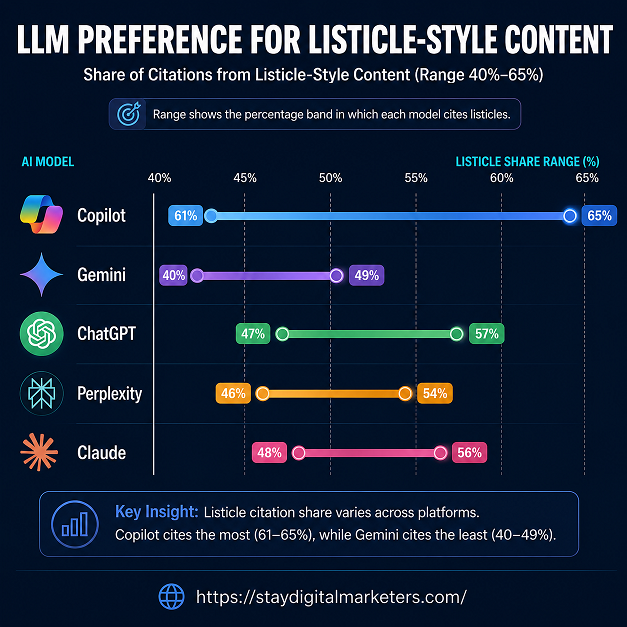
No. Listicle share of the most-cited URLs ranged from about 40 percent on Copilot to about 65 percent on Gemini in Evertune’s dataset, and rocketblue’s content-type breakdown shows a similar spread, from 5.07 percent on Grok to 15.22 percent on Claude. Google’s Gemini-powered surfaces, Gemini, AI Mode, and AI Overviews, also share the highest overlap in which specific URLs they cite, meaning a listicle that earns a citation on one Google surface has a meaningfully better chance of surfacing on the other two as well. Copilot behaves the most differently, sharing only 4 to 6 percent of its top-cited URLs with any other model, so a listicle strategy built only around ChatGPT or Gemini patterns will likely underperform there.
The clearest risk is self-ranking. Google has said publicly it is targeting listicles where a publisher ranks its own product first without disclosed criteria, and a Federal Trade Commission rule separately prohibits a business from misrepresenting that a page it controls offers independent reviews of a category that includes its own product. Listicles built for AI citation should either come from genuinely independent publishers or disclose the affiliation plainly, since both the citation risk and the regulatory risk point the same direction.
| Model | Share of Top-Cited URLs That Are Listicles | Cross-Model URL Overlap |
| Gemini | About 65% (highest of all models measured) | High overlap with AI Mode and AI Overviews |
| Google AI Mode / AI Overviews | Within the 40-65% range measured | High overlap with each other and Gemini |
| Perplexity | Within the 40-65% range measured | Shares over 20% of top URLs with Google surfaces |
| ChatGPT | Within the 40-65% range measured | Shares over 15% of top URLs with Google surfaces |
| Copilot | About 40% (lowest of all models measured) | Only 4-6% overlap with any other model |
It depends on how citations are measured. Listicles make up roughly half of the most-cited URLs and 63 percent of total citations in one large 2026 study, but only 9 to 15 percent of citations when classified by content type across a broader dataset. Both figures are accurate; they measure different things.
Most heavily cited listicles run 1,000 to 2,000 words, though this varies by platform. Copilot tends to cite shorter pages around 964 words, while Gemini favors longer pages around 1,977 words. Consistent H2 and H3 structure throughout the page matters as much as total word count.
Rank them. Ranked lists such as “Top 5 CRM Tools” made up 71 to 86 percent of listicle citations across the models studied, while unranked groupings such as “7 Ways to Save on Groceries” trailed as a distant second choice for AI citation.
Yes. Google has confirmed it targets self-promotional listicles that rank a publisher’s own product first without disclosed criteria, and a Federal Trade Commission rule separately restricts businesses from presenting pages they control as independent reviews of their own product category.
No. Listicle share of top-cited URLs ranged from about 40 percent on Copilot to about 65 percent on Gemini in one 2026 study. Google’s Gemini-powered surfaces overlap heavily in which URLs they cite, while Copilot shares only 4 to 6 percent of its top URLs with any other model.
Yes. Images appear in 95.13 percent of content cited by LLMs across a review of more than a million citations, making visual elements close to universal among AI-cited pages. A listicle with a comparison graphic or supporting image holds a structural advantage over a text-only version.
A listicle earns repeat AI citations only if it also carries the off-page signals that make a domain worth citing in the first place, since Evertune’s research found corporate, earned-media, and affiliate domains dominate the sources AI models pull comparison content from. Stay Digital Marketers works with brands on that surrounding authority layer, including guest posting, digital PR and press release distribution, SaaS backlinks, niche edits, multilingual backlinks, Wikipedia page creation, and Google Knowledge Panel creation, alongside broader SEO services, so a well-built listicle sits on a domain with enough earned authority to actually accumulate citations rather than being overlooked.

Filza Taj is an MPhil in Human Resources-turned SEO Specialist, Content Strategist, and Digital Marketing Consultant with over 5 years of experience helping businesses in 30+ countries grow online. As the Founder of Stay Digital Marketers (staydigitalmarketers.com), she delivers results-driven solutions in link building, guest posting, PR distribution, niche edits, multilingual backlinks, and content marketing. She publishes daily SEO insights and actionable strategies to help brands strengthen their online presence, attract the right audience, and convert clicks into loyal customers.
Filza@staydigitalmarketers.com
Stay Digital Marketers
Need SEO, Link Building or Digital Marketing Services?
Request a Free Audit →