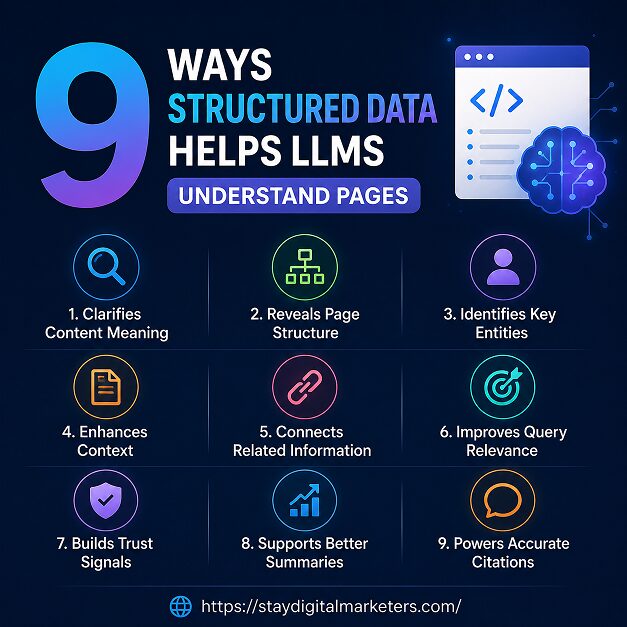

Structured data is a standardized code format, most often JSON-LD, that describes the content on a page in language machines can parse without guessing at meaning. It labels entities such as articles, products, organizations, people, and events, then defines how those entities connect to each other across a site. Google, Bing, ChatGPT, Perplexity, and Gemini all depend on some version of this labeling to understand what a page covers before deciding whether it belongs in an answer.
Structured data tools for AI search optimization are software platforms that generate, validate, and manage this markup at scale. They exist because manually writing JSON-LD for every article, product, and FAQ page on a growing site is slow and error-prone, and a single mismatch between visible text and schema can get a page ignored rather than cited.
Key Takeaways
AI search systems mostly rely on retrieval-augmented generation. Before writing an answer, the model retrieves a set of candidate pages, then extracts facts from them to compose a response. Clean, well-labeled entities make that extraction faster and reduce the chance a model misreads a price, a date, or a claim. JSON-LD usage across the web climbed to roughly 41 percent of sites in 2026, up from about 34 percent in 2022, a shift driven partly by AI systems favoring the format over microdata and RDFa, which embed markup directly inside HTML tags rather than isolating it in a clean script block, according to 2026 web tracking data from Maintouch.
Most roundups treat schema as a direct citation lever, and that claim deserves more scrutiny than it usually gets. Ahrefs analyzed six million URLs in 2026 and found that pages cited by AI engines carry JSON-LD almost three times more often than uncited pages, then ran a controlled test on 1,885 pages that added structured data between August 2025 and March 2026 against matched control pages. The result showed no measurable citation lift from the markup itself. The correlation is real; the causation is not. Structured data rarely creates citation opportunities on its own, but it clears the path for genuinely citable content, expert sourcing, statistics, and direct answers, to get parsed correctly once that content exists. Google also fully deprecated FAQPage rich results in Search as of May 2026, though AI engines still consume the underlying schema for citation extraction, so the markup keeps its value even where the visual snippet disappeared.
Not every tool on a roundup list does the same job, so it helps to judge candidates against a short checklist rather than a feature list. Five criteria, grouped here as the SCALE checklist, separate a useful tool from a cosmetic one.
Teams that skip the consistency check tend to be penalized most often in practice, since a schema block listing five FAQ answers when only three appear on the page is one of the most common structured data violations found in site audits.
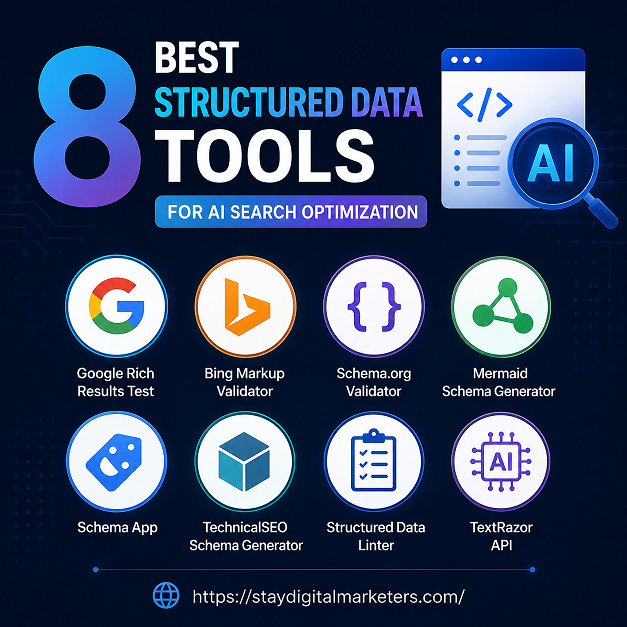
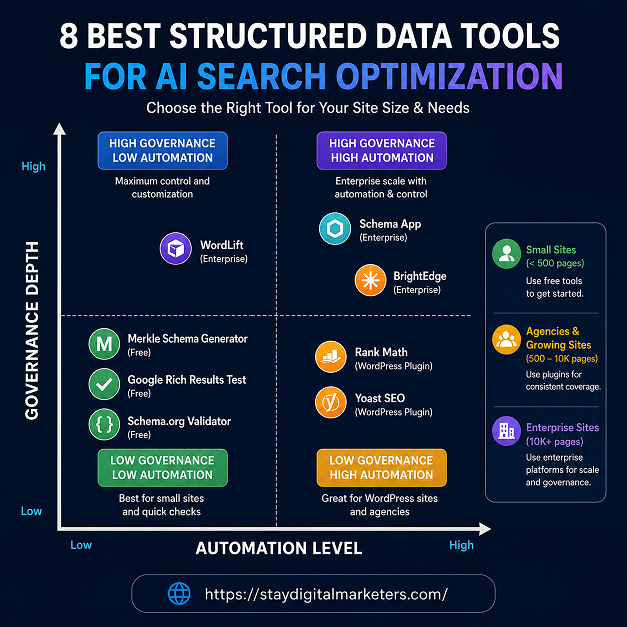
The eight tools below cover the full range, from free manual generators to enterprise knowledge graph platforms, so the right pick depends on site size, technical resources, and how much control the team wants over automation.
Schema App is a governed structured data deployment platform built for enterprises managing schema across thousands of templated pages. It generates JSON-LD and connects it into a hosted knowledge graph, applies changes across a site through centralized templates, and gives technical SEO teams version control and audit trails. It suits organizations that need to prove exactly what schema shipped and when, rather than casual users adding markup to a handful of pages. The tradeoff is setup time, since the governance layer that makes it strong for compliance also makes it slower to configure than a plugin.

WordLift positions itself as an AI visibility and knowledge graph platform rather than a pure schema generator. It builds an open, linked knowledge graph from a site’s content, publishes it as JSON-LD, and connects entities to authoritative external sources so search engines and AI systems can disambiguate what a page covers. It suits publishers and enterprises that want structured data to function as operational infrastructure feeding multiple AI systems, not a one-time markup task.

InLinks combines automated schema generation with internal linking, useful for mid-sized sites that want quick entity wins without a dedicated developer. It scans pages for question-style headings and applies FAQ schema automatically, uses a Same As tag to connect entities to sources such as Wikipedia for disambiguation, and pushes markup live through a single script tag. The automation is convenient, but auto-generated schema still needs manual spot checks against the consistency rule above before it ships at scale.

Rank Math is a WordPress plugin that builds schema generation into everyday publishing rather than treating it as a separate project. It ships pre-built schema types for articles, products, recipes, FAQs, and local business listings, and lets editors assign schema per post or per content type without touching code. For agencies running client sites on WordPress, it is often the fastest path to consistent baseline coverage. It is not built for non-WordPress environments or complex multi-entity knowledge graphs.

Yoast SEO covers the same WordPress schema basics as Rank Math, including article, FAQ, how-to, and organization markup, and has extended into AI visibility with its AI+ Brand Insights feature, which tracks how often a brand gets mentioned across AI answer engines. That pairing makes it useful for teams that want schema management and basic AI citation monitoring in one plugin, rather than running separate tools for each. The monitoring layer is newer and less detailed than dedicated AI visibility platforms.

For sites that are not ready to commit to a platform, Stay Digital Marketers free Schema Markup Generator remains a solid starting point. It is a manual, form-based tool that outputs clean JSON-LD for common schema types without requiring a login or a plugin. It is best treated as a way to learn schema structure or patch a handful of pages, then graduate to an automated tool once patterns stabilize and the page count grows past what manual generation can reasonably cover.

No structured data workflow is complete without validation, and these two free tools catch different classes of errors. Google’s Rich Results Test checks eligibility for the rich result types Google still supports and flags Google-specific warnings. The Schema.org Validator checks markup against the full Schema.org specification regardless of whether Google currently uses that property. Running both before publishing catches the errors that silently drain citation eligibility.

BrightEdge is an enterprise SEO platform that has extended into entity modeling for AI search through its AI Catalyst and AI Hyper Cube modules, which report on how ChatGPT, Google AI Overviews, and Perplexity mention and cite a brand. Its strength is organizing large page sets into a coherent knowledge graph backed by a long history of keyword data. The caveat is that its suggested optimizations are often reverse-engineered from traditional SEO keywords, so it fits enterprises wanting entity structure and reporting more than one built around how people phrase questions to AI.

| Tool | Best For | Automation Level | Where to Start |
| Schema App | Enterprise governance across many templates | High, template-driven | Multi-template enterprise sites |
| WordLift | AI knowledge graphs and entity infrastructure | High | Publishers and large content teams |
| InLinks | Entity SEO plus internal linking | Automated | Mid-size sites without dev resources |
| Rank Math | WordPress schema in daily publishing | Semi-automated | WordPress agencies and client sites |
| Yoast SEO | WordPress schema plus AI mention tracking | Semi-automated | Teams wanting schema and monitoring together |
| Merkle Generator | Free, manual JSON-LD snippets | Manual | Small sites and learning schema basics |
| Rich Results Test + Validator | Pre-publish and ongoing validation | N/A, validation only | Every site, before every deploy |
| BrightEdge | Enterprise entity modeling and AI reporting | High | Large, keyword-driven enterprises |
Sites that treat this as a recurring quarterly habit rather than a one-time launch task are consistently the ones that keep their schema error rate near zero in later audits.
Merkle’s Schema Markup Generator is the best free starting point for manual JSON-LD, and Google’s Rich Results Test plus the Schema.org Validator cover free validation. Together they handle basic coverage and quality checks without a subscription, though sites publishing at volume will eventually need an automated tool to keep pace.
No. A large-scale Ahrefs study found that pages cited by AI carry JSON-LD nearly three times more often than uncited pages, but a controlled test on the same dataset found no direct citation lift from adding the markup. Structured data supports citability; it does not cause it on its own.
Yes. Google removed the visual FAQ rich result from Search in May 2026, but AI engines still parse FAQPage schema to extract question-and-answer pairs for citations. The markup lost its search-results snippet, not its usefulness for AI-generated answers.
Schema App is primarily a governed schema deployment platform built for managing markup across many templates. WordLift is broader, functioning as an AI knowledge graph and visibility platform that treats structured data as infrastructure feeding multiple AI systems, not just a markup task.
There is no single answer, since AI Overviews draw on whichever schema matches the query type. Article and FAQPage schema support informational queries, Product and PriceSpecification support commercial ones, and HowTo supports step-based questions. Matching schema type to content intent matters more than picking one universal type.
Run validation before every publish and again on a quarterly cadence for the full site, using Google’s Rich Results Test and the Schema.org Validator. Update schema immediately whenever a referenced fact changes, since outdated markup, like an old price or discontinued service, undermines the trust signal it is meant to provide.
Structured data works best as one layer in a wider technical and content strategy rather than a standalone fix, since AI engines weigh entity clarity alongside authority signals like backlinks and consistent citations across the web. Stay Digital Marketers works with brands on the backlink side of that equation, including guest posting, press release distribution, SaaS backlinks, niche edits, multilingual backlinks, Wikipedia page creation, and Google Knowledge Panel creation, alongside broader SEO services, so the entity signals structured data establishes on-page are matched by authority signals off-page.

Filza Taj is an MPhil in Human Resources-turned SEO Specialist, Content Strategist, and Digital Marketing Consultant with over 5 years of experience helping businesses in 30+ countries grow online. As the Founder of Stay Digital Marketers (staydigitalmarketers.com), she delivers results-driven solutions in link building, guest posting, PR distribution, niche edits, multilingual backlinks, and content marketing. She publishes daily SEO insights and actionable strategies to help brands strengthen their online presence, attract the right audience, and convert clicks into loyal customers.
Filza@staydigitalmarketers.com
Stay Digital Marketers
Need SEO, Link Building or Digital Marketing Services?
Request a Free Audit →