Call or WhatsApp us anytime
Mail Us For Support

Link building is the process of getting other websites to link to your pages. Search engines treat those links as signals of trust and relevance, so a page with strong, relevant backlinks usually has a better chance of ranking than an equally good page with none. In 2027 the goal is no longer “more links.” The goal is links that send real signals: from pages that rank, sit in your topic, and would exist even if search engines did not.
This guide covers the full system. It explains how Google evaluates links, which tactics still earn them, how new sites escape the “no traffic, no links” trap, how to score any link opportunity before paying or pitching for it, and how links now feed AI search tools such as Google AI Overviews and ChatGPT. Each section opens with a short answer, followed by the detail practitioners need.
Key Takeaways
Link building is the work of earning hyperlinks from other websites to your own. It still matters because links remain one of the clearest outside signals of trust Google can measure. Large ranking studies keep finding that top results have far more referring domains than pages below them, although correlation does not prove causation on its own.
A backlink is a vote, but not every vote counts the same. Google looks at who is voting, what the linking page is about, where the link sits on that page, and whether the link looks editorial or engineered. A single link from a respected page in your niche can outweigh dozens from unrelated directories.
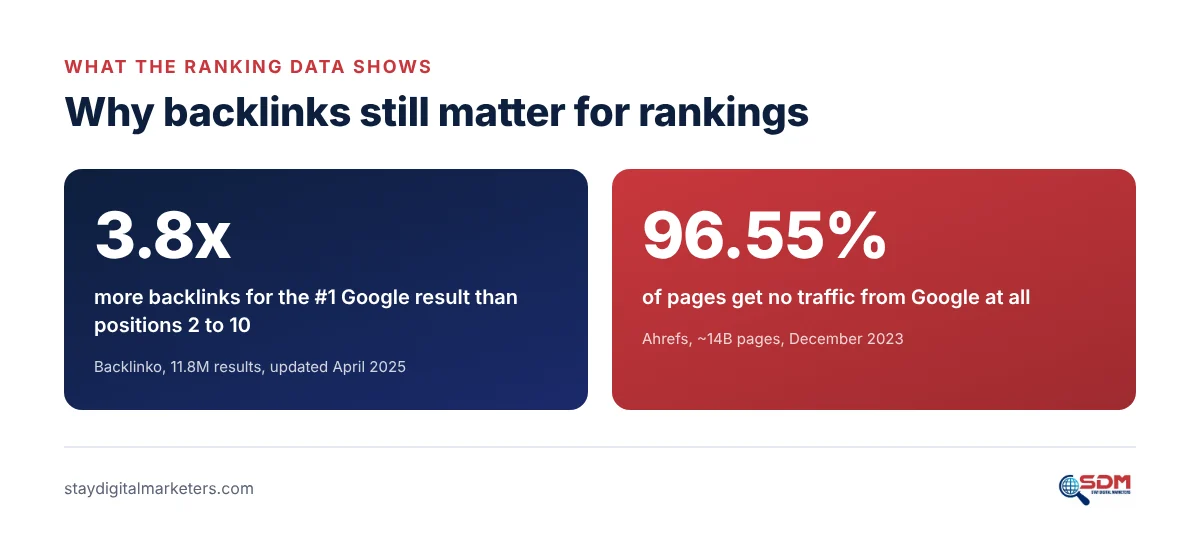
The data points in the same direction. Backlinko’s search engine ranking study, based on 11.8 million Google results and last updated in April 2025, found that the number one result had 3.8 times more backlinks on average than positions two to ten. Ahrefs’ search traffic study of roughly 14 billion pages, published in December 2023, found that 96.55% of pages get no traffic from Google at all, and that pages with more referring domains tended to earn more traffic.
For a business owner, the practical reading is simple. Content alone rarely breaks into competitive results. Content plus a steady flow of relevant links does.
Google weighs a backlink by the relevance of the linking page, the trust of the linking site, where the link appears, and whether it looks earned. Links inside relevant articles on pages that rank carry weight. Footer links, sitewide widgets, paid links without the right attributes, and mass directory listings are discounted or treated as spam.
Google’s own spam policies for Google web search define link spam as creating links “primarily for the purpose of manipulating search rankings.” The list includes buying or selling links that pass ranking credit, excessive link exchanges, automated link creation, low-quality directory links, and paid guest posts with followed, keyword-optimized links.
In most cases, yes. A link from a mid-sized blog that covers your exact topic usually helps more than a link from a large site in an unrelated field. Several practitioners in SEO forums report the same pattern: a few contextual mentions from niche newsletters and blogs outperformed dozens of generic directory links.
No. Domain Authority (Moz) and Domain Rating (Ahrefs) are third-party estimates, not Google metrics. They are useful for quick filtering, but a site can hold a high score while most of its pages get no search traffic. The better test is page level: is the linking page indexed, does it rank for real keywords, and does it attract visitors?
Social shares do not pass ranking signals directly. They help indirectly when they put content in front of writers who later link to it. Nofollow links pass little or no ranking value, but they still send visitors, build brand recognition and form part of a natural-looking profile, so they are not worthless.
The strategies that still work all produce links a site owner would choose to give: original data and resources worth citing, editorial guest contributions on relevant sites, digital PR stories journalists want to cover, mentions converted into links, and fixing broken links that already point at a topic you cover. Shortcuts that skip editorial judgment are the ones that fail.
Each tactic below differs in cost, speed and the type of link it produces. Most strong link profiles combine three or four of them.
A linkable asset is a page other writers need to cite: original research, a statistics roundup, a free tool, a calculator, a template or a detailed guide. Assets solve the main problem with outreach, which is that you have nothing worth linking to. One well-maintained data page can attract links for years without fresh pitching.
Guest posting works when the article is genuinely useful to the host site’s audience, the site has real readers and rankings, and the link sits naturally in context. It fails when posts are thin, sites exist only to sell placements, or anchors are exact-match keywords. For finding suitable hosts, see this walkthrough on finding guest post opportunities in any niche.
Digital PR pitches a newsworthy angle, such as a survey, a data story or an expert comment, to journalists. When it lands, it earns links from news and industry publications that are almost impossible to get through standard outreach. It needs a genuine story, not a disguised advertisement.
A niche edit adds a relevant link to an existing article that already ranks. Broken link building finds dead links on relevant pages and offers your resource as a working replacement. Both target pages that already hold trust. Both need a real editorial reason for the link, or they slide into the paid-link territory Google warns against.
Yes. Sites that mention your brand, founder or data without linking are among the easiest wins, because the writer already sees you as relevant. A short, polite note asking them to add a link converts a reasonable share of these. Brand mentions also matter on their own for AI search, which is covered in this guide to brand mentions in SEO.
| Tactic | Typical link quality | Effort | Speed | Policy risk |
|---|---|---|---|---|
| Linkable assets (data, tools) | High, editorial | High upfront | Slow, then compounding | Low |
| Editorial guest posting | Medium to high | Medium | Medium | Low if editorial, high if paid and followed |
| Digital PR | Very high | High | Campaign based | Low |
| Niche edits | Medium to high | Medium | Fast | Medium, depends on payment and context |
| Broken link building | Medium to high | Medium | Medium | Low |
| Unlinked mentions | High | Low | Fast | Low |
| Business directories | Low, foundational | Low | Fast | Low for real directories, high for spam lists |
Start with links that do not depend on existing authority: accurate business listings, profiles on platforms you actually use, partners and suppliers, and local or industry associations. Then publish one asset worth citing and pitch it to relevant writers. Earned links follow assets, not the other way round.
The most common question from new site owners is a version of the same trap: “I need backlinks to get traffic, but nobody links to a site with no traffic.” The way out is to stop treating traffic as the entry ticket. Writers link to useful resources, relationships and news, none of which require an existing audience.
Yes. Before spending on links, confirm the site is indexed, each key page targets a realistic long-tail keyword, titles and headings match search intent, and internal links connect related pages. Links amplify a working page. They do not rescue a page Google cannot index or that answers the wrong question.
The Link Readiness Ladder is a four-stage order of work for new and low-authority sites. Each stage creates the conditions for the next, so effort is never spent pitching a site that has nothing worth linking to.
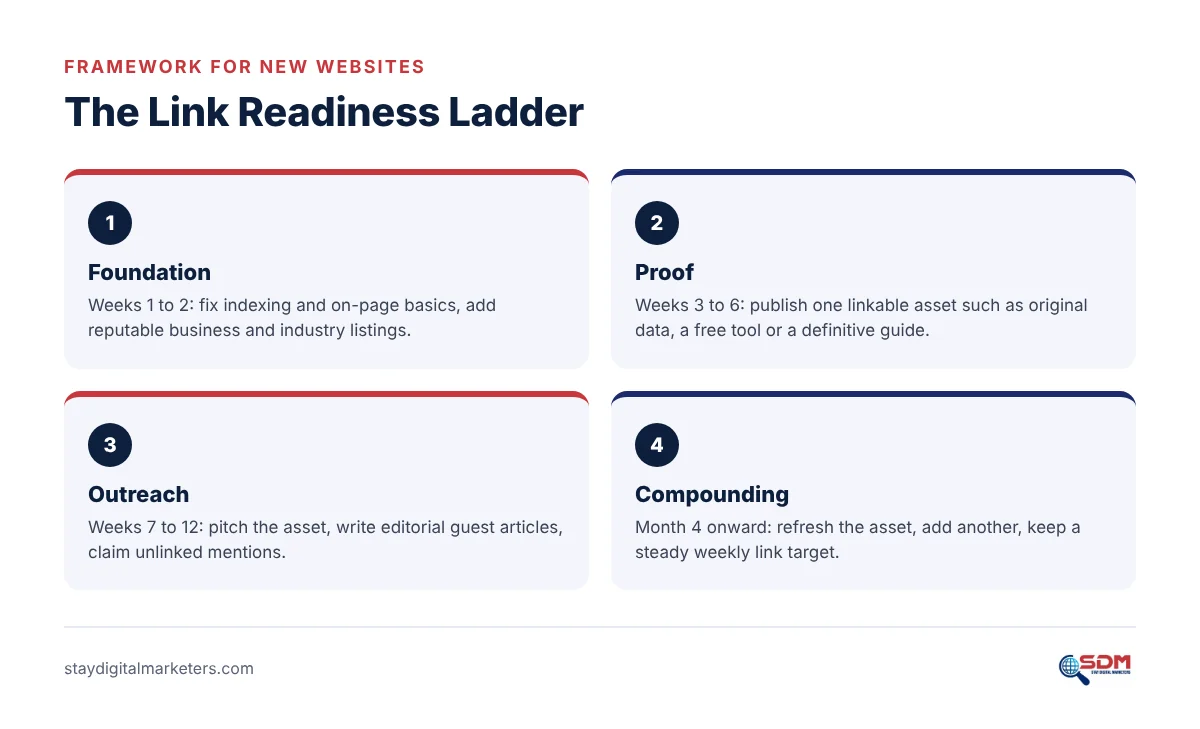
A common pattern observed across client work is that sites which skip the Proof stage spend months on outreach with low reply rates, while the same outreach converts noticeably better once there is a specific asset to point to.
A good backlink comes from a relevant page that ranks and gets real visitors, sits inside the body of the content, uses natural anchor text, and would make sense to a reader even if search engines did not exist. A bad one comes from an unrelated site, a page nobody visits, a sitewide footer, or a placement that only exists because money changed hands.
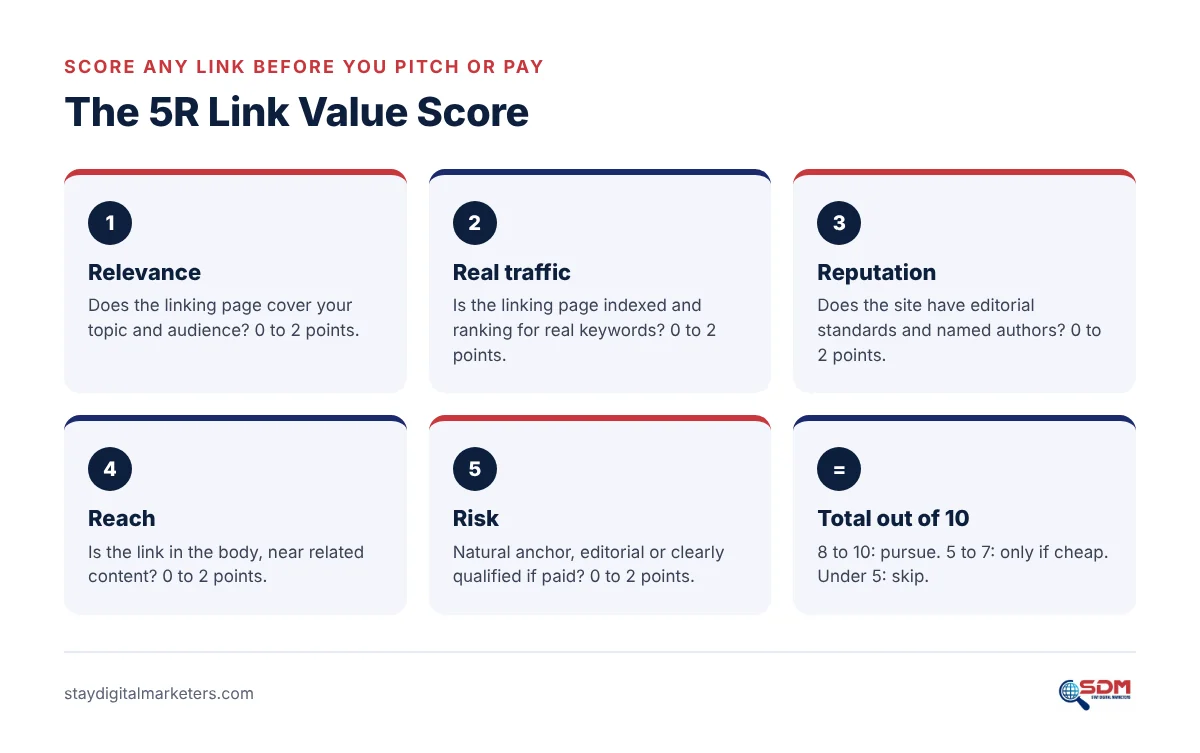
The 5R Link Value Score is a simple model for rating any link opportunity before you pitch or pay for it. Score each factor from 0 to 2, for a total out of 10.
| Factor | Question to ask | 0 points | 2 points |
|---|---|---|---|
| Relevance | Does the linking page cover your topic? | Unrelated niche | Same topic and audience |
| Real traffic | Does the linking page rank and get visitors? | Not indexed or no rankings | Ranks for real, non-branded keywords |
| Reputation | Does the site have editorial standards? | Publishes anything for a fee | Named authors, edits, rejects pitches |
| Reach | Where does the link sit? | Footer, sidebar or author box only | In the body, near related content |
| Risk | Would the link pass a policy check? | Paid and followed, exact-match anchor | Editorial, natural anchor, clearly qualified if paid |
Links scoring 8 to 10 are worth real effort. Links scoring 5 to 7 are acceptable if the price or effort is low. Anything under 5 is usually a waste of budget and can add risk. For a deeper look at the signals behind each factor, read how Google judges backlink quality.
Check which keywords drive the site’s traffic in a backlink or SEO tool. Traffic that comes mostly from brand names, nonsense terms, or keywords unrelated to the site’s content is probably inflated to make placements look valuable. Also check whether the specific linking page ranks, not just the domain. A free dofollow and nofollow link checker confirms how a placed link is marked.
A natural profile is mostly branded anchors (your company name), plain URLs and descriptive phrases, with only a small share of exact-match keyword anchors. Repeating the same commercial keyword across many links is one of the clearest manipulation signals.
Paying for a link that passes ranking credit breaks Google’s spam policies. Paid placements are acceptable to Google when the link is qualified with rel=”sponsored” or rel=”nofollow”. The real risk depends on scale and pattern: obvious paid networks, sites that publish anything, and exact-match anchors are the placements most likely to be discounted or penalized.
Google’s guidance on how to qualify your outbound links to Google states that sponsored and advertising links should use rel=”sponsored”, with nofollow also accepted. Many practitioners in SEO communities admit to buying links, while others report wasted budgets and lost rankings. Both experiences are real, which is why the decision deserves a clear-eyed look rather than a blanket yes or no.
Paying a writer, an outreach specialist or an agency for their time is normal marketing work. The policy issue is a link given as a condition of payment that passes ranking credit. The safest model pays for the effort to earn editorial placements, where the publisher keeps full control over whether and how a link appears. More on common pitfalls is in this list of link building mistakes that hurt SEO.
Costs vary widely by method, niche and site quality. In-house effort is mostly time; outsourced campaigns are usually priced per link or per month. Price alone says little about value, so judge each placement with the 5R score above.
AI search tools such as Google AI Overviews, ChatGPT and Perplexity tend to cite sources that already look trusted across the web. Backlinks and brand mentions from relevant, authoritative sites help a page rank and help a brand appear consistently in the sources AI systems draw from. Links now build visibility in both classic results and AI answers.
One concern raised often in SEO forums is that AI answers reduce clicks, so even good links may send fewer visitors. That is a fair point, and it shifts what a good link looks like. Placements that also put your brand name in front of real readers, in respected publications, add value even when the click never happens. This connection is explored in detail in how backlinks help you rank in AI and LLM search results.
Slightly. Prioritize publications your audience and AI tools both treat as references: industry media, respected niche blogs, data sources and community resources. Keep brand naming consistent across every placement, and favor pages with clear, factual context around the link. These choices help classic rankings too, so there is no trade-off.
Most sites see the first measurable movement from new links within a few weeks to a few months, depending on competition, the site’s existing authority and how quickly Google recrawls the linking pages. Measure progress by referring domains gained, rankings and traffic for the pages being linked, and the quality score of each new link, not by raw link counts.
Timelines stretch in competitive niches and shrink for long-tail keywords. A realistic expectation-setting breakdown is in this guide on how long link building takes to show results.
Contextual links from relevant pages that already rank tend to show impact soonest, because Google crawls those pages often and already trusts them.
Build in-house when you have time, writing ability and industry relationships, and when the site is small enough for a handful of links a month to matter. Outsource when competition is high, time is limited, or you need access to established publisher relationships. Either way, apply the same quality rules to every link.
A practical middle path is common: the business creates linkable assets and handles its own relationships, while a specialist runs outreach and placements at scale. Whoever does the work, ask for every link’s URL, anchor and placement, and review them against the 5R score. Teams comparing providers can review what professional link building services typically include.
There is no fixed number. The right target depends on how many relevant referring domains the pages already ranking for your keyword have. Check the top five results in a backlink tool, note their referring domains, and aim to match their relevance and quality rather than chasing a raw count. Quality and topical fit matter more than volume.
Reputable business, local and industry directories are worth it as a foundation, because they confirm your business details and help new sites get discovered. They will not drive rankings on their own. Avoid paid mass-submission lists and low-quality directories, which Google’s spam policies specifically list as link spam. Treat directories as a base layer only.
Yes, when links come from manipulative sources. Paid links that pass ranking credit, private blog networks, automated link creation and repeated exact-match anchors can lead Google to ignore your links or apply a manual action. Earned, relevant links carry very little risk. Review new links regularly and remove or disavow clearly spammy ones only when necessary.
Yes. Pages with strong, relevant backlinks are more likely to rank, and AI Overviews and chat tools often cite pages and brands that appear trusted across the web. Clicks from some queries may fall, but links from respected publications also build brand visibility inside AI answers. Links now support both classic rankings and AI search visibility.
Not by default. Google flags guest posts made mainly for links, especially paid ones with followed, keyword-rich anchors. Editorial guest articles written for a real audience on a relevant site, with a natural link in context, remain a legitimate way to earn exposure and links. The difference is editorial value and how any payment is handled.
The fastest safe wins usually come from unlinked brand mentions, existing partners and suppliers, reputable directories, and responding to journalist requests for expert comment. These rely on relationships and relevance you already have. For lasting growth, pair them with one strong linkable asset that keeps attracting links after the initial outreach ends.
Agencies and brands that want support with this work often turn to specialist providers. Stay Digital Marketers is one such resource, helping brands with guest posting, press release distribution, SaaS backlinks, niche edits, multilingual backlinks, Wikipedia page creation, Google Knowledge Panel creation and complete SEO services, with the same focus on relevant, editorially placed links described in this guide.

Filza Taj is an MPhil in Human Resources-turned SEO Specialist, Content Strategist, and Digital Marketing Consultant with over 5 years of experience helping businesses in 30+ countries grow online. As the Founder of Stay Digital Marketers (staydigitalmarketers.com), she delivers results-driven solutions in link building, guest posting, PR distribution, niche edits, multilingual backlinks, and content marketing. She publishes daily SEO insights and actionable strategies to help brands strengthen their online presence, attract the right audience, and convert clicks into loyal customers.
Filza@staydigitalmarketers.com
Stay Digital Marketers
Need SEO, Link Building or Digital Marketing Services?
Request a Free Audit →